---
title: "Building a Composable CMS Strategy"
canonical_url: "https://www.laioutr.com/en/blog/choosing-composable-cms-best-practices"
locale: en
meta:
description: "The framework that separates success from failure when implementing a modular composable CMS."
"og:description": "The framework that separates success from failure when implementing a modular composable CMS."
"og:title": "Building a Composable CMS Strategy"
---

# Building Your Composable CMS Strategy: The Framework That Separates Success from Failure
Table of contents
1. [1.Why Composable CMS Matters Now More Than Ever](#why-composable-cms-matters-now-more-than-ever)
2. [2.The First Critical Decision: Organizational Readiness Before Technology Selection](#the-first-critical-decision-organizational-readiness-before-technology-selection)
3. [3.The Architecture Question That Changes Everything](#the-architecture-question-that-changes-everything)
4. [4.The Governance Structure That Prevents Drift](#the-governance-structure-that-prevents-drift)
5. [5.Building Incrementally Without Destroying What Works](#building-incrementally-without-destroying-what-works)
6. [6.The Metrics Question Nobody Asks](#the-metrics-question-nobody-asks)
7. [7.Thinking Strategically About Vendor Lock-in](#thinking-strategically-about-vendor-lock-in)
8. [8.The Implementation Cadence That Creates Momentum](#the-implementation-cadence-that-creates-momentum)
9. [9.Conclusion: Intentionality Is the Competitive Advantage](#conclusion-intentionality-is-the-competitive-advantage)
The allure of a composable CMS is seductive. Point to the flexibility. Highlight the cost savings. Emphasize the ability to swap components without rebuilding your entire system. Yet organizations across industries continue to stumble when implementing modular content infrastructure. They invest heavily in the wrong combination of tools. They create integration nightmares that consume development resources for months. They discover too late that their architectural choices have locked them into vendor ecosystems nearly as constraining as the monolithic systems they were trying to escape.
The problem is not with composable CMS as a concept. The problem is that most organizations approach it backwards. They begin with tool selection, then scramble to make their organizational structure fit the technology. This leads to failure.
## Why Composable CMS Matters Now More Than Ever
The content landscape has fundamentally shifted. Websites are no longer the destination for your content strategy. Your organization is publishing to mobile applications, smart speakers, chatbots, personalization engines, social platforms, and channels that did not exist eighteen months ago.
Traditional monolithic CMS platforms were designed for a different era. They assume content serves a single channel. They couple content management with presentation logic. They force your editorial workflows to conform to predetermined templates and rigid approval hierarchies. This architecture made sense when a website was your primary publishing concern.
Today, it is a liability.
A composable CMS decouples content management from distribution. Content becomes data, accessed through APIs. Your editorial team works within interfaces optimized for human collaboration. Your development teams build experiences on whatever frontend frameworks maximize velocity. Your business intelligence systems can consume content streams in real time. Your personalization engines can dynamically assemble experiences based on customer context.
But building this architecture requires a fundamentally different approach than selecting best-of-breed applications and hoping integration will sort itself out.
## The First Critical Decision: Organizational Readiness Before Technology Selection
Most composable CMS projects begin with stakeholders gathering to debate whether they should choose a headless CMS, a traditional API-enabled system, or a hybrid model. This is the wrong starting question.
Your first decision should be brutally honest organizational assessment. Not all organizations are ready for composable infrastructure.
Composable systems require distributed ownership. Someone owns the content management layer. Someone else owns the personalization logic. A third team maintains the API contracts that bind these systems together. This demands clarity about accountability, decision authority, and cross-functional governance that many organizations lack.
If your editorial teams have spent years operating within rigid approval workflows, moving them to a composable environment where multiple channels can publish simultaneously will surface cultural challenges before technical ones. If your development organization is accustomed to monolithic deployments with infrequent releases, moving to an environment where microservices are deployed independently creates coordination complexity they may not be equipped to handle.
Before selecting a single CMS vendor, you must assess three dimensions:
First, your technical capability maturity. Can your development teams manage API versioning strategies? Do they understand distributed system challenges like eventual consistency? Can they debug integration failures across multiple vendor systems simultaneously? If the answer to any of these is uncertain, your implementation will suffer.
Second, your organizational structure's alignment with distributed systems thinking. The way your company is organized should reflect how your systems will be organized. Conway's Law is not a suggestion; it is an observation about how organizational structure inevitably shapes technical architecture. If decision authority is centralized, your composable system will acquire distributed complexity without distributed control, the worst possible outcome.
Third, your content maturity. Do you have structured content models? Can you articulate how your content maps to different channels? Do you have a single source of truth for master data, or are multiple systems maintaining conflicting versions of the same information? Composable systems amplify content discipline challenges. They do not solve them.
Only after honest assessment of these dimensions should you begin vendor evaluation.
## The Architecture Question That Changes Everything
Most organizations frame the composable question as a tactical decision: which CMS should we purchase? This is thinking at the wrong level of abstraction.
The real question is architectural: how will content flow through our organization? Who creates it, who approves it, where does it live, and how does it reach the experiences our customers encounter?
Consider two fictional organizations making different architectural choices.
Organization A decides that their CMS will be the source of truth for all managed content. Their editorial teams work within the CMS interface exclusively. Content flows from the CMS through an API layer to a personalization platform, which then sends content fragments to different channels. This is hub-and-spoke architecture. The CMS is the hub.
Organization B decides that their CMS is one of several content sources. Long-form articles live in the CMS. Product information lives in their commerce platform. Pricing lives in their ERP system. Customer data lives in their CDP. The personalization platform becomes the hub, requesting content from multiple sources as needed, assembling experiences dynamically.
These are not merely different tool configurations. They are fundamentally different computational models with different failure modes, scaling characteristics, and operational complexities.
Organization A's approach is simpler to understand but creates bottlenecks. The CMS becomes critical infrastructure. Outages affect all downstream channels. Performance limitations in your CMS API become performance limitations for your entire digital experience.
Organization B's approach distributes complexity. It requires sophisticated orchestration logic. A failure in the commerce platform does not prevent personalization, but it does degrade the experience. Integration points are numerous and must be monitored carefully. But no single system failure brings down your entire content infrastructure.
There is no universally correct answer. The answer depends on your organization's risk tolerance, technical capability, content structure, and business priorities. But making this decision consciously, with full understanding of the tradeoffs, is infinitely preferable to making it accidentally through a series of vendor selections.
## The Governance Structure That Prevents Drift
A composable CMS without governance is a collection of point solutions accidentally connected together. Within two years, you will have API contracts that nobody understands, integration patterns that contradict one another, and vendors recommended by different teams that cannot interoperate.
Effective composable architectures require governance, but not the kind most organizations implement.
Most organizations try to prevent drift through documentation requirements and approval gates. They require teams to document before implementing. They require architecture review boards to approve integration approaches. This creates processes that people resent, circumvent, and eventually ignore.
Better organizations prevent drift through economic incentives. If your development team can integrate with a new vendor faster by connecting it to your existing integration platform than by building a direct integration, they will choose the path of least resistance. If your personalization team has to write less code when they use standard content model definitions than when they define new ones, they will adopt the standards.
This requires investment in integration platforms, metadata management, and API gateway tooling. It requires accepting some inefficiency in individual projects to maintain coherence across the portfolio. It requires treating composable architecture as a continuously evolving system rather than a point-in-time decision.
## Building Incrementally Without Destroying What Works
The most dangerous composable implementations are those that try to replace everything simultaneously. The organization running a monolithic CMS for fifteen years cannot reasonably migrate to a full composable architecture in a single project.
Successful implementations recognize that evolution is safer than revolution. You are not choosing between your existing system and a new one. You are choosing how to gradually decouple your existing system while new capabilities are added elsewhere.
This might mean that your new mobile application consumes content from a new headless CMS while your website continues consuming content from your existing system. It means your team builds an API layer in front of your existing CMS so that tools can interact with it programmatically. It means you add personalization capabilities without ripping out your current editorial workflow.
This incremental approach creates its own challenges. You now have content being managed in multiple systems. You have potential for the same content to be stored in different places with different versions of truth. You have teams using different workflows, different approval processes, different metadata structures.
But these challenges are explicitly visible. You can manage them consciously. You can establish procedures for keeping them synchronized. You can plan the next evolution with full understanding of what you are trying to solve.
Organizations that attempt to do everything at once discover halfway through the project that the new architecture does not actually address their fundamental problems. By then, they have already decommissioned the old system. They are left with no fallback plan and significant pressure to make the new system work regardless of its actual suitability.
## The Metrics Question Nobody Asks
At the end of a composable CMS implementation, you need evidence that the investment was worthwhile. Most organizations measure success through output metrics: how much content is published, how many API calls occur, how many microservices are deployed.
These metrics tell you activity is happening. They do not tell you whether the activity is creating value.
Better metrics focus on outcome and efficiency. How much faster does your team publish content to new channels? What percentage of content creation effort is being spent on content itself versus managing content systems? How many unplanned outages occur, and what is their impact duration? How many potential personalization opportunities are you actually capturing?
There is a specific metric that matters more than most: the time from editorial decision to customer experience. An organization running a monolithic CMS might publish an article and see it live on web in fifteen minutes. But if that same organization runs a composable system where the article goes into the CMS, is retrieved by a personalization platform, is rendered into six different experiences for six different audience segments, and then is distributed across web, mobile, and email channels, and this entire process takes forty-five minutes, the composable system is creating invisible complexity.
Alternatively, if that same composable process takes forty-five minutes but enables the team to publish to channels that were previously impossible to reach, and enables personalization that increased engagement by measurable percentages, then the system is creating real value. The same metric has different meaning depending on context.
The organizations that get the most value from composable CMS implementations are those that define these outcome metrics before they begin implementation. They use the metrics to guide architecture decisions. They measure obsessively during the project. And they are willing to admit when implementation tradeoffs have created more problems than they have solved, and to adjust accordingly.
## Thinking Strategically About Vendor Lock-in
The promise of composable architecture is freedom from vendor lock-in. If you dislike your CMS, you replace it with a different one. Your API contracts remain stable. Your systems continue functioning.
This promise is mathematically impossible.
You will develop custom code against whatever CMS API you choose. You will build optimization logic specific to that vendor's data model. You will make architectural assumptions that are valid for one vendor but not for another. When you eventually move to a different vendor, you will rewrite significant portions of this custom code.
The real strategic question is not whether you will experience lock-in. You will. The question is what form that lock-in will take, how expensive it will be to escape, and whether the value you get while locked in justifies the future cost of escaping.
Some organizations deliberately embrace shallow lock-in: they choose a vendor where switching costs are reasonable, and they plan to reevaluate every three to five years. They accept that switching will be expensive but not catastrophic.
Other organizations choose to minimize lock-in by building abstraction layers that decouple their application code from specific vendor APIs. This approach delays lock-in and makes switching feasible. It also adds complexity and ongoing maintenance burden to maintain these abstraction layers when vendor APIs evolve.
Neither approach is correct universally. But making this decision consciously, understanding that some form of lock-in is inevitable, and planning accordingly, is far superior to assuming that choosing the right vendor magically solves the problem.
## The Implementation Cadence That Creates Momentum
The organizations that execute composable CMS implementations successfully do so with a clear cadence. They do not attempt to design the entire future architecture before writing a single line of code.
Instead, they execute in three-month cycles. In each cycle, they take one piece of the architectural puzzle, implement it, put it in production, learn from production behavior, and adjust their understanding of what comes next. This might mean building the initial CMS layer in the first cycle. Adding an API gateway in the second cycle. Integrating personalization in the third cycle. Each cycle demonstrates progress. Each cycle surfaces integration challenges that are addressed before subsequent decisions are made.
This approach prevents architecture discussions from becoming theoretical. When a team is arguing about whether event-driven architecture or request-response architecture is superior, the answer becomes clear when they build both and operate them in production.
It also provides a natural exit point. Organizations that find themselves misaligned with the composable strategy can adjust course without having invested years into a path they now recognize as unsuitable.
## Conclusion: Intentionality Is the Competitive Advantage
Organizations succeed with composable CMS implementations not because they have chosen the most sophisticated technology or the most prestigious vendor. They succeed because they have made intentional choices about what problem they are trying to solve, what organizational capabilities they need to develop, and how they will measure success.
They succeed because they recognize that the technical decision to adopt composable architecture is actually an organizational decision about how they want to structure content creation, distribution, and personalization for the next phase of their business.
The organizations that fail do so because they treat composable CMS selection as a commodity purchasing decision. They evaluate features on spreadsheets. They choose the vendor that seems to have the best checklist. They assume implementation will sort itself out.
Your composable CMS strategy should be unique to your organization, intentionally designed for your specific constraints, and measured against outcomes that matter to your business. When you approach it that way, the choice of specific technology becomes a detail. The real decision is about how your organization evolves to deliver value through content in channels that did not exist when you started.
### **More from the Laioutr Platform**
- [Composable Headless Frontend](https://www.laioutr.com/en/composable-headless-frontend)
- [Content Management](https://www.laioutr.com/en/product/content-management)
- [Agentic Frontend Management Platform](https://www.laioutr.com/en/agentic-frontend-management-platform)
Related reading: [Ecommerce Search Optimization: From Discovery Barrier to Revenue Driver](https://www.laioutr.com/en/blog/ecommerce-search-best-practices) and [Digital Asset Management Best Practices for Composable Commerce](https://www.laioutr.com/en/blog/dam-best-practices).
---
Share this article
[Share on Facebook](https://www.facebook.com/sharer/sharer.php?u=https%3A%2F%2Fwww.laioutr.com%2Fen%2Fblog%2Fchoosing-composable-cms-best-practices) [Share on X](https://x.com/intent/post?url=https%3A%2F%2Fwww.laioutr.com%2Fen%2Fblog%2Fchoosing-composable-cms-best-practices&text=) [Share on LinkedIn](https://www.linkedin.com/sharing/share-offsite/?url=https%3A%2F%2Fwww.laioutr.com%2Fen%2Fblog%2Fchoosing-composable-cms-best-practices) [Share on Pinterest](https://pinterest.com/pin/create/button/?url=https%3A%2F%2Fwww.laioutr.com%2Fen%2Fblog%2Fchoosing-composable-cms-best-practices&description=) [Share via email](mailto:?subject=&body=%0A%0Ahttps%3A%2F%2Fwww.laioutr.com%2Fen%2Fblog%2Fchoosing-composable-cms-best-practices)
## More articles on frontend and headless
Practical know-how for frontend development, smart agents, and headless
[To the blog](https://www.laioutr.com/en/blogs/insights)
[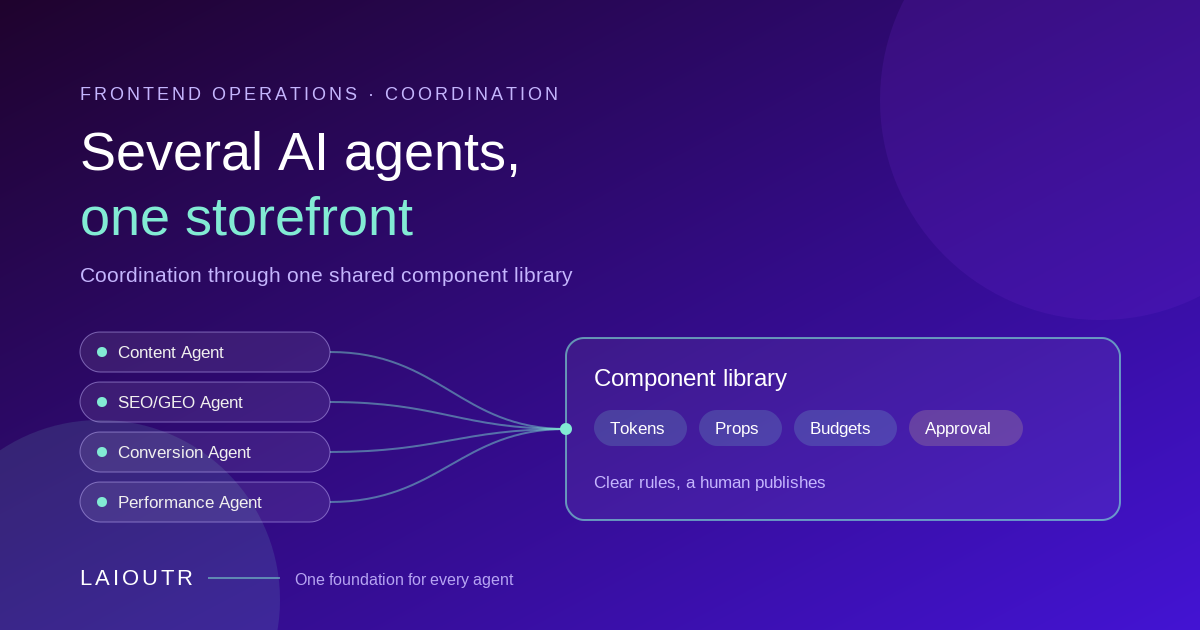Several AI Agents, One Storefront: Coordination Without Collisions
When several AI agents work on the same storefront, conflicts rarely happen between the agents thems…](https://www.laioutr.com/en/blog/frontend-operations-multi-agent-coordination-storefront-2026)
[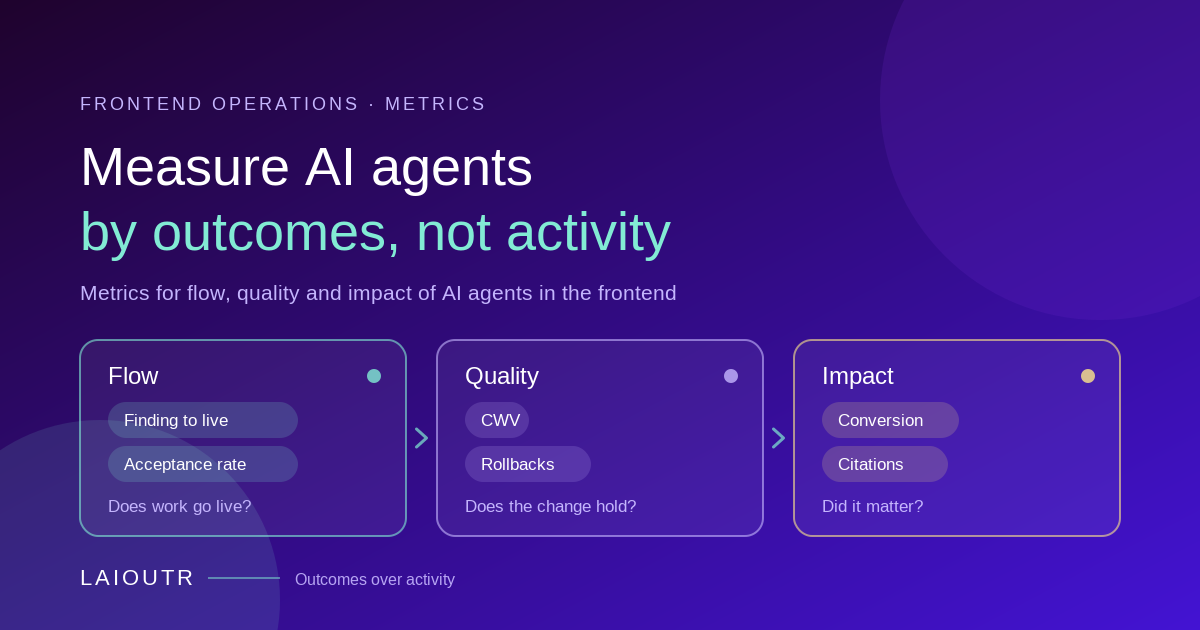Measuring AI Agents by Outcomes: Agentic Frontend Management Metrics
AI agents in the frontend should be measured by outcomes, not by activity. The number of prompts, ge…](https://www.laioutr.com/en/blog/frontend-operations-measuring-ai-agents-outcomes-2026)
[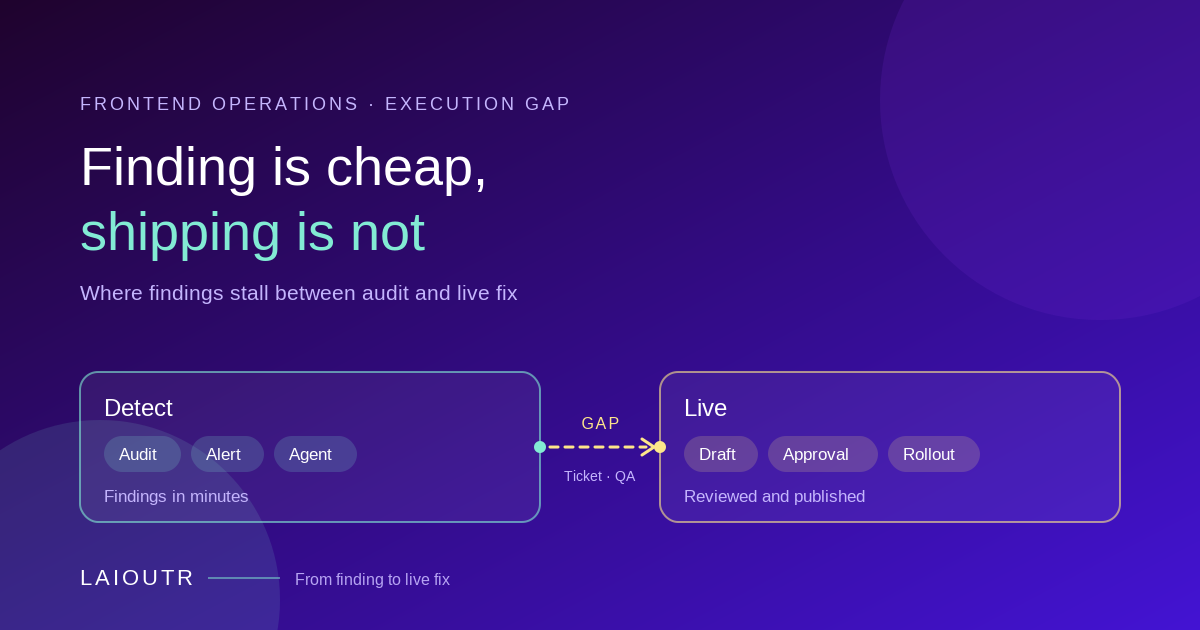The Execution Gap in the Frontend: Finding Is Cheap, Shipping Is Not
The execution gap in the frontend is the time, and the number of handoffs, between "we know wha…](https://www.laioutr.com/en/blog/frontend-operations-execution-gap-detect-vs-deploy-2026)
[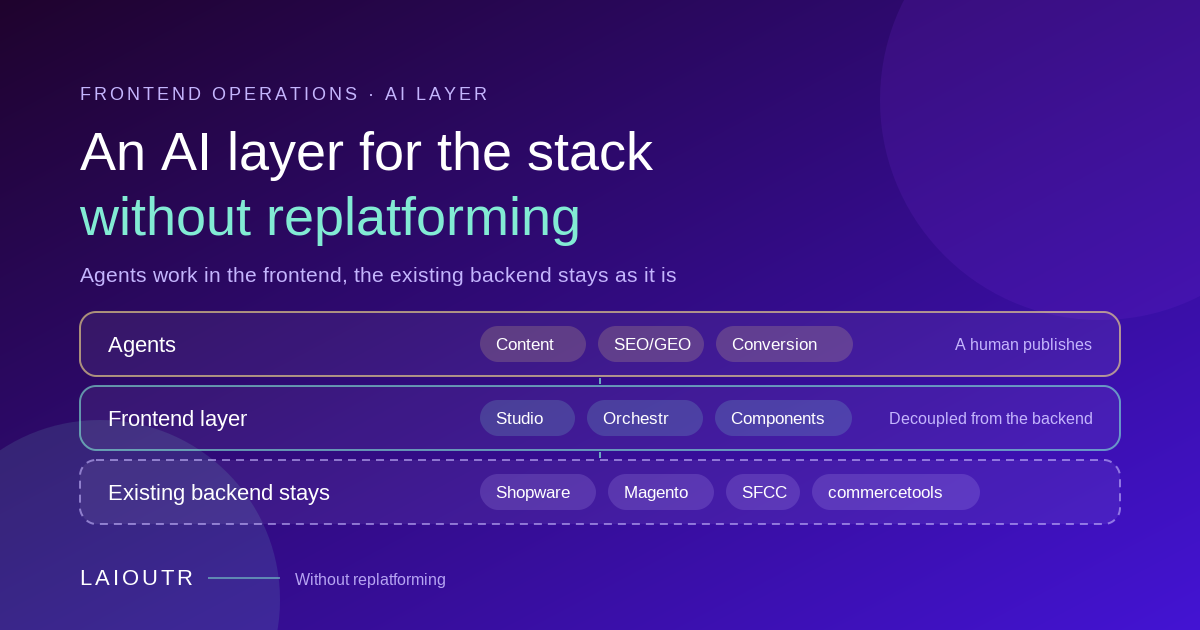Adding an AI Layer to an Existing Commerce Stack Without Replatforming
An AI layer can be added to an existing commerce stack without replacing the shop system. The most p…](https://www.laioutr.com/en/blog/frontend-operations-ai-layer-existing-stack-without-replatforming-2026)
[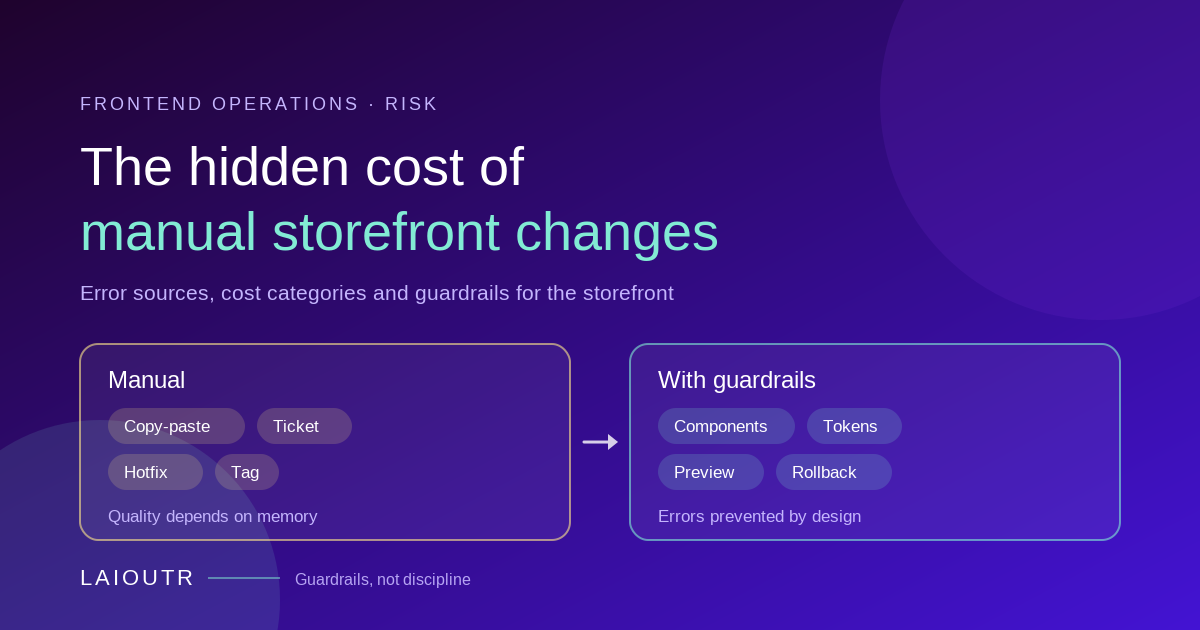The Hidden Cost of Manual Storefront Changes and How to Cut It
Manual frontend changes are the many small edits that keep a storefront running day to day: a new ba…](https://www.laioutr.com/en/blog/frontend-operations-hidden-cost-manual-storefront-changes-2026)
[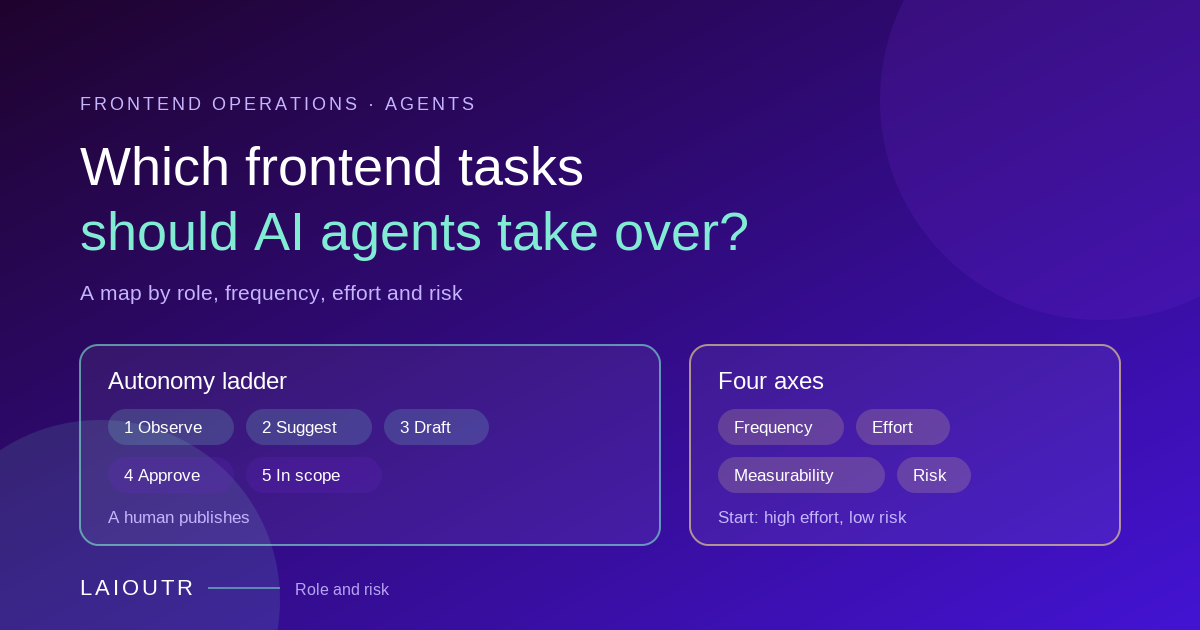Which Frontend Tasks Should AI Agents Take Over? Role and Risk Map
AI agents should first take over the frontend tasks that come up often, involve a lot of manual work…](https://www.laioutr.com/en/blog/frontend-operations-agent-task-map-role-risk-2026)
[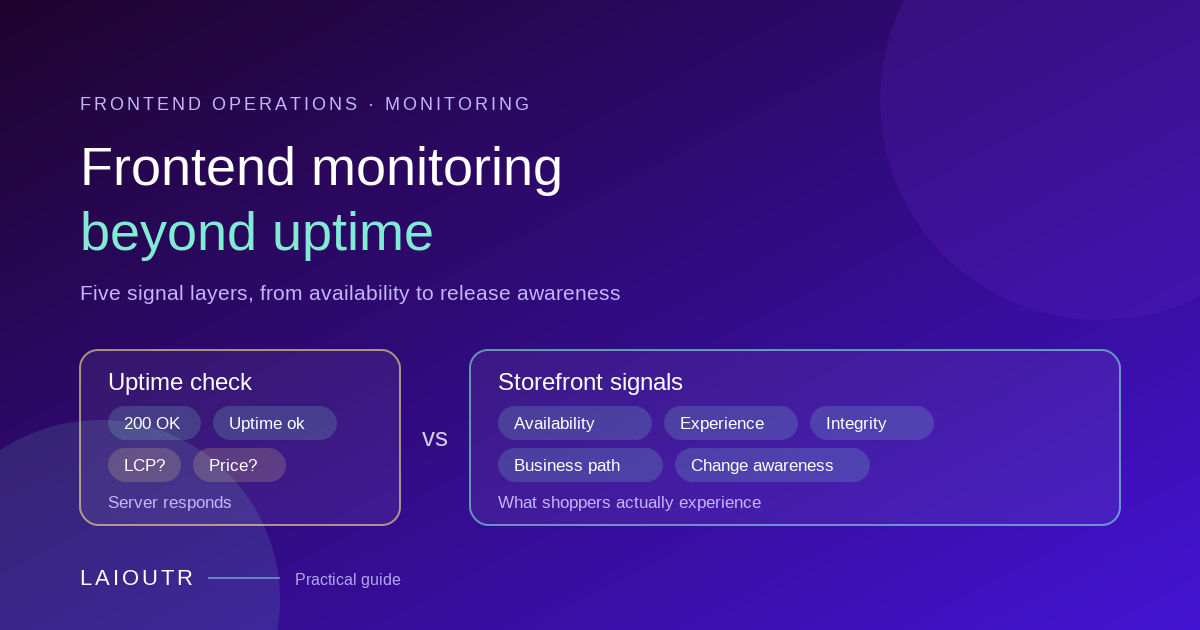Frontend Monitoring Beyond Uptime: Signals a Storefront Needs
Frontend monitoring beyond uptime means checking a storefront not only for availability but for what…](https://www.laioutr.com/en/blog/frontend-operations-monitoring-beyond-uptime-2026)
[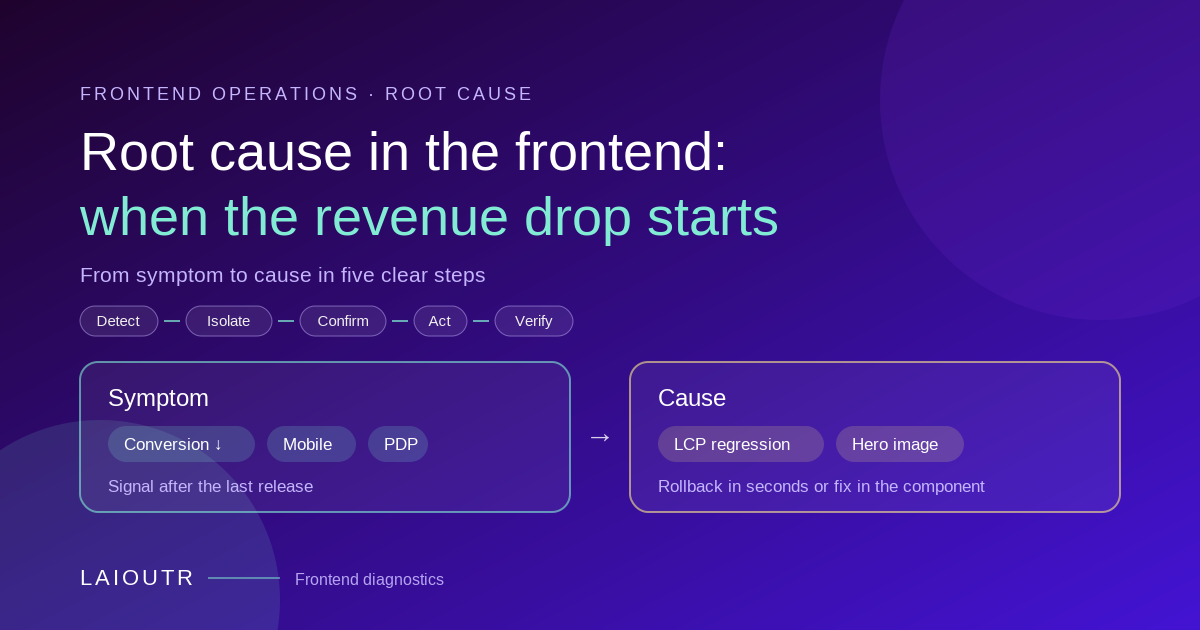Root Cause in the Frontend: When Revenue Drops Start in the Storefront
When revenue or conversion rate drops suddenly, the cause often is not traffic, pricing or the comme…](https://www.laioutr.com/en/blog/frontend-operations-root-cause-revenue-drop-storefront-2026)
[Laioutr Academy Is Live: The Video Manual for Laioutr
Since October 15, 2026, the Laioutr Academy has been live at academy.laioutr.com. It is the user man…](https://www.laioutr.com/en/blog/laioutr-academy-launch-video-manual-certification)
[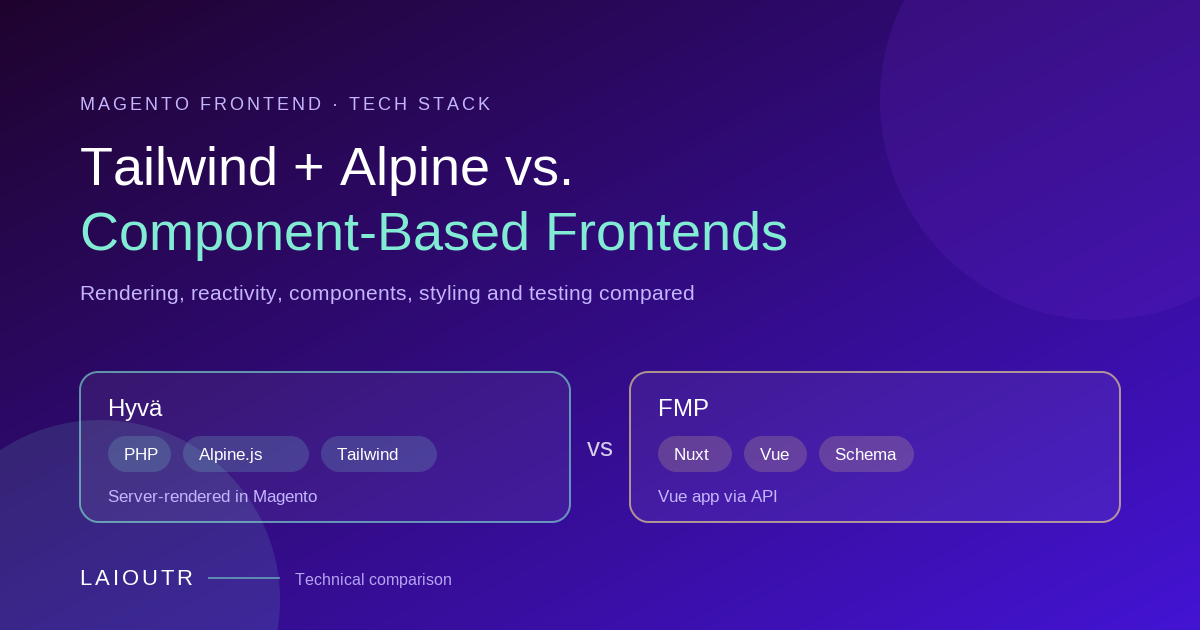Tailwind + Alpine vs. Component-Based Frontends for Magento
Hyvä renders Magento pages on the server with PHP templates and layout XML, adds interactivity throu…](https://www.laioutr.com/en/blog/tailwind-alpine-magento-vs-component-based-frontend-2026)
[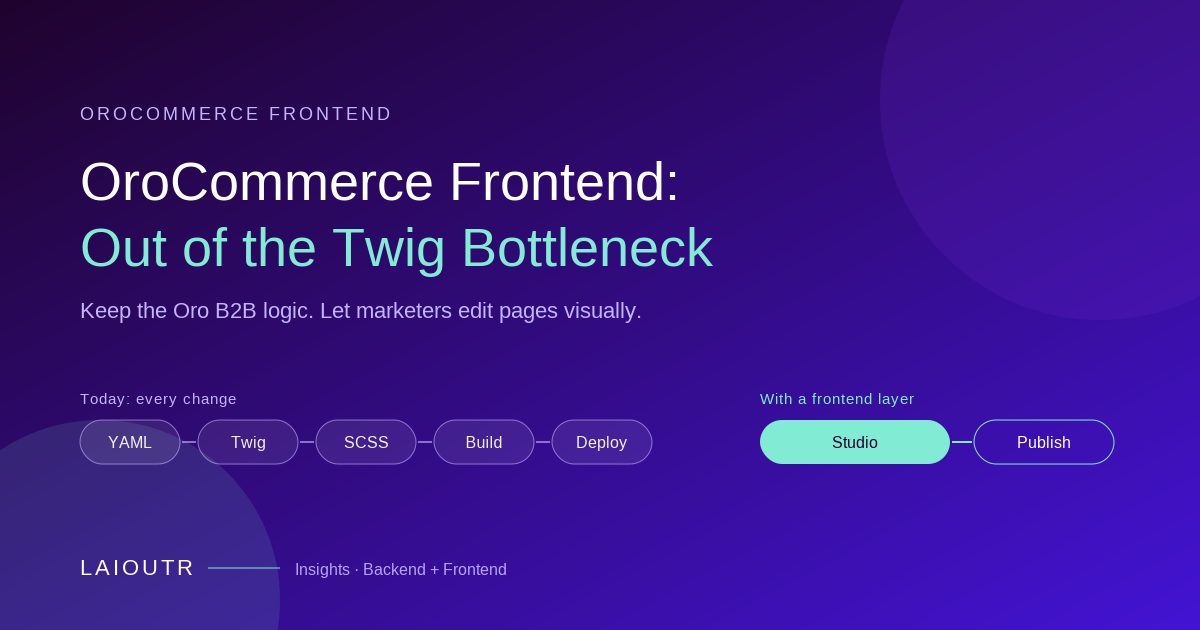OroCommerce Frontend: Out of the Twig and Layouts Bottleneck
The OroCommerce frontend is a server-rendered storefront built from Symfony bundles, OroLayouts and …](https://www.laioutr.com/en/blog/orocommerce-frontend-twig-layouts-bottleneck)
[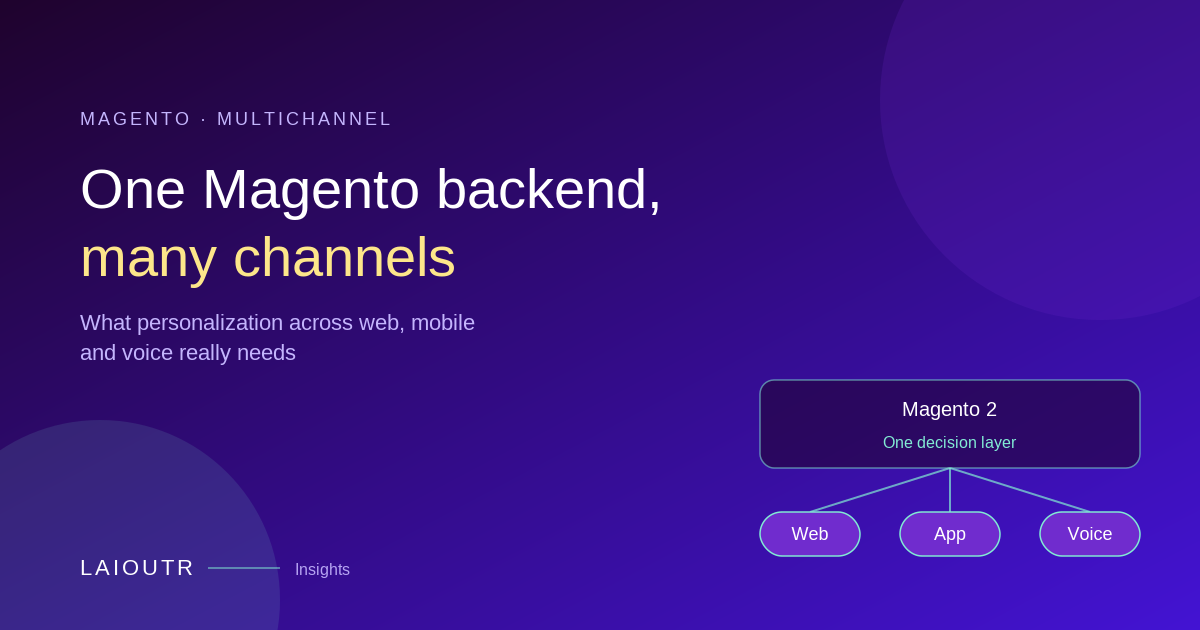One Magento Backend, Many Channels: Personalization in Practice
Personalization across web, mobile and voice on a single Magento backend does not start with a featu…](https://www.laioutr.com/en/blog/magento-multichannel-personalization-web-mobile-voice-2026)
[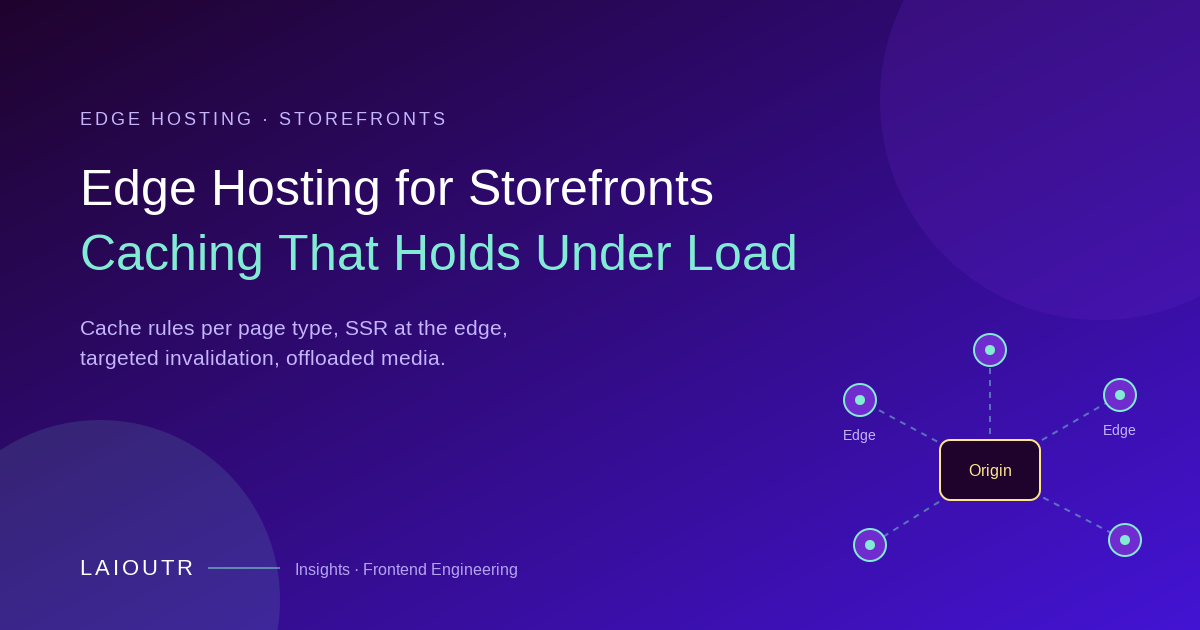Edge Hosting for Storefronts: Caching That Holds Under Peak Load
Edge hosting keeps a storefront fast under load when most requests never reach the origin: pages and…](https://www.laioutr.com/en/blog/edge-hosting-storefronts-peak-traffic-caching-2026)
[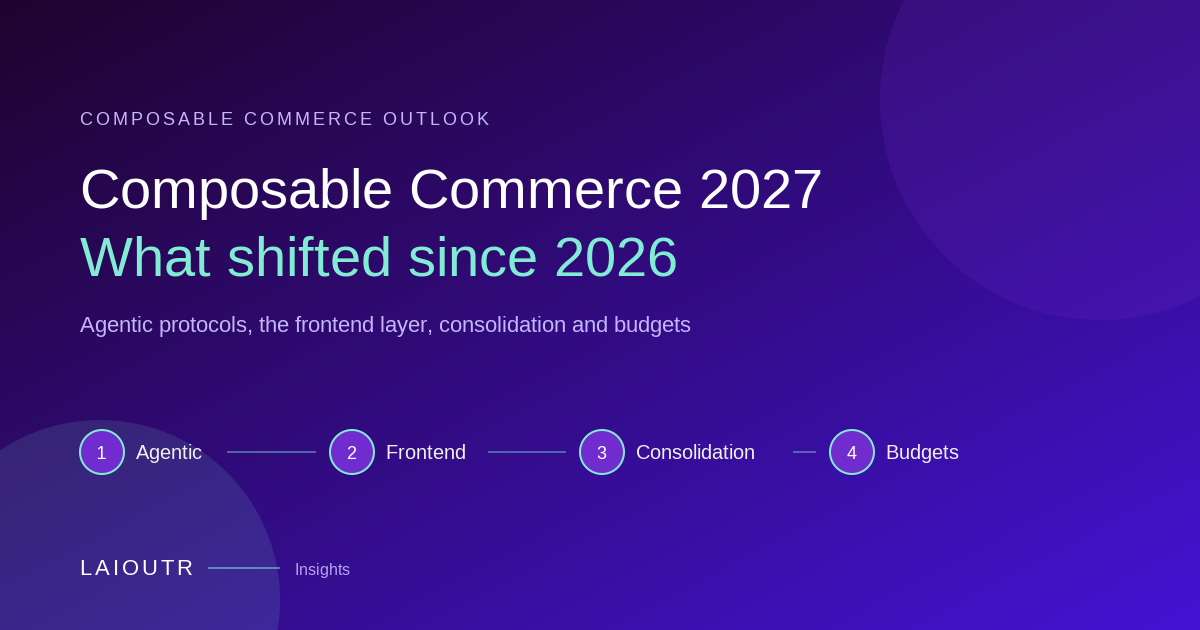Composable Commerce 2027: What Shifted and What Comes Next
Composable commerce enters 2027 with a different agenda than a year ago. The architecture question i…](https://www.laioutr.com/en/blog/composable-commerce-2027-outlook)
[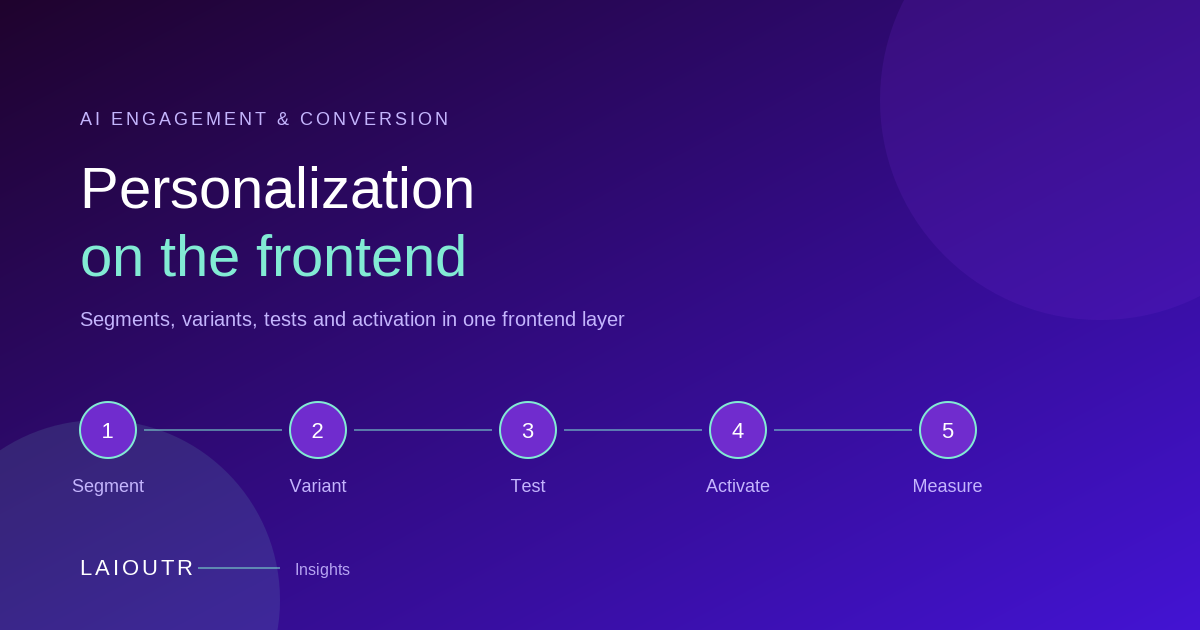AI Engagement and Conversion: Personalization on the Frontend
AI-driven engagement and conversion on the frontend rests on five mechanics: segments decide who see…](https://www.laioutr.com/en/blog/ai-engagement-conversion-frontend-personalization)
## Apps for the Laioutr platform
[View all apps](https://www.laioutr.com/en/apps)
[](https://www.laioutr.com/en/apps/shopify)
Laioutr
[Shopify](https://www.laioutr.com/en/apps/shopify)
Shopify is a commerce platform for selling online and in physical retail.
[](https://www.laioutr.com/en/apps/shopware)
Laioutr
[Shopware](https://www.laioutr.com/en/apps/shopware)
Shopware is a flexible ecommerce platform from Europe for product catalogs and omnichannel commerce.
[](https://www.laioutr.com/en/apps/adobe-commerce)
Laioutr
[Adobe Commerce](https://www.laioutr.com/en/apps/adobe-commerce)
Adobe Commerce is an enterprise commerce platform for complex, global B2C and B2B scenarios.
Planned
[](https://www.laioutr.com/en/apps/b2b-sellers)
Laioutr
[B2Bsellers](https://www.laioutr.com/en/apps/b2b-sellers)
B2B suite for Shopware that turns an online store into a professional B2B commerce platform.
Planned
[](https://www.laioutr.com/en/apps/commerce-layer)
Laioutr
[Commerce Layer](https://www.laioutr.com/en/apps/commerce-layer)
Commerce Layer is a headless commerce platform for making inventory and catalogs available online.
[](https://www.laioutr.com/en/apps/commercetools)
Laioutr
[Commercetools](https://www.laioutr.com/en/apps/commercetools)
Commercetools is a SaaS-based headless ecommerce platform used worldwide.
[](https://www.laioutr.com/en/apps/emporix)
Laioutr
[Emporix](https://www.laioutr.com/en/apps/emporix)
Emporix is a composable, API-first commerce platform for scalable B2B and B2C scenarios.
Planned
[](https://www.laioutr.com/en/apps/hcl-software)
Laioutr
[HCL Software](https://www.laioutr.com/en/apps/hcl-software)
Enterprise suite for digital commerce and experience with extensive configurability.
Planned
[](https://www.laioutr.com/en/apps/intershop)
Laioutr
[Intershop](https://www.laioutr.com/en/apps/intershop)
Enterprise commerce platform for complex B2B and B2C business models.
Planned
[](https://www.laioutr.com/en/apps/magento-2)
Laioutr
[Magento 2](https://www.laioutr.com/en/apps/magento-2)
Widely used, extensible commerce platform for B2C and B2B scenarios.
[](https://www.laioutr.com/en/apps/oxid-eshop)
Laioutr
[OXID eShop](https://www.laioutr.com/en/apps/oxid-eshop)
OXID eShop is an extensible commerce platform for complex B2B and B2C requirements.
Planned
[](https://www.laioutr.com/en/apps/patchworks)
Laioutr
[Patchworks](https://www.laioutr.com/en/apps/patchworks)
Patchworks is a low-code iPaaS that connects ecommerce, ERP, WMS, 3PL, and marketplaces.
Planned
[](https://www.laioutr.com/en/apps/PrestaShop)
Laioutr
[Prestashop](https://www.laioutr.com/en/apps/PrestaShop)
Open-source commerce platform for small and midsize merchants in Europe and beyond.
Planned
[](https://www.laioutr.com/en/apps/saleor)
Laioutr
[Saleor](https://www.laioutr.com/en/apps/saleor)
Open-source, API-first commerce platform built on GraphQL for custom storefronts.
Planned
[](https://www.laioutr.com/en/apps/salesforce-commerce-cloud)
Laioutr
[Salesforce Commerce Cloud](https://www.laioutr.com/en/apps/salesforce-commerce-cloud)
Salesforce Commerce Cloud is a cloud-based enterprise commerce platform for businesses of any size.
Planned
[](https://www.laioutr.com/en/apps/sap-commerce-cloud)
Laioutr
[SAP Commerce Cloud](https://www.laioutr.com/en/apps/sap-commerce-cloud)
Enterprise commerce platform for complex catalogs, pricing models, and omnichannel journeys.
Planned
[](https://www.laioutr.com/en/apps/scayle)
Laioutr
[Scayle](https://www.laioutr.com/en/apps/scayle)
SCAYLE is a commerce engine that helps brands and retailers scale their business.
Planned
[](https://www.laioutr.com/en/apps/spryker)
Laioutr
[Spryker](https://www.laioutr.com/en/apps/spryker)
Composable commerce platform for sophisticated B2B and B2C business models.
[](https://www.laioutr.com/en/apps/sylius)
Laioutr
[Sylius](https://www.laioutr.com/en/apps/sylius)
Sylius is a developer-friendly ecommerce framework for B2C and B2B shopping experiences.
Planned
[](https://www.laioutr.com/en/apps/vendure)
Laioutr
[Vendure](https://www.laioutr.com/en/apps/vendure)
Vendure is a headless commerce platform for businesses with complex requirements.
Coming Soon
[](https://www.laioutr.com/en/apps/vtex)
Laioutr
[VTEX](https://www.laioutr.com/en/apps/vtex)
Cloud-native, composable commerce platform for B2B and B2C at scale.
Planned
[](https://www.laioutr.com/en/apps/websale)
Laioutr
[Websale](https://www.laioutr.com/en/apps/websale)
Stable, enterprise-ready commerce backend for complex retail environments.
Strategy call
## The frontend as a control layer
A conversation about stack, roadmap and replatforming scenario. The outcome: a clear picture of how Laioutr fits, what it costs and how fast the go-live can happen.
*"After 30 minutes, we knew Laioutr makes our replatforming feasible."*
*Daniel B., CEO,* [*hygibox.de*](https://hygibox.de)
[Book a demo](https://www.laioutr.com/en/contact)
## Structured Data
```json
{
"@context": "https://schema.org",
"@graph": [
{
"@type": "Organization",
"@id": "https://www.laioutr.com/#identity",
"name": "Laioutr",
"legalName": "Laioutr GmbH",
"url": "https://www.laioutr.com/",
"logo": {
"@type": "ImageObject",
"url": "https://www.laioutr.com/laioutr-logo.png",
"width": 400,
"height": 400
},
"email": "info@laioutr.com",
"telephone": "+49 30 75435715",
"address": {
"@type": "PostalAddress",
"streetAddress": "Münchweilersteig 5",
"postalCode": "12559",
"addressLocality": "Berlin",
"addressCountry": "DE"
},
"vatID": "DE450905846",
"sameAs": [
"https://www.linkedin.com/company/laioutr",
"https://www.youtube.com/@Laioutr",
"https://x.com/laioutr"
]
},
{
"@type": "WebSite",
"@id": "https://www.laioutr.com/en/#website",
"url": "https://www.laioutr.com/en/",
"name": "Laioutr",
"inLanguage": "en",
"publisher": {
"@id": "https://www.laioutr.com/#identity"
}
},
{
"@type": "BlogPosting",
"@id": "https://www.laioutr.com/en/blog/choosing-composable-cms-best-practices#article",
"headline": "Building Your Composable CMS Strategy: The Framework That Separates Success from Failure",
"description": "The framework that separates success from failure when implementing a modular composable CMS.",
"image": [
"https://eu-west-2.graphassets.com/cmii2mlqi0dux06l5543v7nkc/cmnucypviw8mi07mgmwsd5asa"
],
"datePublished": "2026-06-30T17:27:36.707316+00:00",
"dateModified": "2026-06-30T17:27:36.414794+00:00",
"inLanguage": "en",
"articleSection": "Insights",
"keywords": "Industry & Trends",
"author": {
"@type": "Person",
"name": "Marcel Thiesies",
"jobTitle": "Co-Founder & CEO, Laioutr",
"image": "https://eu-west-2.graphassets.com/cmii2mlqi0dux06l5543v7nkc/cmj01b962364n07lb0iguvts5"
},
"publisher": {
"@id": "https://www.laioutr.com/#identity"
},
"mainEntityOfPage": {
"@id": "https://www.laioutr.com/en/blog/choosing-composable-cms-best-practices#webpage"
},
"isPartOf": {
"@id": "https://www.laioutr.com/en/#website"
}
},
{
"@type": "WebPage",
"@id": "https://www.laioutr.com/en/blog/choosing-composable-cms-best-practices#webpage",
"url": "https://www.laioutr.com/en/blog/choosing-composable-cms-best-practices",
"name": "Building Your Composable CMS Strategy: The Framework That Separates Success from Failure",
"description": "The framework that separates success from failure when implementing a modular composable CMS.",
"inLanguage": "en",
"isPartOf": {
"@id": "https://www.laioutr.com/en/#website"
},
"breadcrumb": {
"@id": "https://www.laioutr.com/en/blog/choosing-composable-cms-best-practices#breadcrumb"
},
"primaryImageOfPage": {
"@type": "ImageObject",
"url": "https://eu-west-2.graphassets.com/cmii2mlqi0dux06l5543v7nkc/cmnucypviw8mi07mgmwsd5asa"
},
"datePublished": "2026-06-30T17:27:36.707316+00:00",
"dateModified": "2026-06-30T17:27:36.414794+00:00",
"mainEntity": {
"@id": "https://www.laioutr.com/en/blog/choosing-composable-cms-best-practices#article"
}
},
{
"@type": "BreadcrumbList",
"@id": "https://www.laioutr.com/en/blog/choosing-composable-cms-best-practices#breadcrumb",
"itemListElement": [
{
"@type": "ListItem",
"position": 1,
"name": "Laioutr",
"item": "https://www.laioutr.com/en/"
},
{
"@type": "ListItem",
"position": 2,
"name": "Insights",
"item": "https://www.laioutr.com/en/blogs/insights"
},
{
"@type": "ListItem",
"position": 3,
"name": "Building Your Composable CMS Strategy: The Framework That Separates Success from Failure"
}
]
}
]
}
```