---
title: "Closing Marketing Velocity Gaps"
canonical_url: "https://www.laioutr.com/en/blog/closing-marketing-velocity-gaps"
locale: en
meta:
description: "How high-performing teams break through the marketing velocity ceiling by closing structural gaps."
"og:description": "How high-performing teams break through the marketing velocity ceiling by closing structural gaps."
"og:title": "Closing Marketing Velocity Gaps"
---

# Breaking Through the Marketing Velocity Ceiling: How High-Performing Teams Close Structural Gaps
Table of contents
1. [1.Gap One: The Content Creation Vacuum](#gap-one-the-content-creation-vacuum)
2. [2.Gap Two: The Technical Dependency Trap](#gap-two-the-technical-dependency-trap)
3. [3.Gap Three: The Fragmentation Tax](#gap-three-the-fragmentation-tax)
4. [4.Why These Gaps Persist](#why-these-gaps-persist)
5. [5.The Velocity Advantage Compounds](#the-velocity-advantage-compounds)
6. [6.Structuring for Velocity](#structuring-for-velocity)
7. [7.Conclusion](#conclusion)
The difference between a marketing team that ships one campaign per month and one that executes a dozen is rarely about raw talent or budget. It's about velocity. And velocity is a function of architecture, not effort.
Today's most aggressive competitors have cracked something that eluded the marketing industry for nearly a decade: how to dramatically accelerate the pace of marketing without sacrificing quality or exploding operational complexity. What they've discovered is that most organizations operate with three silent killers embedded in their workflows: gaps that compound over time and force impossible trade-offs between speed and control.
At Laioutr, we work with marketing organizations across sectors, and we've seen this pattern repeat consistently. Teams that recognize and address these gaps systematically gain measurable advantages in market responsiveness, customer acquisition efficiency, and overall competitive positioning. Those that ignore them find themselves outpaced by more agile competitors.
This post examines the three primary velocity gaps that constrain marketing organizations, why they're so difficult to solve, and how the most effective teams are closing them.
## Gap One: The Content Creation Vacuum
Most marketing organizations have optimized the work that happens after content goes live. They've perfected testing and personalization. They've built sophisticated analytics to understand what resonates. They've developed rapid iteration loops around post-launch activities.
But they've largely ignored the slowest part of the entire process: the journey from strategic brief to published asset.
Consider a typical scenario. A marketing leader defines a campaign concept on Monday morning. The brief lands in a project management tool. Designers begin initial concepting. Within days, someone realizes the design requires custom development work. The request queues up behind other priorities. Two weeks pass. Finally, a developer has bandwidth and builds the template. The design and development still don't quite align with the original vision because of constraints discovered halfway through. Another round of iteration follows.
Four weeks after the initial brief, the asset finally publishes.
This timeline isn't incompetence. It's the natural outcome of fragmented workflow architecture where handoffs between teams require context-switching, where decisions demand synchronous meetings, and where "done" is determined by the constraints of implementation, not the original strategic goal.
Now consider what this timeline means for competitive positioning. If a marketing team executes this cycle once per month, they ship 12 major campaigns per year. If they can compress this cycle to three weeks, they ship 17 campaigns annually. That's not a 40% efficiency gain in isolation; that's 40% more opportunities to test market positioning, validate messaging, optimize offers, and capture emerging demand.
But the gap isn't really about time. It's about the structural barrier that makes time inevitable.
The teams that have closed this gap typically share one characteristic: they've removed the dependency chain. Instead of content creation flowing through multiple sequential approval gates and technical implementation bottlenecks, they've restructured the workflow so that strategic teams can ideate, design, and compose assets with substantially reduced technical friction.
This doesn't mean ignoring governance. It means recognizing that governance frameworks can be embedded into the tools and workflows that marketers use directly, rather than implemented through gatekeeping and review cycles. When marketers can work with pre-built brand-compliant components, pre-configured design systems, and intelligent templates, the need for extensive developer coordination diminishes dramatically.
The result: weeks become days. Days become hours for simple variants and optimizations.
## Gap Two: The Technical Dependency Trap
Closely related to the content creation gap is a second, deeper structural problem: the technical dependency trap.
In most organizations, any structural change to how marketing content is delivered requires developer involvement. Need to adjust the responsive behavior of a campaign landing page? Developer work. Want to modify the personalization logic for a particular audience segment? Developer work. Need to add a new data source that influences which customer journey variation a user experiences? Developer work.
This isn't intentional gatekeeping. It's architectural reality. When the systems that deliver marketing content are built as monolithic stacks or tightly coupled integrations, changes ripple through multiple layers, and the only people equipped to safely navigate those changes are the ones who built the systems.
The consequence is predictable: marketing teams defer non-urgent improvements, they prioritize the highest-ROI changes only, and they leave significant optimization opportunities on the table because the friction to implement them exceeds the expected payoff.
Meanwhile, more agile competitors who've decoupled their content delivery architecture from their content creation workflow are continually optimizing their conversion paths, testing new audience segmentation strategies, and refining their personalization rules without waiting for developer sprints.
High-velocity teams have solved this by adopting composable architecture patterns. Rather than building marketing infrastructure as a single integrated platform, they treat it as a modular ecosystem. Content creation, personalization logic, analytics, data connections, and asset delivery are all designed as separate capabilities that work together without requiring a monolithic rewiring when one component changes.
This architectural shift is significant because it fundamentally alters what's possible without developer involvement. Marketers can adjust personalization rules, modify segment definitions, test new data flows, and even restructure campaign architecture within a governance framework that's built into the system, not imposed around it.
The technical dependency trap gets closed when the boundary between "what marketing can change" and "what requires development" is redefined in marketing's favor, without compromising system integrity or data governance.
## Gap Three: The Fragmentation Tax
Here's an uncomfortable truth: the average marketing organization uses dozens of tools. Content management systems, personalization engines, experimentation platforms, analytics tools, customer data platforms, marketing automation solutions, design platforms, asset management systems, testing frameworks.
Each tool solves a specific problem well. Collectively, they create a multiplication problem.
When these tools don't communicate seamlessly, information lives in multiple systems of record. A customer segment created in one platform doesn't automatically sync to another, so personalization logic gets rebuilt manually. Analytics from different tools tell slightly different stories because they import data differently. Time that should be spent on strategy gets spent on manual data reconciliation and system orchestration.
The hidden cost of fragmentation isn't visible in any single tool's analytics or any team member's timesheet. It accumulates across hundreds of small inefficiencies: duplicate work, context-switching, inconsistent customer views, delayed decision-making because data isn't current.
For a seven-person marketing team, this might cost a few hours weekly in friction and manual coordination. For a fifty-person team with diverse specializations, it can consume several full-time equivalent roles just managing integrations and keeping data synchronized.
Teams that have closed the fragmentation gap have pursued integration differently. Rather than selecting tools and then struggling to make them work together, they've adopted systems built on composable architecture principles that allow best-of-breed tools to connect through standards-based integrations.
This doesn't mean replacing all existing tools. It means selecting integration architecture that treats the existing marketing tech stack as a network of connected systems rather than islands that happen to coexist.
When a customer data platform, a personalization engine, a testing platform, and an analytics tool are all designed to work together through clean data exchange, the friction drops dramatically. The information that needs to be shared between systems flows automatically. Marketers get a unified view of performance across the entire customer journey. The time cost of maintaining the ecosystem shrinks.
## Why These Gaps Persist
Before exploring solutions, it's worth understanding why these three gaps are so remarkably common.
Historically, marketing infrastructure was built to optimize post-launch activities. The industry invested heavily in testing, analytics, and personalization because those activities directly generated measurable ROI. A 2% improvement in conversion rate is immediately quantifiable. A faster content creation workflow is harder to measure in advance, so it received less investment.
Additionally, marketing tools were built by companies solving specific problems: content management, testing, analytics, personalization. Each tool company built the best solution possible within their scope, but the interactions between tools were treated as an afterthought. The result is an ecosystem where point solutions excel individually but struggle collectively.
Finally, organizational structure amplified the gaps. Content teams work one way, technical teams work another. These teams communicate primarily through project tickets and review cycles. The workflow architecture evolved to fit how these teams work in isolation rather than being designed for how they need to work together.
Closing these gaps requires challenging those assumptions. It means questioning whether the current organizational structure actually serves marketing velocity, whether the tool ecosystem is optimized for the most critical work, and whether the integration architecture makes sense for how marketing actually operates.
## The Velocity Advantage Compounds
Here's why closing these gaps matters strategically: velocity advantages compound exponentially in dynamic markets.
A team that runs 50 experiments per year versus 12 learns roughly four times as much annually about what resonates with their market. That learning advantage compounds. They identify winning strategies sooner. They optimize conversion paths faster. They respond to market changes and competitive threats more quickly.
The team with superior velocity doesn't just win individual campaigns. They develop superior strategic understanding of their market. They build internal knowledge that becomes harder for competitors to replicate. They achieve lower customer acquisition costs through continuous optimization. They capture demand windows before competitors recognize them.
Over three to five years, this velocity advantage can translate to significant market share and competitive positioning differences.
But the advantage only materializes if velocity is approached strategically as a structural capability rather than tactically as a desire to "work faster."
## Structuring for Velocity
The most effective approach to closing marketing velocity gaps involves three elements working in concert.
First, audit your workflow architecture honestly. Map how content actually gets created and deployed. Identify where the sequential dependencies are and why they exist. Distinguish between dependencies that provide genuine governance value and those that are simply how things have always been done. The goal isn't to eliminate all gatekeeping, but to push control and governance as far upstream as possible, embedding it into tools and templates rather than review cycles.
Second, evaluate your tool architecture from the perspective of data and workflow integration. Can key systems exchange information? Are there redundant data entry points that suggest tools aren't properly integrated? Are there manual workarounds that suggest your existing tools don't quite fit your workflow? The answers suggest where friction is hiding.
Third, prioritize closing gaps in order of velocity impact. A gap affecting every campaign is more valuable to close than one affecting a subset. A gap in content creation has more leverage than a gap in post-launch optimization because it affects the numerator of total experiments possible. Focus on the gaps that, if closed, would most directly increase the number of experiments your team can execute.
The teams that have executed this systematically report dramatic improvements in time-to-launch, reduction in manual coordination work, and increase in the number of variants and experiments they can execute. More importantly, they report a strategic shift: from a reactive posture where they're executing requested campaigns to a more proactive posture where they're continuously optimizing their market approach.
That shift, more than any specific tool, is what separates high-velocity organizations from those constrained by structural gaps.
## Conclusion
Marketing velocity is increasingly a competitive advantage. But velocity isn't a personality trait or a sign of hustle. It's a function of how work flows through an organization, how teams interact, how tools exchange information, and whether the architecture enables or hinders forward motion.
The three gaps we've explored (content creation bottlenecks, technical dependencies, and tool fragmentation) are remarkably common because they're the natural outcome of how marketing infrastructure was traditionally built and how organizations typically operate.
But they're not inevitable. By auditing where friction actually exists, by being intentional about which dependencies provide genuine value, and by addressing gaps systematically, marketing organizations can break through the velocity ceiling and build competitive advantages that compound over time.
The question isn't whether your organization has these gaps. The question is whether you're willing to address them strategically.
### **More from the Laioutr Platform**
- [Composable Digital Experience Platform](https://www.laioutr.com/en/composable-digital-experience-platform)
- [Agentic Frontend Management Platform](https://www.laioutr.com/en/agentic-frontend-management-platform)
- [Personalization](https://www.laioutr.com/en/product/personalization)
- [Composable Visual Page Builder](https://www.laioutr.com/en/composable-visual-page-builder)
Related reading: [The False Choice Between Speed and Strategy - Why Marketing Velocity Demands Intent, Not Just Haste](https://www.laioutr.com/en/blog/marketing-velocity-crisis) and [From Strategy to Reality: How Composable Architecture Closes the Innovation Gap](https://www.laioutr.com/en/blog/closing-gap-concept-to-live-experience).
---
Share this article
[Share on Facebook](https://www.facebook.com/sharer/sharer.php?u=https%3A%2F%2Fwww.laioutr.com%2Fen%2Fblog%2Fclosing-marketing-velocity-gaps) [Share on X](https://x.com/intent/post?url=https%3A%2F%2Fwww.laioutr.com%2Fen%2Fblog%2Fclosing-marketing-velocity-gaps&text=) [Share on LinkedIn](https://www.linkedin.com/sharing/share-offsite/?url=https%3A%2F%2Fwww.laioutr.com%2Fen%2Fblog%2Fclosing-marketing-velocity-gaps) [Share on Pinterest](https://pinterest.com/pin/create/button/?url=https%3A%2F%2Fwww.laioutr.com%2Fen%2Fblog%2Fclosing-marketing-velocity-gaps&description=) [Share via email](mailto:?subject=&body=%0A%0Ahttps%3A%2F%2Fwww.laioutr.com%2Fen%2Fblog%2Fclosing-marketing-velocity-gaps)
## More articles on frontend and headless
Practical know-how for frontend development, smart agents, and headless
[To the blog](https://www.laioutr.com/en/blogs/insights)
[Several AI Agents, One Storefront: Coordination Without Collisions
When several AI agents work on the same storefront, conflicts rarely happen between the agents thems…](https://www.laioutr.com/en/blog/frontend-operations-multi-agent-coordination-storefront-2026)
[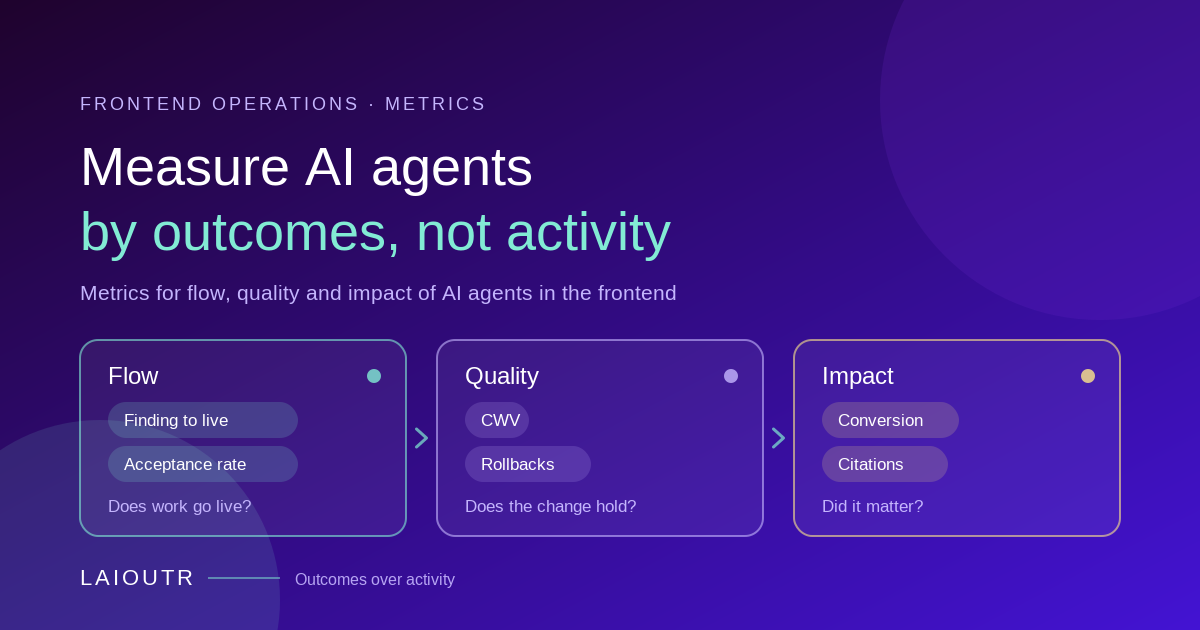Measuring AI Agents by Outcomes: Agentic Frontend Management Metrics
AI agents in the frontend should be measured by outcomes, not by activity. The number of prompts, ge…](https://www.laioutr.com/en/blog/frontend-operations-measuring-ai-agents-outcomes-2026)
[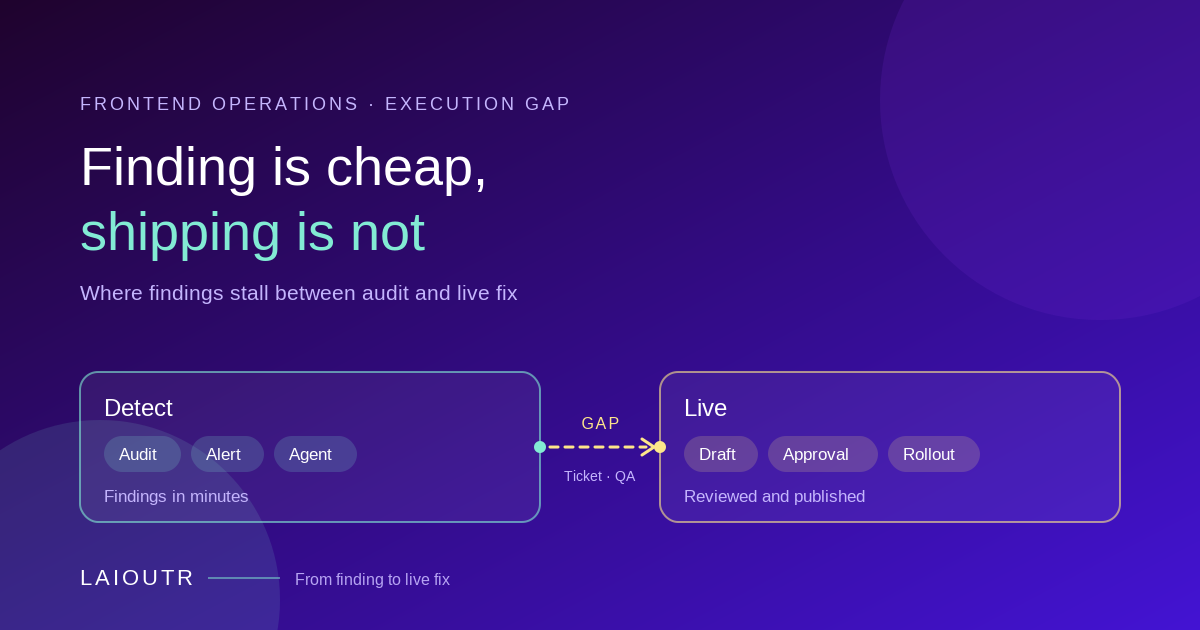The Execution Gap in the Frontend: Finding Is Cheap, Shipping Is Not
The execution gap in the frontend is the time, and the number of handoffs, between "we know wha…](https://www.laioutr.com/en/blog/frontend-operations-execution-gap-detect-vs-deploy-2026)
[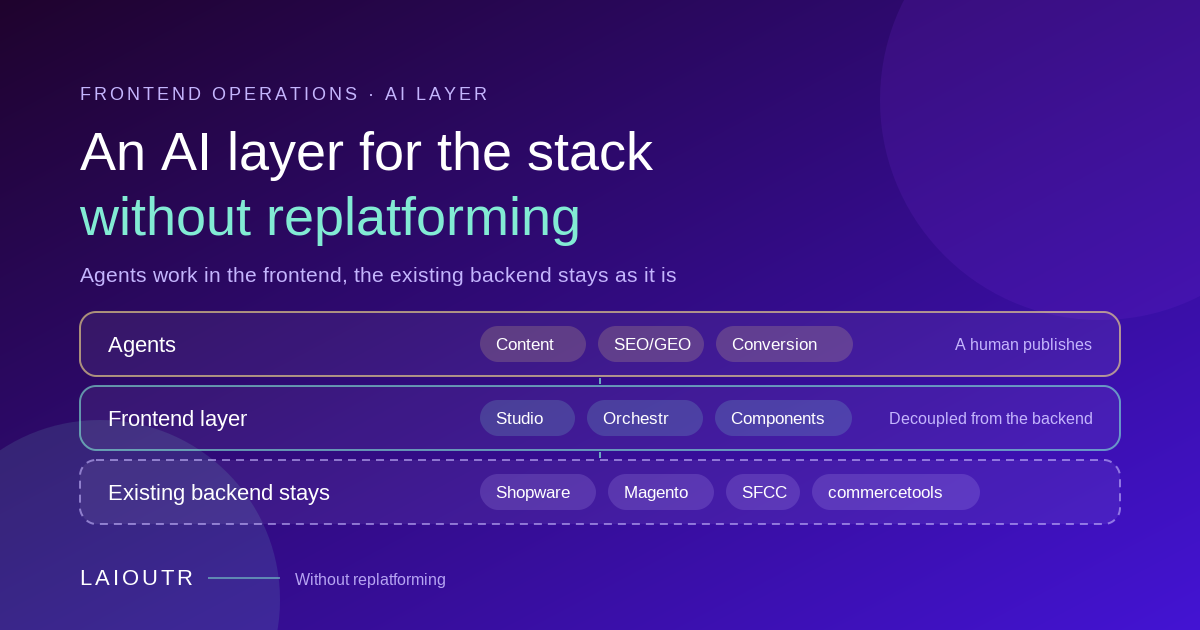Adding an AI Layer to an Existing Commerce Stack Without Replatforming
An AI layer can be added to an existing commerce stack without replacing the shop system. The most p…](https://www.laioutr.com/en/blog/frontend-operations-ai-layer-existing-stack-without-replatforming-2026)
[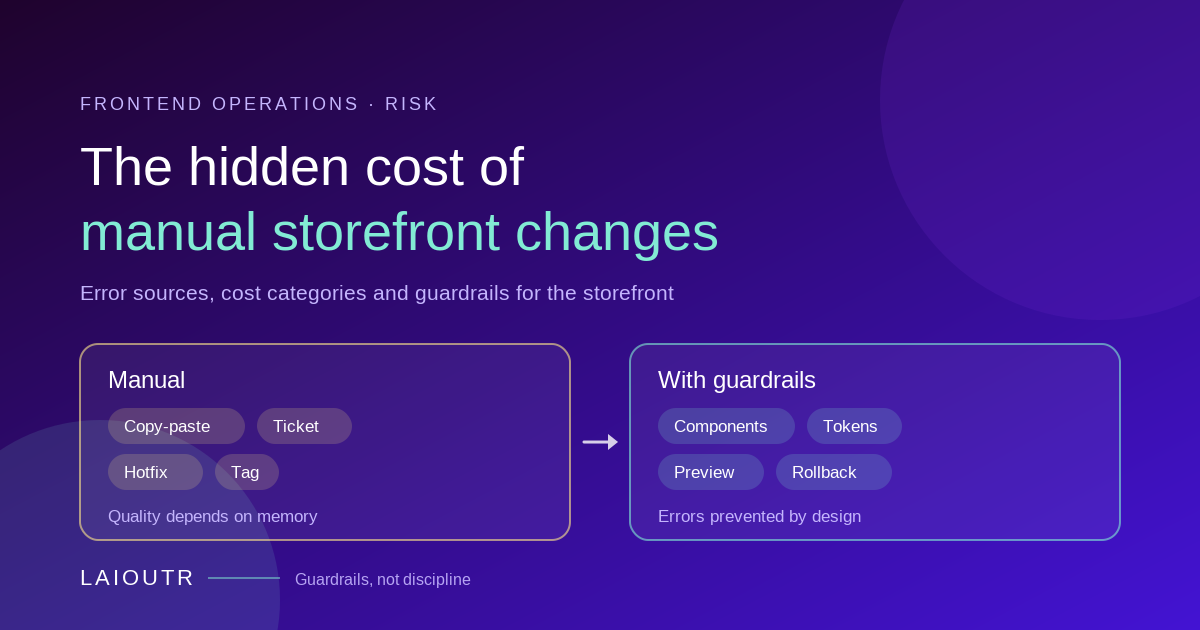The Hidden Cost of Manual Storefront Changes and How to Cut It
Manual frontend changes are the many small edits that keep a storefront running day to day: a new ba…](https://www.laioutr.com/en/blog/frontend-operations-hidden-cost-manual-storefront-changes-2026)
[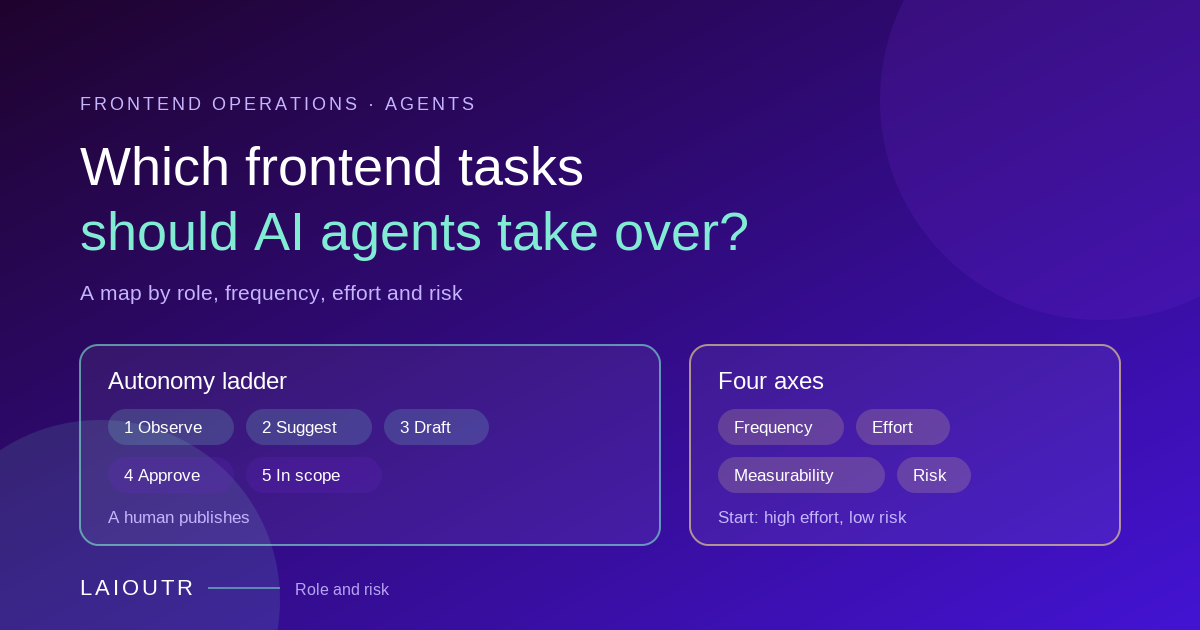Which Frontend Tasks Should AI Agents Take Over? Role and Risk Map
AI agents should first take over the frontend tasks that come up often, involve a lot of manual work…](https://www.laioutr.com/en/blog/frontend-operations-agent-task-map-role-risk-2026)
[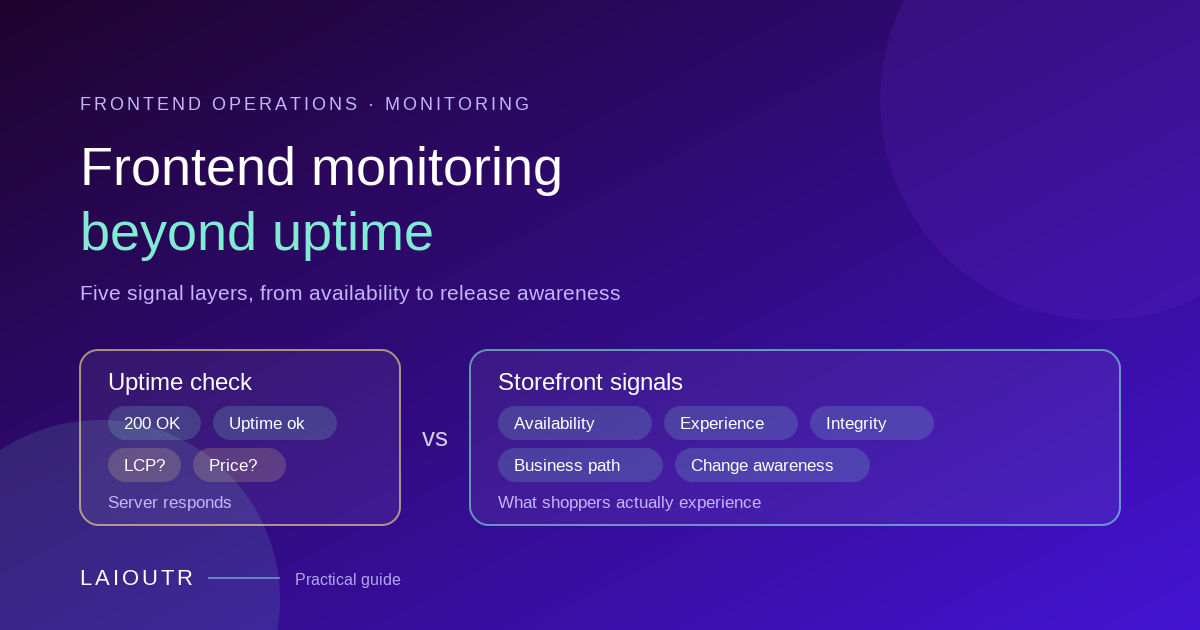Frontend Monitoring Beyond Uptime: Signals a Storefront Needs
Frontend monitoring beyond uptime means checking a storefront not only for availability but for what…](https://www.laioutr.com/en/blog/frontend-operations-monitoring-beyond-uptime-2026)
[Root Cause in the Frontend: When Revenue Drops Start in the Storefront
When revenue or conversion rate drops suddenly, the cause often is not traffic, pricing or the comme…](https://www.laioutr.com/en/blog/frontend-operations-root-cause-revenue-drop-storefront-2026)
[Laioutr Academy Is Live: The Video Manual for Laioutr
Since October 15, 2026, the Laioutr Academy has been live at academy.laioutr.com. It is the user man…](https://www.laioutr.com/en/blog/laioutr-academy-launch-video-manual-certification)
[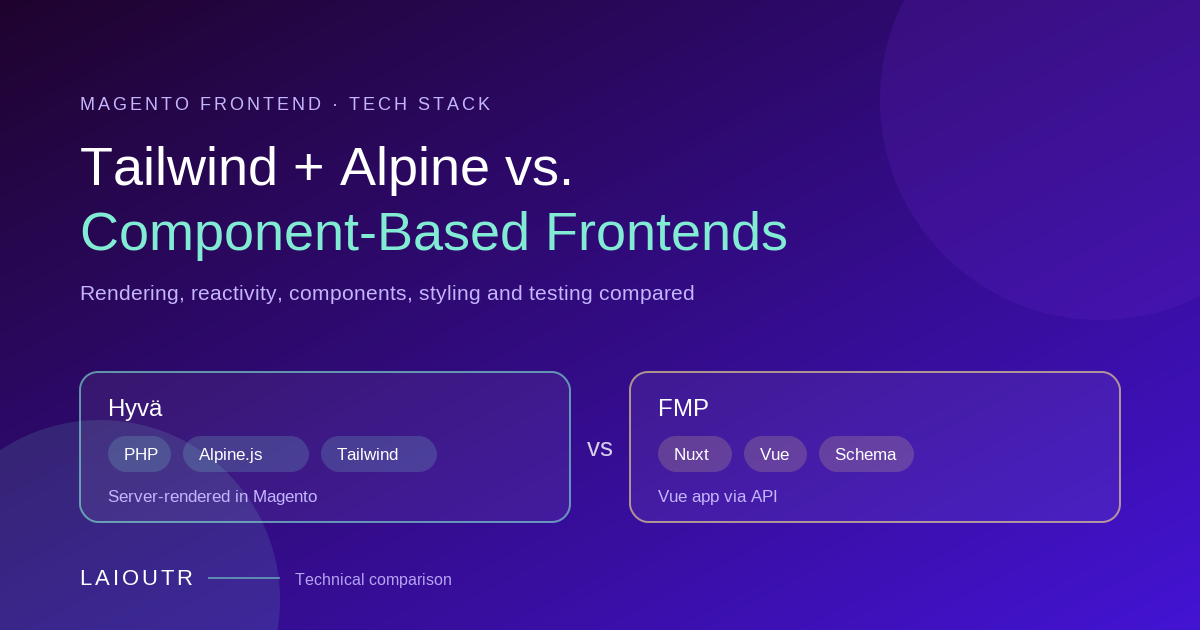Tailwind + Alpine vs. Component-Based Frontends for Magento
Hyvä renders Magento pages on the server with PHP templates and layout XML, adds interactivity throu…](https://www.laioutr.com/en/blog/tailwind-alpine-magento-vs-component-based-frontend-2026)
[OroCommerce Frontend: Out of the Twig and Layouts Bottleneck
The OroCommerce frontend is a server-rendered storefront built from Symfony bundles, OroLayouts and …](https://www.laioutr.com/en/blog/orocommerce-frontend-twig-layouts-bottleneck)
[One Magento Backend, Many Channels: Personalization in Practice
Personalization across web, mobile and voice on a single Magento backend does not start with a featu…](https://www.laioutr.com/en/blog/magento-multichannel-personalization-web-mobile-voice-2026)
[Edge Hosting for Storefronts: Caching That Holds Under Peak Load
Edge hosting keeps a storefront fast under load when most requests never reach the origin: pages and…](https://www.laioutr.com/en/blog/edge-hosting-storefronts-peak-traffic-caching-2026)
[Composable Commerce 2027: What Shifted and What Comes Next
Composable commerce enters 2027 with a different agenda than a year ago. The architecture question i…](https://www.laioutr.com/en/blog/composable-commerce-2027-outlook)
[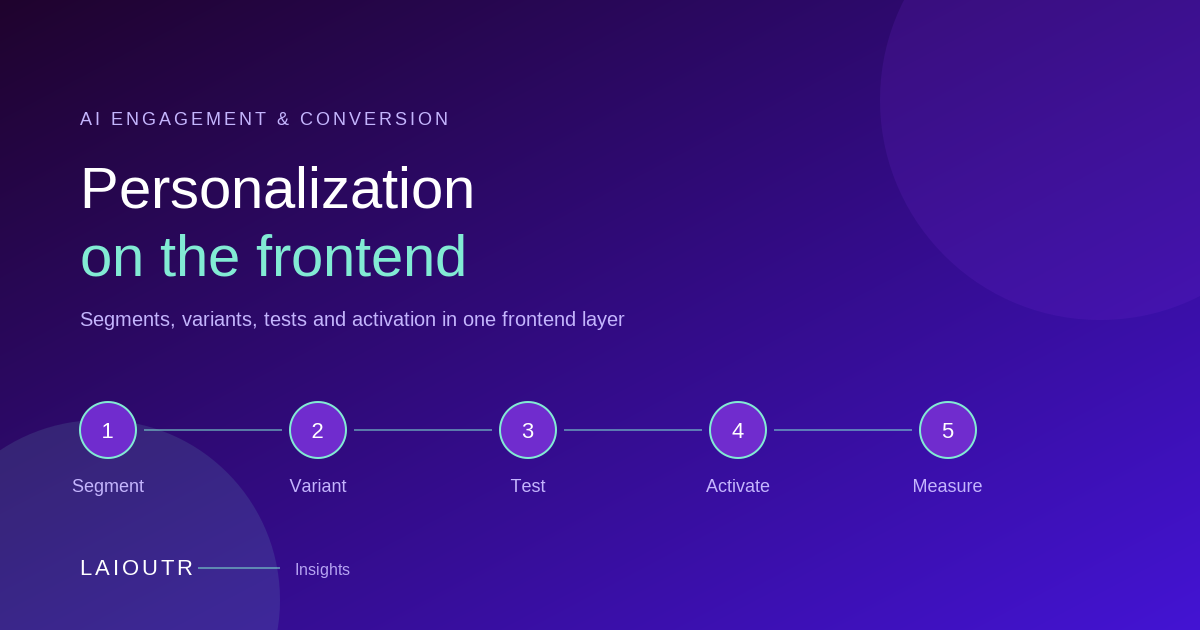AI Engagement and Conversion: Personalization on the Frontend
AI-driven engagement and conversion on the frontend rests on five mechanics: segments decide who see…](https://www.laioutr.com/en/blog/ai-engagement-conversion-frontend-personalization)
## Apps for the Laioutr platform
[View all apps](https://www.laioutr.com/en/apps)
[](https://www.laioutr.com/en/apps/shopify)
Laioutr
[Shopify](https://www.laioutr.com/en/apps/shopify)
Shopify is a commerce platform for selling online and in physical retail.
[](https://www.laioutr.com/en/apps/shopware)
Laioutr
[Shopware](https://www.laioutr.com/en/apps/shopware)
Shopware is a flexible ecommerce platform from Europe for product catalogs and omnichannel commerce.
[](https://www.laioutr.com/en/apps/adobe-commerce)
Laioutr
[Adobe Commerce](https://www.laioutr.com/en/apps/adobe-commerce)
Adobe Commerce is an enterprise commerce platform for complex, global B2C and B2B scenarios.
Planned
[](https://www.laioutr.com/en/apps/b2b-sellers)
Laioutr
[B2Bsellers](https://www.laioutr.com/en/apps/b2b-sellers)
B2B suite for Shopware that turns an online store into a professional B2B commerce platform.
Planned
[](https://www.laioutr.com/en/apps/commerce-layer)
Laioutr
[Commerce Layer](https://www.laioutr.com/en/apps/commerce-layer)
Commerce Layer is a headless commerce platform for making inventory and catalogs available online.
[](https://www.laioutr.com/en/apps/commercetools)
Laioutr
[Commercetools](https://www.laioutr.com/en/apps/commercetools)
Commercetools is a SaaS-based headless ecommerce platform used worldwide.
[](https://www.laioutr.com/en/apps/emporix)
Laioutr
[Emporix](https://www.laioutr.com/en/apps/emporix)
Emporix is a composable, API-first commerce platform for scalable B2B and B2C scenarios.
Planned
[](https://www.laioutr.com/en/apps/hcl-software)
Laioutr
[HCL Software](https://www.laioutr.com/en/apps/hcl-software)
Enterprise suite for digital commerce and experience with extensive configurability.
Planned
[](https://www.laioutr.com/en/apps/intershop)
Laioutr
[Intershop](https://www.laioutr.com/en/apps/intershop)
Enterprise commerce platform for complex B2B and B2C business models.
Planned
[](https://www.laioutr.com/en/apps/magento-2)
Laioutr
[Magento 2](https://www.laioutr.com/en/apps/magento-2)
Widely used, extensible commerce platform for B2C and B2B scenarios.
[](https://www.laioutr.com/en/apps/oxid-eshop)
Laioutr
[OXID eShop](https://www.laioutr.com/en/apps/oxid-eshop)
OXID eShop is an extensible commerce platform for complex B2B and B2C requirements.
Planned
[](https://www.laioutr.com/en/apps/patchworks)
Laioutr
[Patchworks](https://www.laioutr.com/en/apps/patchworks)
Patchworks is a low-code iPaaS that connects ecommerce, ERP, WMS, 3PL, and marketplaces.
Planned
[](https://www.laioutr.com/en/apps/PrestaShop)
Laioutr
[Prestashop](https://www.laioutr.com/en/apps/PrestaShop)
Open-source commerce platform for small and midsize merchants in Europe and beyond.
Planned
[](https://www.laioutr.com/en/apps/saleor)
Laioutr
[Saleor](https://www.laioutr.com/en/apps/saleor)
Open-source, API-first commerce platform built on GraphQL for custom storefronts.
Planned
[](https://www.laioutr.com/en/apps/salesforce-commerce-cloud)
Laioutr
[Salesforce Commerce Cloud](https://www.laioutr.com/en/apps/salesforce-commerce-cloud)
Salesforce Commerce Cloud is a cloud-based enterprise commerce platform for businesses of any size.
Planned
[](https://www.laioutr.com/en/apps/sap-commerce-cloud)
Laioutr
[SAP Commerce Cloud](https://www.laioutr.com/en/apps/sap-commerce-cloud)
Enterprise commerce platform for complex catalogs, pricing models, and omnichannel journeys.
Planned
[](https://www.laioutr.com/en/apps/scayle)
Laioutr
[Scayle](https://www.laioutr.com/en/apps/scayle)
SCAYLE is a commerce engine that helps brands and retailers scale their business.
Planned
[](https://www.laioutr.com/en/apps/spryker)
Laioutr
[Spryker](https://www.laioutr.com/en/apps/spryker)
Composable commerce platform for sophisticated B2B and B2C business models.
[](https://www.laioutr.com/en/apps/sylius)
Laioutr
[Sylius](https://www.laioutr.com/en/apps/sylius)
Sylius is a developer-friendly ecommerce framework for B2C and B2B shopping experiences.
Planned
[](https://www.laioutr.com/en/apps/vendure)
Laioutr
[Vendure](https://www.laioutr.com/en/apps/vendure)
Vendure is a headless commerce platform for businesses with complex requirements.
Coming Soon
[](https://www.laioutr.com/en/apps/vtex)
Laioutr
[VTEX](https://www.laioutr.com/en/apps/vtex)
Cloud-native, composable commerce platform for B2B and B2C at scale.
Planned
[](https://www.laioutr.com/en/apps/websale)
Laioutr
[Websale](https://www.laioutr.com/en/apps/websale)
Stable, enterprise-ready commerce backend for complex retail environments.

Strategy call
## The frontend as a control layer
A conversation about stack, roadmap and replatforming scenario. The outcome: a clear picture of how Laioutr fits, what it costs and how fast the go-live can happen.
*"After 30 minutes, we knew Laioutr makes our replatforming feasible."*
*Daniel B., CEO,* [*hygibox.de*](https://hygibox.de)
[Book a demo](https://www.laioutr.com/en/contact)
## Structured Data
```json
{
"@context": "https://schema.org",
"@graph": [
{
"@type": "Organization",
"@id": "https://www.laioutr.com/#identity",
"name": "Laioutr",
"legalName": "Laioutr GmbH",
"url": "https://www.laioutr.com/",
"logo": {
"@type": "ImageObject",
"url": "https://www.laioutr.com/laioutr-logo.png",
"width": 400,
"height": 400
},
"email": "info@laioutr.com",
"telephone": "+49 30 75435715",
"address": {
"@type": "PostalAddress",
"streetAddress": "Münchweilersteig 5",
"postalCode": "12559",
"addressLocality": "Berlin",
"addressCountry": "DE"
},
"vatID": "DE450905846",
"sameAs": [
"https://www.linkedin.com/company/laioutr",
"https://www.youtube.com/@Laioutr",
"https://x.com/laioutr"
]
},
{
"@type": "WebSite",
"@id": "https://www.laioutr.com/en/#website",
"url": "https://www.laioutr.com/en/",
"name": "Laioutr",
"inLanguage": "en",
"publisher": {
"@id": "https://www.laioutr.com/#identity"
}
},
{
"@type": "BlogPosting",
"@id": "https://www.laioutr.com/en/blog/closing-marketing-velocity-gaps#article",
"headline": "Breaking Through the Marketing Velocity Ceiling: How High-Performing Teams Close Structural Gaps",
"description": "How high-performing teams break through the marketing velocity ceiling by closing structural gaps.",
"image": [
"https://eu-west-2.graphassets.com/cmii2mlqi0dux06l5543v7nkc/cmnucypviw8mi07mgmwsd5asa"
],
"datePublished": "2026-10-26T10:56:59.744656+00:00",
"dateModified": "2026-10-26T10:56:59.311923+00:00",
"inLanguage": "en",
"articleSection": "Insights",
"keywords": "Industry & Trends",
"author": {
"@type": "Person",
"name": "Marcel Thiesies",
"jobTitle": "Co-Founder & CEO, Laioutr",
"image": "https://eu-west-2.graphassets.com/cmii2mlqi0dux06l5543v7nkc/cmj01b962364n07lb0iguvts5"
},
"publisher": {
"@id": "https://www.laioutr.com/#identity"
},
"mainEntityOfPage": {
"@id": "https://www.laioutr.com/en/blog/closing-marketing-velocity-gaps#webpage"
},
"isPartOf": {
"@id": "https://www.laioutr.com/en/#website"
}
},
{
"@type": "WebPage",
"@id": "https://www.laioutr.com/en/blog/closing-marketing-velocity-gaps#webpage",
"url": "https://www.laioutr.com/en/blog/closing-marketing-velocity-gaps",
"name": "Breaking Through the Marketing Velocity Ceiling: How High-Performing Teams Close Structural Gaps",
"description": "How high-performing teams break through the marketing velocity ceiling by closing structural gaps.",
"inLanguage": "en",
"isPartOf": {
"@id": "https://www.laioutr.com/en/#website"
},
"breadcrumb": {
"@id": "https://www.laioutr.com/en/blog/closing-marketing-velocity-gaps#breadcrumb"
},
"primaryImageOfPage": {
"@type": "ImageObject",
"url": "https://eu-west-2.graphassets.com/cmii2mlqi0dux06l5543v7nkc/cmnucypviw8mi07mgmwsd5asa"
},
"datePublished": "2026-10-26T10:56:59.744656+00:00",
"dateModified": "2026-10-26T10:56:59.311923+00:00",
"mainEntity": {
"@id": "https://www.laioutr.com/en/blog/closing-marketing-velocity-gaps#article"
}
},
{
"@type": "BreadcrumbList",
"@id": "https://www.laioutr.com/en/blog/closing-marketing-velocity-gaps#breadcrumb",
"itemListElement": [
{
"@type": "ListItem",
"position": 1,
"name": "Laioutr",
"item": "https://www.laioutr.com/en/"
},
{
"@type": "ListItem",
"position": 2,
"name": "Insights",
"item": "https://www.laioutr.com/en/blogs/insights"
},
{
"@type": "ListItem",
"position": 3,
"name": "Breaking Through the Marketing Velocity Ceiling: How High-Performing Teams Close Structural Gaps"
}
]
}
]
}
```