---
title: "How CMS Is Reshaping Strategy"
canonical_url: "https://www.laioutr.com/en/blog/content-management-past-present-future"
locale: en
meta:
description: "Beyond legacy: how content management systems are reshaping enterprise strategy across past, present and future."
"og:description": "Beyond legacy: how content management systems are reshaping enterprise strategy across past, present and future."
"og:title": "How CMS Is Reshaping Strategy"
---

# Beyond Legacy: How Content Management Systems Are Reshaping Enterprise Strategy
Table of contents
1. [1.The Static Web Era: When Developers Were Gatekeepers](#the-static-web-era-when-developers-were-gatekeepers)
2. [2.The Monolithic Dream: Consolidation and Control](#the-monolithic-dream-consolidation-and-control)
3. 3.The Multi-Channel Mandate: When One Source Wasn't Enough
4. [4.The Strategic Imperative: Composability Over Integration](#the-strategic-imperative-composability-over-integration)
5. [5.What This Means for Marketing Effectiveness](#what-this-means-for-marketing-effectiveness)
6. [6.The Governance Challenge Nobody Talks About](#the-governance-challenge-nobody-talks-about)
7. [7.The Human Layer: Where Technology Meets Execution](#the-human-layer-where-technology-meets-execution)
8. [8.Navigating the Present: Practical Decision Framework](#navigating-the-present-practical-decision-framework)
9. [9.The Future: Convergence Around Content Models](#the-future-convergence-around-content-models)
10. [10.Conclusion: Strategic Content Infrastructure as Competitive Advantage](#conclusion-strategic-content-infrastructure-as-competitive-advantage)
The history of content management mirrors the broader maturation of enterprise software. What began as simple document repositories has evolved into sophisticated platforms that fundamentally shape how organizations create, distribute, and monetize their intellectual capital. Yet despite decades of innovation, many enterprises remain trapped in architectural decisions that no longer serve their strategic goals.
At Laioutr, we work with organizations across industries wrestling with this fundamental question: How do you manage content at scale without sacrificing speed, flexibility, or control? Understanding where we've been helps illuminate the path forward.
## The Static Web Era: When Developers Were Gatekeepers
Content management didn't begin with systems bearing that name. In the mid-1990s, "managing content" meant managing HTML files. Publishing required technical expertise. A marketing manager who wanted to change product copy on a website had to submit a request to a developer, wait for implementation, and hope the change addressed what they actually needed to communicate.
This worked for static brochure sites. Businesses published quarterly updates. The web was an afterthought to core operations, not the primary interface between companies and customers.
The implications were profound. Marketing departments couldn't respond to market conditions quickly. Sales teams couldn't tailor messaging without engineering support. Customer service couldn't publish FAQs or update product documentation independently. Businesses optimized for availability of technical resources rather than business velocity.
This era taught us something crucial: separating content creators from publication mechanisms creates organizational friction that compounds over time. The cost isn't just measured in delayed launches, though that's real. It's measured in strategic opportunity cost, in campaigns that ship later than competitors, in messaging that becomes stale before reaching customers.
## The Monolithic Dream: Consolidation and Control
As the web became critical to business, the 2000s brought the enterprise CMS boom. Companies like Vignette, Stellent, and proprietary systems promised a solution: one integrated platform where content, design, workflow, and publishing could all coexist.
The appeal was rational. IT departments wanted control. Enterprises wanted governance. Consolidation meant single vendor relationships, unified training, coordinated upgrades. For large organizations with the resources to implement these systems properly, monolithic CMSs solved real problems.
But they created new constraints in the process. These platforms were heavyweight. Implementation took months or years. Customization required specialists. If you needed functionality the system didn't natively support, you either compromised your requirements or paid for deep customization. Once you were locked in, switching costs were astronomical.
More importantly, monolithic systems assumed a relatively stable content landscape. They worked well when you published to a website. The entire platform architecture revolved around that single publishing channel. Then mobile arrived. Then apps. Then progressive web experiences and native applications that needed the same content in different formats.
The monolithic CMS struggled to adapt. It was designed to answer one question: "How do we publish content to the web?" It was spectacularly unprepared for: "How do we manage content across twelve different touchpoints with different formatting requirements?"
## The Multi-Channel Mandate: When One Source Wasn't Enough
By the 2010s, the business reality became undeniable. Content needed to flow across multiple channels. A product description might appear on a website, in a mobile app, on a partner portal, in printed catalogs, embedded in customer presentations, and syndicated to review sites.
Traditional CMS architecture created impossible paradoxes. You could maintain content in a single system with some channels, but then other channels required separate content stores. You ended up with content fragmentation: exactly what CMS technology was supposed to prevent. A customer service representative couldn't update product information once and have it propagate everywhere. They updated one system, forgot another, and suddenly marketing was contradicting customer service.
Organizations responded by accumulating systems. A CMS for the website. A DAM for marketing assets. An e-commerce platform for product information. A customer data platform. A marketing automation system. Each maintained its own version of truth, and reconciling those versions became increasingly expensive.
Some enterprises built integration layers, trying to stitch disparate systems together through APIs and middleware. This created its own problems. The integration logic became mission-critical infrastructure. When it broke, it broke silently in many cases. When one system needed to change, you had to audit all downstream systems to understand the impact.
We encountered an energy company managing content across seven different systems. A simple product name change required coordinating updates across marketing, legal (for compliance), customer service, e-commerce, and partner portals. The project took six weeks. The regulatory risk of having inconsistent product information created constant tension between departments.
## The Strategic Imperative: Composability Over Integration
The architecture emerging over the last five years represents a fundamental rethinking of how enterprises should approach content infrastructure.
Rather than attempting to build monoliths that do everything, modern platforms embrace composability. Your content infrastructure becomes a collection of specialized, focused systems that exchange information through well-defined interfaces.
This isn't simply "using multiple systems." It's about designing systems that are specifically built to compose well together. A content management platform focused solely on managing content structure and relationships. A delivery layer that can consume that content and format it for any channel. A governance layer that ensures compliance and quality regardless of where content appears.
The architectural difference is crucial. Legacy integration approaches treat incompatibility as something to overcome through custom middleware. Composable approaches prevent the incompatibility from arising in the first place, through standardized content models and API contracts.
When your content system stores product information in a standardized schema and exposes it through consistent APIs, your mobile app doesn't need a specialized data layer. Your partner portal doesn't need custom development. A new channel can integrate in days rather than months because the hard problems have been solved once, at the platform level, not for each new implementation.
## What This Means for Marketing Effectiveness
The implications for marketers are significant. A marketing leader with a composable content infrastructure can answer questions that were impossible five years ago.
"What content do we have about enterprise security features?" Rather than checking the website CMS, the product information system, and the knowledge base, there's one source where you can discover all references to this topic across all content types, all channels.
"How do we update our messaging across all touchpoints?" A strategic decision to emphasize certain product benefits becomes executable across every channel because your content system speaks a common language. You don't need to route requests through multiple departments hoping each will remember to make the change.
"Can we launch this experience in a new market?" Your content infrastructure isn't bound to a specific language or region. You can implement regional variations without duplicating your entire content management burden.
These aren't theoretical benefits. They're the difference between marketing organizations that can move at the speed of business and those that are perpetually constrained by technical debt.
## The Governance Challenge Nobody Talks About
There's a darker side to distributed, composable systems that deserves attention. The same flexibility that enables agility can create governance chaos if you're not careful.
When content lived in a monolithic system, governance was straightforward. Workflow states, approval chains, role-based access controls were built into the platform. When content lives across multiple systems with different governance capabilities, enforcing consistent standards becomes much harder.
A typical example is a financial services firm that implemented a composable content architecture without establishing clear governance principles first. Within six months, they had marketing messaging on their website that contradicted approved positioning in their partner portal. Regulatory documents had different version numbers in different places. Customer service representatives couldn't tell which documentation was current.
The mistake wasn't adopting composable architecture. The mistake was not recognizing that flexibility requires discipline. Governance needs to operate at a higher level than any individual system. You need clear standards for content structure, approval workflows, version management, and metadata. These standards need to be enforced across your entire ecosystem, not within individual platforms.
This is an area where many organizations stumble. They're excited about the flexibility composable systems provide and haven't built the organizational discipline those systems require. It's like switching from a strictly regulated stock exchange to algorithmic trading without implementing circuit breakers.
## The Human Layer: Where Technology Meets Execution
The final challenge in modern content management is one technology cannot solve alone: human alignment.
Content management systems don't fail because the software is inadequate. They fail because organizations underestimate the change management required to use them effectively.
When you move from a monolithic system where content lives in one place to a composable architecture where content is managed in specialized systems, you're changing how people work. Copywriters need to learn new tools. Designers need to understand content modeling. Product managers need to think about how their content will be consumed in channels they may never see directly.
This requires investment in training that goes beyond typical software onboarding. It requires helping teams understand why the new architecture is better, not just how to use it. It requires changing workflows and approval processes.
The organizations that successfully modernize their content infrastructure are those that invest as heavily in change management and team enablement as they do in technology selection. They recognize that a state-of-the-art platform used poorly will underperform a solid platform used well.
## Navigating the Present: Practical Decision Framework
If you're evaluating content management approaches for your organization, here's a framework that we've found useful.
Start by mapping your content landscape. How many systems manage content today? What are the pain points with each? Which ones exist primarily because they had to be built to bridge gaps between your other systems?
Next, identify the future content surface. Where will your content need to appear in three years? Mobile apps, voice assistants, AR experiences, partner ecosystems? Don't limit your thinking to channels that exist today.
Then assess your governance maturity. Can your organization enforce content standards across multiple systems? Do you have clarity about who owns different content types? Can you manage metadata consistently?
Finally, evaluate the total cost of ownership. This includes not just software licensing, but integration costs, training and change management, and the ongoing maintenance burden of keeping everything in sync.
Many organizations discover that the cheapest platform option creates the highest total cost because of integration complexity and organizational friction. The more expensive platform that's specifically designed to compose well with adjacent systems often delivers better economics and faster time-to-value.
## The Future: Convergence Around Content Models
Looking forward, we expect the industry to converge around a few core principles that have emerged from the last decade of experience.
Content will be modeled explicitly and stored independently of its presentation. This seems obvious now, but it represents a major shift from how content was managed even a few years ago. The data model matters more than the user interface.
Systems will exchange information through standardized contracts. APIs will become as fundamental to CMS architecture as databases. Interoperability won't be an afterthought; it will be a core requirement.
Governance will be elevated to architectural priority. The systems best suited to modern enterprise content challenges will be those that make governance policies explicit and enforceable across the entire system, not hidden in configuration screens.
Marketing and product teams will have direct access to content infrastructure without requiring engineering intermediation for routine tasks. The era of developers as permanent gatekeepers to content is ending. But this requires platforms that are powerful enough for sophisticated content modeling yet accessible to non-technical experts.
## Conclusion: Strategic Content Infrastructure as Competitive Advantage
Content management might seem like a purely technical decision. In reality, it's a strategic one that shapes how quickly your organization can respond to market opportunities, how consistently you can communicate with customers, and how effectively you can scale content operations.
The enterprises that will outmaneuver competitors over the next several years won't be those with the flashiest content or the largest budgets. They'll be those with the most flexible, scalable, and well-governed content infrastructure.
Legacy monolithic systems provided stability when the content landscape was predictable. That era is over. The companies winning today are those that have evolved beyond that constraint, that have embraced composable architectures while maintaining rigorous governance standards, and that have invested in the organizational change required to use these tools effectively.
The future belongs to organizations that treat content infrastructure as a strategic capability, not just a tactical tool. That journey starts with understanding where you are, being clear about where you need to go, and having a realistic assessment of what it will take to get there.
### **More from the Laioutr Platform**
- [Composable Digital Experience Platform](https://www.laioutr.com/en/composable-digital-experience-platform)
- [Agentic Frontend Management Platform](https://www.laioutr.com/en/agentic-frontend-management-platform)
- [Content Management](https://www.laioutr.com/en/product/content-management)
- [Composable Visual Page Builder](https://www.laioutr.com/en/composable-visual-page-builder)
Related reading: [The Evolution of Headless CMS: From Developer Dream to Enterprise Standard](https://www.laioutr.com/en/blog/headless-cms-past-present-future) and [The Future of Project Management at Digital Agencies: Breaking Free from Sequential Workflows](https://www.laioutr.com/en/blog/future-agency-project-management).
---
Share this article
[Share on Facebook](https://www.facebook.com/sharer/sharer.php?u=https%3A%2F%2Fwww.laioutr.com%2Fen%2Fblog%2Fcontent-management-past-present-future) [Share on X](https://x.com/intent/post?url=https%3A%2F%2Fwww.laioutr.com%2Fen%2Fblog%2Fcontent-management-past-present-future&text=) [Share on LinkedIn](https://www.linkedin.com/sharing/share-offsite/?url=https%3A%2F%2Fwww.laioutr.com%2Fen%2Fblog%2Fcontent-management-past-present-future) [Share on Pinterest](https://pinterest.com/pin/create/button/?url=https%3A%2F%2Fwww.laioutr.com%2Fen%2Fblog%2Fcontent-management-past-present-future&description=) [Share via email](mailto:?subject=&body=%0A%0Ahttps%3A%2F%2Fwww.laioutr.com%2Fen%2Fblog%2Fcontent-management-past-present-future)
## More articles on frontend and headless
Practical know-how for frontend development, smart agents, and headless
[To the blog](https://www.laioutr.com/en/blogs/insights)
[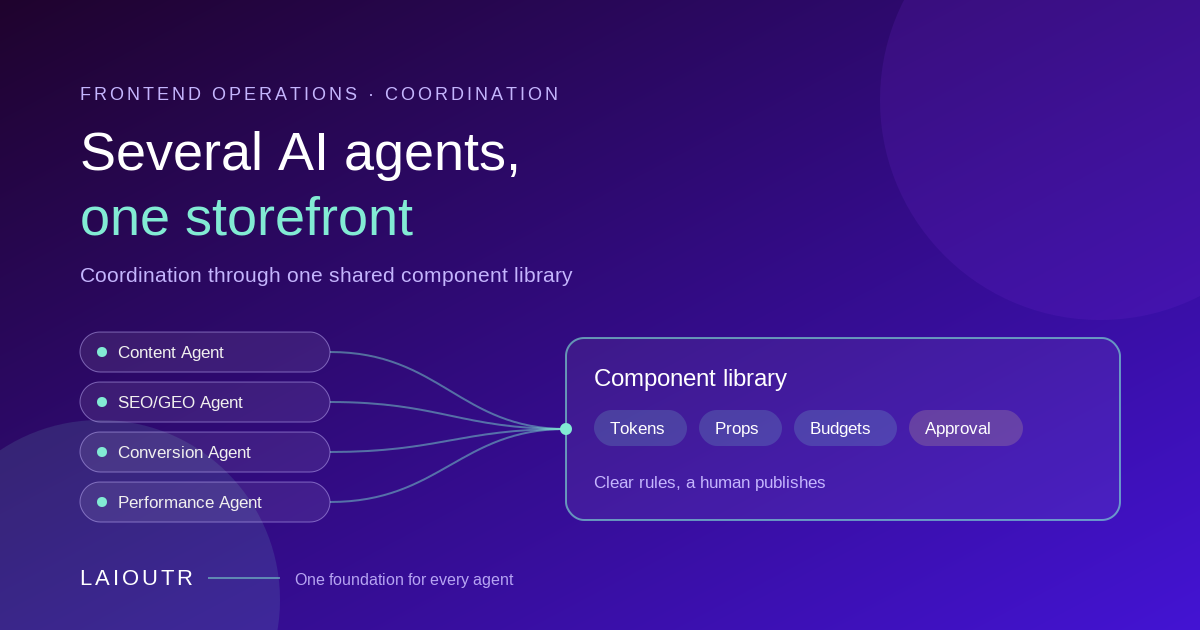Several AI Agents, One Storefront: Coordination Without Collisions
When several AI agents work on the same storefront, conflicts rarely happen between the agents thems…](https://www.laioutr.com/en/blog/frontend-operations-multi-agent-coordination-storefront-2026)
[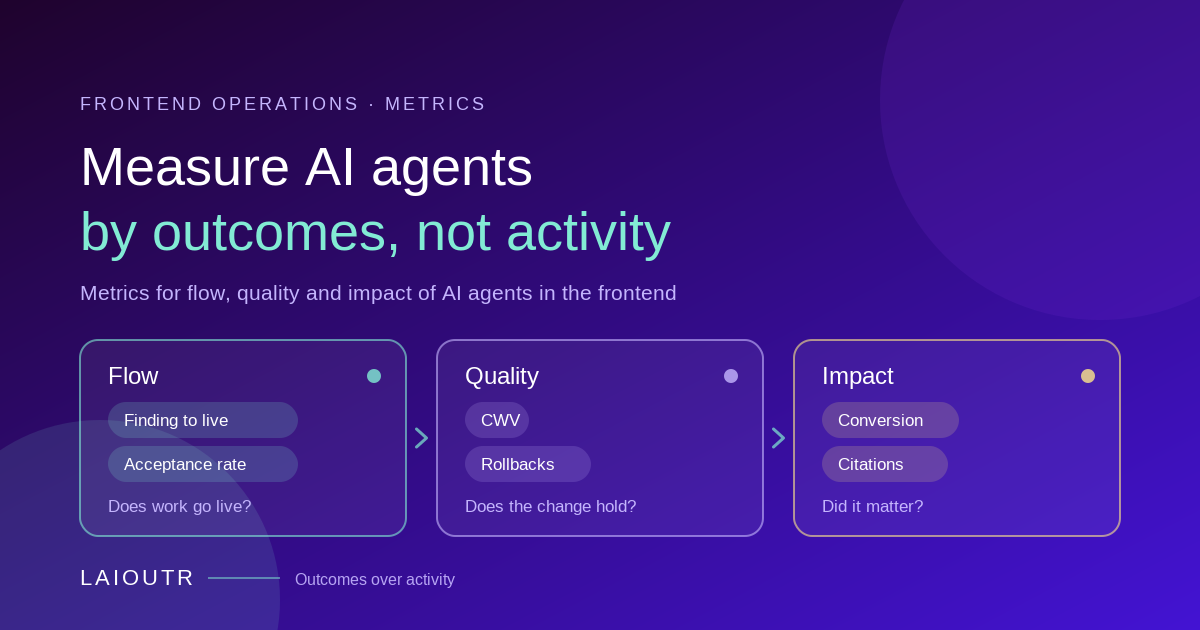Measuring AI Agents by Outcomes: Agentic Frontend Management Metrics
AI agents in the frontend should be measured by outcomes, not by activity. The number of prompts, ge…](https://www.laioutr.com/en/blog/frontend-operations-measuring-ai-agents-outcomes-2026)
[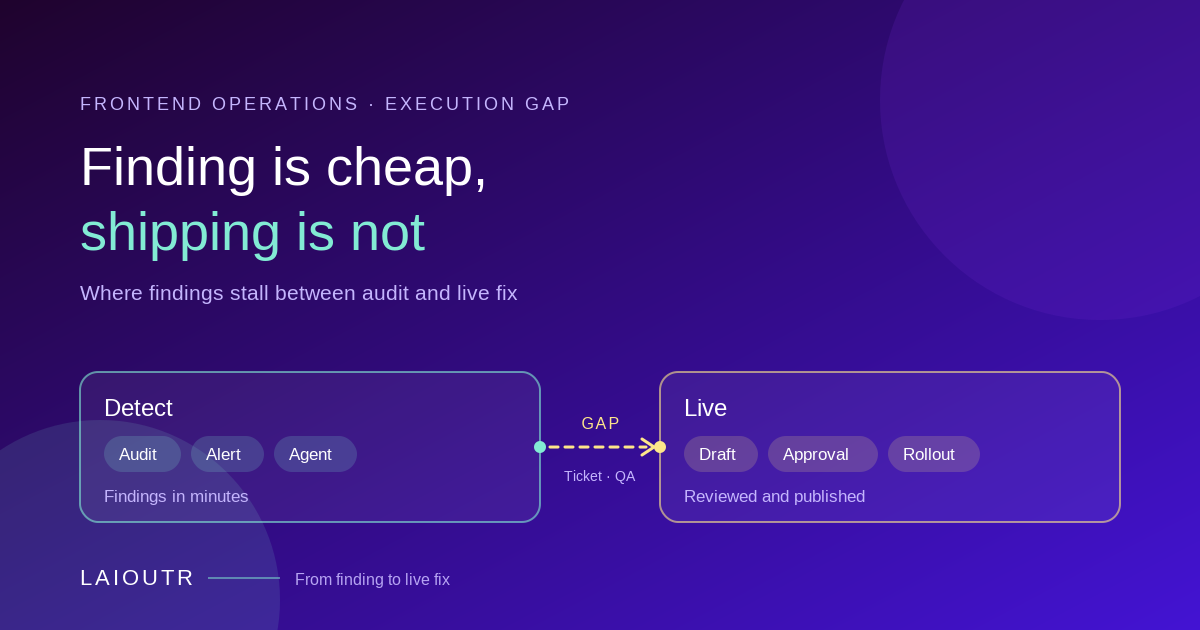The Execution Gap in the Frontend: Finding Is Cheap, Shipping Is Not
The execution gap in the frontend is the time, and the number of handoffs, between "we know wha…](https://www.laioutr.com/en/blog/frontend-operations-execution-gap-detect-vs-deploy-2026)
[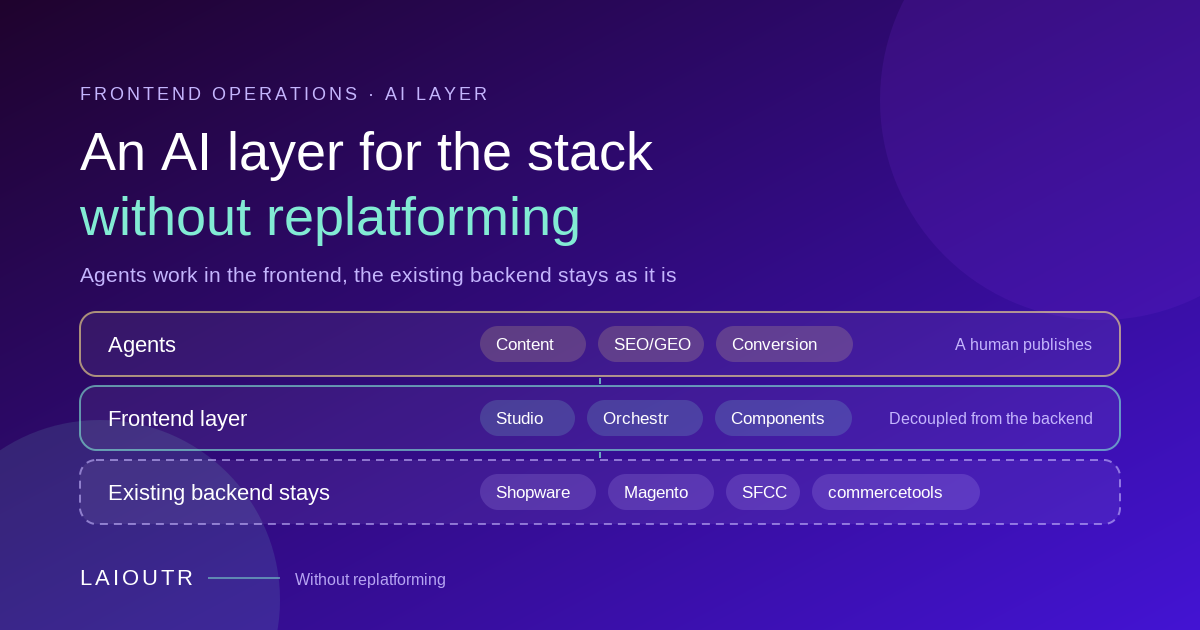Adding an AI Layer to an Existing Commerce Stack Without Replatforming
An AI layer can be added to an existing commerce stack without replacing the shop system. The most p…](https://www.laioutr.com/en/blog/frontend-operations-ai-layer-existing-stack-without-replatforming-2026)
[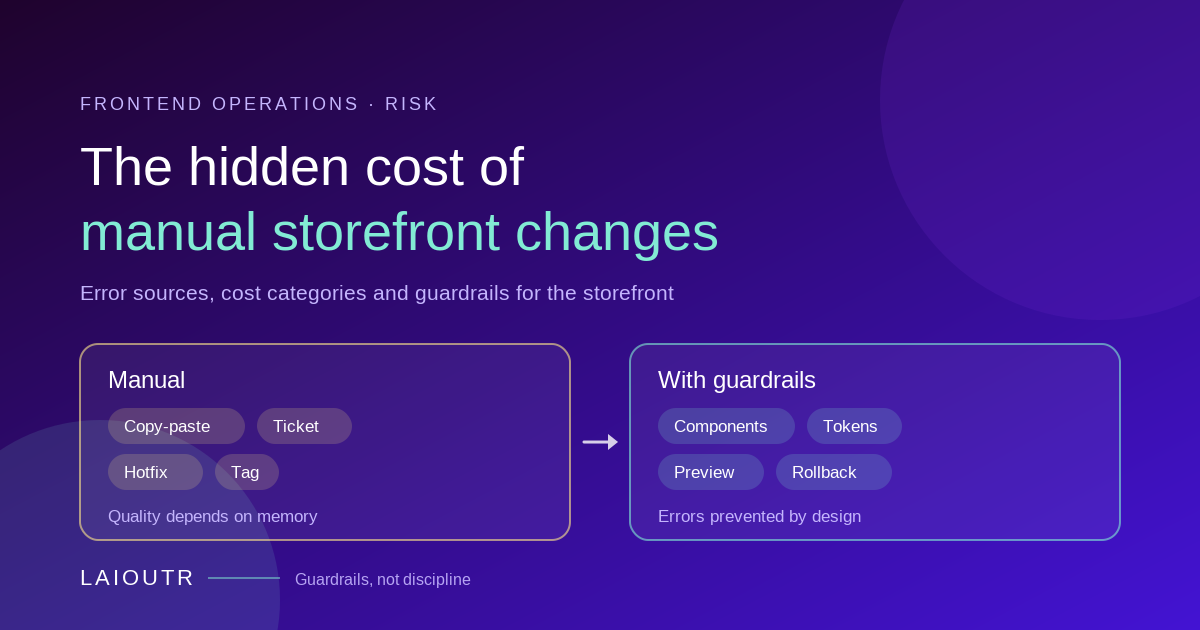The Hidden Cost of Manual Storefront Changes and How to Cut It
Manual frontend changes are the many small edits that keep a storefront running day to day: a new ba…](https://www.laioutr.com/en/blog/frontend-operations-hidden-cost-manual-storefront-changes-2026)
[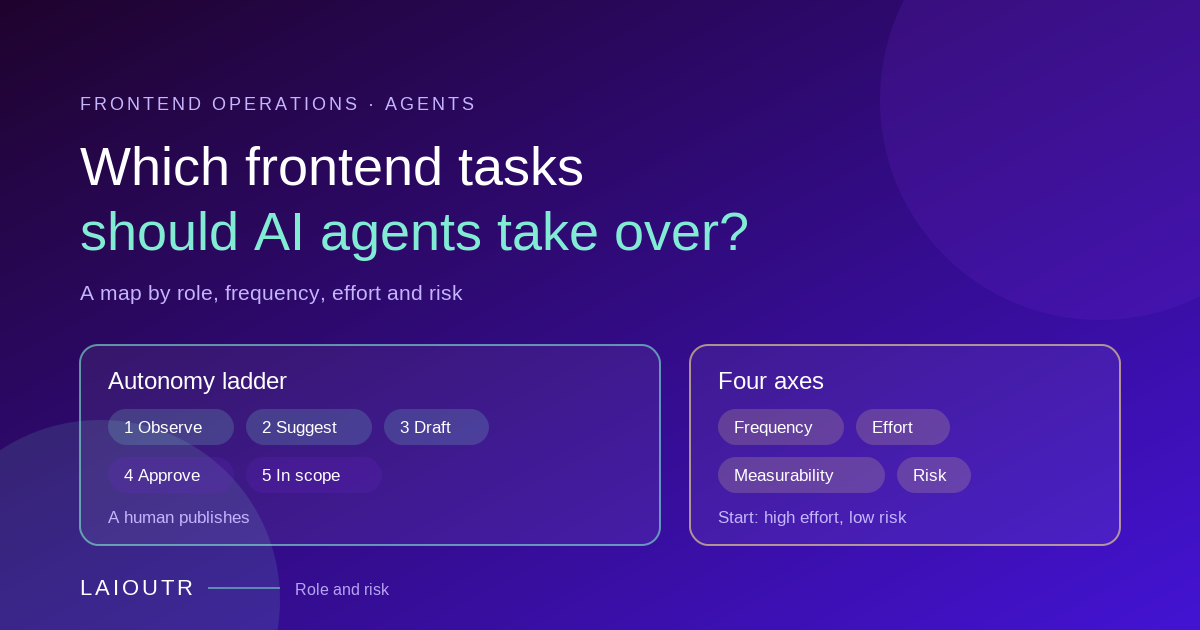Which Frontend Tasks Should AI Agents Take Over? Role and Risk Map
AI agents should first take over the frontend tasks that come up often, involve a lot of manual work…](https://www.laioutr.com/en/blog/frontend-operations-agent-task-map-role-risk-2026)
[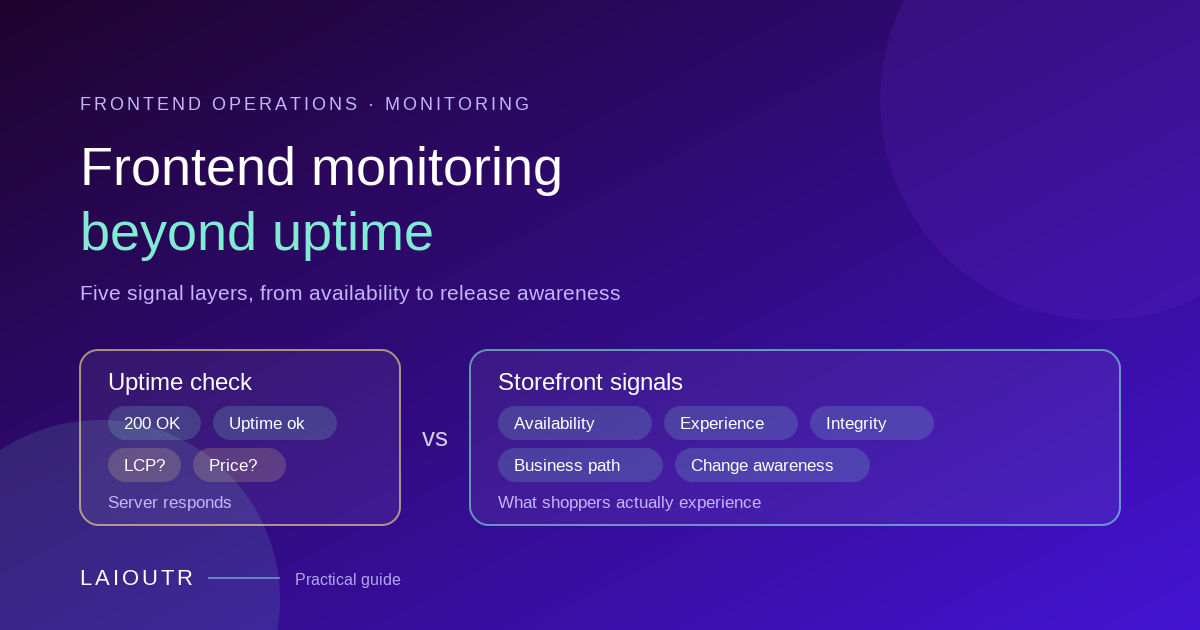Frontend Monitoring Beyond Uptime: Signals a Storefront Needs
Frontend monitoring beyond uptime means checking a storefront not only for availability but for what…](https://www.laioutr.com/en/blog/frontend-operations-monitoring-beyond-uptime-2026)
[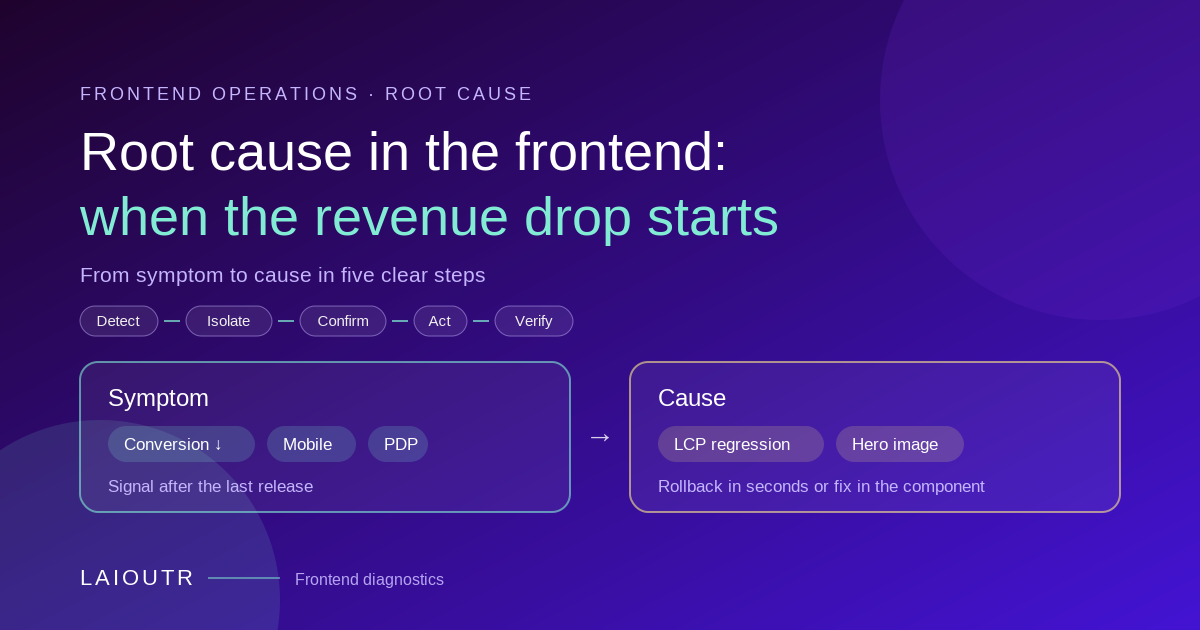Root Cause in the Frontend: When Revenue Drops Start in the Storefront
When revenue or conversion rate drops suddenly, the cause often is not traffic, pricing or the comme…](https://www.laioutr.com/en/blog/frontend-operations-root-cause-revenue-drop-storefront-2026)
[Laioutr Academy Is Live: The Video Manual for Laioutr
Since October 15, 2026, the Laioutr Academy has been live at academy.laioutr.com. It is the user man…](https://www.laioutr.com/en/blog/laioutr-academy-launch-video-manual-certification)
[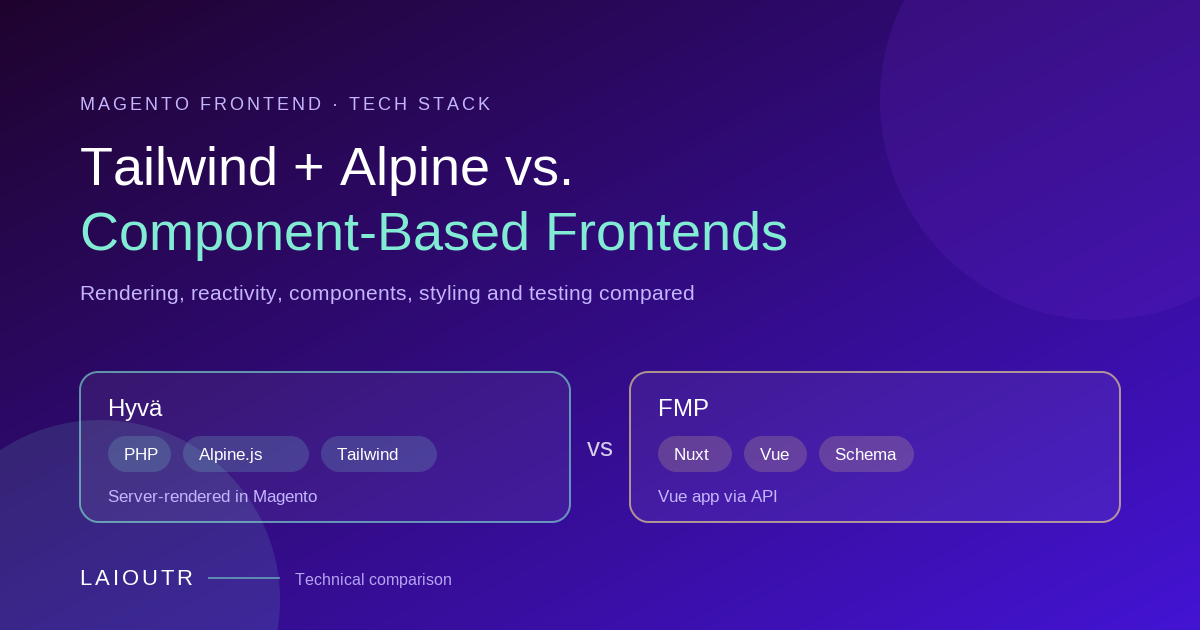Tailwind + Alpine vs. Component-Based Frontends for Magento
Hyvä renders Magento pages on the server with PHP templates and layout XML, adds interactivity throu…](https://www.laioutr.com/en/blog/tailwind-alpine-magento-vs-component-based-frontend-2026)
[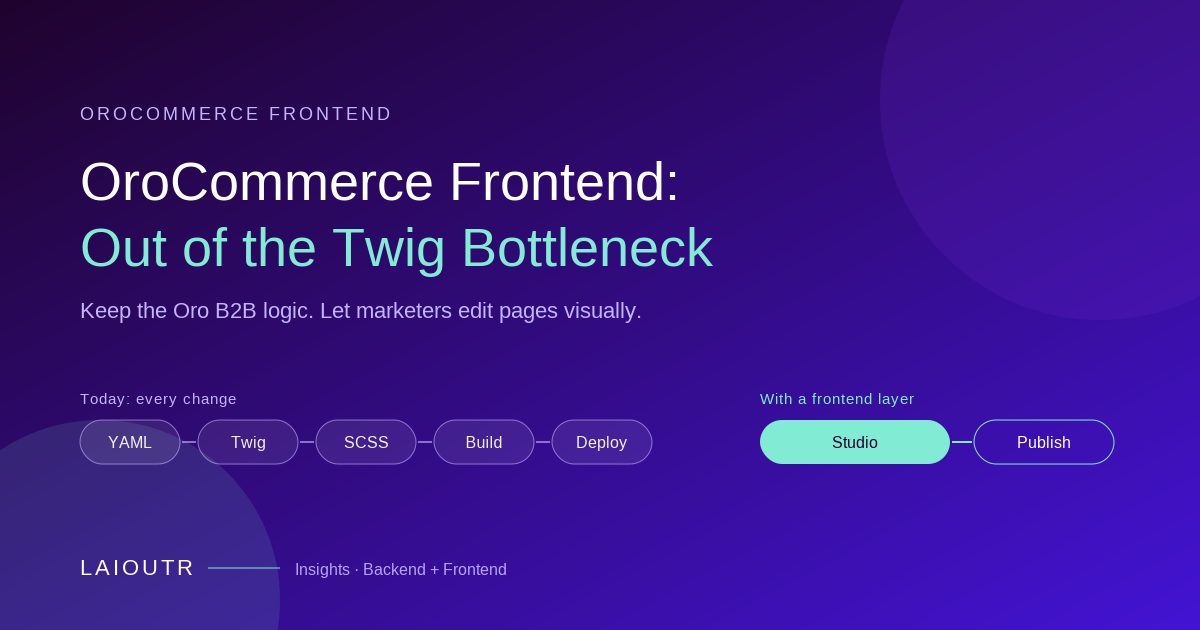OroCommerce Frontend: Out of the Twig and Layouts Bottleneck
The OroCommerce frontend is a server-rendered storefront built from Symfony bundles, OroLayouts and …](https://www.laioutr.com/en/blog/orocommerce-frontend-twig-layouts-bottleneck)
[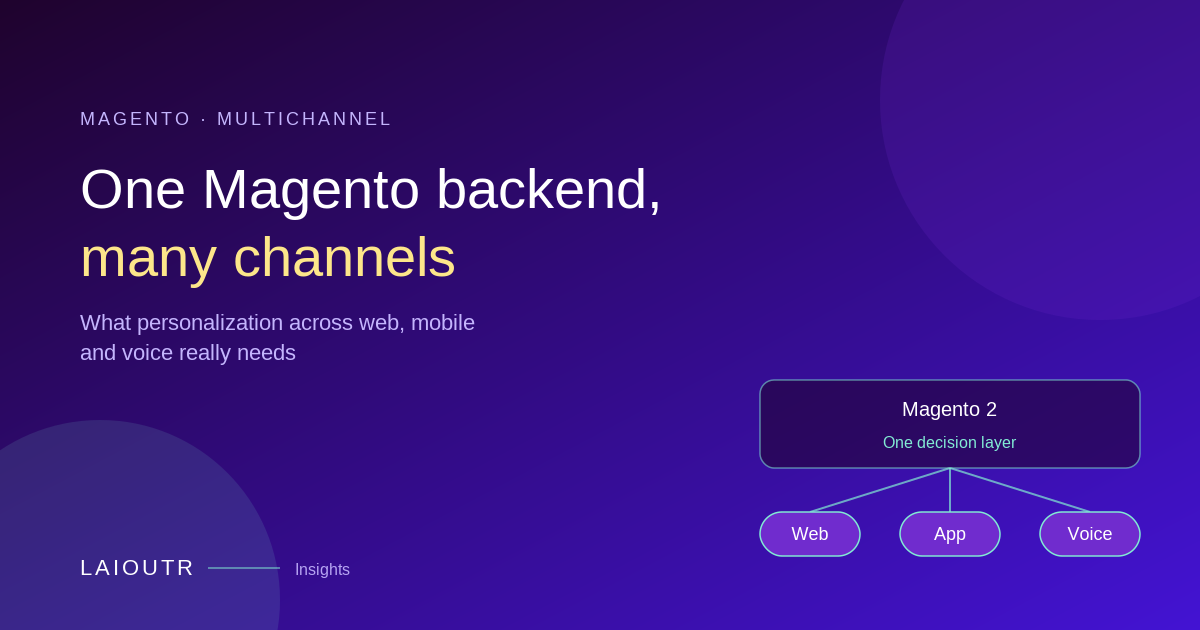One Magento Backend, Many Channels: Personalization in Practice
Personalization across web, mobile and voice on a single Magento backend does not start with a featu…](https://www.laioutr.com/en/blog/magento-multichannel-personalization-web-mobile-voice-2026)
[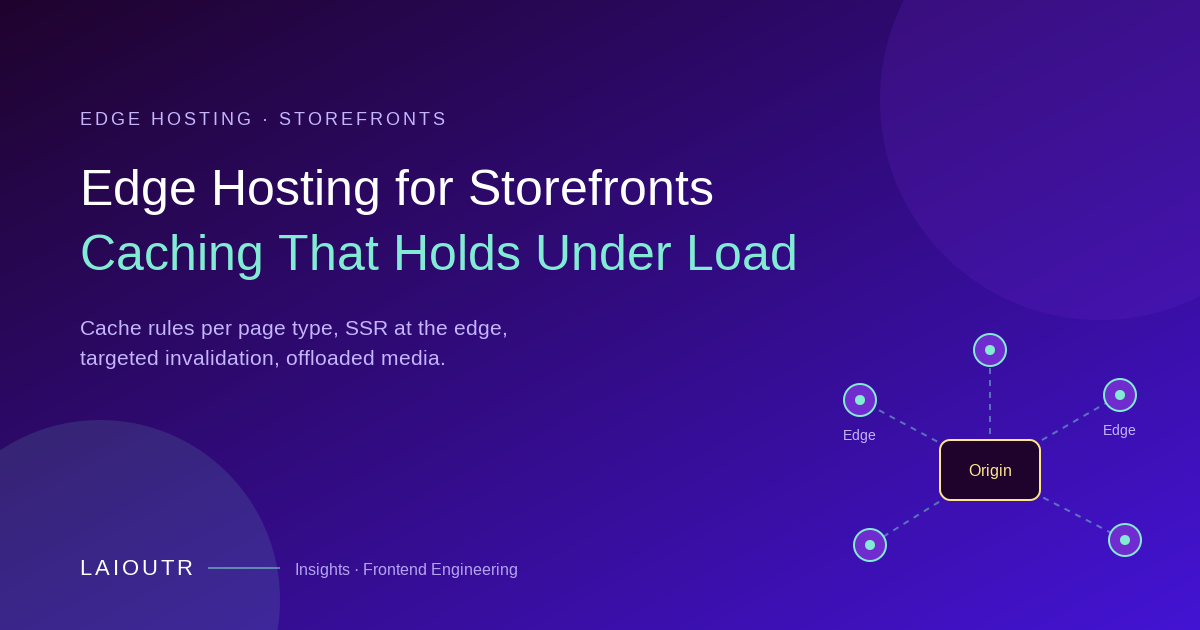Edge Hosting for Storefronts: Caching That Holds Under Peak Load
Edge hosting keeps a storefront fast under load when most requests never reach the origin: pages and…](https://www.laioutr.com/en/blog/edge-hosting-storefronts-peak-traffic-caching-2026)
[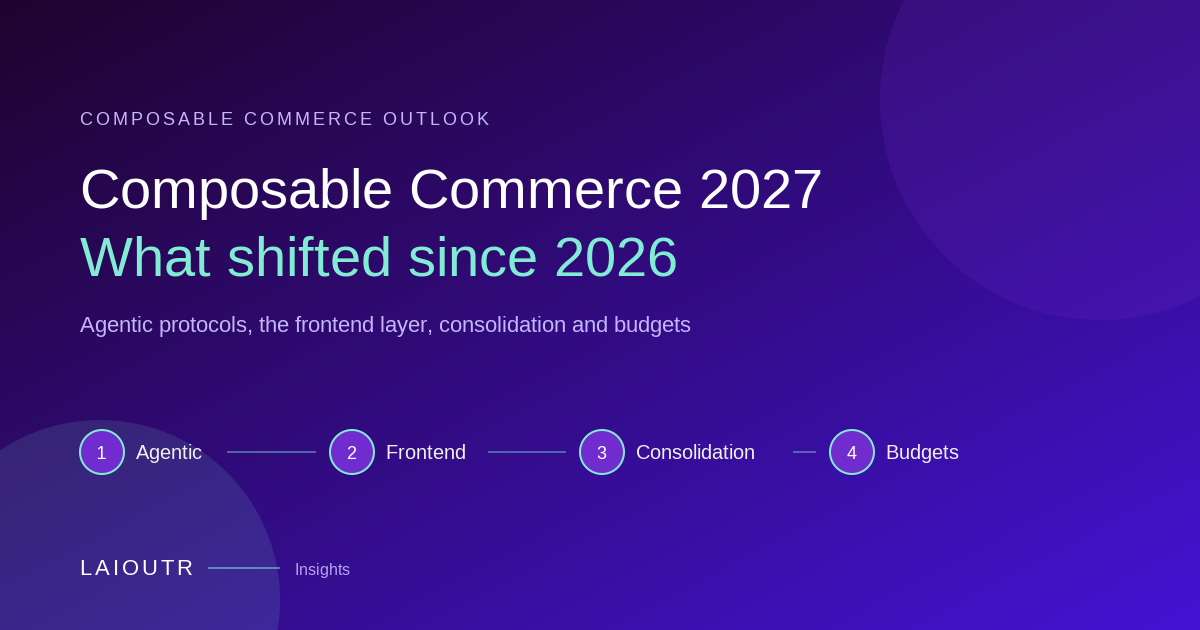Composable Commerce 2027: What Shifted and What Comes Next
Composable commerce enters 2027 with a different agenda than a year ago. The architecture question i…](https://www.laioutr.com/en/blog/composable-commerce-2027-outlook)
[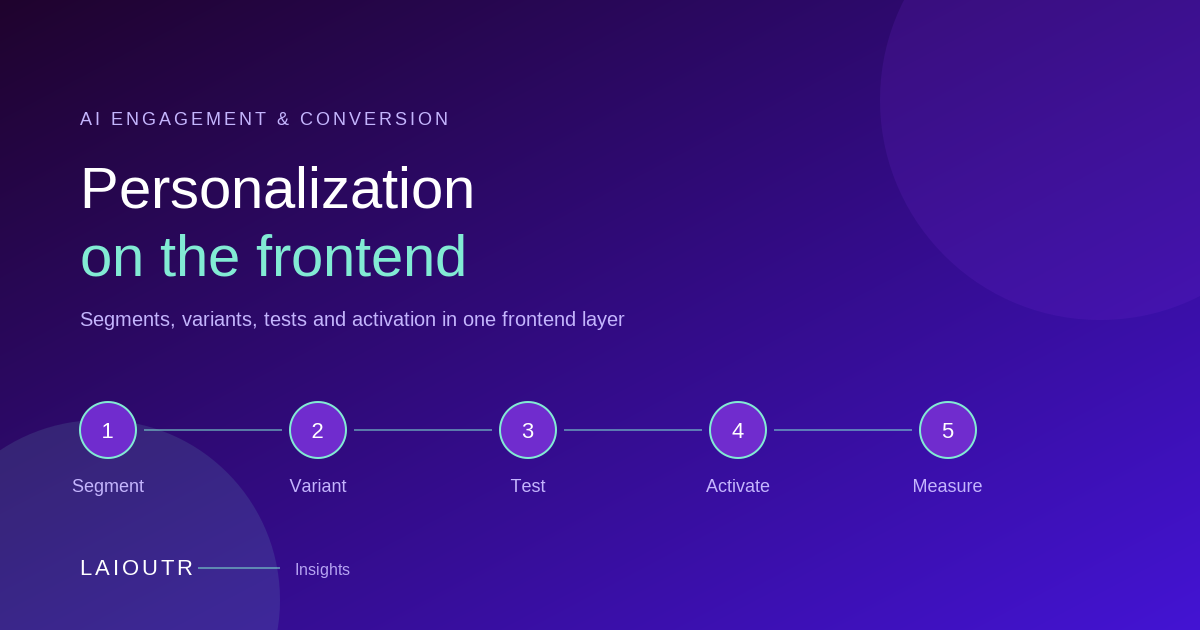AI Engagement and Conversion: Personalization on the Frontend
AI-driven engagement and conversion on the frontend rests on five mechanics: segments decide who see…](https://www.laioutr.com/en/blog/ai-engagement-conversion-frontend-personalization)
## Apps for the Laioutr platform
[View all apps](https://www.laioutr.com/en/apps)
[](https://www.laioutr.com/en/apps/shopify)
Laioutr
[Shopify](https://www.laioutr.com/en/apps/shopify)
Shopify is a commerce platform for selling online and in physical retail.
[](https://www.laioutr.com/en/apps/shopware)
Laioutr
[Shopware](https://www.laioutr.com/en/apps/shopware)
Shopware is a flexible ecommerce platform from Europe for product catalogs and omnichannel commerce.
[](https://www.laioutr.com/en/apps/adobe-commerce)
Laioutr
[Adobe Commerce](https://www.laioutr.com/en/apps/adobe-commerce)
Adobe Commerce is an enterprise commerce platform for complex, global B2C and B2B scenarios.
Planned
[](https://www.laioutr.com/en/apps/b2b-sellers)
Laioutr
[B2Bsellers](https://www.laioutr.com/en/apps/b2b-sellers)
B2B suite for Shopware that turns an online store into a professional B2B commerce platform.
Planned
[](https://www.laioutr.com/en/apps/commerce-layer)
Laioutr
[Commerce Layer](https://www.laioutr.com/en/apps/commerce-layer)
Commerce Layer is a headless commerce platform for making inventory and catalogs available online.
[](https://www.laioutr.com/en/apps/commercetools)
Laioutr
[Commercetools](https://www.laioutr.com/en/apps/commercetools)
Commercetools is a SaaS-based headless ecommerce platform used worldwide.
[](https://www.laioutr.com/en/apps/emporix)
Laioutr
[Emporix](https://www.laioutr.com/en/apps/emporix)
Emporix is a composable, API-first commerce platform for scalable B2B and B2C scenarios.
Planned
[](https://www.laioutr.com/en/apps/hcl-software)
Laioutr
[HCL Software](https://www.laioutr.com/en/apps/hcl-software)
Enterprise suite for digital commerce and experience with extensive configurability.
Planned
[](https://www.laioutr.com/en/apps/intershop)
Laioutr
[Intershop](https://www.laioutr.com/en/apps/intershop)
Enterprise commerce platform for complex B2B and B2C business models.
Planned
[](https://www.laioutr.com/en/apps/magento-2)
Laioutr
[Magento 2](https://www.laioutr.com/en/apps/magento-2)
Widely used, extensible commerce platform for B2C and B2B scenarios.
[](https://www.laioutr.com/en/apps/oxid-eshop)
Laioutr
[OXID eShop](https://www.laioutr.com/en/apps/oxid-eshop)
OXID eShop is an extensible commerce platform for complex B2B and B2C requirements.
Planned
[](https://www.laioutr.com/en/apps/patchworks)
Laioutr
[Patchworks](https://www.laioutr.com/en/apps/patchworks)
Patchworks is a low-code iPaaS that connects ecommerce, ERP, WMS, 3PL, and marketplaces.
Planned
[](https://www.laioutr.com/en/apps/PrestaShop)
Laioutr
[Prestashop](https://www.laioutr.com/en/apps/PrestaShop)
Open-source commerce platform for small and midsize merchants in Europe and beyond.
Planned
[](https://www.laioutr.com/en/apps/saleor)
Laioutr
[Saleor](https://www.laioutr.com/en/apps/saleor)
Open-source, API-first commerce platform built on GraphQL for custom storefronts.
Planned
[](https://www.laioutr.com/en/apps/salesforce-commerce-cloud)
Laioutr
[Salesforce Commerce Cloud](https://www.laioutr.com/en/apps/salesforce-commerce-cloud)
Salesforce Commerce Cloud is a cloud-based enterprise commerce platform for businesses of any size.
Planned
[](https://www.laioutr.com/en/apps/sap-commerce-cloud)
Laioutr
[SAP Commerce Cloud](https://www.laioutr.com/en/apps/sap-commerce-cloud)
Enterprise commerce platform for complex catalogs, pricing models, and omnichannel journeys.
Planned
[](https://www.laioutr.com/en/apps/scayle)
Laioutr
[Scayle](https://www.laioutr.com/en/apps/scayle)
SCAYLE is a commerce engine that helps brands and retailers scale their business.
Planned
[](https://www.laioutr.com/en/apps/spryker)
Laioutr
[Spryker](https://www.laioutr.com/en/apps/spryker)
Composable commerce platform for sophisticated B2B and B2C business models.
[](https://www.laioutr.com/en/apps/sylius)
Laioutr
[Sylius](https://www.laioutr.com/en/apps/sylius)
Sylius is a developer-friendly ecommerce framework for B2C and B2B shopping experiences.
Planned
[](https://www.laioutr.com/en/apps/vendure)
Laioutr
[Vendure](https://www.laioutr.com/en/apps/vendure)
Vendure is a headless commerce platform for businesses with complex requirements.
Coming Soon
[](https://www.laioutr.com/en/apps/vtex)
Laioutr
[VTEX](https://www.laioutr.com/en/apps/vtex)
Cloud-native, composable commerce platform for B2B and B2C at scale.
Planned
[](https://www.laioutr.com/en/apps/websale)
Laioutr
[Websale](https://www.laioutr.com/en/apps/websale)
Stable, enterprise-ready commerce backend for complex retail environments.
Strategy call
## The frontend as a control layer
A conversation about stack, roadmap and replatforming scenario. The outcome: a clear picture of how Laioutr fits, what it costs and how fast the go-live can happen.
*"After 30 minutes, we knew Laioutr makes our replatforming feasible."*
*Daniel B., CEO,* [*hygibox.de*](https://hygibox.de)
[Book a demo](https://www.laioutr.com/en/contact)
## Structured Data
```json
{
"@context": "https://schema.org",
"@graph": [
{
"@type": "Organization",
"@id": "https://www.laioutr.com/#identity",
"name": "Laioutr",
"legalName": "Laioutr GmbH",
"url": "https://www.laioutr.com/",
"logo": {
"@type": "ImageObject",
"url": "https://www.laioutr.com/laioutr-logo.png",
"width": 400,
"height": 400
},
"email": "info@laioutr.com",
"telephone": "+49 30 75435715",
"address": {
"@type": "PostalAddress",
"streetAddress": "Münchweilersteig 5",
"postalCode": "12559",
"addressLocality": "Berlin",
"addressCountry": "DE"
},
"vatID": "DE450905846",
"sameAs": [
"https://www.linkedin.com/company/laioutr",
"https://www.youtube.com/@Laioutr",
"https://x.com/laioutr"
]
},
{
"@type": "WebSite",
"@id": "https://www.laioutr.com/en/#website",
"url": "https://www.laioutr.com/en/",
"name": "Laioutr",
"inLanguage": "en",
"publisher": {
"@id": "https://www.laioutr.com/#identity"
}
},
{
"@type": "BlogPosting",
"@id": "https://www.laioutr.com/en/blog/content-management-past-present-future#article",
"headline": "Beyond Legacy: How Content Management Systems Are Reshaping Enterprise Strategy",
"description": "Beyond legacy: how content management systems are reshaping enterprise strategy across past, present and future.",
"image": [
"https://eu-west-2.graphassets.com/cmii2mlqi0dux06l5543v7nkc/cmnucypviw8mi07mgmwsd5asa"
],
"datePublished": "2026-10-26T13:18:47.853846+00:00",
"dateModified": "2026-10-26T13:18:44.430647+00:00",
"inLanguage": "en",
"articleSection": "Insights",
"keywords": "Industry & Trends",
"author": {
"@type": "Person",
"name": "Marcel Thiesies",
"jobTitle": "Co-Founder & CEO, Laioutr",
"image": "https://eu-west-2.graphassets.com/cmii2mlqi0dux06l5543v7nkc/cmj01b962364n07lb0iguvts5"
},
"publisher": {
"@id": "https://www.laioutr.com/#identity"
},
"mainEntityOfPage": {
"@id": "https://www.laioutr.com/en/blog/content-management-past-present-future#webpage"
},
"isPartOf": {
"@id": "https://www.laioutr.com/en/#website"
}
},
{
"@type": "WebPage",
"@id": "https://www.laioutr.com/en/blog/content-management-past-present-future#webpage",
"url": "https://www.laioutr.com/en/blog/content-management-past-present-future",
"name": "Beyond Legacy: How Content Management Systems Are Reshaping Enterprise Strategy",
"description": "Beyond legacy: how content management systems are reshaping enterprise strategy across past, present and future.",
"inLanguage": "en",
"isPartOf": {
"@id": "https://www.laioutr.com/en/#website"
},
"breadcrumb": {
"@id": "https://www.laioutr.com/en/blog/content-management-past-present-future#breadcrumb"
},
"primaryImageOfPage": {
"@type": "ImageObject",
"url": "https://eu-west-2.graphassets.com/cmii2mlqi0dux06l5543v7nkc/cmnucypviw8mi07mgmwsd5asa"
},
"datePublished": "2026-10-26T13:18:47.853846+00:00",
"dateModified": "2026-10-26T13:18:44.430647+00:00",
"mainEntity": {
"@id": "https://www.laioutr.com/en/blog/content-management-past-present-future#article"
}
},
{
"@type": "BreadcrumbList",
"@id": "https://www.laioutr.com/en/blog/content-management-past-present-future#breadcrumb",
"itemListElement": [
{
"@type": "ListItem",
"position": 1,
"name": "Laioutr",
"item": "https://www.laioutr.com/en/"
},
{
"@type": "ListItem",
"position": 2,
"name": "Insights",
"item": "https://www.laioutr.com/en/blogs/insights"
},
{
"@type": "ListItem",
"position": 3,
"name": "Beyond Legacy: How Content Management Systems Are Reshaping Enterprise Strategy"
}
]
}
]
}
```