---
title: "Content Modeling Best Practices for Composable Commerce"
canonical_url: "https://www.laioutr.com/en/blog/content-modeling-best-practices"
locale: en
meta:
description: "A consultancy guide to content modeling best practices for composable commerce."
"og:description": "A consultancy guide to content modeling best practices for composable commerce."
"og:title": "Content Modeling Best Practices for Composable Commerce"
---

# Content Modeling Best Practices for Composable Commerce: A Consultancy Guide
Table of contents
1. [1.Understanding Content Models in Composable Commerce](#understanding-content-models-in-composable-commerce)
2. [2.Strategic Timing Removes Roadblocks Later](#strategic-timing-removes-roadblocks-later)
3. [3.Cross-Functional Collaboration is Non-Negotiable](#cross-functional-collaboration-is-non-negotiable)
4. [4.Separate Content Substance from Presentation Logic](#separate-content-substance-from-presentation-logic)
5. [5.Create Transparent Authoring Workflows](#create-transparent-authoring-workflows)
6. [6.Eliminate Redundancy Through Intentional Reuse](#eliminate-redundancy-through-intentional-reuse)
7. [7.Design for Intuitive Authoring Experiences](#design-for-intuitive-authoring-experiences)
8. 8.Document Models Where They'll Actually Be Used
9. [9.Balance Comprehensiveness with Practicality](#balance-comprehensiveness-with-practicality)
10. [10.Treat Your Model as Strategic Infrastructure](#treat-your-model-as-strategic-infrastructure)
11. [11.Moving Forward](#moving-forward)
When we work with organizations undertaking digital transformation and composable commerce initiatives, we consistently observe the same pattern: teams that invest time in thoughtful content modeling early achieve dramatically better outcomes than those who treat it as an afterthought. The difference isn't just technical-it's transformational. A well-designed content model becomes the foundation for scalability, flexibility, and sustainable growth across your entire commerce ecosystem.
At Laioutr, we've guided hundreds of brands through this journey, and the insights we've gathered reveal that content modeling isn't merely a technical exercise. It's a strategic practice that aligns business objectives, enables team collaboration, and ultimately determines whether your composable commerce initiative delivers the agility you invested in achieving.
## Understanding Content Models in Composable Commerce
A content model defines the structure, attributes, and relationships of all content that powers your commerce experiences. In a composable architecture, where you're orchestrating content across multiple channels, APIs, and touchpoints, this model becomes your contract between your content infrastructure and the experiences you build on top of it.
Think of your content model as a blueprint. Just as architects can't build a functional building without understanding load-bearing walls, room adjacencies, and utility requirements, your development and content teams can't build cohesive commerce experiences without understanding how your content is structured and how different pieces relate to one another.
The stakes have escalated in the composable era. When your content must serve websites, mobile applications, voice assistants, email campaigns, in-store displays, and yet-to-be-invented channels, the structural decisions you make become exponentially more important. A content model that works perfectly for a single website can become a bottleneck when that same content needs to fuel dozens of different experiences.
## Strategic Timing Removes Roadblocks Later
One of the most common mistakes we see clients make is postponing content modeling until their systems are already live or problems have emerged. By that point, technical debt has accumulated, inefficiencies are embedded in workflows, and changing the model requires disrupting operations.
The ideal timing windows are predictable. Begin modeling when you're planning a CMS migration, redesigning your commerce platform, launching into new markets, or introducing new product categories. These natural inflection points provide leverage. You're already reviewing processes and infrastructure, so incorporating content modeling strategy doesn't require additional approval or timeline adjustments.
However, don't wait for these windows passively. Even during business-as-usual periods, investing in content model refinement pays dividends. We've worked with clients who tackled this challenge incrementally, region by region or category by category, without waiting for a wholesale migration. Piecemeal approaches take longer but create less operational disruption.
The real cost of delay compounds over time. Every piece of content created without a governing model adds friction to future efforts. Every workaround a team implements becomes a precedent that others follow. Every person who doesn't understand your content structure creates a bus factor for future projects.
## Cross-Functional Collaboration is Non-Negotiable
Content models fail when they're designed in isolation. We've learned this through difficult projects where brilliant architects created theoretically perfect models that turned out to be unusable by actual content teams, or models that worked beautifully in development but couldn't accommodate real-world business requirements.
Your modeling process must include everyone who touches content across its lifecycle. This means bringing together:
UX and product teams who understand how content needs to be presented and arranged in different contexts. Developers who understand the technical constraints and opportunities of your stack. Content creators and editors who understand the realities of maintaining your content over months and years. Subject matter experts who understand the nuances, edge cases, and business logic within your domain. Marketers who understand audience segmentation and campaign requirements. System integrators like us who've seen patterns across multiple implementations and can identify what typically causes friction.
When these perspectives are represented, the modeling process becomes a negotiation. The UX team wants maximum flexibility in layout options. The developers want simplicity and consistency. The content team wants intuitive interfaces and clear guidance. The marketing team wants to reuse content across campaigns. These aren't conflicts to eliminate-they're tensions to balance thoughtfully.
The collaborations that work best follow a structured process: First, establish shared vocabulary. Second, map current state processes and pain points. Third, define content types based on editorial intent, not presentation. Fourth, prototype the model with real scenarios. Fifth, validate with actual stakeholders who'll use the system daily.
## Separate Content Substance from Presentation Logic
One of the most consequential modeling mistakes is conflating what content is with how it looks. When you structure content around presentation requirements, you lock that content into specific use cases and dramatically reduce its reusability.
Consider a product card. A presentation-driven model might include attributes for "headline-font-color," "background-image-opacity," and "button-border-radius." But in a composable architecture serving multiple channels, these attributes become quickly irrelevant. A mobile app doesn't need border-radius specifications. An email campaign has different color requirements. An AI-powered recommendation engine doesn't care about visual properties at all.
A substance-driven model instead asks: What information does this product represent that's valuable independent of how we display it? The answer might include: product name, description, price, SKU, category, attributes, availability, certifications, and related products. These attributes remain consistent whether you're rendering a card on a website, responding to an API call, or populating a recommendation engine.
The separation matters practically too. When presentation styling is embedded in your content model, changing the design of your website requires content team involvement and model migrations. When presentation is purely a concern of the rendering layer, designers and developers can iterate freely without touching content or requiring model changes.
This principle extends to structured data, image relationships, and even taxonomy. Ask yourself with each attribute: Is this inherently part of what this content is, or is this how we're choosing to display it right now?
## Create Transparent Authoring Workflows
Your content model becomes useless if content teams don't understand how to maintain it. We've inherited multiple projects where models were technically sound but practically abandoned because authors didn't understand how to use them effectively.
This requires you to think not just about the model itself, but about the editorial experience and the workflow that content moves through. How does content move from creation to publication? Who approves what? What happens when content needs to be updated? How do multiple contributors collaborate on a single piece?
Document these workflows explicitly. Pair your content model documentation with process documentation. Provide templates that show authors exactly how to fill each field. Create examples that demonstrate the relationship between content structure and what appears on the website or application.
The workflow transparency also enables governance. When everyone understands how content flows and why certain attributes matter, they're more likely to complete them consistently. When the reasons are opaque, authors take shortcuts and invent their own patterns.
Include in your documentation some guidance about when to create new content types versus when to repurpose existing ones. This discretion, guided by clear principles, prevents model creep while allowing flexibility.
## Eliminate Redundancy Through Intentional Reuse
Content redundancy appears subtle at first. One team creates a set of author attributes because they're building an author bio feature. Another team, unaware of the first team's work, creates a similar structure for author pages. Soon you have two competing definitions of what an author is, and they're inconsistent.
The solution is intentional reuse patterns. Identify content structures that appear multiple times in your model and consider whether they should be components that multiple content types reference.
This requires you to invest in building component libraries within your model. A heading component might be reused in articles, landing pages, and product descriptions. A testimonial structure might be used in multiple contexts. A media gallery structure might serve product pages, lookbooks, and case studies.
The reuse pays dividends in multiple ways. Consistency improves as the same structure appears across different contexts. Maintenance becomes simpler because updating a component definition updates every place it's used. Teams discover they need fewer content types than they initially imagined. Authoring becomes faster because templates and patterns are proven and familiar.
However, resist the temptation to over-normalize. Not every similar-looking structure should be forced into a single component. Sometimes slight differences are intentional and meaningful. The goal is intentional consistency, not absolute uniformity.
## Design for Intuitive Authoring Experiences
Your content model's final destination is the authoring interface where your team spends hours each day. A model might be logically perfect, but if the interface obscures it or makes editing tedious, it will be circumvented and undermined.
This means organizing content types logically, grouping related attributes together, providing helpful descriptions for every field, and enabling searching when you have many attributes. It means sensible default states and validation that helps authors succeed rather than just catching errors.
Some practical patterns we recommend: Group related attributes into logical sections. Provide meaningful field labels and descriptions that explain what each attribute is for and how it's used. Use appropriate input types-dropdown selects for constrained lists, rich text editors where formatting is needed, simple text fields otherwise. Implement progressive disclosure so advanced options don't clutter the interface for basic use cases.
Test your authoring interface with actual content creators before finalizing your model. Watch them attempt to create real content. Notice where they struggle or express confusion. These moments reveal where your model structure isn't intuitive.
## Document Models Where They'll Actually Be Used
Content models live in multiple places: databases, spreadsheets, diagrams, and documentation systems. The key is ensuring they're documented wherever teams need to reference them.
We've seen teams create beautiful content model documentation in Confluence or a dedicated wiki, only to have it become outdated within months. The documentation diverges from reality because the team naturally consults the system itself rather than external documentation.
The solution is strategic documentation. Your system of record should be your actual schema, automatically documented. Your collaborative tool should be a spreadsheet where non-technical stakeholders can view and discuss the model. Your visual tool should be diagrams that help people understand relationships and architecture. Your operational guide should be the templates and examples your authors use daily.
Make documentation maintenance someone's responsibility. Designate a person or team to review model changes quarterly and ensure that secondary documentation reflects the current state. Without this responsibility, documentation will inevitably drift.
## Balance Comprehensiveness with Practicality
The temptation when building a content model is to account for every possible scenario, edge case, and future requirement. This temptation often leads to models with hundreds of attributes, dozens of content types, and structures so complex that nobody fully understands them.
In practice, the most successful models are simpler than expected. They include the attributes that are consistently used and valuable, plus reasonable flexibility for future needs. They accommodate most cases elegantly rather than accommodating every case awkwardly.
The question to ask is: Does this attribute or content type exist because we genuinely need it, or because we might need it someday? The "someday" attributes rarely pay off. They add cognitive load to everyone using the system, create maintenance burden, and often become obsolete before they're ever used.
When you encounter an edge case that doesn't fit your model, resist the immediate impulse to expand the model to accommodate it. First ask whether you could address the edge case through process, configuration, or alternative patterns. Sometimes edge cases point to flaws in the model, but sometimes they're just genuinely exceptional situations that can be handled through exception processes.
Build your model progressively. Start with core content types and attributes. Deploy and validate with real content. Then expand based on observed needs rather than predicted ones.
## Treat Your Model as Strategic Infrastructure
Finally, recognize that your content model isn't a technical artifact to be designed once and then ignored. It's strategic infrastructure that evolves as your business evolves, as technology advances, and as you learn what works and what doesn't.
Allocate resources to ongoing model governance. Review the model quarterly to identify attributes that aren't being used, content types that have become complicated, or patterns that have emerged in how teams work around the current structure. These reviews should inform incremental improvements.
When you're evaluating new requirements, ask how they affect the model. Sometimes new requirements suggest the model needs updating. Sometimes they point to processes that need changing instead. Being intentional about this distinction prevents model bloat while ensuring the model stays relevant.
Your composable commerce initiative will be far more successful when it's built on a foundation of thoughtful, well-maintained content modeling. The investment in getting this right early compounds over time, enabling the flexibility and agility that composable commerce promises.
## Moving Forward
Content modeling best practices ultimately come down to this: invest in clarity, collaboration, and sustainability from the beginning. The shortcuts taken in this phase become the constraints and inefficiencies of later phases. The time spent building a coherent model is the time saved preventing fragmentation, inconsistency, and rework across all your commerce experiences.
If you're undertaking a composable commerce initiative or looking to improve your current content infrastructure, this foundation deserves attention and resources. The difference between organizations that prosper in composable commerce and those that struggle often comes down to this unsexy, invisible layer of content modeling that enables everything built on top of it.
### **More from the Laioutr Platform**
- [Composable Digital Experience Platform](https://www.laioutr.com/en/composable-digital-experience-platform)
- [Agentic Frontend Management Platform](https://www.laioutr.com/en/agentic-frontend-management-platform)
- [Content Management](https://www.laioutr.com/en/product/content-management)
- [Composable Visual Page Builder](https://www.laioutr.com/en/composable-visual-page-builder)
Related reading: [Ecommerce Search Optimization: From Discovery Barrier to Revenue Driver](https://www.laioutr.com/en/blog/ecommerce-search-best-practices) and [Digital Asset Management Best Practices for Composable Commerce](https://www.laioutr.com/en/blog/dam-best-practices).
---
Share this article
[Share on Facebook](https://www.facebook.com/sharer/sharer.php?u=https%3A%2F%2Fwww.laioutr.com%2Fen%2Fblog%2Fcontent-modeling-best-practices) [Share on X](https://x.com/intent/post?url=https%3A%2F%2Fwww.laioutr.com%2Fen%2Fblog%2Fcontent-modeling-best-practices&text=) [Share on LinkedIn](https://www.linkedin.com/sharing/share-offsite/?url=https%3A%2F%2Fwww.laioutr.com%2Fen%2Fblog%2Fcontent-modeling-best-practices) [Share on Pinterest](https://pinterest.com/pin/create/button/?url=https%3A%2F%2Fwww.laioutr.com%2Fen%2Fblog%2Fcontent-modeling-best-practices&description=) [Share via email](mailto:?subject=&body=%0A%0Ahttps%3A%2F%2Fwww.laioutr.com%2Fen%2Fblog%2Fcontent-modeling-best-practices)
## More interesting articles
Practical know-how for frontend development, smart agents, and headless
[To the blog](https://www.laioutr.com/en/blogs)
[Website Tracking in E-Commerce 2026: An Honest Stack Overview
Website tracking in e-commerce is not one tool but a stack of five layers: consent management, tag m…](https://www.laioutr.com/en/blog/website-tracking-ecommerce-stack-overview-2026)
[One Content Source, Every Channel: Print to Storefront
Re-keying happens when the same product text, specification or image is typed in again for every cha…](https://www.laioutr.com/en/blog/unified-content-source-print-to-storefront-omnichannel-2026)
[Third-Party Cookies Are Not Dead: Why Data Still Has Gaps
Third-party cookies still exist in 2026. Google decided in 2025 not to remove them from Chrome and r…](https://www.laioutr.com/en/blog/third-party-cookies-2026-why-tracking-data-has-gaps)
[Guest Checkout vs. Customer Account: A Frontend Decision to Test
Guest checkout should be the default path in a B2C storefront, and the customer account should be an…](https://www.laioutr.com/en/blog/guest-checkout-vs-customer-account-frontend-testing)
[Google Tag Manager Only With Consent: The Hanover Court Ruling
Google Tag Manager may only be loaded after a visitor has given valid consent. That is the core of a…](https://www.laioutr.com/en/blog/google-tag-manager-consent-vg-hannover-ruling-2026)
[Composable Commerce Agency 2026: Three Offers Instead of One
A composable commerce agency does not win in 2026 with one standard package. It wins with three clea…](https://www.laioutr.com/en/blog/composable-commerce-agency-three-offer-models-2026)
[Algolia in a Composable Frontend: Indexing, Events, Integration
An Algolia integration in a composable frontend consists of three layers that are best planned separ…](https://www.laioutr.com/en/blog/algolia-indexing-events-composable-frontend-2026)
[Discount Campaigns in Online Stores: Black Friday Sale Pages
A discount campaign in an online store works when the goal, the discount mechanic and the campaign p…](https://www.laioutr.com/en/blog/discount-campaigns-online-store-black-friday-sale-pages)
[iPhone Duo and Ecommerce: What Merchants Need to Know Now
iPhone Duo goes on sale on October 23, 2026. Online stores don't need a dedicated app or a custo…](https://www.laioutr.com/en/blog/iphone-duo-ecommerce-foldable-storefront)
[Structured Product Data: How It Shows Up in Your Storefront
Structured product data means every product fact lives in a typed attribute with a unit, a stable id…](https://www.laioutr.com/en/blog/structured-product-data-pim-frontend-2026)
[44% Decide via Trial or PoC: How to Run a Storefront PoC in DACH
In DACH, software decisions are increasingly made hands-on: in the study "Software Buying in DA…](https://www.laioutr.com/en/blog/storefront-proof-of-concept-dach-buyers-2026)
[Frontend Management Platform Comparison: How to Choose the Right FMP
Choosing a frontend management platform (FMP) is less about feature lists and more about where your …](https://www.laioutr.com/en/blog/frontend-management-platform-comparison-how-to-choose-2026)
[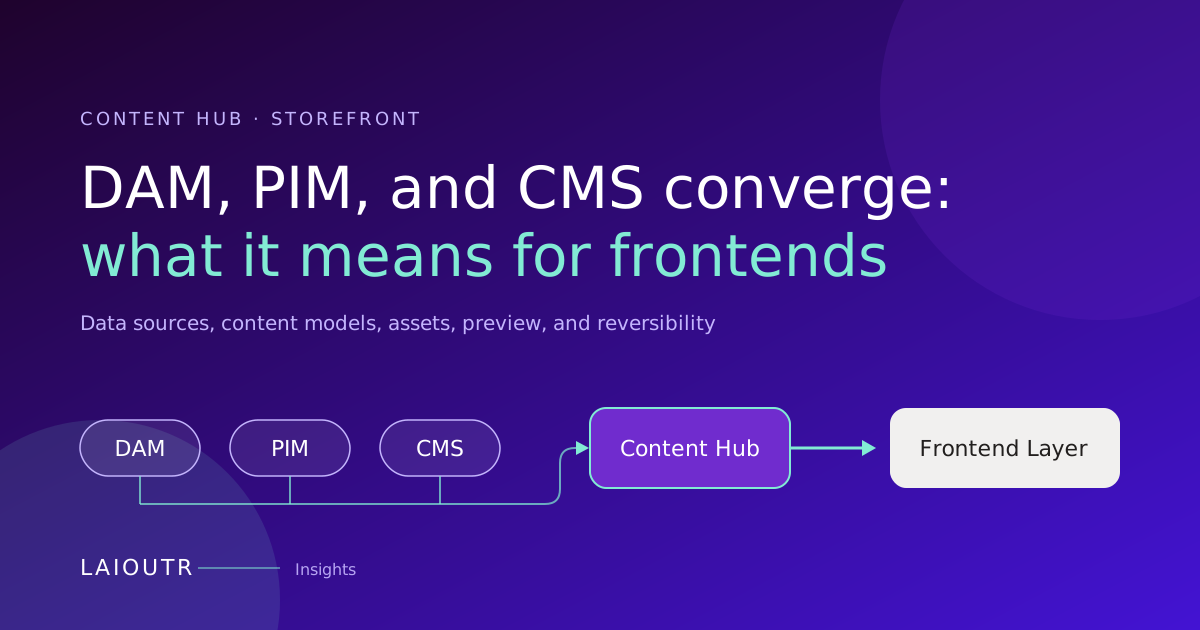DAM, PIM, and CMS Are Converging: What It Means for Your Storefront
DAM, PIM, and CMS vendors are moving into each other's territory, and more teams now evaluate on…](https://www.laioutr.com/en/blog/dam-pim-cms-convergence-content-hub-storefront-2026)
[Contentful Live Preview: What Your Frontend Has to Deliver
Contentful Live Preview lets editors see a draft right next to the entry editor and watch changes ap…](https://www.laioutr.com/en/blog/contentful-live-preview-frontend-perspective-2026)
[Content Governance at Scale: Product Content and Brand Assets
Content governance at scale means that roles, approvals, brand rules, asset rights and translations …](https://www.laioutr.com/en/blog/content-governance-product-content-brand-assets-frontend-2026)
[](https://www.laioutr.com/en/apps/shopify)
Laioutr
[Shopify](https://www.laioutr.com/en/apps/shopify)
Shopify is a commerce platform for selling online and in physical retail.
[](https://www.laioutr.com/en/apps/shopware)
Laioutr
[Shopware](https://www.laioutr.com/en/apps/shopware)
Shopware is a flexible ecommerce platform from Europe for product catalogs and omnichannel commerce.
[](https://www.laioutr.com/en/apps/adobe-commerce)
Laioutr
[Adobe Commerce](https://www.laioutr.com/en/apps/adobe-commerce)
Adobe Commerce is an enterprise commerce platform for complex, global B2C and B2B scenarios.
Planned
[](https://www.laioutr.com/en/apps/b2b-sellers)
Laioutr
[B2Bsellers](https://www.laioutr.com/en/apps/b2b-sellers)
B2B suite for Shopware that turns an online store into a professional B2B commerce platform.
Planned
[](https://www.laioutr.com/en/apps/commerce-layer)
Laioutr
[Commerce Layer](https://www.laioutr.com/en/apps/commerce-layer)
Commerce Layer is a headless commerce platform for making inventory and catalogs available online.
[](https://www.laioutr.com/en/apps/commercetools)
Laioutr
[Commercetools](https://www.laioutr.com/en/apps/commercetools)
Commercetools is a SaaS-based headless ecommerce platform used worldwide.
[](https://www.laioutr.com/en/apps/emporix)
Laioutr
[Emporix](https://www.laioutr.com/en/apps/emporix)
Emporix is a composable, API-first commerce platform for scalable B2B and B2C scenarios.
Planned
[](https://www.laioutr.com/en/apps/hcl-software)
Laioutr
[HCL Software](https://www.laioutr.com/en/apps/hcl-software)
Enterprise suite for digital commerce and experience with extensive configurability.
Planned
[](https://www.laioutr.com/en/apps/intershop)
Laioutr
[Intershop](https://www.laioutr.com/en/apps/intershop)
Enterprise commerce platform for complex B2B and B2C business models.
Planned
[](https://www.laioutr.com/en/apps/magento-2)
Laioutr
[Magento 2](https://www.laioutr.com/en/apps/magento-2)
Widely used, extensible commerce platform for B2C and B2B scenarios.
[](https://www.laioutr.com/en/apps/oxid-eshop)
Laioutr
[OXID eShop](https://www.laioutr.com/en/apps/oxid-eshop)
OXID eShop is an extensible commerce platform for complex B2B and B2C requirements.
Planned
[](https://www.laioutr.com/en/apps/patchworks)
Laioutr
[Patchworks](https://www.laioutr.com/en/apps/patchworks)
Patchworks is a low-code iPaaS that connects ecommerce, ERP, WMS, 3PL, and marketplaces.
Planned
[](https://www.laioutr.com/en/apps/PrestaShop)
Laioutr
[Prestashop](https://www.laioutr.com/en/apps/PrestaShop)
Open-source commerce platform for small and midsize merchants in Europe and beyond.
Planned
[](https://www.laioutr.com/en/apps/saleor)
Laioutr
[Saleor](https://www.laioutr.com/en/apps/saleor)
Open-source, API-first commerce platform built on GraphQL for custom storefronts.
Planned
[](https://www.laioutr.com/en/apps/salesforce-commerce-cloud)
Laioutr
[Salesforce Commerce Cloud](https://www.laioutr.com/en/apps/salesforce-commerce-cloud)
Salesforce Commerce Cloud is a cloud-based enterprise commerce platform for businesses of any size.
Planned
[](https://www.laioutr.com/en/apps/sap-commerce-cloud)
Laioutr
[SAP Commerce Cloud](https://www.laioutr.com/en/apps/sap-commerce-cloud)
Enterprise commerce platform for complex catalogs, pricing models, and omnichannel journeys.
Planned
[](https://www.laioutr.com/en/apps/scayle)
Laioutr
[Scayle](https://www.laioutr.com/en/apps/scayle)
SCAYLE is a commerce engine that helps brands and retailers scale their business.
Planned
[](https://www.laioutr.com/en/apps/spryker)
Laioutr
[Spryker](https://www.laioutr.com/en/apps/spryker)
Composable commerce platform for sophisticated B2B and B2C business models.
[](https://www.laioutr.com/en/apps/sylius)
Laioutr
[Sylius](https://www.laioutr.com/en/apps/sylius)
Sylius is a developer-friendly ecommerce framework for B2C and B2B shopping experiences.
Planned
[](https://www.laioutr.com/en/apps/vendure)
Laioutr
[Vendure](https://www.laioutr.com/en/apps/vendure)
Vendure is a headless commerce platform for businesses with complex requirements.
Coming Soon
[](https://www.laioutr.com/en/apps/vtex)
Laioutr
[VTEX](https://www.laioutr.com/en/apps/vtex)
Cloud-native, composable commerce platform for B2B and B2C at scale.
Planned
[](https://www.laioutr.com/en/apps/websale)
Laioutr
[Websale](https://www.laioutr.com/en/apps/websale)
Stable, enterprise-ready commerce backend for complex retail environments.
Strategy call
## Ready to turn your frontend into a control layer?
Show us your stack, your roadmap, your replatforming scenario, and we'll show you how Laioutr fits, what it costs, and how fast you go live.
*"After 30 minutes, we knew Laioutr makes our replatforming feasible." - Daniel B., CEO,* [*hygibox.de*](https://hygibox.de)
[Book a demo](https://www.laioutr.com/en/contact)
## Structured Data
```json
{
"@context": "https://schema.org",
"@graph": [
{
"@type": "Organization",
"@id": "https://www.laioutr.com/#identity",
"name": "Laioutr",
"legalName": "Laioutr GmbH",
"url": "https://www.laioutr.com/",
"logo": {
"@type": "ImageObject",
"url": "https://www.laioutr.com/laioutr-logo.png",
"width": 400,
"height": 400
},
"email": "info@laioutr.com",
"telephone": "+49 30 75435715",
"address": {
"@type": "PostalAddress",
"streetAddress": "Münchweilersteig 5",
"postalCode": "12559",
"addressLocality": "Berlin",
"addressCountry": "DE"
},
"vatID": "DE450905846",
"sameAs": [
"https://www.linkedin.com/company/laioutr",
"https://www.youtube.com/@Laioutr",
"https://x.com/laioutr"
]
},
{
"@type": "WebSite",
"@id": "https://www.laioutr.com/en/#website",
"url": "https://www.laioutr.com/en/",
"name": "Laioutr",
"inLanguage": "en",
"publisher": {
"@id": "https://www.laioutr.com/#identity"
}
},
{
"@type": "BlogPosting",
"@id": "https://www.laioutr.com/en/blog/content-modeling-best-practices#article",
"headline": "Content Modeling Best Practices for Composable Commerce: A Consultancy Guide",
"description": "A consultancy guide to content modeling best practices for composable commerce.",
"image": [
"https://eu-west-2.graphassets.com/cmii2mlqi0dux06l5543v7nkc/cmnucypviw8mi07mgmwsd5asa"
],
"datePublished": "2026-06-30T17:31:42.522235+00:00",
"dateModified": "2026-06-30T17:31:42.26748+00:00",
"inLanguage": "en",
"articleSection": "Insights",
"keywords": "Composable, Headless Commerce",
"author": {
"@type": "Person",
"name": "Marcel Thiesies",
"jobTitle": "Co-Founder & CEO, Laioutr",
"image": "https://eu-west-2.graphassets.com/cmii2mlqi0dux06l5543v7nkc/cmj01b962364n07lb0iguvts5"
},
"publisher": {
"@id": "https://www.laioutr.com/#identity"
},
"mainEntityOfPage": {
"@id": "https://www.laioutr.com/en/blog/content-modeling-best-practices#webpage"
},
"isPartOf": {
"@id": "https://www.laioutr.com/en/#website"
}
},
{
"@type": "WebPage",
"@id": "https://www.laioutr.com/en/blog/content-modeling-best-practices#webpage",
"url": "https://www.laioutr.com/en/blog/content-modeling-best-practices",
"name": "Content Modeling Best Practices for Composable Commerce: A Consultancy Guide",
"description": "A consultancy guide to content modeling best practices for composable commerce.",
"inLanguage": "en",
"isPartOf": {
"@id": "https://www.laioutr.com/en/#website"
},
"breadcrumb": {
"@id": "https://www.laioutr.com/en/blog/content-modeling-best-practices#breadcrumb"
},
"primaryImageOfPage": {
"@type": "ImageObject",
"url": "https://eu-west-2.graphassets.com/cmii2mlqi0dux06l5543v7nkc/cmnucypviw8mi07mgmwsd5asa"
},
"datePublished": "2026-06-30T17:31:42.522235+00:00",
"dateModified": "2026-06-30T17:31:42.26748+00:00",
"mainEntity": {
"@id": "https://www.laioutr.com/en/blog/content-modeling-best-practices#article"
}
},
{
"@type": "BreadcrumbList",
"@id": "https://www.laioutr.com/en/blog/content-modeling-best-practices#breadcrumb",
"itemListElement": [
{
"@type": "ListItem",
"position": 1,
"name": "Laioutr",
"item": "https://www.laioutr.com/en/"
},
{
"@type": "ListItem",
"position": 2,
"name": "Insights",
"item": "https://www.laioutr.com/en/blogs/insights"
},
{
"@type": "ListItem",
"position": 3,
"name": "Content Modeling Best Practices for Composable Commerce: A Consultancy Guide"
}
]
}
]
}
```