---
title: "Customer-First Means Reimagining Your Tech Stack"
canonical_url: "https://www.laioutr.com/en/blog/customer-first-start-with-cms"
locale: en
meta:
description: "Why customer-first means reimagining your tech stack starting point, beginning with the CMS."
"og:description": "Why customer-first means reimagining your tech stack starting point, beginning with the CMS."
"og:title": "Customer-First Means Reimagining Your Tech Stack"
---

# Customer-First Means Reimagining Your Tech Stack Starting Point
Table of contents
1. [1.The Customer-First Paradox](#the-customer-first-paradox)
2. [2.The Architecture Trap](#the-architecture-trap)
3. [3.What Actually Matters First](#what-actually-matters-first)
4. [4.The Modularity Advantage](#the-modularity-advantage)
5. [5.Real Cost of Misalignment](#real-cost-of-misalignment)
6. [6.The Reorientation Process](#the-reorientation-process)
7. [7.The Competitive Implication](#the-competitive-implication)
8. [8.Moving Forward](#moving-forward)
Every organization claims to be customer-first. It's woven into mission statements, repeated in quarterly business reviews, and cited as justification for major technology investments. Yet when we examine how companies actually build their digital infrastructure, we find something contradictory happening: organizations are making technology decisions based on departmental needs, vendor consolidation, or inherited systems rather than starting from genuine customer requirements.
The most telling symptom of this misalignment appears in one specific decision that echoes through years of technical debt and missed opportunities: starting with the CMS.
This isn't a criticism of content management systems themselves. CMSes serve important functions. But treating a CMS as the foundation of your customer experience architecture reveals a fundamental misunderstanding of what being customer-first actually means.
## The Customer-First Paradox
True customer-first strategy requires answering this question first: What does your customer actually need to accomplish? Not what does your content team need to publish. Not what does your marketing department need to manage. Not what does your IT department need to standardize. What does your customer need?
This distinction matters enormously because the answers point to completely different technology requirements.
When you begin with a CMS, you're inherently starting with a tool designed to solve content creators' problems. How do we store content? How do we version it? How do we manage workflows? How do we publish across channels? These are valuable problems to solve, but they belong to the publishing side of your organization, not the customer side.
The customer doesn't care about your content management workflow. They care about finding what they need, understanding your value, moving through their decision journey, and completing their desired action. They care about speed, clarity, relevance, and friction-free navigation. They care about personalization, accessibility, and experiences that feel designed for them specifically, not experiences that feel like content containers.
A CMS excels at solving the first problem set. It struggles with the second. And when you build your entire customer experience infrastructure around a tool not designed for customer experience, you create layers of workarounds that compound over time.
## The Architecture Trap
Years of implementing digital transformations across diverse industries has revealed a consistent pattern: organizations that prioritize their CMS selection before clarifying their customer experience requirements end up building increasingly elaborate compensation mechanisms for fundamental architectural mismatches.
Your design team needs to put a banner across the top of your homepage for a specific user segment based on their behavior. CMS: not really built for that. Your customer success team needs personalized onboarding flows. CMS: you'll need plugins and custom development. Your product team wants to A/B test different value propositions for different visitor types. CMS: you're now integrating external testing platforms and building data pipelines to synchronize results back.
Each individual request is solvable. But the accumulation of solutions creates technical complexity that slows innovation, increases maintenance burden, and paradoxically makes your stack less customer-responsive than a more modular approach would be.
The CMS becomes the center of gravity. Every new requirement gets evaluated through the lens of "how do we adapt our CMS to handle this?" rather than "what's the best tool or approach for solving this customer problem?" This inversion of priorities creates path dependencies that lock organizations into suboptimal solutions for years.
## What Actually Matters First
If we're truly committed to customer-first strategy, the starting point needs to shift. Instead of asking "what CMS should we adopt?" the question becomes: "What are the discrete experiences our customers need, and what are the specific technical requirements for each?"
For a SaaS company, this might mean starting with your customer onboarding experience. What does a new customer need to see, learn, and complete in their first week? That's your primary experience. You build the complete technical stack to support that experience optimally. Only after you've defined that do you ask: what content management challenges emerge from maintaining this experience?
For a media company, the starting point might be the reader journey. What types of content does our reader encounter? How do they discover it? What's their engagement path? How do we measure whether we're serving their interests? Answer these questions first, then design your content infrastructure around those answers.
For an e-commerce business, it's the product discovery and purchase journey. The entire technology stack should be optimized around making that journey frictionless, personal, and aligned with buyer behavior. Content management is a supporting function within that larger purpose, not the foundation.
This shift has profound implications. It means you might choose three or four best-of-breed tools instead of one monolithic platform. It means your content team works within systems designed for your specific content models rather than cramming your content models into generic structures. It means new requirements can be solved by adding specialized capabilities rather than extending an increasingly complex core system.
## The Modularity Advantage
Modern composable architecture makes this approach not just possible but practical in ways that weren't available even five years ago. You can now select specialized tools for content creation, experience composition, content delivery, personalization, analytics, and customer data, then connect them through APIs in ways that are simultaneously more flexible and more maintainable than traditional monolithic approaches.
This doesn't mean avoiding a CMS entirely. It means understanding a CMS as one component within a larger customer experience architecture, selected for specific strengths after you've clarified what your customer experience actually requires.
An organization that starts this way makes different choices than one that starts with CMS selection. They might choose a lightweight, headless content system optimized for structured data. They might combine lightweight content management with a dedicated experience composition platform. They might use content-specific tools like product information management for e-commerce or a specialized configuration system for software documentation.
The specific technologies matter less than the process: customer requirements first, experience architecture second, then component selection in service of that architecture.
## Real Cost of Misalignment
The cost of starting in the wrong place compounds. When your CMS doesn't match your customer needs, you don't just face technical friction. You create organizational friction.
Your marketing team wants to deploy personalized campaigns, but your CMS wasn't designed for audience segmentation, so you bolted on a marketing automation platform that never quite synchronizes properly with your content system. Your product team discovers that your CMS can't handle the dynamic content structures your new product feature requires, so you build a parallel system. Your development team spends resources maintaining integrations and synchronization between systems that should never have needed to coexist.
These aren't small costs. In typical setups, the maintenance burden of misaligned technology often consumes a large share of the technology team's capacity. That's resources that could be invested in customer-facing innovation instead flowing into system integration and workarounds.
Additionally, you create a customer-facing cost: slower iteration cycles, higher latency between customer feedback and product response, inability to implement customer-specific experiences because your architecture makes them technically difficult or expensive.
## The Reorientation Process
Shifting from CMS-first thinking to customer-first architecture doesn't require starting from scratch if you're already mid-journey. It requires deliberate reorientation:
First, conduct a clear-eyed audit of your customer experience requirements independent of your current technology stack. What experiences matter most? What customer outcomes are you trying to drive? What are the actual technical challenges in delivering those experiences with your current infrastructure?
Second, map your current technology choices against those requirements. Where do you have good alignment? Where are you maintaining compensatory complexity? Where are you unable to move because your technology foundations don't support it?
Third, build a prioritized roadmap for reorientation. This isn't a rip-and-replace exercise. It's usually a multi-year process of gradually shifting decision-making authority from technology-first to customer-requirement-first. New projects get built with the new priorities. Existing systems get maintained but not extended. Gradually, your architecture evolves.
Finally, change how you evaluate technology investments. Instead of "does this improve our CMS," the question becomes "does this improve our ability to deliver customer value?" and "does this fit coherently into our customer experience architecture?"
## The Competitive Implication
Here's what makes this shift strategically important: organizations that nail this reorientation gain cumulative advantage. They move faster because their technology supports rapid iteration rather than constraining it. They serve customers better because their architecture is designed around customer needs rather than content management workflows. They retain engineering talent because they're solving interesting customer problems rather than maintaining increasingly baroque workarounds.
In fast-moving markets, this compounds. By year two of following customer-first architecture, you're not just building the same features faster. You're building features that weren't possible in your previous architecture. You're responding to market changes that your competitors, still tied to their monolithic systems, struggle to address.
The organizations that are genuinely customer-first aren't the ones who say it in their mission statements. They're the ones whose technology architecture reflects it. That architecture rarely starts with a CMS.
## Moving Forward
If your organization is evaluating major technology changes, or if you're looking at your current stack and feeling the friction of misalignment, the opportunity is to ask the foundational question: Are we building technology around what our customers need, or are we fitting our customers into the capabilities of our technology?
The answer should drive everything else.
True customer-first strategy means being willing to question inherited assumptions about what goes first, what goes second, and what serves what. It means recognizing that the CMS is a valuable tool for a specific purpose, but that purpose is supporting your customer experience architecture, not forming its foundation.
Start with customers. Build your architecture around their needs. Then select technologies that support that architecture. This sequence, more than any specific tool choice, determines whether your organization can genuinely deliver customer-first value, or whether you're just organizing complexity around a tool that was never designed to solve your actual problem.
### **More from the Laioutr Platform**
- [Composable Digital Experience Platform](https://www.laioutr.com/en/composable-digital-experience-platform)
- [Agentic Frontend Management Platform](https://www.laioutr.com/en/agentic-frontend-management-platform)
- [Content Management](https://www.laioutr.com/en/product/content-management)
- [Composable Visual Page Builder](https://www.laioutr.com/en/composable-visual-page-builder)
Related reading: [Why Most Composable Commerce Migrations Fail Before They Start](https://www.laioutr.com/en/blog/why-most-composable-commerce-migrations-fail-before-they-start) and [Breaking the Cold Start Barrier: Why Digital Experience Deployment Timelines Are Still Broken](https://www.laioutr.com/en/blog/prototype-to-production-cold-start).
---
Share this article
[Share on Facebook](https://www.facebook.com/sharer/sharer.php?u=https%3A%2F%2Fwww.laioutr.com%2Fen%2Fblog%2Fcustomer-first-start-with-cms) [Share on X](https://x.com/intent/post?url=https%3A%2F%2Fwww.laioutr.com%2Fen%2Fblog%2Fcustomer-first-start-with-cms&text=) [Share on LinkedIn](https://www.linkedin.com/sharing/share-offsite/?url=https%3A%2F%2Fwww.laioutr.com%2Fen%2Fblog%2Fcustomer-first-start-with-cms) [Share on Pinterest](https://pinterest.com/pin/create/button/?url=https%3A%2F%2Fwww.laioutr.com%2Fen%2Fblog%2Fcustomer-first-start-with-cms&description=) [Share via email](mailto:?subject=&body=%0A%0Ahttps%3A%2F%2Fwww.laioutr.com%2Fen%2Fblog%2Fcustomer-first-start-with-cms)
## More articles on frontend and headless
Practical know-how for frontend development, smart agents, and headless
[To the blog](https://www.laioutr.com/en/blogs/insights)
[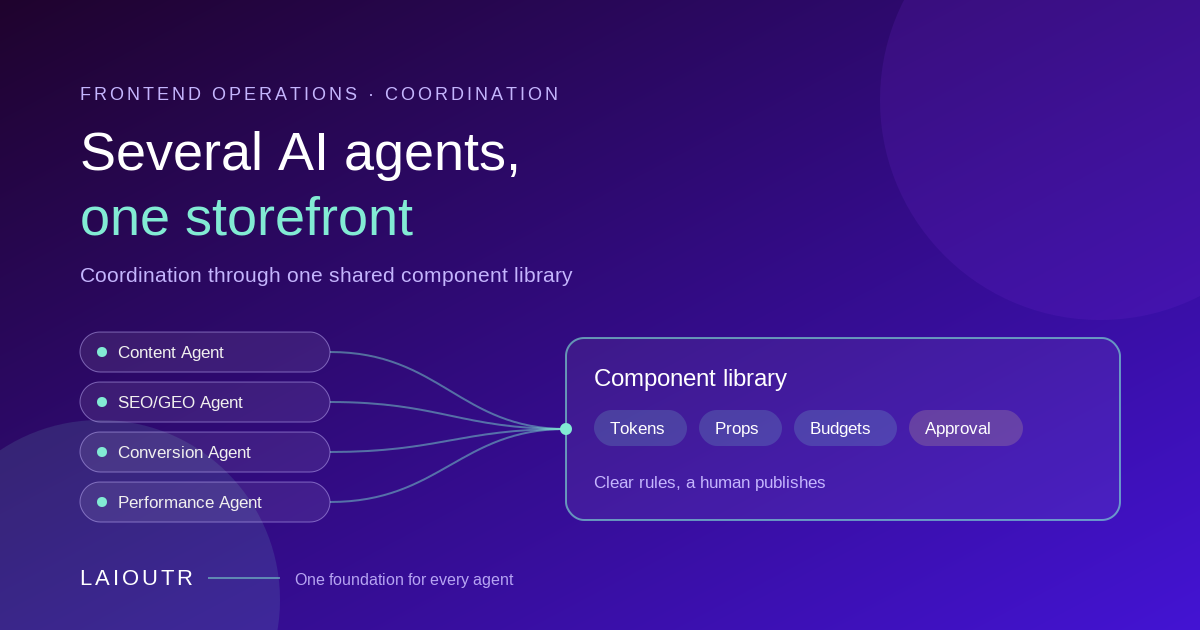Several AI Agents, One Storefront: Coordination Without Collisions
When several AI agents work on the same storefront, conflicts rarely happen between the agents thems…](https://www.laioutr.com/en/blog/frontend-operations-multi-agent-coordination-storefront-2026)
[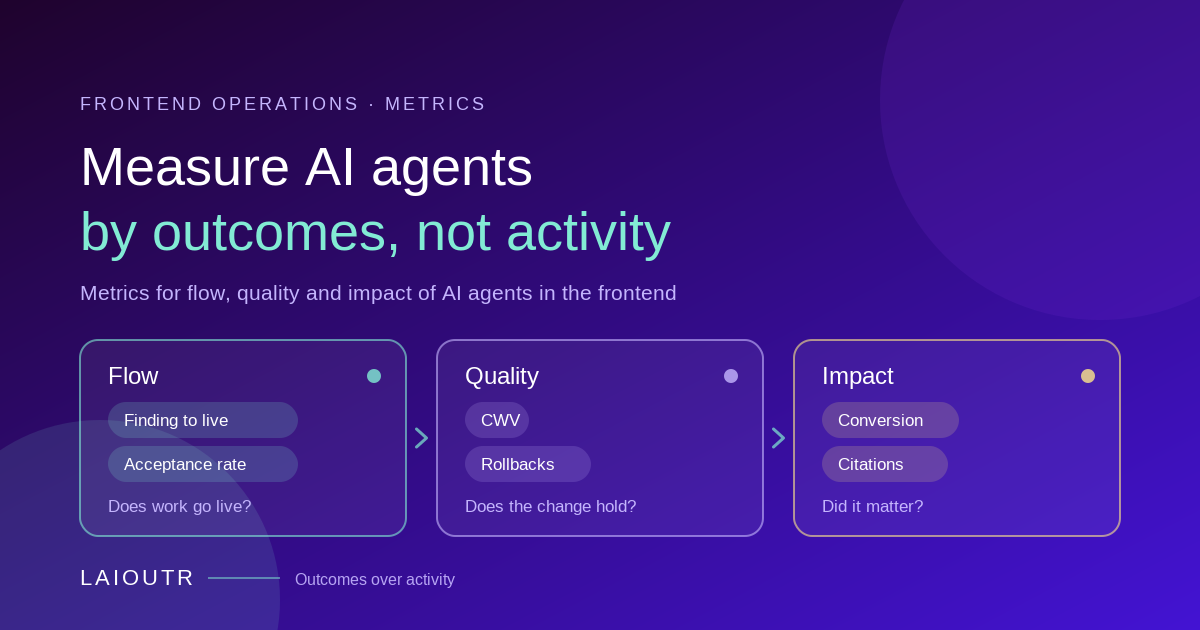Measuring AI Agents by Outcomes: Agentic Frontend Management Metrics
AI agents in the frontend should be measured by outcomes, not by activity. The number of prompts, ge…](https://www.laioutr.com/en/blog/frontend-operations-measuring-ai-agents-outcomes-2026)
[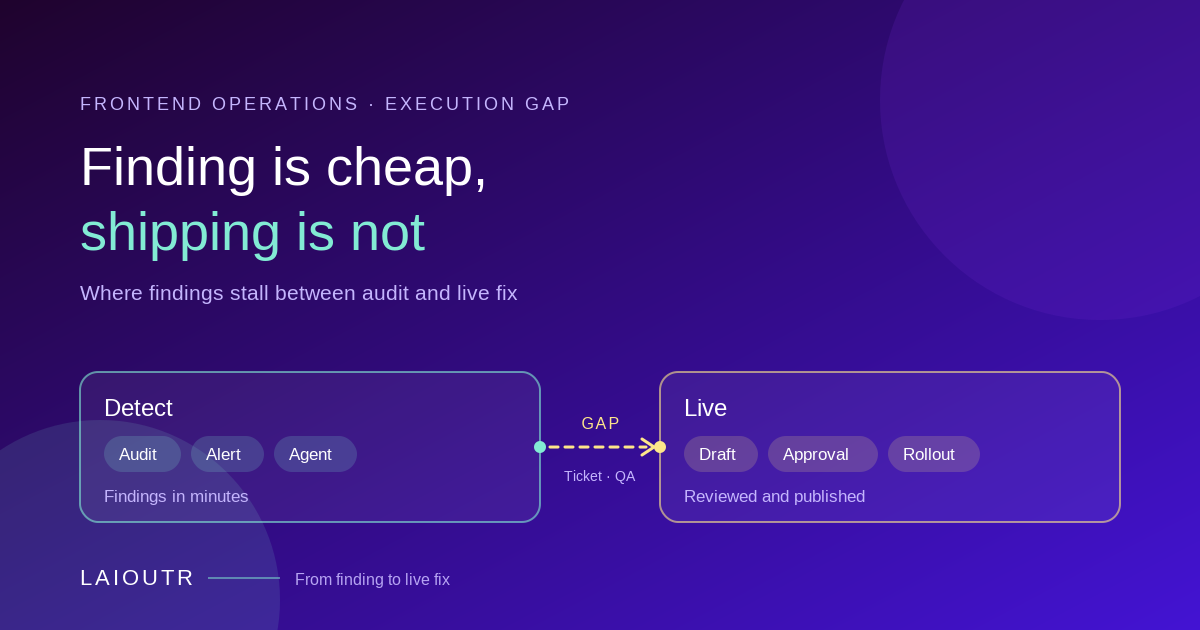The Execution Gap in the Frontend: Finding Is Cheap, Shipping Is Not
The execution gap in the frontend is the time, and the number of handoffs, between "we know wha…](https://www.laioutr.com/en/blog/frontend-operations-execution-gap-detect-vs-deploy-2026)
[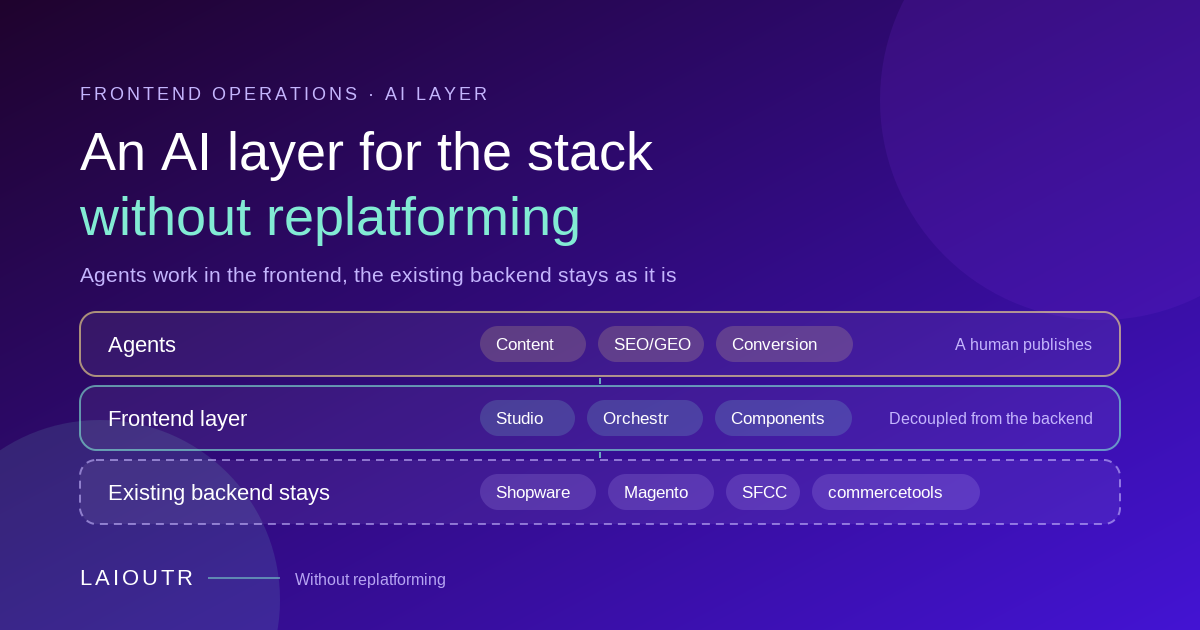Adding an AI Layer to an Existing Commerce Stack Without Replatforming
An AI layer can be added to an existing commerce stack without replacing the shop system. The most p…](https://www.laioutr.com/en/blog/frontend-operations-ai-layer-existing-stack-without-replatforming-2026)
[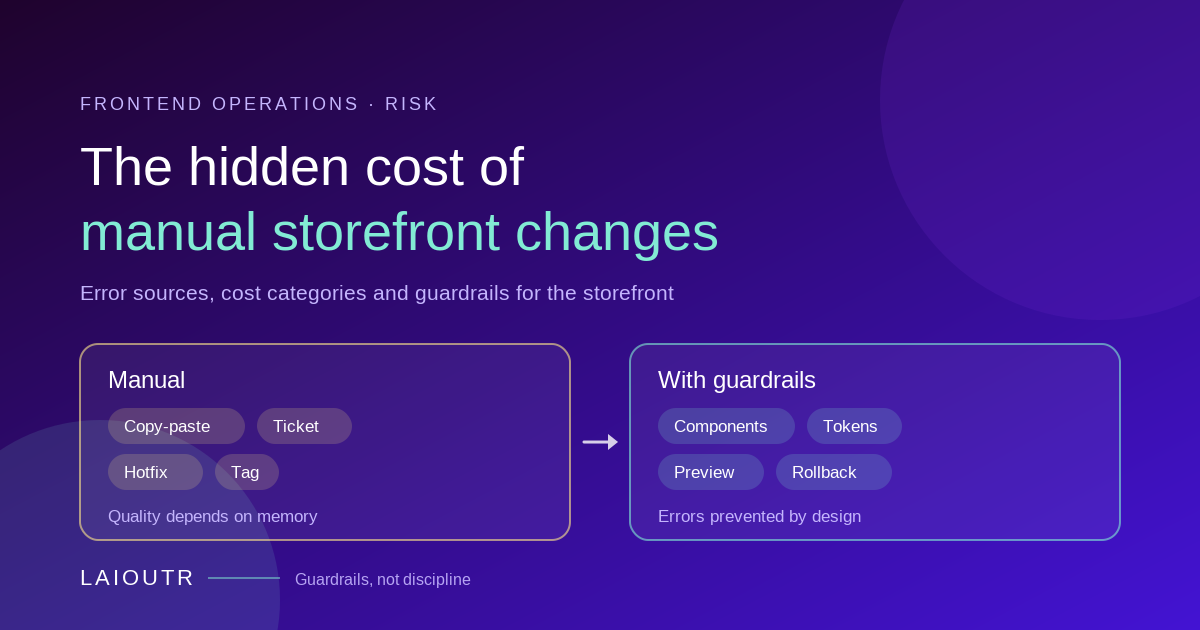The Hidden Cost of Manual Storefront Changes and How to Cut It
Manual frontend changes are the many small edits that keep a storefront running day to day: a new ba…](https://www.laioutr.com/en/blog/frontend-operations-hidden-cost-manual-storefront-changes-2026)
[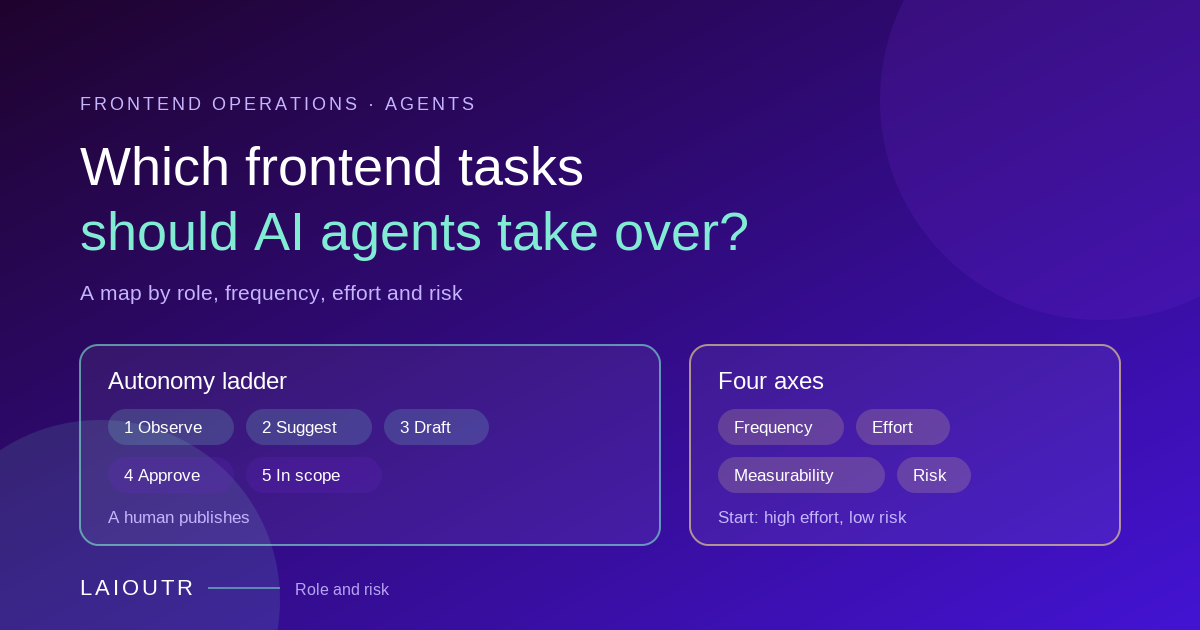Which Frontend Tasks Should AI Agents Take Over? Role and Risk Map
AI agents should first take over the frontend tasks that come up often, involve a lot of manual work…](https://www.laioutr.com/en/blog/frontend-operations-agent-task-map-role-risk-2026)
[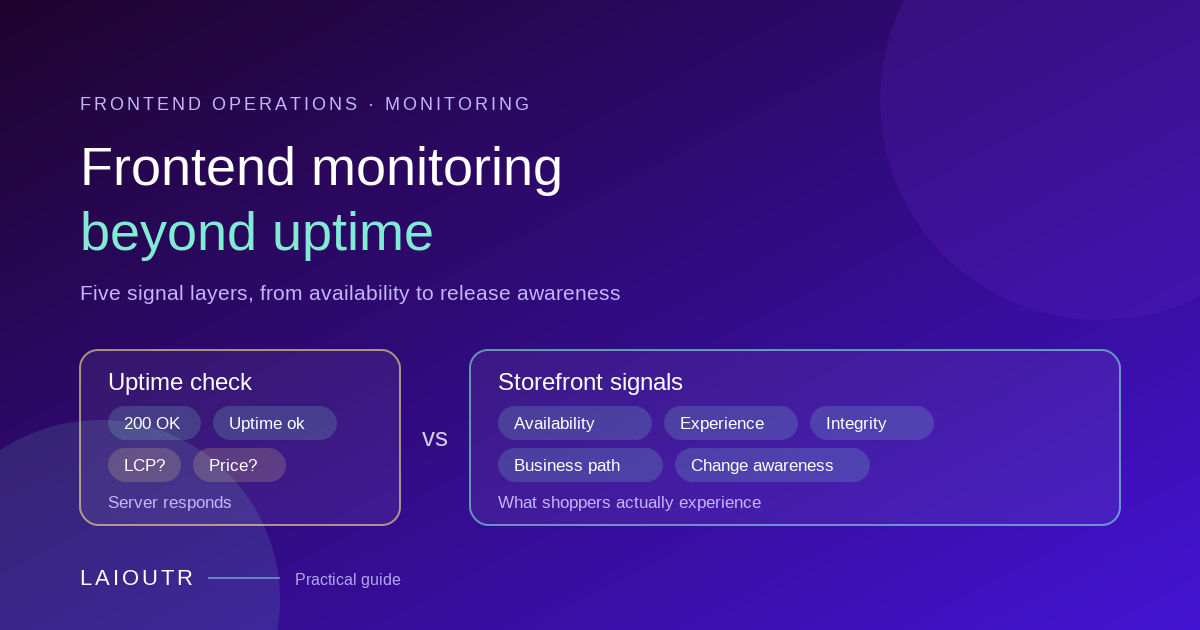Frontend Monitoring Beyond Uptime: Signals a Storefront Needs
Frontend monitoring beyond uptime means checking a storefront not only for availability but for what…](https://www.laioutr.com/en/blog/frontend-operations-monitoring-beyond-uptime-2026)
[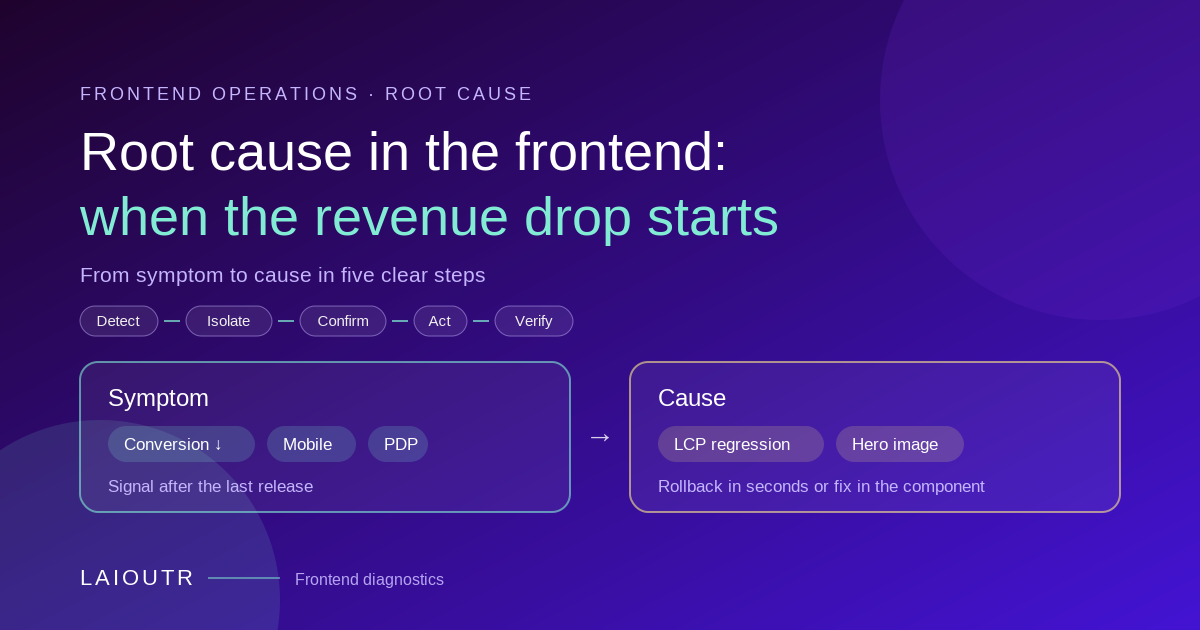Root Cause in the Frontend: When Revenue Drops Start in the Storefront
When revenue or conversion rate drops suddenly, the cause often is not traffic, pricing or the comme…](https://www.laioutr.com/en/blog/frontend-operations-root-cause-revenue-drop-storefront-2026)
[Laioutr Academy Is Live: The Video Manual for Laioutr
Since October 15, 2026, the Laioutr Academy has been live at academy.laioutr.com. It is the user man…](https://www.laioutr.com/en/blog/laioutr-academy-launch-video-manual-certification)
[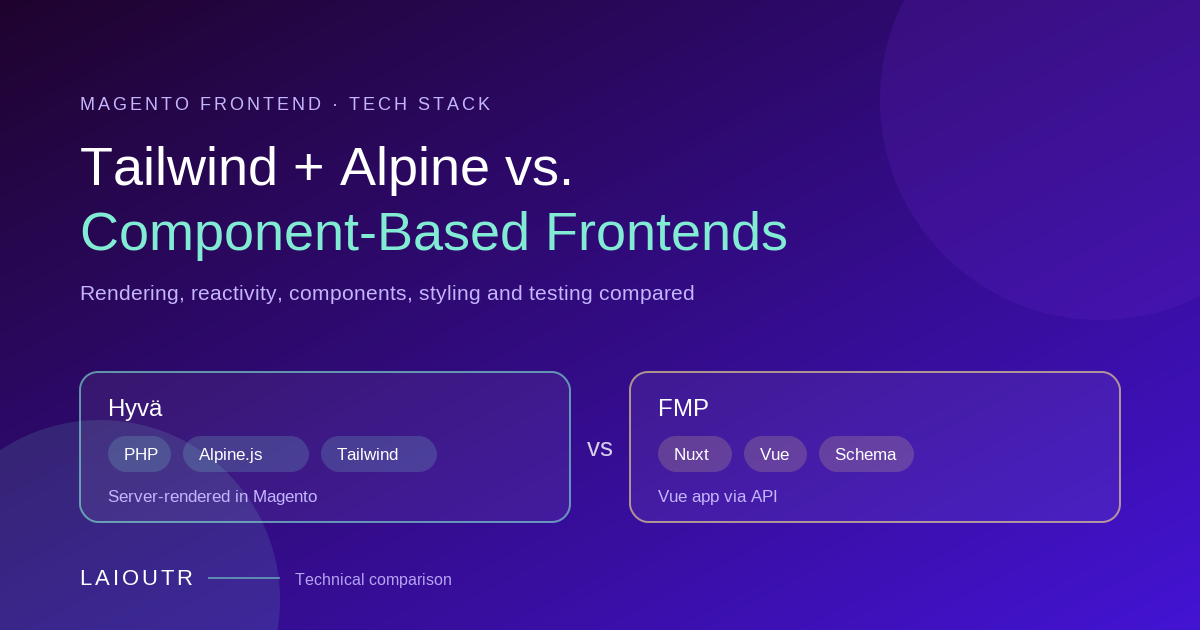Tailwind + Alpine vs. Component-Based Frontends for Magento
Hyvä renders Magento pages on the server with PHP templates and layout XML, adds interactivity throu…](https://www.laioutr.com/en/blog/tailwind-alpine-magento-vs-component-based-frontend-2026)
[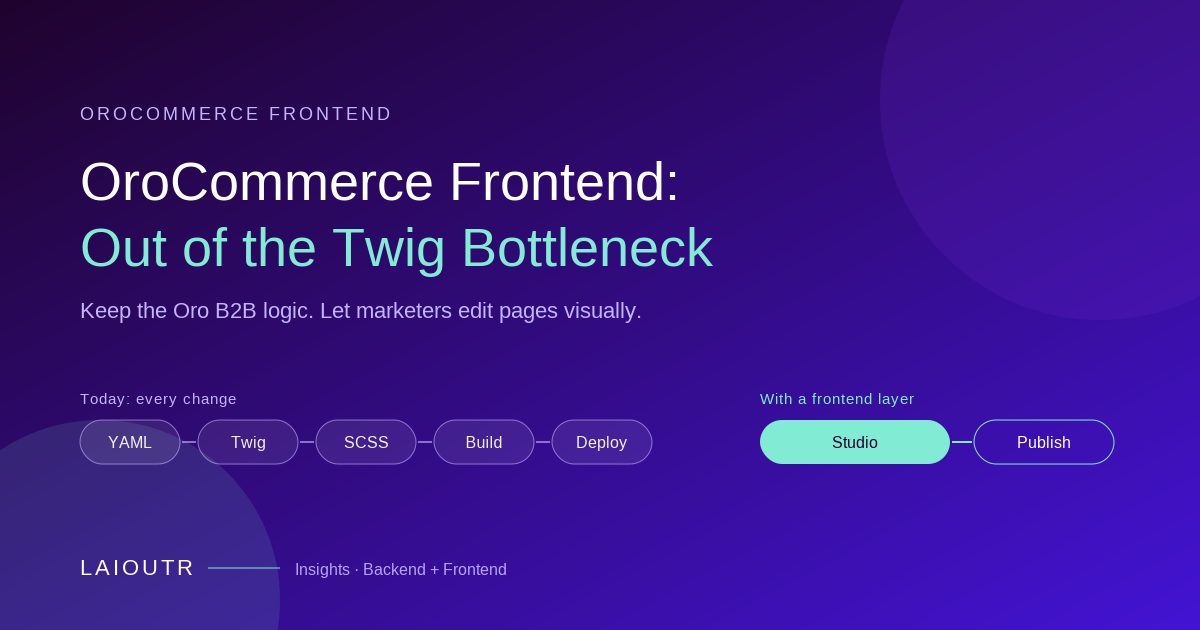OroCommerce Frontend: Out of the Twig and Layouts Bottleneck
The OroCommerce frontend is a server-rendered storefront built from Symfony bundles, OroLayouts and …](https://www.laioutr.com/en/blog/orocommerce-frontend-twig-layouts-bottleneck)
[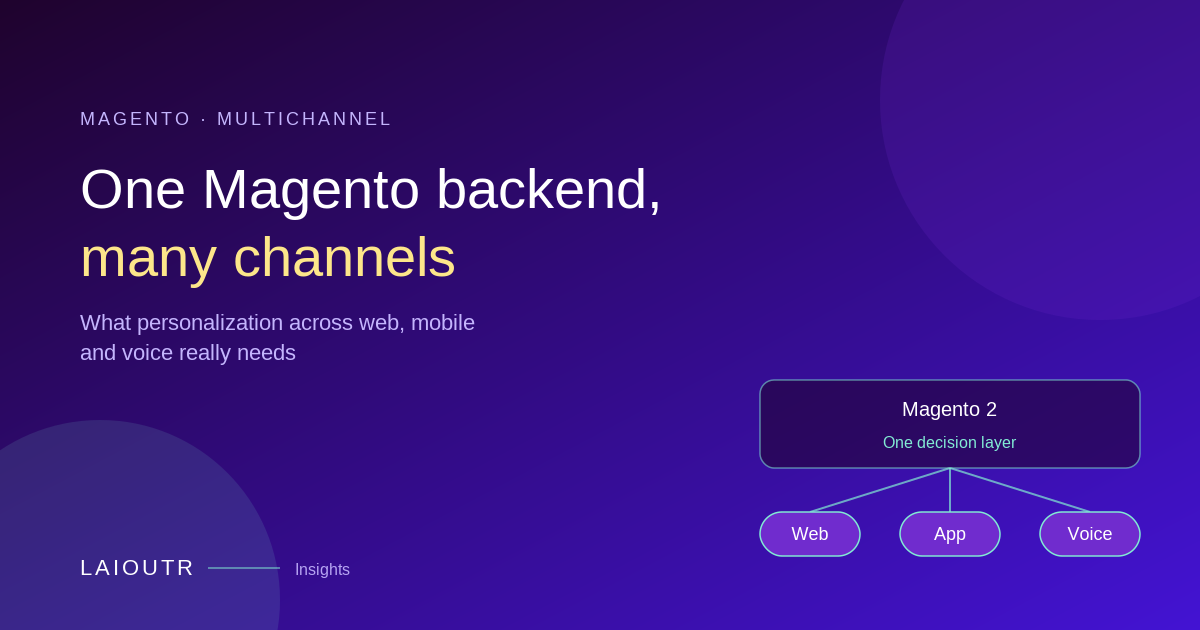One Magento Backend, Many Channels: Personalization in Practice
Personalization across web, mobile and voice on a single Magento backend does not start with a featu…](https://www.laioutr.com/en/blog/magento-multichannel-personalization-web-mobile-voice-2026)
[Edge Hosting for Storefronts: Caching That Holds Under Peak Load
Edge hosting keeps a storefront fast under load when most requests never reach the origin: pages and…](https://www.laioutr.com/en/blog/edge-hosting-storefronts-peak-traffic-caching-2026)
[Composable Commerce 2027: What Shifted and What Comes Next
Composable commerce enters 2027 with a different agenda than a year ago. The architecture question i…](https://www.laioutr.com/en/blog/composable-commerce-2027-outlook)
[AI Engagement and Conversion: Personalization on the Frontend
AI-driven engagement and conversion on the frontend rests on five mechanics: segments decide who see…](https://www.laioutr.com/en/blog/ai-engagement-conversion-frontend-personalization)
## Apps for the Laioutr platform
[View all apps](https://www.laioutr.com/en/apps)
[](https://www.laioutr.com/en/apps/shopify)
Laioutr
[Shopify](https://www.laioutr.com/en/apps/shopify)
Shopify is a commerce platform for selling online and in physical retail.
[](https://www.laioutr.com/en/apps/shopware)
Laioutr
[Shopware](https://www.laioutr.com/en/apps/shopware)
Shopware is a flexible ecommerce platform from Europe for product catalogs and omnichannel commerce.
[](https://www.laioutr.com/en/apps/adobe-commerce)
Laioutr
[Adobe Commerce](https://www.laioutr.com/en/apps/adobe-commerce)
Adobe Commerce is an enterprise commerce platform for complex, global B2C and B2B scenarios.
Planned
[](https://www.laioutr.com/en/apps/b2b-sellers)
Laioutr
[B2Bsellers](https://www.laioutr.com/en/apps/b2b-sellers)
B2B suite for Shopware that turns an online store into a professional B2B commerce platform.
Planned
[](https://www.laioutr.com/en/apps/commerce-layer)
Laioutr
[Commerce Layer](https://www.laioutr.com/en/apps/commerce-layer)
Commerce Layer is a headless commerce platform for making inventory and catalogs available online.
[](https://www.laioutr.com/en/apps/commercetools)
Laioutr
[Commercetools](https://www.laioutr.com/en/apps/commercetools)
Commercetools is a SaaS-based headless ecommerce platform used worldwide.
[](https://www.laioutr.com/en/apps/emporix)
Laioutr
[Emporix](https://www.laioutr.com/en/apps/emporix)
Emporix is a composable, API-first commerce platform for scalable B2B and B2C scenarios.
Planned
[](https://www.laioutr.com/en/apps/hcl-software)
Laioutr
[HCL Software](https://www.laioutr.com/en/apps/hcl-software)
Enterprise suite for digital commerce and experience with extensive configurability.
Planned
[](https://www.laioutr.com/en/apps/intershop)
Laioutr
[Intershop](https://www.laioutr.com/en/apps/intershop)
Enterprise commerce platform for complex B2B and B2C business models.
Planned
[](https://www.laioutr.com/en/apps/magento-2)
Laioutr
[Magento 2](https://www.laioutr.com/en/apps/magento-2)
Widely used, extensible commerce platform for B2C and B2B scenarios.
[](https://www.laioutr.com/en/apps/oxid-eshop)
Laioutr
[OXID eShop](https://www.laioutr.com/en/apps/oxid-eshop)
OXID eShop is an extensible commerce platform for complex B2B and B2C requirements.
Planned
[](https://www.laioutr.com/en/apps/patchworks)
Laioutr
[Patchworks](https://www.laioutr.com/en/apps/patchworks)
Patchworks is a low-code iPaaS that connects ecommerce, ERP, WMS, 3PL, and marketplaces.
Planned
[](https://www.laioutr.com/en/apps/PrestaShop)
Laioutr
[Prestashop](https://www.laioutr.com/en/apps/PrestaShop)
Open-source commerce platform for small and midsize merchants in Europe and beyond.
Planned
[](https://www.laioutr.com/en/apps/saleor)
Laioutr
[Saleor](https://www.laioutr.com/en/apps/saleor)
Open-source, API-first commerce platform built on GraphQL for custom storefronts.
Planned
[](https://www.laioutr.com/en/apps/salesforce-commerce-cloud)
Laioutr
[Salesforce Commerce Cloud](https://www.laioutr.com/en/apps/salesforce-commerce-cloud)
Salesforce Commerce Cloud is a cloud-based enterprise commerce platform for businesses of any size.
Planned
[](https://www.laioutr.com/en/apps/sap-commerce-cloud)
Laioutr
[SAP Commerce Cloud](https://www.laioutr.com/en/apps/sap-commerce-cloud)
Enterprise commerce platform for complex catalogs, pricing models, and omnichannel journeys.
Planned
[](https://www.laioutr.com/en/apps/scayle)
Laioutr
[Scayle](https://www.laioutr.com/en/apps/scayle)
SCAYLE is a commerce engine that helps brands and retailers scale their business.
Planned
[](https://www.laioutr.com/en/apps/spryker)
Laioutr
[Spryker](https://www.laioutr.com/en/apps/spryker)
Composable commerce platform for sophisticated B2B and B2C business models.
[](https://www.laioutr.com/en/apps/sylius)
Laioutr
[Sylius](https://www.laioutr.com/en/apps/sylius)
Sylius is a developer-friendly ecommerce framework for B2C and B2B shopping experiences.
Planned
[](https://www.laioutr.com/en/apps/vendure)
Laioutr
[Vendure](https://www.laioutr.com/en/apps/vendure)
Vendure is a headless commerce platform for businesses with complex requirements.
Coming Soon
[](https://www.laioutr.com/en/apps/vtex)
Laioutr
[VTEX](https://www.laioutr.com/en/apps/vtex)
Cloud-native, composable commerce platform for B2B and B2C at scale.
Planned
[](https://www.laioutr.com/en/apps/websale)
Laioutr
[Websale](https://www.laioutr.com/en/apps/websale)
Stable, enterprise-ready commerce backend for complex retail environments.
Strategy call
## The frontend as a control layer
A conversation about stack, roadmap and replatforming scenario. The outcome: a clear picture of how Laioutr fits, what it costs and how fast the go-live can happen.
*"After 30 minutes, we knew Laioutr makes our replatforming feasible."*
*Daniel B., CEO,* [*hygibox.de*](https://hygibox.de)
[Book a demo](https://www.laioutr.com/en/contact)
## Structured Data
```json
{
"@context": "https://schema.org",
"@graph": [
{
"@type": "Organization",
"@id": "https://www.laioutr.com/#identity",
"name": "Laioutr",
"legalName": "Laioutr GmbH",
"url": "https://www.laioutr.com/",
"logo": {
"@type": "ImageObject",
"url": "https://www.laioutr.com/laioutr-logo.png",
"width": 400,
"height": 400
},
"email": "info@laioutr.com",
"telephone": "+49 30 75435715",
"address": {
"@type": "PostalAddress",
"streetAddress": "Münchweilersteig 5",
"postalCode": "12559",
"addressLocality": "Berlin",
"addressCountry": "DE"
},
"vatID": "DE450905846",
"sameAs": [
"https://www.linkedin.com/company/laioutr",
"https://www.youtube.com/@Laioutr",
"https://x.com/laioutr"
]
},
{
"@type": "WebSite",
"@id": "https://www.laioutr.com/en/#website",
"url": "https://www.laioutr.com/en/",
"name": "Laioutr",
"inLanguage": "en",
"publisher": {
"@id": "https://www.laioutr.com/#identity"
}
},
{
"@type": "BlogPosting",
"@id": "https://www.laioutr.com/en/blog/customer-first-start-with-cms#article",
"headline": "Customer-First Means Reimagining Your Tech Stack Starting Point",
"description": "Why customer-first means reimagining your tech stack starting point, beginning with the CMS.",
"image": [
"https://eu-west-2.graphassets.com/cmii2mlqi0dux06l5543v7nkc/cmnucypviw8mi07mgmwsd5asa"
],
"datePublished": "2026-10-26T13:19:09.444026+00:00",
"dateModified": "2026-10-26T13:19:06.392757+00:00",
"inLanguage": "en",
"articleSection": "Insights",
"keywords": "Composable, Experience Operations",
"author": {
"@type": "Person",
"name": "Marcel Thiesies",
"jobTitle": "Co-Founder & CEO, Laioutr",
"image": "https://eu-west-2.graphassets.com/cmii2mlqi0dux06l5543v7nkc/cmj01b962364n07lb0iguvts5"
},
"publisher": {
"@id": "https://www.laioutr.com/#identity"
},
"mainEntityOfPage": {
"@id": "https://www.laioutr.com/en/blog/customer-first-start-with-cms#webpage"
},
"isPartOf": {
"@id": "https://www.laioutr.com/en/#website"
}
},
{
"@type": "WebPage",
"@id": "https://www.laioutr.com/en/blog/customer-first-start-with-cms#webpage",
"url": "https://www.laioutr.com/en/blog/customer-first-start-with-cms",
"name": "Customer-First Means Reimagining Your Tech Stack Starting Point",
"description": "Why customer-first means reimagining your tech stack starting point, beginning with the CMS.",
"inLanguage": "en",
"isPartOf": {
"@id": "https://www.laioutr.com/en/#website"
},
"breadcrumb": {
"@id": "https://www.laioutr.com/en/blog/customer-first-start-with-cms#breadcrumb"
},
"primaryImageOfPage": {
"@type": "ImageObject",
"url": "https://eu-west-2.graphassets.com/cmii2mlqi0dux06l5543v7nkc/cmnucypviw8mi07mgmwsd5asa"
},
"datePublished": "2026-10-26T13:19:09.444026+00:00",
"dateModified": "2026-10-26T13:19:06.392757+00:00",
"mainEntity": {
"@id": "https://www.laioutr.com/en/blog/customer-first-start-with-cms#article"
}
},
{
"@type": "BreadcrumbList",
"@id": "https://www.laioutr.com/en/blog/customer-first-start-with-cms#breadcrumb",
"itemListElement": [
{
"@type": "ListItem",
"position": 1,
"name": "Laioutr",
"item": "https://www.laioutr.com/en/"
},
{
"@type": "ListItem",
"position": 2,
"name": "Insights",
"item": "https://www.laioutr.com/en/blogs/insights"
},
{
"@type": "ListItem",
"position": 3,
"name": "Customer-First Means Reimagining Your Tech Stack Starting Point"
}
]
}
]
}
```