---
title: "Distributed Order Management in the Frontend"
canonical_url: "https://www.laioutr.com/en/blog/distributed-order-management-frontend-2026"
locale: en
meta:
description: "Distributed order management spreads inventory, routing, and fulfillment across sources. How the frontend surfaces that without burdening the customer."
"og:description": "Distributed order management spreads inventory, routing, and fulfillment across sources. How the frontend surfaces that without burdening the customer."
"og:title": "Distributed Order Management in the Frontend"
---
# Distributed Order Management, and How It Shows Up in the Frontend
Table of contents
1. [1.Availability Signals on the Product Detail Page](#availability-signals-on-the-product-detail-page)
2. [2.Delivery Promises Built From Multiple Sources](#delivery-promises-built-from-multiple-sources)
3. [3.Making Partial Shipments Visible and Traceable](#making-partial-shipments-visible-and-traceable)
4. [4.Cancellations and Returns Across System Boundaries](#cancellations-and-returns-across-system-boundaries)
5. [5.Status Tracking as One Continuous Story](#status-tracking-as-one-continuous-story)
6. [6.Performance Requirements for Availability APIs](#performance-requirements-for-availability-apis)
7. 7.When This Complexity Isn't Needed
8. [8.Common Failure Modes in Practice](#common-failure-modes-in-practice)
9. [9.Who Owns the Normalization Logic](#who-owns-the-normalization-logic)
10. [10.Keep the Backend Distributed, Make the Frontend the Consistency Layer](#keep-the-backend-distributed-make-the-frontend-the-consistency-layer)
11. [11.Where This Lands](#where-this-lands)
Once a retailer runs more than one warehouse, more than one sales channel, or marketplaces alongside their own store, a single inventory system stops being enough. Distributed order management spreads availability lookups, routing decisions, and fulfillment across multiple sources: warehouses, stores, third-party partners, sometimes even marketplace stock. That's a backend decision, and it should stay one. What changes is the job of the frontend. It has to make the consequences of that distribution understandable to the customer, without exposing the complexity behind it. A wrong availability badge, a vague delivery promise, or a confusing partial shipment costs trust, regardless of how well the backend is actually working underneath. This post walks through where distributed order management concretely surfaces in the frontend, the failure modes that typically follow, and how the frontend becomes a consistency layer instead of passing the distribution straight through to the customer.
## Availability Signals on the Product Detail Page
The product detail page is the first place distributed order management shows up. When stock is aggregated across several warehouses, a store, and possibly a drop-ship partner, a badge that says "in stock" or "ships in 2-3 days" needs to reflect a real, current aggregation of those sources, not a static number from an overnight batch import. Frontends that only display the last source they queried regularly produce broken promises: marked as available even though a reserved quantity from a different channel has already sold it out. A solid setup re-checks availability as close to checkout as feasible and communicates uncertainty honestly, using phrasing like "limited availability" rather than a seemingly exact unit count that may already be stale.
## Delivery Promises Built From Multiple Sources
Once a cart contains items fulfilled from different sources, a single delivery date becomes fiction. One item ships from the central warehouse tomorrow, another from a partner store in four days. Good frontend practice shows the delivery promise per fulfillment group, not as one smoothed-over number for the whole cart. That means more information at checkout, but less disappointment after purchase. Retailers who instead communicate one optimistic date just push the problem into customer service, where it gets more expensive. The job of the frontend here isn't to hide the distribution, it's to translate it into an understandable, honest statement. A useful rule of thumb: the more fulfillment groups a cart contains, the more it matters to keep the layout compact, grouping items that share a delivery date into a single line instead of listing eight separate rows.
## Making Partial Shipments Visible and Traceable
Partial shipments are a direct consequence of distributed fulfillment sources, and they still surprise plenty of customers when they weren't flagged at checkout. A frontend that takes distributed order management seriously marks in the cart which line items are likely to ship separately, and after purchase, tracks the status of each partial shipment individually, rather than as one combined, often contradictory overall status. That measurably reduces support tickets, because customers can understand for themselves why two packages arrive at different times, instead of wondering whether something went wrong.
## Cancellations and Returns Across System Boundaries
With a single inventory source, a cancellation is a simple status change. With distributed fulfillment, a cancellation can touch multiple systems, each with its own processing state. From a customer's point of view, only one question matters: is my refund on the way or not. The frontend should therefore show a consolidated status that summarizes the underlying backend states, rather than leaving the customer with contradictory partial information. Returns work on the same principle: a return may technically route to several fulfillment partners, but the status view for the customer still has to feel like one coherent process. A commonly missed edge case is a partial return inside an already split shipment: one package comes back from the central warehouse, a second stays with the customer, and the refund logic has to track both states separately while the customer-facing view still shows one clear refund amount.
## Status Tracking as One Continuous Story
Tracking data from different logistics partners rarely arrives in the same format or on the same cadence. A frontend that passes this raw data through unchanged shows the customer inconsistent status text for what is essentially the same event: "in transit," "out for delivery," "package is moving" for three shipments in a single order. The better approach is a normalized status logic, either in the frontend or in a layer just ahead of it, that maps the different partner formats onto one consistent, understandable vocabulary. That's translation work, not invention of new facts, but that translation is exactly what determines whether the customer trusts the system.
## Performance Requirements for Availability APIs
An often underestimated side effect of distributed order management is the latency that stacks up when an availability check genuinely has to hit several backend systems in sequence. If the frontend synchronously queries three to five different sources on every page load, response times add up to several hundred milliseconds quickly, which directly hurts Core Web Vitals metrics like Largest Contentful Paint. A practical compromise is a caching layer with a short time-to-live, say 30 to 60 seconds for high-traffic products, combined with a re-check right at the "add to cart" click. That cuts the number of live lookups substantially without sacrificing accuracy at the one point where it actually matters: the moment of purchase decision. Backend systems like commercetools or Shopware ship their own aggregation endpoints for exactly this, bundling server-side what the frontend would otherwise have to assemble client-side, which moves the latency to a place where it's easier to control.
## When This Complexity Isn't Needed
Not every retailer needs this level of differentiation. Anyone shipping from a single warehouse with no marketplace connection simply has no distribution to surface in the frontend, a single delivery date is correct and sufficient in that case. Retailers with very few SKUs and consistently high stock availability also gain little from granular fulfillment displays, the added interface effort isn't proportionate to the benefit. The patterns described here start to pay off once mixed-fulfillment carts become routine, typically once a second warehouse, a store connection, or a marketplace enters the picture. One more edge case worth naming: retailers early in a rollout of distributed order management should phase the granular frontend treatment in gradually, starting with delivery promises, then adding partial shipments and returns, rather than shipping every change at once.
## Common Failure Modes in Practice
Three failure modes show up especially often. First, overselling from stale inventory data, when two channels reserve the same physical stock against each other without a central reservation layer in between. Second, the "silent cancellation," where an item gets canceled in the background because a fulfillment partner can't deliver it after all, and the customer only finds out through an email days later instead of an immediate status change in the account. Third, conflicting tracking numbers, when a frontend only has room for one tracking field per order even though multiple shipments already exist behind the scenes, so the second tracking number either overwrites the first or has to be added manually via a support ticket. A fourth, subtler failure mode involves currency and tax display for cross-border fulfillment: when an item ships from a foreign warehouse, customs fees or a different tax rate can apply that were never surfaced at checkout, which leads to complaints after delivery that were technically correct but communicatively avoidable.
## Who Owns the Normalization Logic
An often underrated organizational question is who is actually responsible for translating raw data into understandable status text. If that logic sits directly inside the storefront frontend, it tends to get duplicated the moment a second channel appears, an app or a marketplace presence, each channel builds its own translation, with the result that a customer sees a different status text on the website than in the app for the same shipment. A backend-for-frontend layer that owns this normalization centrally for every channel avoids that drift, but it requires a deliberate decision from the architecture team to actually build and maintain that layer, rather than quietly letting it land in whichever frontend team happens to have capacity.
## Keep the Backend Distributed, Make the Frontend the Consistency Layer
The central point of this post is deliberately restrained: distributed order management is a sound backend decision for retailers running multiple warehouses, channels, or marketplaces, and it should stay a backend decision. The frontend's job isn't to undo that distribution, it's to translate it into a consistent, honest customer experience. Teams running a [composable headless frontend](https://www.laioutr.com/en/composable-headless-frontend) architecture can build and maintain that consistency layer independently of the backend vendor, which matters especially during a later switch or replatforming project. Retailers running multiple brands or markets add another layer on top, covered further in the [multi-brand and multi-market hub](https://www.laioutr.com/en/product/multi-brand-multi-market). Teams also serving marketplaces and several sales channels will find practical patterns in the [multichannel retail growth kit](https://www.laioutr.com/en/growth-kit/multichannel-retail).
## Where This Lands
Distributed order management stops being a purely backend topic the moment you look at it from the customer's side. The quality of the availability signal, the honesty of the delivery promise, and the clarity of status tracking decide whether customers trust the distributed architecture or grow frustrated with it. Teams that address these points explicitly in the frontend, rather than passing raw backend data through unchanged, cut support load and improve conversion, without ever questioning the backend decision to distribute fulfillment. Teams working the developer side of this same architecture in parallel can find background in [Developer Experience in a Composable Storefront](https://www.laioutr.com/en/blog/developer-experience-composable-storefront-2026).
---
Share this article
[Share on Facebook](https://www.facebook.com/sharer/sharer.php?u=https%3A%2F%2Fwww.laioutr.com%2Fen%2Fblog%2Fdistributed-order-management-frontend-2026) [Share on X](https://x.com/intent/post?url=https%3A%2F%2Fwww.laioutr.com%2Fen%2Fblog%2Fdistributed-order-management-frontend-2026&text=) [Share on LinkedIn](https://www.linkedin.com/sharing/share-offsite/?url=https%3A%2F%2Fwww.laioutr.com%2Fen%2Fblog%2Fdistributed-order-management-frontend-2026) [Share on Pinterest](https://pinterest.com/pin/create/button/?url=https%3A%2F%2Fwww.laioutr.com%2Fen%2Fblog%2Fdistributed-order-management-frontend-2026&description=) [Share via email](mailto:?subject=&body=%0A%0Ahttps%3A%2F%2Fwww.laioutr.com%2Fen%2Fblog%2Fdistributed-order-management-frontend-2026)
## More interesting articles
Practical know-how for frontend development, smart agents, and headless
[To the blog](https://www.laioutr.com/en/blogs)
[iPhone Duo and Ecommerce: What Merchants Need to Know Now
iPhone Duo goes on sale on October 23, 2026. Online stores don't need a dedicated app or a custo…](https://www.laioutr.com/en/blog/iphone-duo-ecommerce-foldable-storefront)
[Structured Product Data: How It Shows Up in Your Storefront
Structured product data means every product fact lives in a typed attribute with a unit, a stable id…](https://www.laioutr.com/en/blog/structured-product-data-pim-frontend-2026)
[44% Decide via Trial or PoC: How to Run a Storefront PoC in DACH
In DACH, software decisions are increasingly made hands-on: in the study "Software Buying in DA…](https://www.laioutr.com/en/blog/storefront-proof-of-concept-dach-buyers-2026)
[Frontend Management Platform Comparison: How to Choose the Right FMP
Choosing a frontend management platform (FMP) is less about feature lists and more about where your …](https://www.laioutr.com/en/blog/frontend-management-platform-comparison-how-to-choose-2026)
[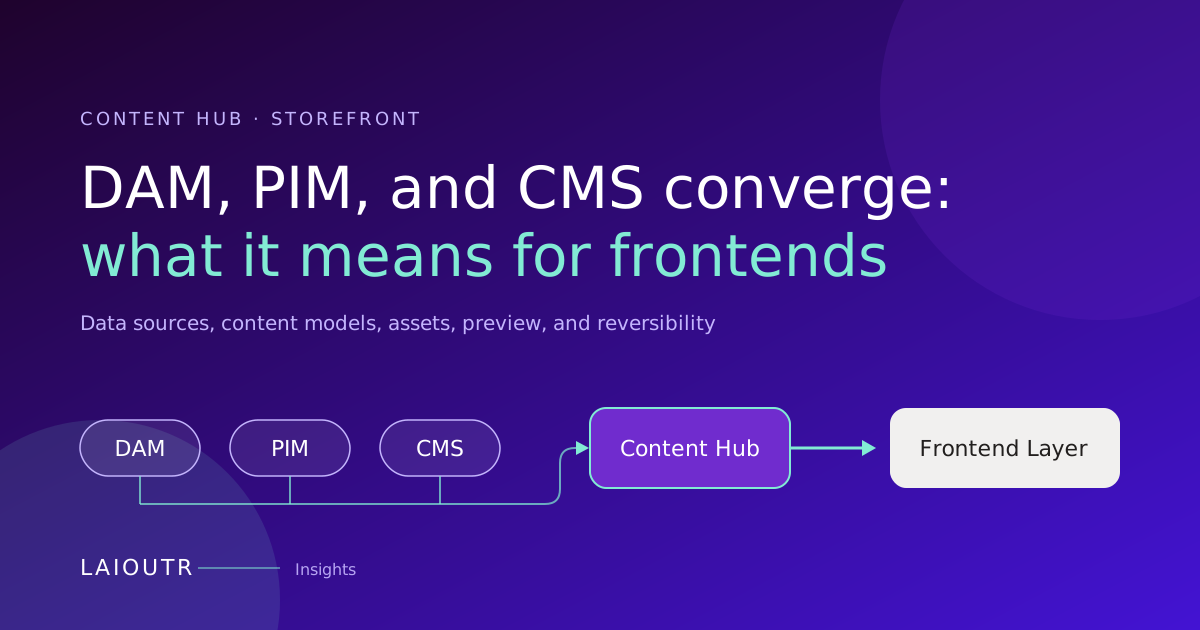DAM, PIM, and CMS Are Converging: What It Means for Your Storefront
DAM, PIM, and CMS vendors are moving into each other's territory, and more teams now evaluate on…](https://www.laioutr.com/en/blog/dam-pim-cms-convergence-content-hub-storefront-2026)
[Contentful Live Preview: What Your Frontend Has to Deliver
Contentful Live Preview lets editors see a draft right next to the entry editor and watch changes ap…](https://www.laioutr.com/en/blog/contentful-live-preview-frontend-perspective-2026)
[Content Governance at Scale: Product Content and Brand Assets
Content governance at scale means that roles, approvals, brand rules, asset rights and translations …](https://www.laioutr.com/en/blog/content-governance-product-content-brand-assets-frontend-2026)
[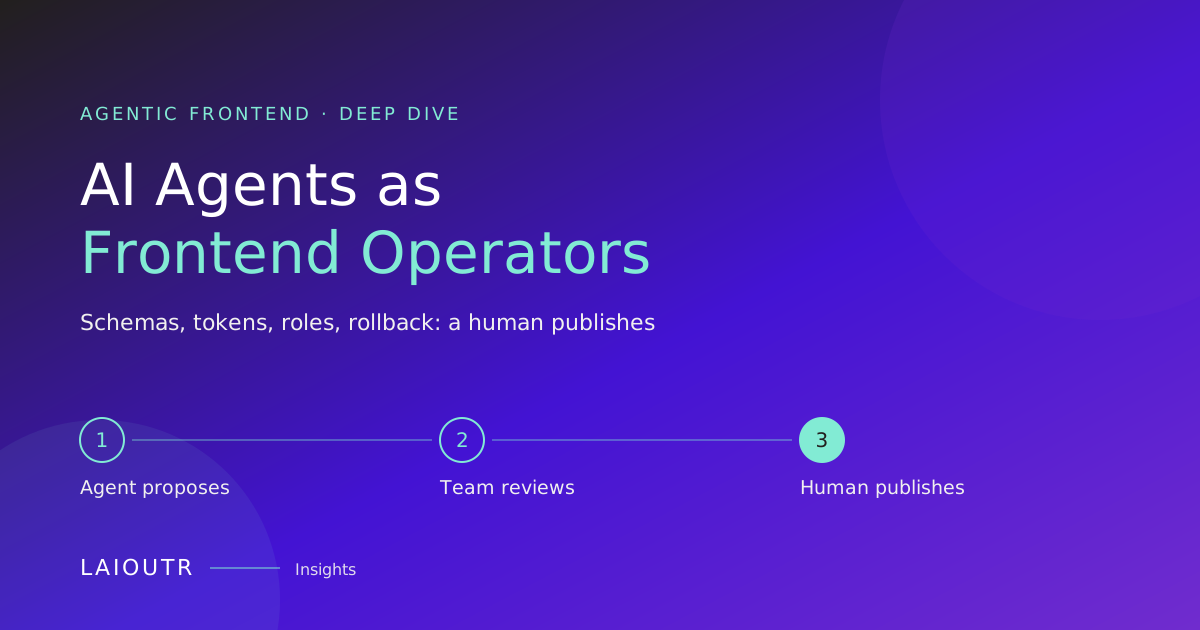AI Agents as Frontend Operators: Architecture and Control Model
An AI agent becomes a frontend operator when it watches the running storefront, spots concrete issue…](https://www.laioutr.com/en/blog/ai-agents-as-frontend-operators-2026)
[Shopping Agents Read Your Feed: What Agentic Commerce Changes
Agentic commerce adds a new reader to your product data: shopping agents in ChatGPT, Google AI Mode,…](https://www.laioutr.com/en/blog/shopping-agents-product-feeds-agentic-data-distribution-2026)
[Server-Side Tracking in E-Commerce: Making Measurement Complete Again
Server-side tracking moves the forwarding of analytics and conversion events from the visitor's …](https://www.laioutr.com/en/blog/server-side-tracking-ecommerce-complete-measurement-2026)
[Product Image Deep Links, Not ZIP Files: Assets That Stay Current
If you still send product images to retailers, marketplaces and press as ZIP files, every package st…](https://www.laioutr.com/en/blog/product-image-deeplinks-asset-distribution-2026)
[PrestaShop 8 to 9 Upgrade Without Replatforming: Decouple the Frontend
You can take most of the risk out of the PrestaShop 8 to 9 upgrade by moving the storefront off the …](https://www.laioutr.com/en/blog/prestashop-8-to-9-upgrade-without-replatforming-2026)
[Order Management With an OMS Like fulfillmenttools: The Frontend View
An efficient order management system decides which location fulfills an order, how much stock is rea…](https://www.laioutr.com/en/blog/order-management-fulfillmenttools-oms-frontend-2026)
[No Replatforming Budget in 2026? Why the Frontend Gets Approved
If your 2026 budget has no room for a replatforming project, you are not alone, and you do not have …](https://www.laioutr.com/en/blog/no-replatforming-budget-frontend-project-approval-2026)
[Garden Retail Order Management: What Your Storefront Must Show
In garden and DIY retail, one cart can hold a parcel item, a patio set that ships by freight, live p…](https://www.laioutr.com/en/blog/garden-retail-order-management-seasonal-frontend-2026)
[](https://www.laioutr.com/en/apps/shopify)
Laioutr
[Shopify](https://www.laioutr.com/en/apps/shopify)
Shopify is a commerce platform for selling online and in physical retail.
[](https://www.laioutr.com/en/apps/shopware)
Laioutr
[Shopware](https://www.laioutr.com/en/apps/shopware)
Shopware is a flexible ecommerce platform from Europe for product catalogs and omnichannel commerce.
[](https://www.laioutr.com/en/apps/adobe-commerce)
Laioutr
[Adobe Commerce](https://www.laioutr.com/en/apps/adobe-commerce)
Adobe Commerce is an enterprise commerce platform for complex, global B2C and B2B scenarios.
Planned
[](https://www.laioutr.com/en/apps/b2b-sellers)
Laioutr
[B2Bsellers](https://www.laioutr.com/en/apps/b2b-sellers)
B2B suite for Shopware that turns an online store into a professional B2B commerce platform.
Planned
[](https://www.laioutr.com/en/apps/commerce-layer)
Laioutr
[Commerce Layer](https://www.laioutr.com/en/apps/commerce-layer)
Commerce Layer is a headless commerce platform for making inventory and catalogs available online.
[](https://www.laioutr.com/en/apps/commercetools)
Laioutr
[Commercetools](https://www.laioutr.com/en/apps/commercetools)
Commercetools is a SaaS-based headless ecommerce platform used worldwide.
[](https://www.laioutr.com/en/apps/emporix)
Laioutr
[Emporix](https://www.laioutr.com/en/apps/emporix)
Emporix is a composable, API-first commerce platform for scalable B2B and B2C scenarios.
Planned
[](https://www.laioutr.com/en/apps/hcl-software)
Laioutr
[HCL Software](https://www.laioutr.com/en/apps/hcl-software)
Enterprise suite for digital commerce and experience with extensive configurability.
Planned
[](https://www.laioutr.com/en/apps/intershop)
Laioutr
[Intershop](https://www.laioutr.com/en/apps/intershop)
Enterprise commerce platform for complex B2B and B2C business models.
Planned
[](https://www.laioutr.com/en/apps/magento-2)
Laioutr
[Magento 2](https://www.laioutr.com/en/apps/magento-2)
Widely used, extensible commerce platform for B2C and B2B scenarios.
[](https://www.laioutr.com/en/apps/oxid-eshop)
Laioutr
[OXID eShop](https://www.laioutr.com/en/apps/oxid-eshop)
OXID eShop is an extensible commerce platform for complex B2B and B2C requirements.
Planned
[](https://www.laioutr.com/en/apps/patchworks)
Laioutr
[Patchworks](https://www.laioutr.com/en/apps/patchworks)
Patchworks is a low-code iPaaS that connects ecommerce, ERP, WMS, 3PL, and marketplaces.
Planned
[](https://www.laioutr.com/en/apps/PrestaShop)
Laioutr
[Prestashop](https://www.laioutr.com/en/apps/PrestaShop)
Open-source commerce platform for small and midsize merchants in Europe and beyond.
Planned
[](https://www.laioutr.com/en/apps/saleor)
Laioutr
[Saleor](https://www.laioutr.com/en/apps/saleor)
Open-source, API-first commerce platform built on GraphQL for custom storefronts.
Planned
[](https://www.laioutr.com/en/apps/salesforce-commerce-cloud)
Laioutr
[Salesforce Commerce Cloud](https://www.laioutr.com/en/apps/salesforce-commerce-cloud)
Salesforce Commerce Cloud is a cloud-based enterprise commerce platform for businesses of any size.
Planned
[](https://www.laioutr.com/en/apps/sap-commerce-cloud)
Laioutr
[SAP Commerce Cloud](https://www.laioutr.com/en/apps/sap-commerce-cloud)
Enterprise commerce platform for complex catalogs, pricing models, and omnichannel journeys.
Planned
[](https://www.laioutr.com/en/apps/scayle)
Laioutr
[Scayle](https://www.laioutr.com/en/apps/scayle)
SCAYLE is a commerce engine that helps brands and retailers scale their business.
Planned
[](https://www.laioutr.com/en/apps/spryker)
Laioutr
[Spryker](https://www.laioutr.com/en/apps/spryker)
Composable commerce platform for sophisticated B2B and B2C business models.
[](https://www.laioutr.com/en/apps/sylius)
Laioutr
[Sylius](https://www.laioutr.com/en/apps/sylius)
Sylius is a developer-friendly ecommerce framework for B2C and B2B shopping experiences.
Planned
[](https://www.laioutr.com/en/apps/vendure)
Laioutr
[Vendure](https://www.laioutr.com/en/apps/vendure)
Vendure is a headless commerce platform for businesses with complex requirements.
Coming Soon
[](https://www.laioutr.com/en/apps/vtex)
Laioutr
[VTEX](https://www.laioutr.com/en/apps/vtex)
Cloud-native, composable commerce platform for B2B and B2C at scale.
Planned
[](https://www.laioutr.com/en/apps/websale)
Laioutr
[Websale](https://www.laioutr.com/en/apps/websale)
Stable, enterprise-ready commerce backend for complex retail environments.

Strategy call
## Ready to turn your frontend into a control layer?
Show us your stack, your roadmap, your replatforming scenario, and we'll show you how Laioutr fits, what it costs, and how fast you go live.
*"After 30 minutes, we knew Laioutr makes our replatforming feasible." - Daniel B., CEO,* [*hygibox.de*](https://hygibox.de)
[Book a demo](https://www.laioutr.com/en/contact)
## Structured Data
```json
{
"@context": "https://schema.org",
"@graph": [
{
"@type": "Organization",
"@id": "https://www.laioutr.com/#identity",
"name": "Laioutr",
"legalName": "Laioutr GmbH",
"url": "https://www.laioutr.com/",
"logo": {
"@type": "ImageObject",
"url": "https://www.laioutr.com/laioutr-logo.png",
"width": 400,
"height": 400
},
"email": "info@laioutr.com",
"telephone": "+49 30 75435715",
"address": {
"@type": "PostalAddress",
"streetAddress": "Münchweilersteig 5",
"postalCode": "12559",
"addressLocality": "Berlin",
"addressCountry": "DE"
},
"vatID": "DE450905846",
"sameAs": [
"https://www.linkedin.com/company/laioutr",
"https://www.youtube.com/@Laioutr",
"https://x.com/laioutr"
]
},
{
"@type": "WebSite",
"@id": "https://www.laioutr.com/en/#website",
"url": "https://www.laioutr.com/en/",
"name": "Laioutr",
"inLanguage": "en",
"publisher": {
"@id": "https://www.laioutr.com/#identity"
}
},
{
"@type": "BlogPosting",
"@id": "https://www.laioutr.com/en/blog/distributed-order-management-frontend-2026#article",
"headline": "Distributed Order Management, and How It Shows Up in the Frontend",
"description": "Distributed order management spreads inventory, routing, and fulfillment across sources. How the frontend surfaces that without burdening the customer.",
"image": [
"https://eu-west-2.graphassets.com/cmii2mlqi0dux06l5543v7nkc/cmtqvl406vmns06miplaaqv4k"
],
"datePublished": "2026-09-07T06:45:27.436568+00:00",
"dateModified": "2026-09-07T06:45:27.024528+00:00",
"inLanguage": "en",
"articleSection": "Insights",
"keywords": "Composable, Experience Operations, Storefront Experience, Information architecture",
"author": {
"@type": "Person",
"name": "Marcel Thiesies",
"jobTitle": "Co-Founder & CEO, Laioutr",
"image": "https://eu-west-2.graphassets.com/cmii2mlqi0dux06l5543v7nkc/cmj01b962364n07lb0iguvts5"
},
"publisher": {
"@id": "https://www.laioutr.com/#identity"
},
"mainEntityOfPage": {
"@id": "https://www.laioutr.com/en/blog/distributed-order-management-frontend-2026#webpage"
},
"isPartOf": {
"@id": "https://www.laioutr.com/en/#website"
}
},
{
"@type": "WebPage",
"@id": "https://www.laioutr.com/en/blog/distributed-order-management-frontend-2026#webpage",
"url": "https://www.laioutr.com/en/blog/distributed-order-management-frontend-2026",
"name": "Distributed Order Management, and How It Shows Up in the Frontend",
"description": "Distributed order management spreads inventory, routing, and fulfillment across sources. How the frontend surfaces that without burdening the customer.",
"inLanguage": "en",
"isPartOf": {
"@id": "https://www.laioutr.com/en/#website"
},
"breadcrumb": {
"@id": "https://www.laioutr.com/en/blog/distributed-order-management-frontend-2026#breadcrumb"
},
"primaryImageOfPage": {
"@type": "ImageObject",
"url": "https://eu-west-2.graphassets.com/cmii2mlqi0dux06l5543v7nkc/cmtqvl406vmns06miplaaqv4k"
},
"datePublished": "2026-09-07T06:45:27.436568+00:00",
"dateModified": "2026-09-07T06:45:27.024528+00:00",
"mainEntity": {
"@id": "https://www.laioutr.com/en/blog/distributed-order-management-frontend-2026#article"
}
},
{
"@type": "BreadcrumbList",
"@id": "https://www.laioutr.com/en/blog/distributed-order-management-frontend-2026#breadcrumb",
"itemListElement": [
{
"@type": "ListItem",
"position": 1,
"name": "Laioutr",
"item": "https://www.laioutr.com/en/"
},
{
"@type": "ListItem",
"position": 2,
"name": "Insights",
"item": "https://www.laioutr.com/en/blogs/insights"
},
{
"@type": "ListItem",
"position": 3,
"name": "Distributed Order Management, and How It Shows Up in the Frontend"
}
]
}
]
}
```