---
title: "Stability Debt in Headless Commerce"
canonical_url: "https://www.laioutr.com/en/blog/ecommerce-code-quality"
locale: en
meta:
description: "Why your headless storefront keeps breaking the same way: understanding and paying down stability debt."
"og:description": "Why your headless storefront keeps breaking the same way: understanding and paying down stability debt."
"og:title": "Stability Debt in Headless Commerce"
---

# The Stability Debt in Headless Commerce: Why Your Storefront Keeps Breaking the Same Way
Table of contents
1. [1.Why Composable Architectures Accumulate Stability Debt](#why-composable-architectures-accumulate-stability-debt)
2. [2.The Five Fault Lines in Modern Composable Storefronts](#the-five-fault-lines-in-modern-composable-storefronts)
3. [3.Why Fixing Bugs Is Easy But Prioritising Them Is Not](#why-fixing-bugs-is-easy-but-prioritising-them-is-not)
4. [4.The Architecture of Stability](#the-architecture-of-stability)
5. [5.From Reactive to Proactive Storefront Health](#from-reactive-to-proactive-storefront-health)
6. [6.Conclusion: The Cycle Breaks at the Architecture Layer](#conclusion-the-cycle-breaks-at-the-architecture-layer)
There is a concept in software engineering called technical debt: the accumulated cost of short-term decisions that were expedient at the time but create long-term friction. Less discussed, but equally destructive, is what you might call stability debt: the accumulated cost of architectural choices that prioritise deployment speed over system-wide reliability.
In headless and composable commerce, stability debt is everywhere. Teams ship fast, markets are added quickly, new services are integrated, and frontend components proliferate. The tooling is better than ever. Releases happen in hours, not weeks. And yet the same categories of bugs resurface, sprint after sprint, market after market, with only slightly different symptoms.
This is not a coincidence. It is the predictable consequence of how composable storefronts are typically built and maintained. Understanding that dynamic is the first step toward actually breaking the cycle.
## Why Composable Architectures Accumulate Stability Debt
The appeal of composable commerce is straightforward: decouple the systems, integrate the best-of-breed tools, and let each layer evolve independently. A commerce engine here, a PIM there, a search service, a middleware layer, a headless frontend. Each team owns its piece. Each service has its release cycle.
The problem is integration surface area. The more systems involved, the more places data gets transformed, cached, reinterpreted, and reshuffled before it reaches the user. And every one of those transformation points is a potential source of inconsistency.
In a monolithic platform, when a price changes, it changes once. In a composable stack, a price might live in the commerce engine, get transformed by middleware, get cached at the CDN layer, and then get rendered by frontend logic that applies promotional overrides. Change one system without updating the others and you have a price mismatch. Change a frontend component without accounting for every market's promotional rules and you have a regression that only surfaces in specific cart configurations in specific countries.
This is stability debt. Not a single bad decision, but the compounding cost of many individually reasonable decisions made without a complete view of the whole system.
## The Five Fault Lines in Modern Composable Storefronts
### 1. The Data Layer Paradox
The most common class of recurring bugs in headless commerce comes from the assumption that the frontend should handle data ambiguity. When multiple backend systems have different update cycles, different caching assumptions, and different representations of the same product, someone has to reconcile them. In many implementations, that someone is the frontend.
This creates what might be called the data layer paradox: the system most visible to users is also the one carrying the heaviest burden of business logic. Price display, availability state, variant logic, promotional application: all of these end up in frontend code because that is where they are visible, and therefore where bugs are caught.
The paradox is that moving logic to the frontend does not solve the inconsistency problem. It creates new failure points that are harder to trace, tightly coupled to UI components, and duplicated across every surface where the same data appears.
The structural fix is to move this responsibility upstream: into a middleware layer that aggregates, normalises, and transforms backend data before it ever reaches the frontend. The frontend becomes a view layer with no opinions about business rules. When a data inconsistency occurs, it surfaces in one place instead of three.
### 2. The Velocity Trap
Modern composable frontends are built for speed. New components ship continuously. Feature flags enable rapid experimentation. A/B tests run across dozens of variants simultaneously. Teams that ship daily are genuinely competitive.
The velocity trap occurs when this deployment pace outstrips the team's ability to understand the full impact of each change. A shared component is refactored for a performance improvement and introduces a subtle hydration mismatch that causes product pages to flicker on mobile. A sorting algorithm is adjusted in one category and silently breaks filter behaviour in three others. A design system update changes the click target of a button in a way that passes desktop QA but fails on touch devices.
None of these issues look like errors in the monitoring tools. Infrastructure is healthy. No exceptions are thrown. The only signal is a gradual decline in conversion on specific paths, which takes days to attribute to a specific release.
Teams in this situation are not moving too fast. They are moving fast without the architectural guardrails that make fast movement safe. The key guardrail is the separation of business logic from presentation logic. When promotional rules, shipping eligibility, and inventory visibility live in the middleware, a frontend refactor cannot break them by accident.
### 3. Checkout Fragility: The Highest Cost Per Bug
Checkout bugs are rare. They are also the most expensive bugs in ecommerce, because they do not erode conversion gradually. They stop purchases entirely.
What makes checkout particularly fragile in composable architectures is the conditional density of its logic. Checkout behaviour is shaped by geography, device type, currency, payment provider, promotional state, inventory configuration, and compliance requirements. Any of those variables can interact with any other. A change to a tax rule in one country can break the checkout flow for a specific combination of payment method and delivery address that was never explicitly tested.
The challenge is not just fixing these bugs when they appear. It is knowing that they have appeared. Checkout failures in a composable stack often surface first through customer support tickets or drops in market-level conversion metrics, not through technical monitoring. By the time a team identifies the issue, it may have been affecting a subset of users for days.
The response to this is a shift in monitoring strategy: from tracking errors to tracking outcomes. If the checkout completion rate in a specific market deviates from its historical baseline following a deployment, that is a signal worth investigating regardless of whether any technical error was logged. Outcome-first monitoring turns reactive debugging into proactive detection.
### 4. Discovery Logic at Scale
Search and navigation feel like UX concerns. In composable commerce, they are infrastructure concerns.
As catalogs grow, merchandising rules multiply. As markets expand, visibility logic diverges. As teams add new features, shared discovery components accumulate exceptions. The result is a patchwork of filtering, sorting, and pagination behaviour that is internally inconsistent: filters that return results in one category but empty states in another, product counts that differ between category listings and search results, pagination loops that emerge only under specific sort conditions.
These inconsistencies are usually noticed first by SEO tools, which detect duplicate content, conflicting canonical signals, and broken internal linking before users do. But the real cost is not search ranking. It is user experience: customers who cannot find what they are looking for, and teams who cannot reliably predict what their discovery layer will do under unfamiliar conditions.
At the root of most discovery inconsistencies is diverging query logic: different assumptions about how products should be filtered, ranked, or paginated that developed independently across different surfaces and have never been reconciled. Resolving this requires treating discovery logic as a shared infrastructure concern, not a frontend implementation detail.
### 5. Localization Complexity as a Bug Multiplier
Every new market added to a composable storefront is, in effect, a set of conditional overrides layered onto the existing system. Different tax rules. Different product restrictions. Different consent requirements. Different shipping constraints. Different age gates. Different legal disclosures.
In practice, these overrides accumulate as conditional logic scattered across frontend components, middleware configurations, and commerce engine settings. They work individually. Where they fail is in combination: when a globally-deployed feature interacts with a market-specific override in a way that neither the feature developer nor the market configurator anticipated.
International teams recognise this pattern immediately. A release that performs flawlessly in the primary market silently breaks a GDPR-specific consent flow in a smaller one. The bug is only discovered because a support ticket arrives from a user in that market, or because someone notices a traffic anomaly in analytics. In neither case is there a technical error in the monitoring tools.
The systemic response is to treat market-specific logic as first-class test surface. Every release that touches shared components should be validated against the configuration of every active market, not just the primary one. That sounds expensive. It is less expensive than discovering a compliance failure after the fact.
## Why Fixing Bugs Is Easy But Prioritising Them Is Not
Most engineering teams are good at fixing bugs. The harder problem is knowing which ones to fix first.
In any given sprint, a composable ecommerce team might be looking at a filter inconsistency in a niche category, a missing shipping method in a high-revenue market, a mobile interaction issue on product pages, a tax rounding error affecting post-purchase calculations, and a pagination edge case on a subset of category pages. All of them are real problems. All of them carry some risk.
The instinct is to prioritise based on visibility: the loudest tickets, the most obvious symptoms, the easiest reproductions. The problem is that visibility and business impact are poorly correlated in composable storefronts. The most damaging bugs are often the quietest ones.
Effective prioritisation requires connecting technical signals to business outcomes. Which of these five issues correlates with a measurable drop in a business metric? Whichever one does is the right first priority, regardless of how technically complex or visible it appears.
That connection requires data: conversion funnel metrics correlated with deployment events, market-level performance baselines, infrastructure signals mapped to user-facing outcomes. Without it, prioritisation is based on intuition and urgency, which consistently leads teams to fix the wrong thing first.
## The Architecture of Stability
Sustained storefront stability is not a testing problem. It is an architecture problem.
The teams that break the cycle of recurring bugs share a set of common architectural commitments. Business logic lives in the middleware, not the frontend. Shared UI components have clearly defined interfaces and are tested in isolation. Data transformation happens in one place, not scattered across surface-specific frontend code. Market configurations are first-class citizens in the testing strategy, not afterthoughts.
These decisions do not eliminate bugs. No architectural choice does. What they do is change the failure mode: from diffuse, hard-to-trace issues that appear across multiple surfaces to localised, attributable failures that are caught earlier and fixed in one place.
The [Laioutr Storefront](https://www.laioutr.com/composable-headless-frontend "/composable-headless-frontend") and [Orchestr middleware layer](https://www.laioutr.com/agentic-frontend-management-platform "/agentic-frontend-management-platform") are built around these principles: clear separation between presentation and logic, a single normalisation layer for multi-source data, and [multi-market architecture](https://www.laioutr.com/product/multi-brand-multi-market "/product/multi-brand-multi-market") that treats localisation as a structural concern rather than a configuration detail.
## From Reactive to Proactive Storefront Health
The final shift required to break the stability debt cycle is a change in how teams think about monitoring. Monitoring is not just a post-incident tool. Used well, it is the mechanism by which teams detect divergence before it becomes a visible problem.
When deployment events are correlated with conversion funnel metrics, anomalies surface early. A release that causes a 2% decline in checkout completion in one market is detectable within hours if the right baselines are in place. Without them, it surfaces as a support ticket three days later.
[Laioutr Performance Monitoring](https://www.laioutr.com/ "/") is designed for this operational model: connecting infrastructure signals with storefront behaviour to give teams actionable, business-impact-aware visibility across all active markets.
## Conclusion: The Cycle Breaks at the Architecture Layer
Recurring bugs in composable storefronts are not the result of insufficient effort. They are the predictable output of architectures that place too much responsibility on the frontend, lack clear system boundaries, and treat market-specific logic as a secondary concern.
The teams that stop fixing the same bugs over and over are not the ones who test more carefully. They are the ones who made architectural decisions that make entire classes of bugs structurally improbable.
Stability debt accrues quietly. It also repays itself quietly, sprint by sprint, as the same categories of issues stop appearing.
*For a deeper look at the technical foundations of composable commerce architecture:* [*MACH Architecture in E-Commerce*](https://www.laioutr.com/en/blog/mach-architecture-in-e-commerce-the-technical-blueprint-for-scalable-future-proof-commerce "MACH Architecture in E-Commerce")
### **More from the Laioutr Platform**
- [Composable Headless Frontend](https://www.laioutr.com/en/composable-headless-frontend)
- [SEO and GEO](https://www.laioutr.com/en/product/seo-and-geo)
- [Agentic Frontend Management Platform](https://www.laioutr.com/en/agentic-frontend-management-platform)
Related reading: [The Hidden Factor in Platform Selection: Why Support Quality Defines Your Composable Commerce ROI](https://www.laioutr.com/en/blog/the-hidden-factor-in-platform-selection-why-support-quality-defines-your-composable-commerce-roi) and [The Hidden Cost of Integration Complexity: Why Your Composable Architecture is Slowing You Down](https://www.laioutr.com/en/blog/glue-code-monster-composable).
---
Share this article
[Share on Facebook](https://www.facebook.com/sharer/sharer.php?u=https%3A%2F%2Fwww.laioutr.com%2Fen%2Fblog%2Fecommerce-code-quality) [Share on X](https://x.com/intent/post?url=https%3A%2F%2Fwww.laioutr.com%2Fen%2Fblog%2Fecommerce-code-quality&text=) [Share on LinkedIn](https://www.linkedin.com/sharing/share-offsite/?url=https%3A%2F%2Fwww.laioutr.com%2Fen%2Fblog%2Fecommerce-code-quality) [Share on Pinterest](https://pinterest.com/pin/create/button/?url=https%3A%2F%2Fwww.laioutr.com%2Fen%2Fblog%2Fecommerce-code-quality&description=) [Share via email](mailto:?subject=&body=%0A%0Ahttps%3A%2F%2Fwww.laioutr.com%2Fen%2Fblog%2Fecommerce-code-quality)
## More articles on frontend and headless
Practical know-how for frontend development, smart agents, and headless
[To the blog](https://www.laioutr.com/en/blogs/insights)
[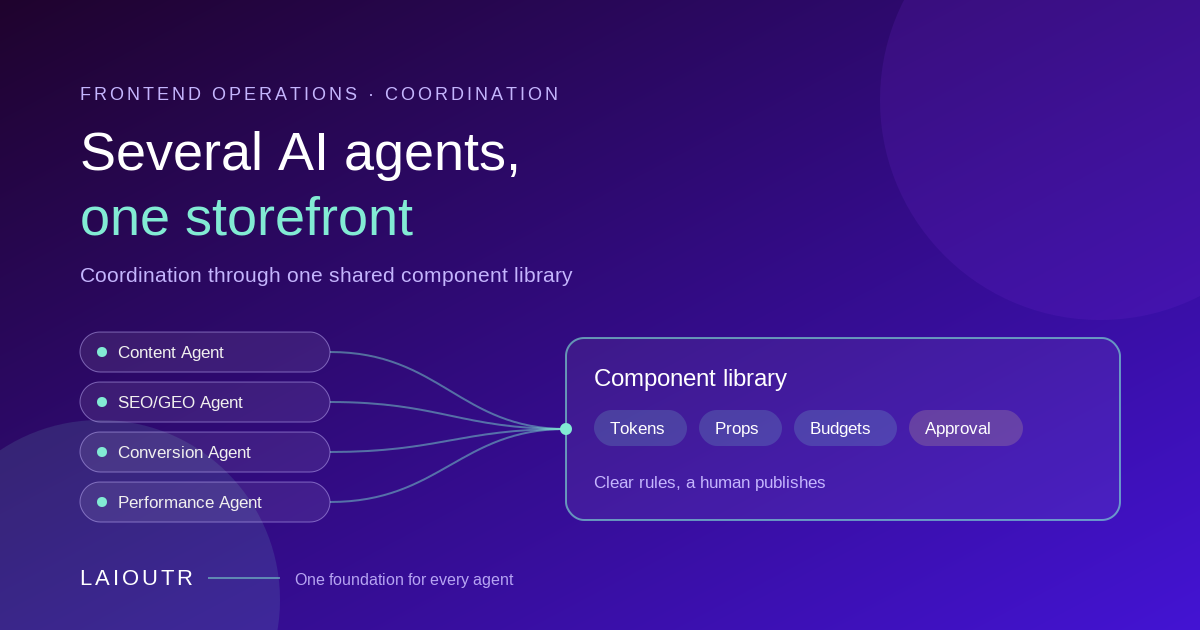Several AI Agents, One Storefront: Coordination Without Collisions
When several AI agents work on the same storefront, conflicts rarely happen between the agents thems…](https://www.laioutr.com/en/blog/frontend-operations-multi-agent-coordination-storefront-2026)
[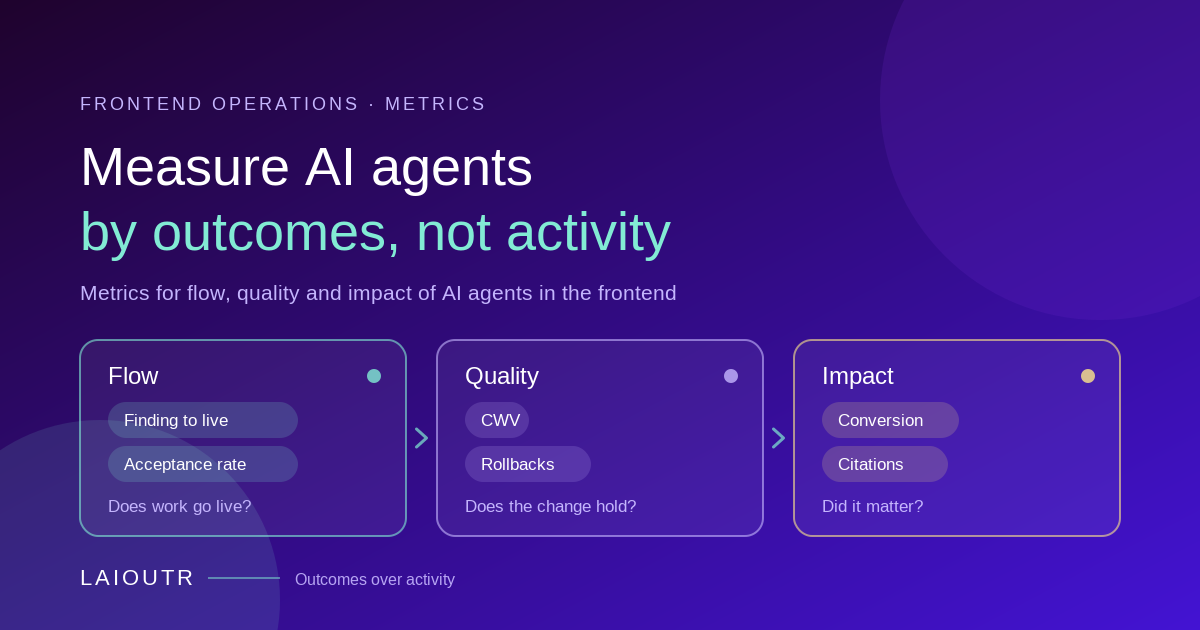Measuring AI Agents by Outcomes: Agentic Frontend Management Metrics
AI agents in the frontend should be measured by outcomes, not by activity. The number of prompts, ge…](https://www.laioutr.com/en/blog/frontend-operations-measuring-ai-agents-outcomes-2026)
[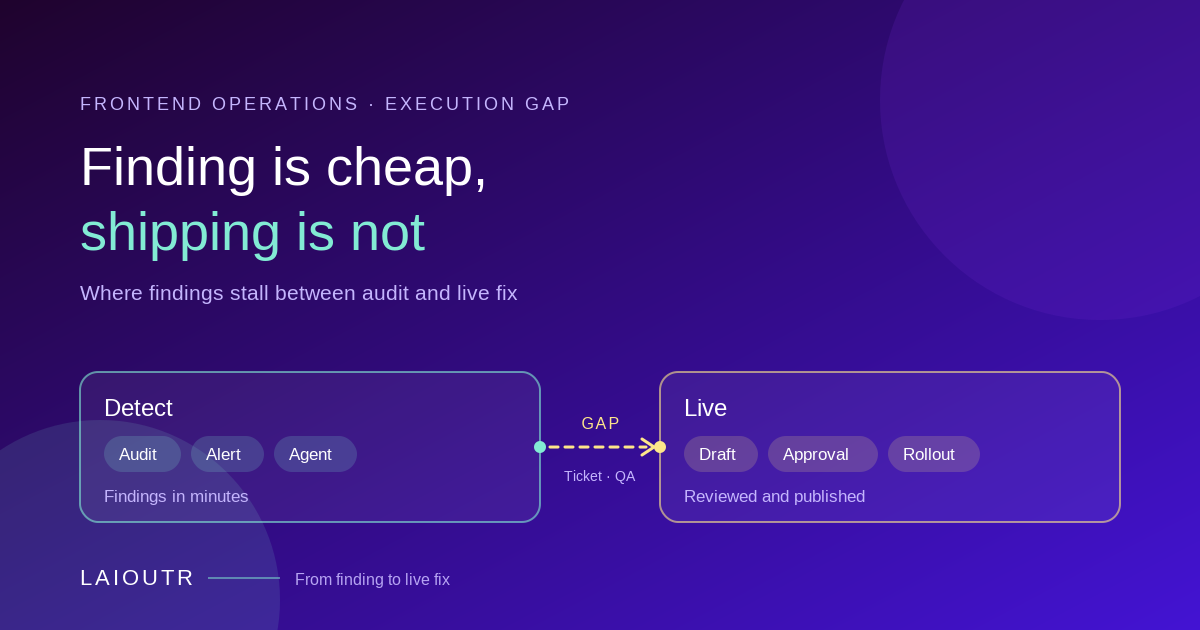The Execution Gap in the Frontend: Finding Is Cheap, Shipping Is Not
The execution gap in the frontend is the time, and the number of handoffs, between "we know wha…](https://www.laioutr.com/en/blog/frontend-operations-execution-gap-detect-vs-deploy-2026)
[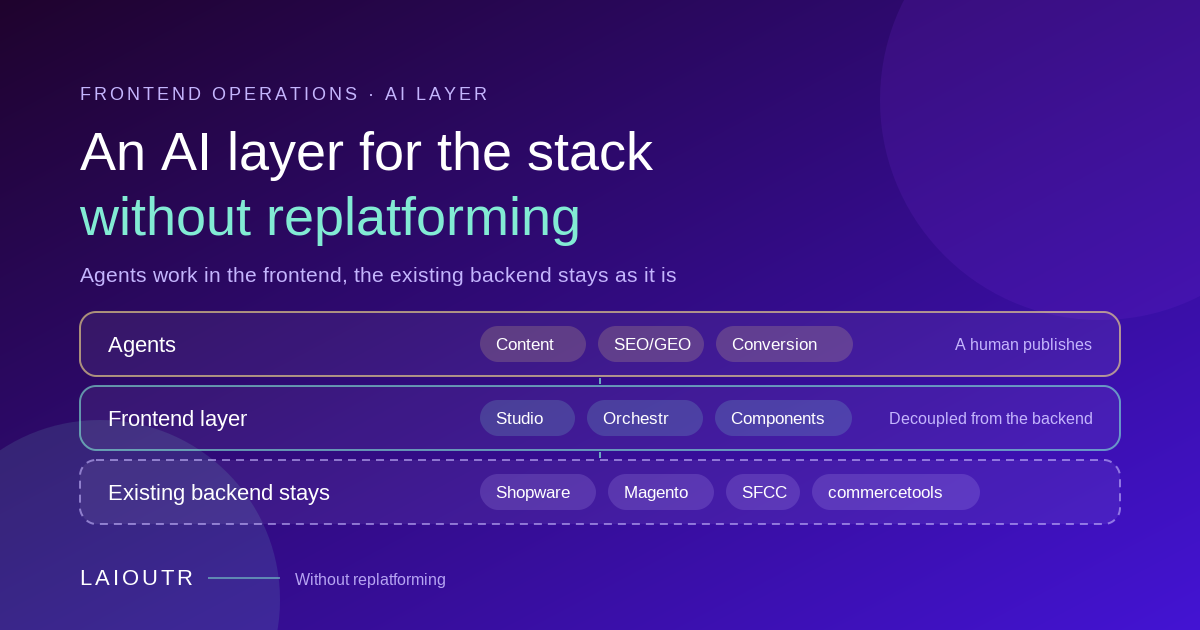Adding an AI Layer to an Existing Commerce Stack Without Replatforming
An AI layer can be added to an existing commerce stack without replacing the shop system. The most p…](https://www.laioutr.com/en/blog/frontend-operations-ai-layer-existing-stack-without-replatforming-2026)
[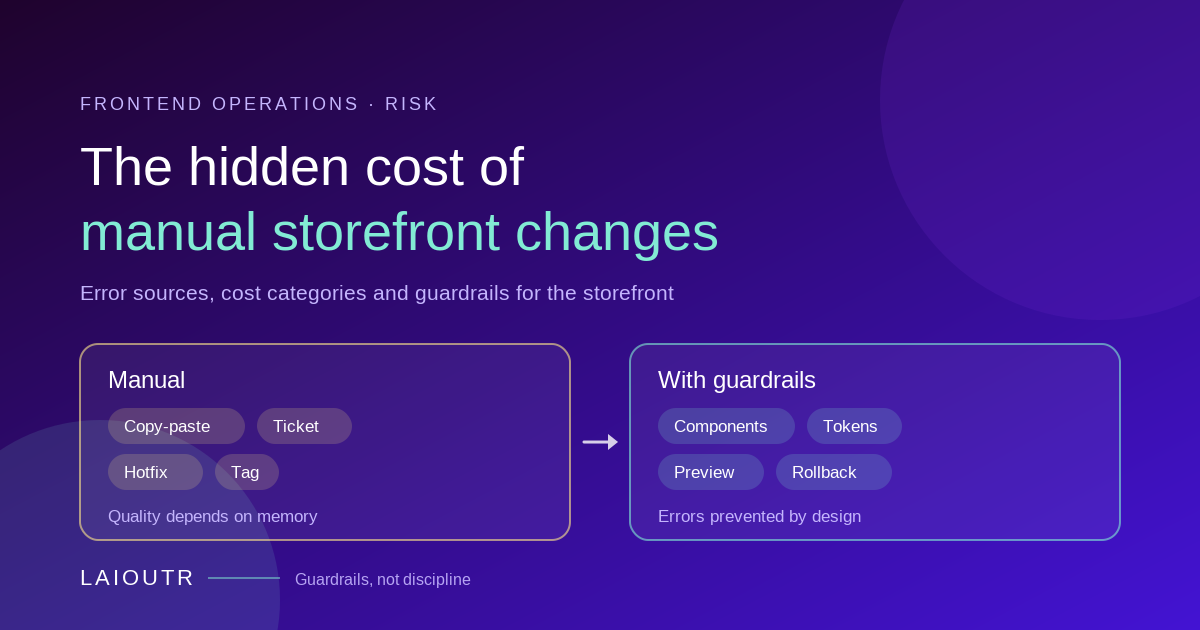The Hidden Cost of Manual Storefront Changes and How to Cut It
Manual frontend changes are the many small edits that keep a storefront running day to day: a new ba…](https://www.laioutr.com/en/blog/frontend-operations-hidden-cost-manual-storefront-changes-2026)
[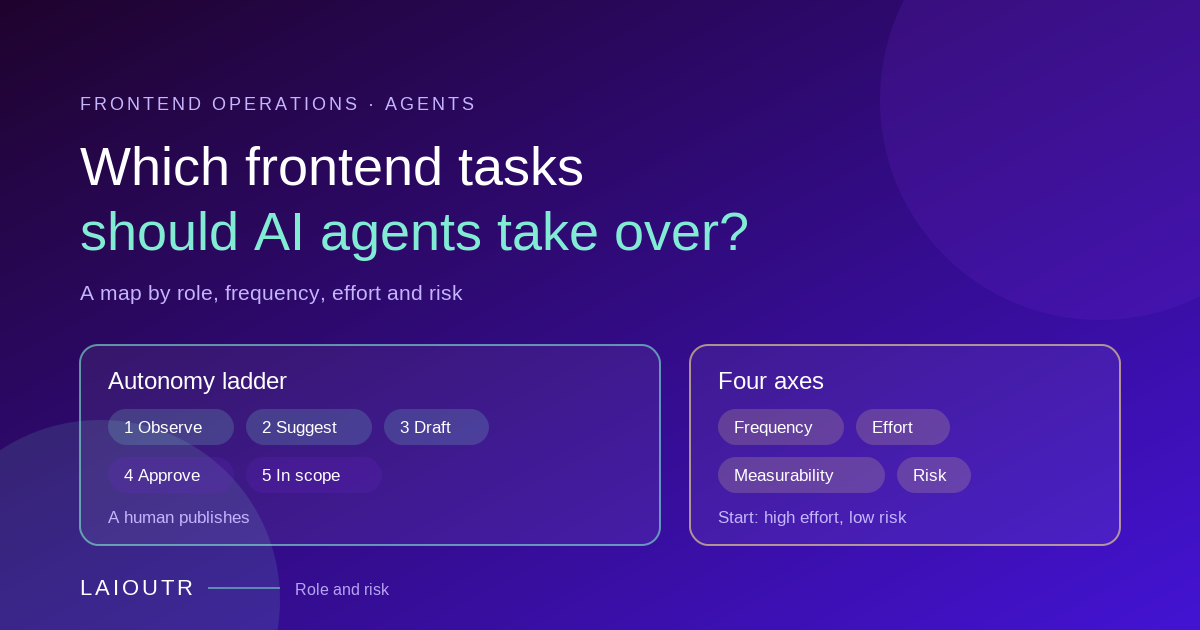Which Frontend Tasks Should AI Agents Take Over? Role and Risk Map
AI agents should first take over the frontend tasks that come up often, involve a lot of manual work…](https://www.laioutr.com/en/blog/frontend-operations-agent-task-map-role-risk-2026)
[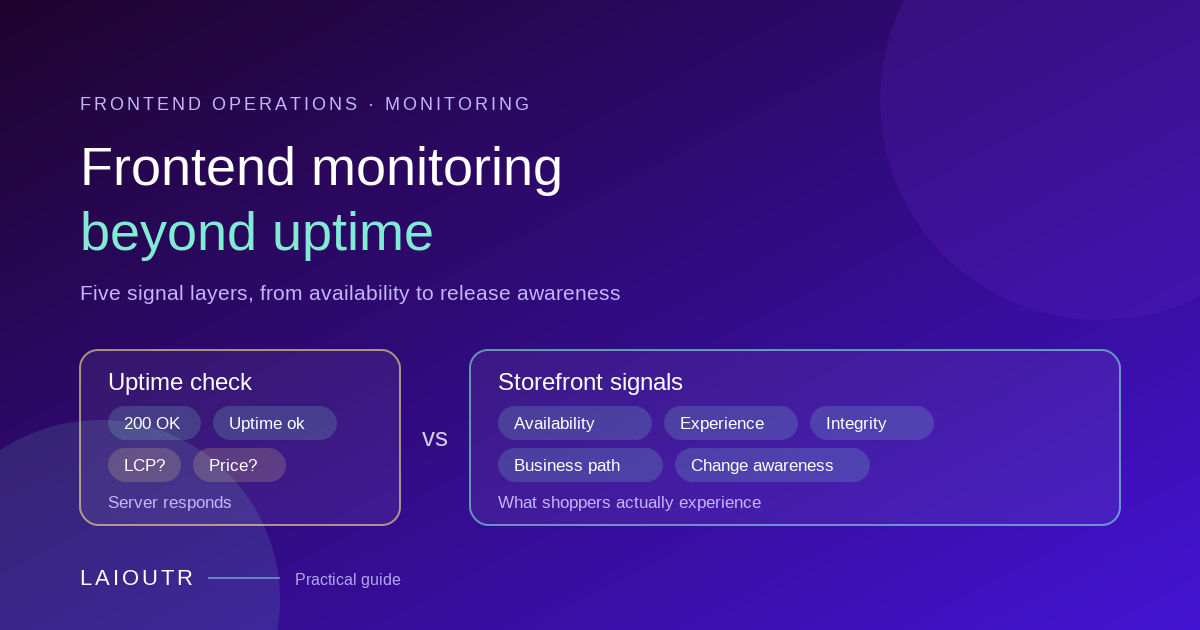Frontend Monitoring Beyond Uptime: Signals a Storefront Needs
Frontend monitoring beyond uptime means checking a storefront not only for availability but for what…](https://www.laioutr.com/en/blog/frontend-operations-monitoring-beyond-uptime-2026)
[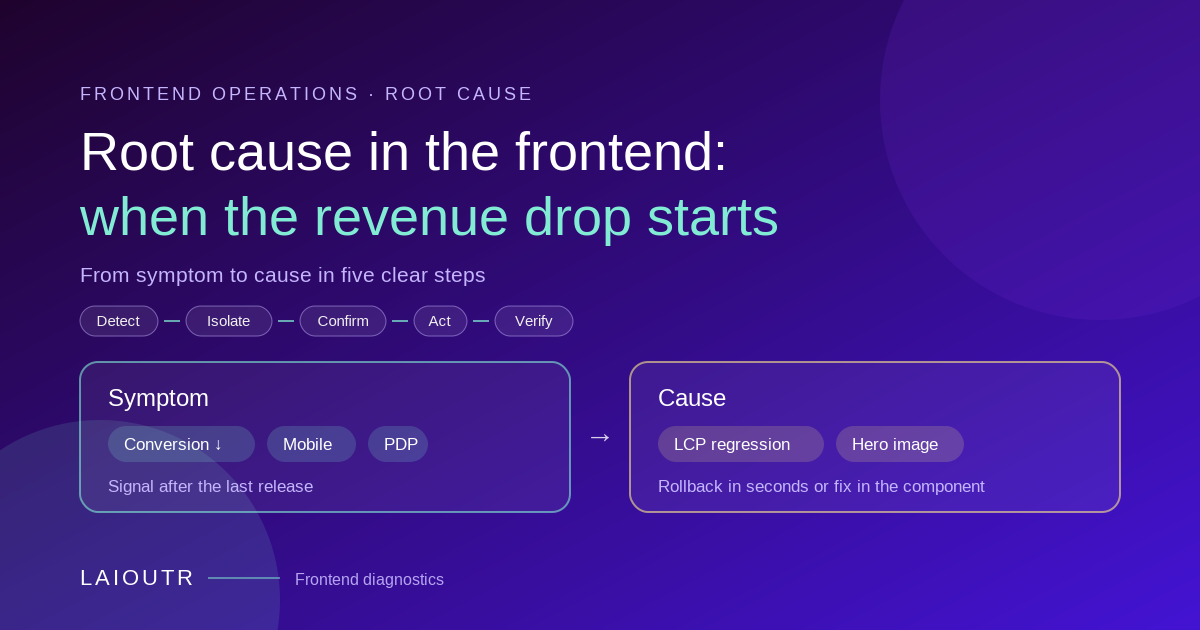Root Cause in the Frontend: When Revenue Drops Start in the Storefront
When revenue or conversion rate drops suddenly, the cause often is not traffic, pricing or the comme…](https://www.laioutr.com/en/blog/frontend-operations-root-cause-revenue-drop-storefront-2026)
[Laioutr Academy Is Live: The Video Manual for Laioutr
Since October 15, 2026, the Laioutr Academy has been live at academy.laioutr.com. It is the user man…](https://www.laioutr.com/en/blog/laioutr-academy-launch-video-manual-certification)
[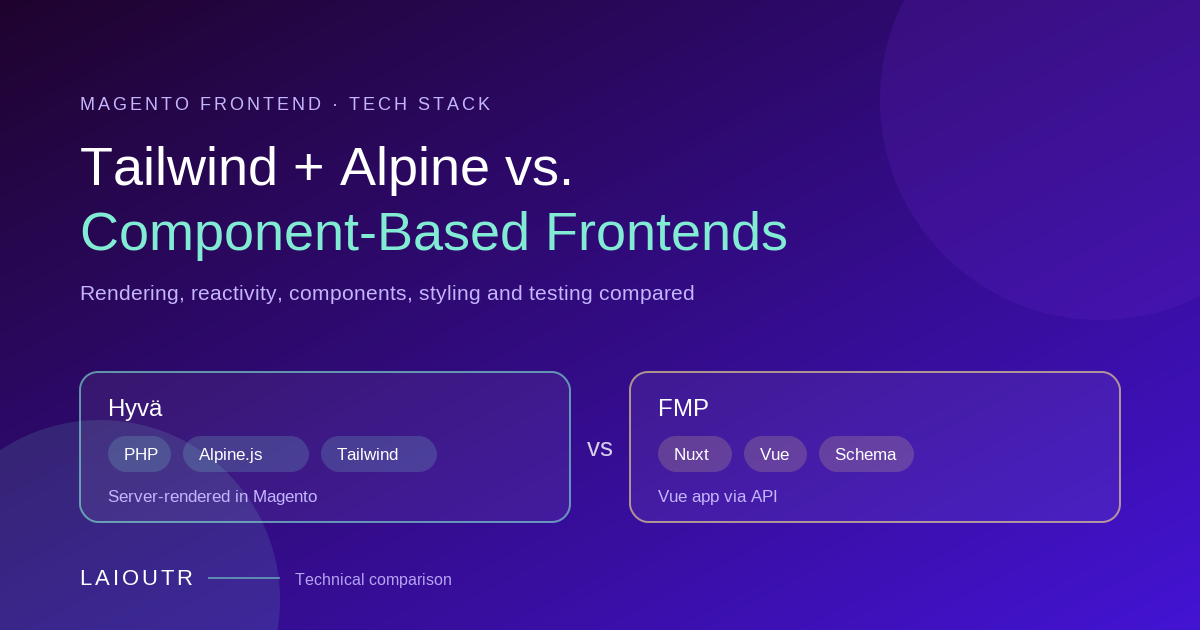Tailwind + Alpine vs. Component-Based Frontends for Magento
Hyvä renders Magento pages on the server with PHP templates and layout XML, adds interactivity throu…](https://www.laioutr.com/en/blog/tailwind-alpine-magento-vs-component-based-frontend-2026)
[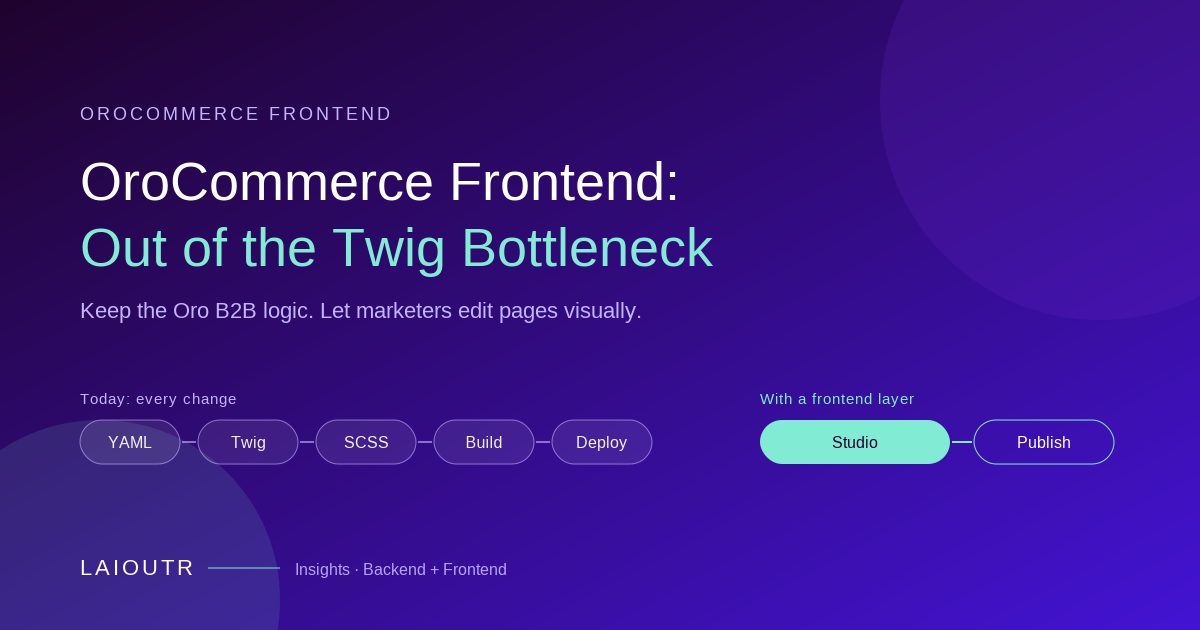OroCommerce Frontend: Out of the Twig and Layouts Bottleneck
The OroCommerce frontend is a server-rendered storefront built from Symfony bundles, OroLayouts and …](https://www.laioutr.com/en/blog/orocommerce-frontend-twig-layouts-bottleneck)
[One Magento Backend, Many Channels: Personalization in Practice
Personalization across web, mobile and voice on a single Magento backend does not start with a featu…](https://www.laioutr.com/en/blog/magento-multichannel-personalization-web-mobile-voice-2026)
[Edge Hosting for Storefronts: Caching That Holds Under Peak Load
Edge hosting keeps a storefront fast under load when most requests never reach the origin: pages and…](https://www.laioutr.com/en/blog/edge-hosting-storefronts-peak-traffic-caching-2026)
[Composable Commerce 2027: What Shifted and What Comes Next
Composable commerce enters 2027 with a different agenda than a year ago. The architecture question i…](https://www.laioutr.com/en/blog/composable-commerce-2027-outlook)
[AI Engagement and Conversion: Personalization on the Frontend
AI-driven engagement and conversion on the frontend rests on five mechanics: segments decide who see…](https://www.laioutr.com/en/blog/ai-engagement-conversion-frontend-personalization)
## Apps for the Laioutr platform
[View all apps](https://www.laioutr.com/en/apps)
[](https://www.laioutr.com/en/apps/shopify)
Laioutr
[Shopify](https://www.laioutr.com/en/apps/shopify)
Shopify is a commerce platform for selling online and in physical retail.
[](https://www.laioutr.com/en/apps/shopware)
Laioutr
[Shopware](https://www.laioutr.com/en/apps/shopware)
Shopware is a flexible ecommerce platform from Europe for product catalogs and omnichannel commerce.
[](https://www.laioutr.com/en/apps/adobe-commerce)
Laioutr
[Adobe Commerce](https://www.laioutr.com/en/apps/adobe-commerce)
Adobe Commerce is an enterprise commerce platform for complex, global B2C and B2B scenarios.
Planned
[](https://www.laioutr.com/en/apps/b2b-sellers)
Laioutr
[B2Bsellers](https://www.laioutr.com/en/apps/b2b-sellers)
B2B suite for Shopware that turns an online store into a professional B2B commerce platform.
Planned
[](https://www.laioutr.com/en/apps/commerce-layer)
Laioutr
[Commerce Layer](https://www.laioutr.com/en/apps/commerce-layer)
Commerce Layer is a headless commerce platform for making inventory and catalogs available online.
[](https://www.laioutr.com/en/apps/commercetools)
Laioutr
[Commercetools](https://www.laioutr.com/en/apps/commercetools)
Commercetools is a SaaS-based headless ecommerce platform used worldwide.
[](https://www.laioutr.com/en/apps/emporix)
Laioutr
[Emporix](https://www.laioutr.com/en/apps/emporix)
Emporix is a composable, API-first commerce platform for scalable B2B and B2C scenarios.
Planned
[](https://www.laioutr.com/en/apps/hcl-software)
Laioutr
[HCL Software](https://www.laioutr.com/en/apps/hcl-software)
Enterprise suite for digital commerce and experience with extensive configurability.
Planned
[](https://www.laioutr.com/en/apps/intershop)
Laioutr
[Intershop](https://www.laioutr.com/en/apps/intershop)
Enterprise commerce platform for complex B2B and B2C business models.
Planned
[](https://www.laioutr.com/en/apps/magento-2)
Laioutr
[Magento 2](https://www.laioutr.com/en/apps/magento-2)
Widely used, extensible commerce platform for B2C and B2B scenarios.
[](https://www.laioutr.com/en/apps/oxid-eshop)
Laioutr
[OXID eShop](https://www.laioutr.com/en/apps/oxid-eshop)
OXID eShop is an extensible commerce platform for complex B2B and B2C requirements.
Planned
[](https://www.laioutr.com/en/apps/patchworks)
Laioutr
[Patchworks](https://www.laioutr.com/en/apps/patchworks)
Patchworks is a low-code iPaaS that connects ecommerce, ERP, WMS, 3PL, and marketplaces.
Planned
[](https://www.laioutr.com/en/apps/PrestaShop)
Laioutr
[Prestashop](https://www.laioutr.com/en/apps/PrestaShop)
Open-source commerce platform for small and midsize merchants in Europe and beyond.
Planned
[](https://www.laioutr.com/en/apps/saleor)
Laioutr
[Saleor](https://www.laioutr.com/en/apps/saleor)
Open-source, API-first commerce platform built on GraphQL for custom storefronts.
Planned
[](https://www.laioutr.com/en/apps/salesforce-commerce-cloud)
Laioutr
[Salesforce Commerce Cloud](https://www.laioutr.com/en/apps/salesforce-commerce-cloud)
Salesforce Commerce Cloud is a cloud-based enterprise commerce platform for businesses of any size.
Planned
[](https://www.laioutr.com/en/apps/sap-commerce-cloud)
Laioutr
[SAP Commerce Cloud](https://www.laioutr.com/en/apps/sap-commerce-cloud)
Enterprise commerce platform for complex catalogs, pricing models, and omnichannel journeys.
Planned
[](https://www.laioutr.com/en/apps/scayle)
Laioutr
[Scayle](https://www.laioutr.com/en/apps/scayle)
SCAYLE is a commerce engine that helps brands and retailers scale their business.
Planned
[](https://www.laioutr.com/en/apps/spryker)
Laioutr
[Spryker](https://www.laioutr.com/en/apps/spryker)
Composable commerce platform for sophisticated B2B and B2C business models.
[](https://www.laioutr.com/en/apps/sylius)
Laioutr
[Sylius](https://www.laioutr.com/en/apps/sylius)
Sylius is a developer-friendly ecommerce framework for B2C and B2B shopping experiences.
Planned
[](https://www.laioutr.com/en/apps/vendure)
Laioutr
[Vendure](https://www.laioutr.com/en/apps/vendure)
Vendure is a headless commerce platform for businesses with complex requirements.
Coming Soon
[](https://www.laioutr.com/en/apps/vtex)
Laioutr
[VTEX](https://www.laioutr.com/en/apps/vtex)
Cloud-native, composable commerce platform for B2B and B2C at scale.
Planned
[](https://www.laioutr.com/en/apps/websale)
Laioutr
[Websale](https://www.laioutr.com/en/apps/websale)
Stable, enterprise-ready commerce backend for complex retail environments.

Strategy call
## The frontend as a control layer
A conversation about stack, roadmap and replatforming scenario. The outcome: a clear picture of how Laioutr fits, what it costs and how fast the go-live can happen.
*"After 30 minutes, we knew Laioutr makes our replatforming feasible."*
*Daniel B., CEO,* [*hygibox.de*](https://hygibox.de)
[Book a demo](https://www.laioutr.com/en/contact)
## Structured Data
```json
{
"@context": "https://schema.org",
"@graph": [
{
"@type": "Organization",
"@id": "https://www.laioutr.com/#identity",
"name": "Laioutr",
"legalName": "Laioutr GmbH",
"url": "https://www.laioutr.com/",
"logo": {
"@type": "ImageObject",
"url": "https://www.laioutr.com/laioutr-logo.png",
"width": 400,
"height": 400
},
"email": "info@laioutr.com",
"telephone": "+49 30 75435715",
"address": {
"@type": "PostalAddress",
"streetAddress": "Münchweilersteig 5",
"postalCode": "12559",
"addressLocality": "Berlin",
"addressCountry": "DE"
},
"vatID": "DE450905846",
"sameAs": [
"https://www.linkedin.com/company/laioutr",
"https://www.youtube.com/@Laioutr",
"https://x.com/laioutr"
]
},
{
"@type": "WebSite",
"@id": "https://www.laioutr.com/en/#website",
"url": "https://www.laioutr.com/en/",
"name": "Laioutr",
"inLanguage": "en",
"publisher": {
"@id": "https://www.laioutr.com/#identity"
}
},
{
"@type": "BlogPosting",
"@id": "https://www.laioutr.com/en/blog/ecommerce-code-quality#article",
"headline": "The Stability Debt in Headless Commerce: Why Your Storefront Keeps Breaking the Same Way",
"description": "Why your headless storefront keeps breaking the same way: understanding and paying down stability debt.",
"image": [
"https://eu-west-2.graphassets.com/cmii2mlqi0dux06l5543v7nkc/cmnucypviw8mi07mgmwsd5asa"
],
"datePublished": "2026-10-26T10:26:24.082104+00:00",
"dateModified": "2026-10-26T10:26:21.418454+00:00",
"inLanguage": "en",
"articleSection": "Insights",
"keywords": "Industry & Trends",
"author": {
"@type": "Person",
"name": "Marcel Thiesies",
"jobTitle": "Co-Founder & CEO, Laioutr",
"image": "https://eu-west-2.graphassets.com/cmii2mlqi0dux06l5543v7nkc/cmj01b962364n07lb0iguvts5"
},
"publisher": {
"@id": "https://www.laioutr.com/#identity"
},
"mainEntityOfPage": {
"@id": "https://www.laioutr.com/en/blog/ecommerce-code-quality#webpage"
},
"isPartOf": {
"@id": "https://www.laioutr.com/en/#website"
}
},
{
"@type": "WebPage",
"@id": "https://www.laioutr.com/en/blog/ecommerce-code-quality#webpage",
"url": "https://www.laioutr.com/en/blog/ecommerce-code-quality",
"name": "The Stability Debt in Headless Commerce: Why Your Storefront Keeps Breaking the Same Way",
"description": "Why your headless storefront keeps breaking the same way: understanding and paying down stability debt.",
"inLanguage": "en",
"isPartOf": {
"@id": "https://www.laioutr.com/en/#website"
},
"breadcrumb": {
"@id": "https://www.laioutr.com/en/blog/ecommerce-code-quality#breadcrumb"
},
"primaryImageOfPage": {
"@type": "ImageObject",
"url": "https://eu-west-2.graphassets.com/cmii2mlqi0dux06l5543v7nkc/cmnucypviw8mi07mgmwsd5asa"
},
"datePublished": "2026-10-26T10:26:24.082104+00:00",
"dateModified": "2026-10-26T10:26:21.418454+00:00",
"mainEntity": {
"@id": "https://www.laioutr.com/en/blog/ecommerce-code-quality#article"
}
},
{
"@type": "BreadcrumbList",
"@id": "https://www.laioutr.com/en/blog/ecommerce-code-quality#breadcrumb",
"itemListElement": [
{
"@type": "ListItem",
"position": 1,
"name": "Laioutr",
"item": "https://www.laioutr.com/en/"
},
{
"@type": "ListItem",
"position": 2,
"name": "Insights",
"item": "https://www.laioutr.com/en/blogs/insights"
},
{
"@type": "ListItem",
"position": 3,
"name": "The Stability Debt in Headless Commerce: Why Your Storefront Keeps Breaking the Same Way"
}
]
}
]
}
```