---
title: "Eliminate Developer Bottlenecks"
canonical_url: "https://www.laioutr.com/en/blog/eliminate-developer-bottlenecks"
locale: en
meta:
description: "Developer bottlenecks tax business agility. See why decoupling the frontend wins in the new era of product velocity."
"og:description": "Developer bottlenecks tax business agility. See why decoupling the frontend wins in the new era of product velocity."
"og:title": "Eliminate Developer Bottlenecks"
---

# The Hidden Cost of Developer Bottlenecks: Why Decoupling Wins in the New Era of Product Velocity
Table of contents
1. [1.The Invisible Tax on Business Agility](#the-invisible-tax-on-business-agility)
2. [2.Understanding the Real Source of Bottlenecks](#understanding-the-real-source-of-bottlenecks)
3. [3.Why Traditional Solutions Fail](#why-traditional-solutions-fail)
4. [4.Decoupling as Competitive Strategy](#decoupling-as-competitive-strategy)
5. [5.Practical Implementation Across Business Processes](#practical-implementation-across-business-processes)
6. [6.The Competitive Advantage Emerges Over Time](#the-competitive-advantage-emerges-over-time)
7. [7.Decoupling Requires Architectural Vision](#decoupling-requires-architectural-vision)
8. [8.Measuring Progress and Impact](#measuring-progress-and-impact)
9. [9.Conclusion: Decoupling as Foundational Strategy](#conclusion-decoupling-as-foundational-strategy)
## The Invisible Tax on Business Agility
Every organization faces a fundamental constraint that rarely appears in quarterly earnings calls or investor presentations: the invisible queue of requests waiting for developer attention. Marketing campaigns delayed three weeks. Product feature launches pushed past optimal market windows. Customer success teams unable to customize workflows without engineering tickets. The cost accumulates silently, measured not in capital expenditure but in missed opportunities.
This constraint operates differently than traditional manufacturing bottlenecks. You cannot solve it through hiring alone. You cannot solve it through longer hours. The constraint exists because fundamental architectural decisions couple business operations to technical implementation, making every small change a negotiation between domains that speak different languages.
The companies winning in 2026 have recognized this pattern and architected their way out of it. They have not eliminated developers or reduced their strategic importance. Instead, they have fundamentally redesigned how business operations and technical systems interact, creating genuine autonomy where dependencies once required constant coordination.
## Understanding the Real Source of Bottlenecks
Most organizations diagnose developer bottlenecks incorrectly. The instinct is to point at insufficient headcount or poor project management. Leadership looks at sprint velocity metrics, measures developer productivity, and concludes the problem is resource allocation. This analysis misses the root cause entirely.
The actual bottleneck emerges from architectural choices made years ago, often without explicit awareness. When content management systems require backend modifications for layout changes. When personalization logic lives embedded in frontend code. When A/B testing infrastructure depends on deploying new code. When customer configuration demands custom development. These decisions create a structural dependency where non-technical teams cannot operate independently.
Consider a practical example: A B2B SaaS company wants to test different call-to-action button colors on their landing page. Sounds simple. In companies with healthy architecture, this task takes thirty minutes. Marketing changes a configuration value, sees the change live immediately, collects conversion data within days. In companies with coupled architecture, this becomes a three-week process. Request submitted as a ticket. Prioritized against other work. Implemented by a developer. Deployed through the standard release process. Possibly reverted if the change breaks something. The actual technical work takes an hour. The organizational overhead takes three weeks.
Multiply this scenario across hundreds of initiatives annually: campaign timing adjustments, regional content customization, feature flag toggles, personalization rules, customer-specific workflows, pricing structure updates. Each one individually small. Collectively they represent months of developer time spent on non-strategic work, creating a persistent queue of blocked business requests.
## Why Traditional Solutions Fail
Organizations typically respond to bottleneck problems through three ineffective approaches that fail to address root causes.
The first approach is hiring more developers. This temporarily increases throughput but maintains the fundamental dependency structure. You employ more people to do essentially the same work. The constraint shifts but does not disappear. And expensive developers spend their time on low-complexity business logic rather than architectural innovation. This approach optimizes for short-term metrics while sacrificing long-term strategic capability.
The second approach involves adopting low-code platforms that promise business teams can build without developers. These tools reduce the coding requirement but often create a different bottleneck: reliance on specialized configuration knowledge and vendor lock-in. Non-technical teams still cannot truly operate independently when systems require understanding proprietary tools and custom logic flows. The bottleneck shifts location rather than disappearing.
The third approach attempts to formalize and streamline the request process: improving ticketing systems, implementing SLA commitments, establishing prioritization frameworks. This approach treats the symptom while accepting the disease. A more efficient queue is still a queue. Formalizing dependency does not eliminate it.
All three approaches share a critical flaw: they accept the architectural reality that business operations depend on developer implementation. They work within that constraint rather than eliminating it.
## Decoupling as Competitive Strategy
The architectural pattern that solves developer bottlenecks is systematic decoupling. This means consciously separating business logic from technical implementation, creating clear boundaries where business teams can operate independently.
Decoupling operates across multiple dimensions simultaneously.
First, it separates content and configuration from code. Rather than embedding business rules in application logic, businesses should expose configuration interfaces where non-developers can modify behavior. Marketing can adjust targeting rules without code changes. Customer success can customize workflows without backend modifications. Product teams can enable feature flags without deploying new versions.
Second, it separates experience logic from data models. The visual experience users encounter should not require changes to underlying data architecture. When you decide to redesign a customer dashboard or reorganize navigation, this should not demand database migrations or API refactoring. Experience logic and data persistence should operate independently.
Third, it separates business rules from infrastructure. Pricing logic, commission structures, promotional rules, approval workflows: these should live in interpretable rule engines rather than buried in application code. When business rules change, business teams should be able to update them directly.
Fourth, it separates deployment from release. An organization can deploy code changes to production without immediately releasing them to customers. This allows developers and business teams to work on different cadences. Developers deploy finished work throughout the day. Business teams release changes when strategically optimal, regardless of development cycles.
This systematic decoupling achieves something remarkable: it makes business agility a property of architecture rather than a function of developer availability. Business teams gain genuine operational autonomy. Developers focus on strategic initiatives rather than mechanical implementation. Both benefit.
## Practical Implementation Across Business Processes
Applying decoupling principles requires examining specific business processes and identifying where dependencies create unnecessary constraints.
Marketing and campaign management typically generates the highest volume of developer requests. Decoupling this domain means separating campaign logic from infrastructure. Marketing teams should control targeting rules, messaging variants, scheduling, and performance analysis without developer involvement. Campaign infrastructure becomes a platform that marketers operate rather than a system developers build for them.
Product configuration frequently creates bottlenecks in B2B companies. Customers with unique requirements submit custom modification requests, translating to development tickets. Decoupling means building configuration systems where customers or customer success teams can modify their experience without custom code. Not every configuration should be supported, but the most common variations should be self-service.
Personalization and experience variants generate significant developer involvement. Decoupling means separating the decision logic (who should see what experience) from the technical implementation (delivering that experience). Business analysts should be able to define personalization rules. Rule engines should execute those rules across the platform without requiring code changes.
Data integration and workflow automation also produce bottlenecks. Rather than building custom integrations for each customer or partner need, organizations should expose automation frameworks where business teams can define workflows. Webhook systems, event streaming, and templated integration patterns enable autonomy without requiring developer implementation for every scenario.
The common thread across these examples: business domains operate through exposed interfaces and configuration systems rather than requesting custom development. Non-developers engage with their domain through tools and platforms designed for that purpose.
## The Competitive Advantage Emerges Over Time
Organizations that successfully decouple their architecture experience compounding advantages that compound across months and years.
In the first three months, the benefit appears modest: certain routine requests complete faster. Marketing campaigns launch slightly quicker. Some customer requests get resolved without developer involvement. Useful but not transformational.
By six months, patterns emerge. Teams recognize they can experiment more frequently. A/B testing becomes part of the normal workflow rather than an expensive request. Customer success can iterate on implementations without waiting for development cycles. Product teams can run rapid validation cycles on proposed features. The pace of experimentation increases measurably.
By twelve months and beyond, the strategic advantage becomes clear. Organizations with decoupled architecture move faster. They respond to competitive threats more quickly. They capitalize on market opportunities before competitors react. Customer-facing teams have operational autonomy. They make decisions without waiting for technical approval. Developers work on genuinely difficult problems rather than mechanical implementation.
This advantage matters particularly in volatile markets. When market conditions shift rapidly, organizational agility becomes a critical competitive factor. Companies that can modify their approach instantly gain meaningful advantage over companies whose every change requires development cycles.
The financial benefit compounds as well. Developer capacity freed from routine requests applies to infrastructure improvement, scaling challenges, and feature development. The cost per business change declines. Time to market improves. Organizational responsiveness increases.
Most importantly, decoupling changes how organizations view their developers. Rather than bottlenecks constraining business progress, they become strategic resources solving genuinely difficult problems. This shift improves both developer satisfaction and business outcomes.
## Decoupling Requires Architectural Vision
Successfully eliminating developer bottlenecks demands something that cannot be purchased or hired: architectural vision aligned across the organization. Leadership must explicitly acknowledge that current dependencies represent a strategic problem requiring structural solutions.
This vision typically begins in technical leadership, but it must expand beyond engineering. Product leadership must embrace the principle that business teams should have direct control over their domains. Operations and finance must support the investment required to build decoupled systems rather than demanding short-term cost minimization. Marketing and customer-facing teams must engage in defining interfaces and configuration systems rather than simply requesting features.
The actual implementation varies across organizations based on their technology stack, organizational structure, and current architecture. There is no universal solution. But the principle remains consistent: identify the dependencies that create bottlenecks, design interfaces that provide autonomy, and systematically move business logic out of application code into configuration layers.
This is not a short-term project. Decoupling architecture takes quarters or years depending on the current state. But every step of progress delivers measurable improvement in organizational agility and developer satisfaction.
## Measuring Progress and Impact
Organizations implementing decoupling should track specific metrics that demonstrate the value of reducing developer bottlenecks.
Time-to-completion for routine business requests provides an immediate measure. Track how long it takes to modify campaigns, adjust configurations, customize customer experiences, or implement marketing changes. As decoupling progresses, this metric should decline sharply for routine work while staying relatively constant for complex development work.
Developer allocation to routine versus strategic work shows whether engineering capacity is being redirected appropriately. If developers spend the majority of their time on routine modifications and configuration requests, decoupling is not progressing. Success means developers focused on complex problems.
Experiment velocity measures how quickly teams can validate new ideas. Decoupled organizations should run significantly more experiments because trying variations does not require development cycles. Higher experiment volume typically correlates with faster learning and better outcomes.
Request fulfillment rate shows what percentage of business requests complete without developer involvement. Organizations should track this increasing substantially as decoupling progresses.
Finally, time-to-market for significant initiatives provides a business-level metric. Organizations with decoupled architecture should consistently launch features, campaigns, and customer initiatives faster than their decoupled counterparts.
## Conclusion: Decoupling as Foundational Strategy
The developers in your organization are not the constraint. The architecture is. Constraints emerge from design decisions that couple business operations to technical implementation. Solving this problem requires recognizing it as an architectural issue requiring architectural solutions, not a resource issue requiring more hiring.
Organizations that systematically decouple their architecture unlock genuine competitive advantages. Business teams gain operational autonomy. Developers focus on strategic problems. Organizations respond faster to market opportunities. Customers experience more rapid innovation.
This shift does not happen overnight. It requires intentional architectural vision, coordinated effort across technical and business domains, and sustained commitment to principles that prioritize autonomy and decoupling.
But the competitive advantage is real. In an era where market responsiveness increasingly determines success, the ability to move fast without waiting for approval or technical implementation becomes a fundamental strategic differentiator. Organizations that successfully decouple their architecture will increasingly dominate their markets. Those that remain stuck in coupled, dependent structures will find themselves progressively left behind.
The question is not whether to address developer bottlenecks. The question is when you will start.
### **More from the Laioutr Platform**
- [Composable Headless Frontend](https://www.laioutr.com/en/composable-headless-frontend)
- [SEO and GEO](https://www.laioutr.com/en/product/seo-and-geo)
- [Agentic Frontend Management Platform](https://www.laioutr.com/en/agentic-frontend-management-platform)
Related reading: [From Dev Bottlenecks to Frontend Flow: How Laioutr Empowers Your Whole Team](https://www.laioutr.com/en/blog/from-dev-bottlenecks-to-frontend-flow-how-laioutr-empowers-your-whole-team) and [The Hidden Costs of eCommerce Frontends (and How to Eliminate Them)](https://www.laioutr.com/en/blog/the-hidden-costs-of-ecommerce-frontends-and-how-to-eliminate-them).
---
Share this article
[Share on Facebook](https://www.facebook.com/sharer/sharer.php?u=https%3A%2F%2Fwww.laioutr.com%2Fen%2Fblog%2Feliminate-developer-bottlenecks) [Share on X](https://x.com/intent/post?url=https%3A%2F%2Fwww.laioutr.com%2Fen%2Fblog%2Feliminate-developer-bottlenecks&text=) [Share on LinkedIn](https://www.linkedin.com/sharing/share-offsite/?url=https%3A%2F%2Fwww.laioutr.com%2Fen%2Fblog%2Feliminate-developer-bottlenecks) [Share on Pinterest](https://pinterest.com/pin/create/button/?url=https%3A%2F%2Fwww.laioutr.com%2Fen%2Fblog%2Feliminate-developer-bottlenecks&description=) [Share via email](mailto:?subject=&body=%0A%0Ahttps%3A%2F%2Fwww.laioutr.com%2Fen%2Fblog%2Feliminate-developer-bottlenecks)
## More articles on frontend and headless
Practical know-how for frontend development, smart agents, and headless
[To the blog](https://www.laioutr.com/en/blogs/insights)
[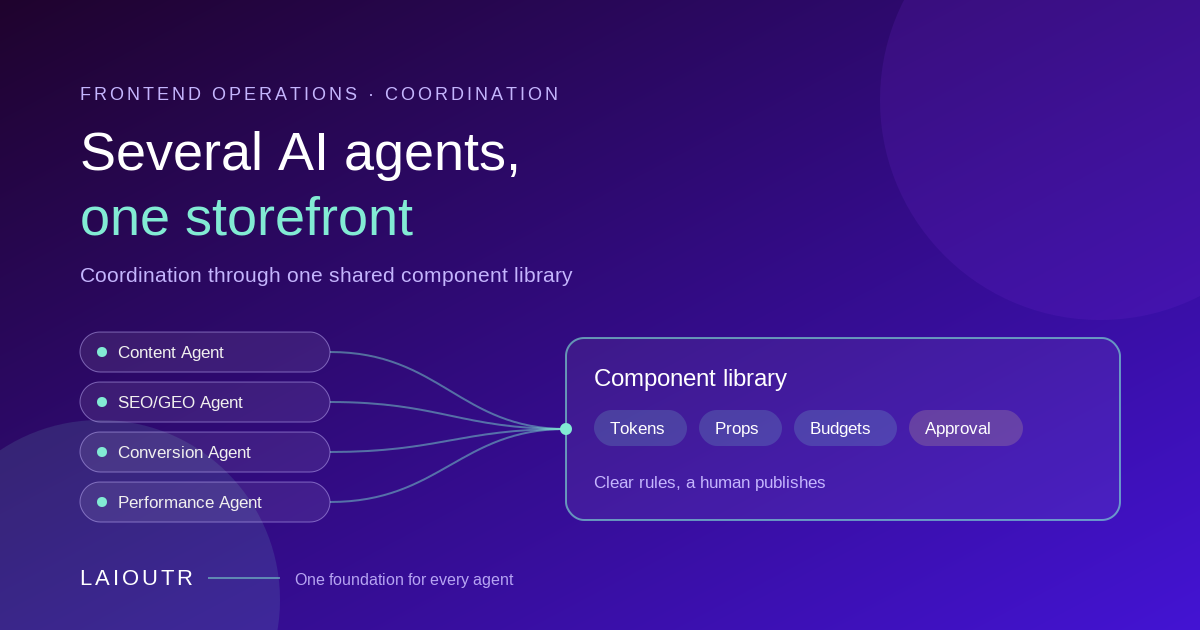Several AI Agents, One Storefront: Coordination Without Collisions
When several AI agents work on the same storefront, conflicts rarely happen between the agents thems…](https://www.laioutr.com/en/blog/frontend-operations-multi-agent-coordination-storefront-2026)
[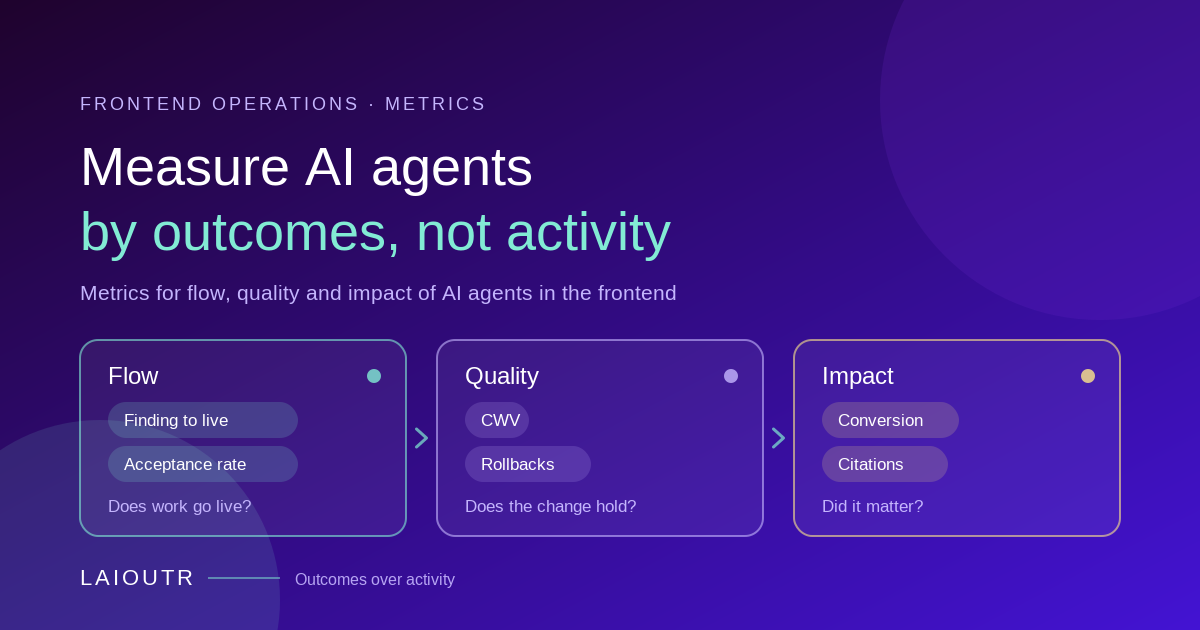Measuring AI Agents by Outcomes: Agentic Frontend Management Metrics
AI agents in the frontend should be measured by outcomes, not by activity. The number of prompts, ge…](https://www.laioutr.com/en/blog/frontend-operations-measuring-ai-agents-outcomes-2026)
[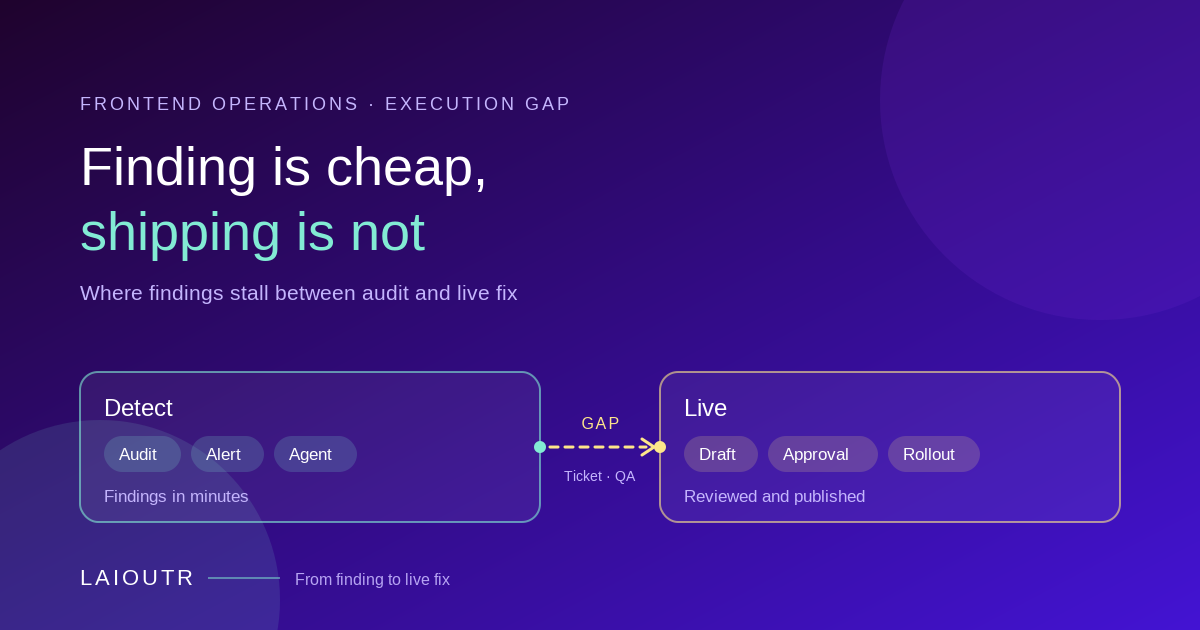The Execution Gap in the Frontend: Finding Is Cheap, Shipping Is Not
The execution gap in the frontend is the time, and the number of handoffs, between "we know wha…](https://www.laioutr.com/en/blog/frontend-operations-execution-gap-detect-vs-deploy-2026)
[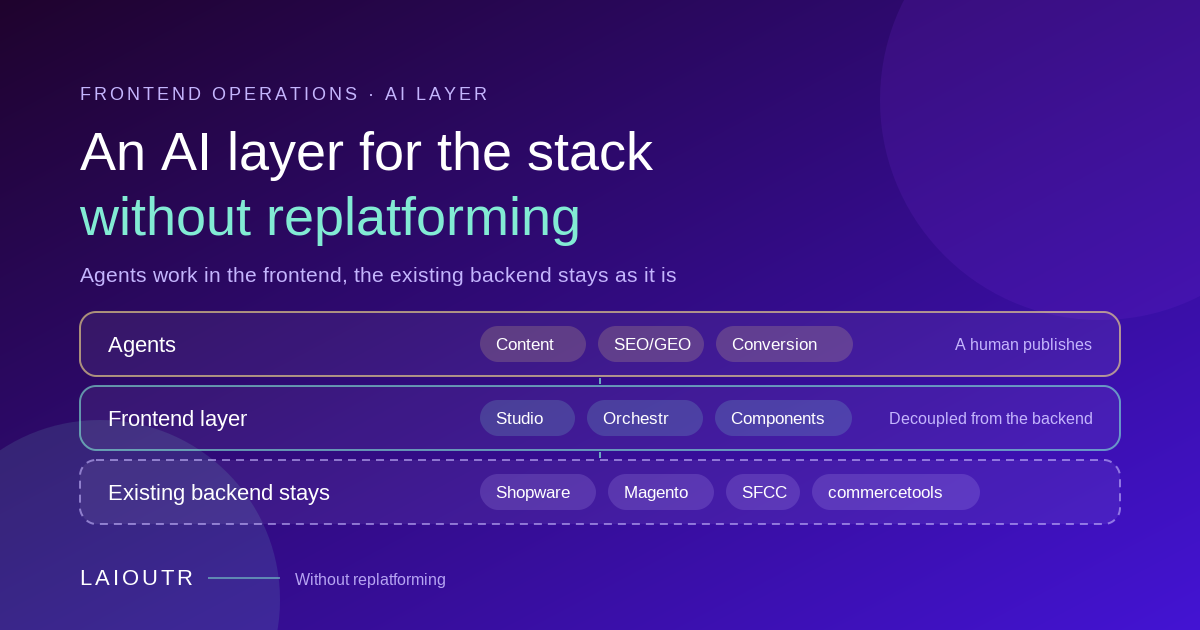Adding an AI Layer to an Existing Commerce Stack Without Replatforming
An AI layer can be added to an existing commerce stack without replacing the shop system. The most p…](https://www.laioutr.com/en/blog/frontend-operations-ai-layer-existing-stack-without-replatforming-2026)
[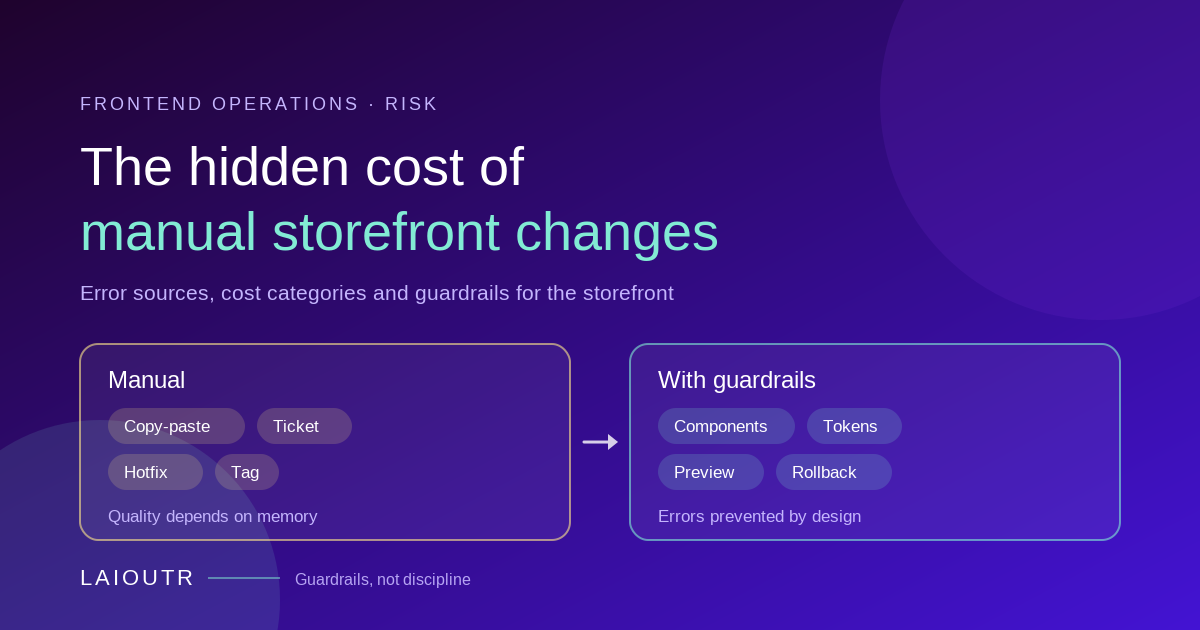The Hidden Cost of Manual Storefront Changes and How to Cut It
Manual frontend changes are the many small edits that keep a storefront running day to day: a new ba…](https://www.laioutr.com/en/blog/frontend-operations-hidden-cost-manual-storefront-changes-2026)
[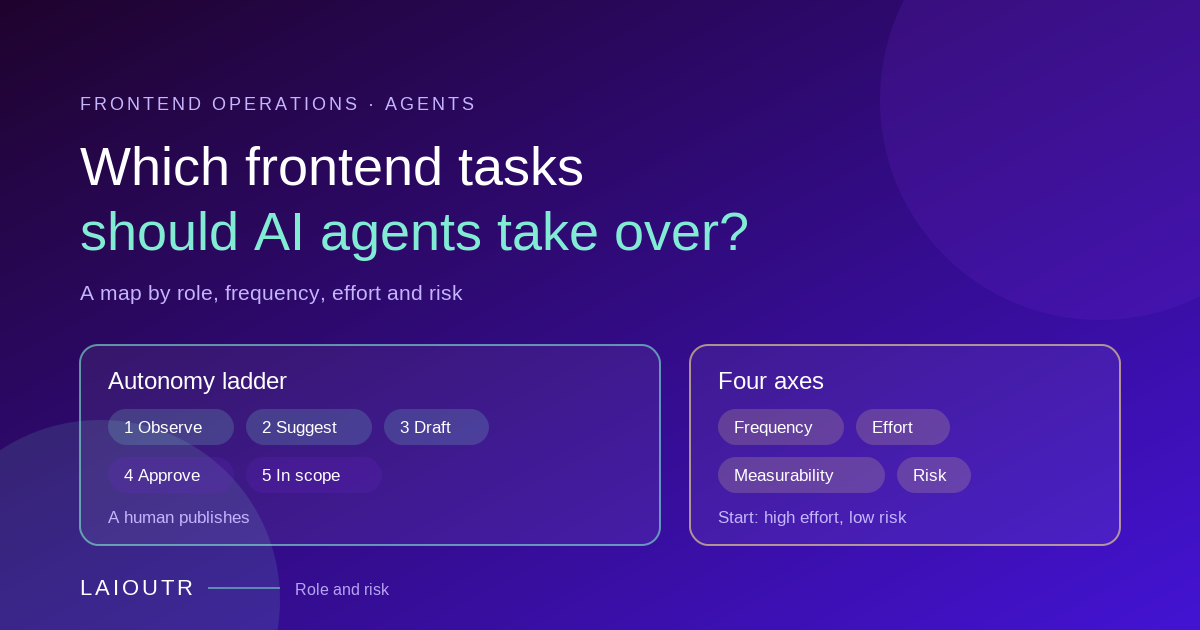Which Frontend Tasks Should AI Agents Take Over? Role and Risk Map
AI agents should first take over the frontend tasks that come up often, involve a lot of manual work…](https://www.laioutr.com/en/blog/frontend-operations-agent-task-map-role-risk-2026)
[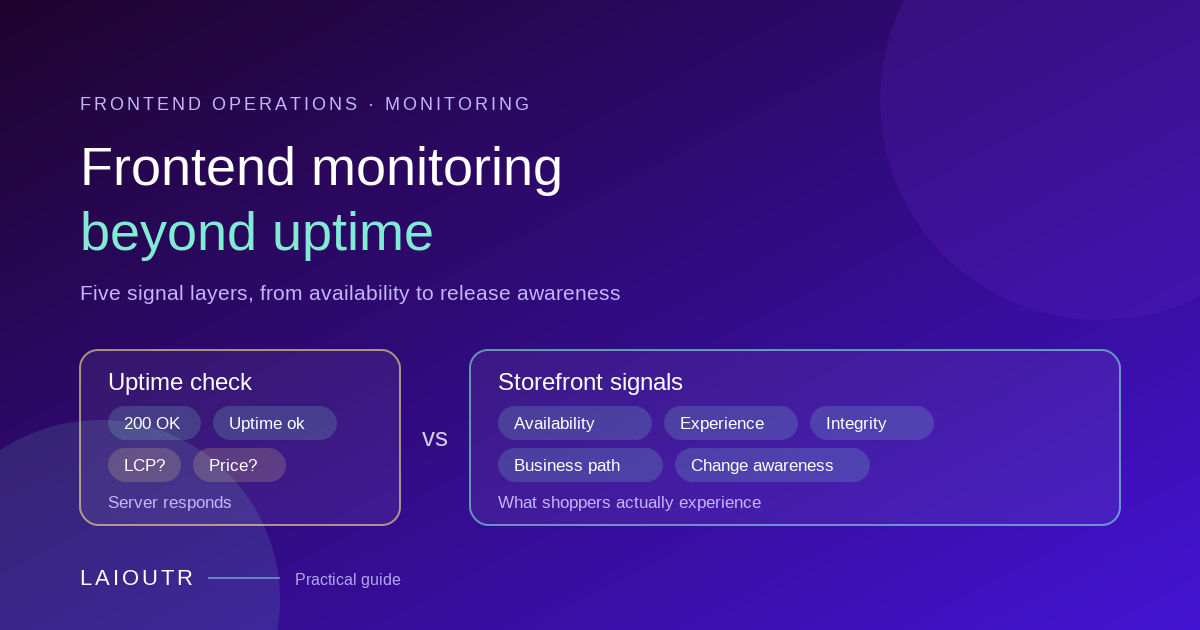Frontend Monitoring Beyond Uptime: Signals a Storefront Needs
Frontend monitoring beyond uptime means checking a storefront not only for availability but for what…](https://www.laioutr.com/en/blog/frontend-operations-monitoring-beyond-uptime-2026)
[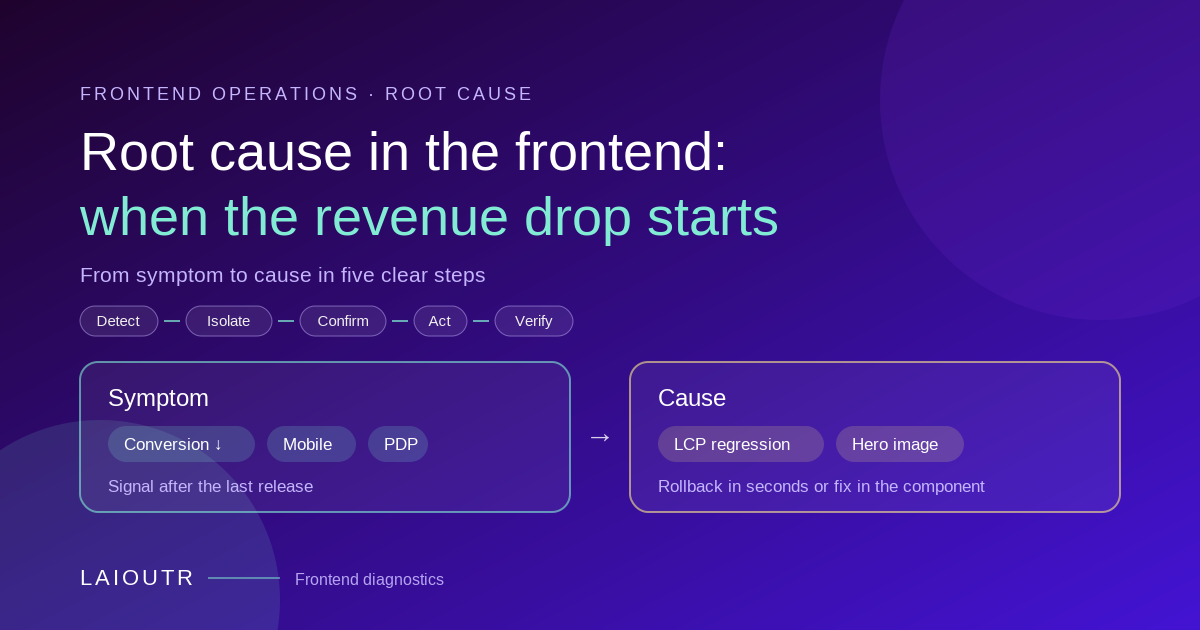Root Cause in the Frontend: When Revenue Drops Start in the Storefront
When revenue or conversion rate drops suddenly, the cause often is not traffic, pricing or the comme…](https://www.laioutr.com/en/blog/frontend-operations-root-cause-revenue-drop-storefront-2026)
[Laioutr Academy Is Live: The Video Manual for Laioutr
Since October 15, 2026, the Laioutr Academy has been live at academy.laioutr.com. It is the user man…](https://www.laioutr.com/en/blog/laioutr-academy-launch-video-manual-certification)
[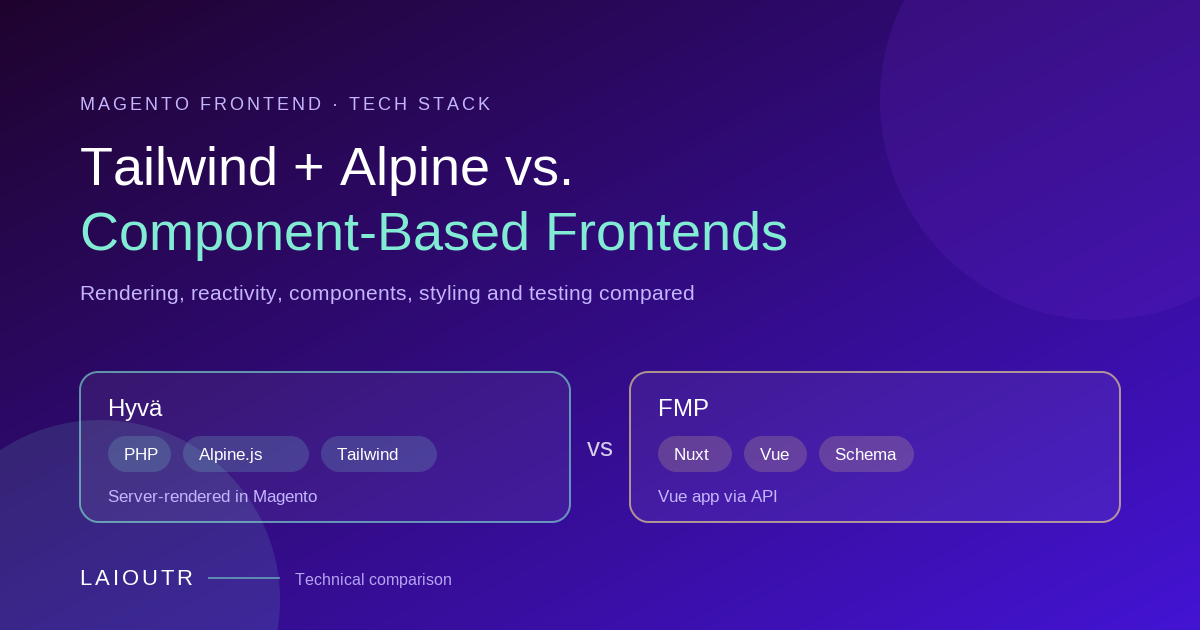Tailwind + Alpine vs. Component-Based Frontends for Magento
Hyvä renders Magento pages on the server with PHP templates and layout XML, adds interactivity throu…](https://www.laioutr.com/en/blog/tailwind-alpine-magento-vs-component-based-frontend-2026)
[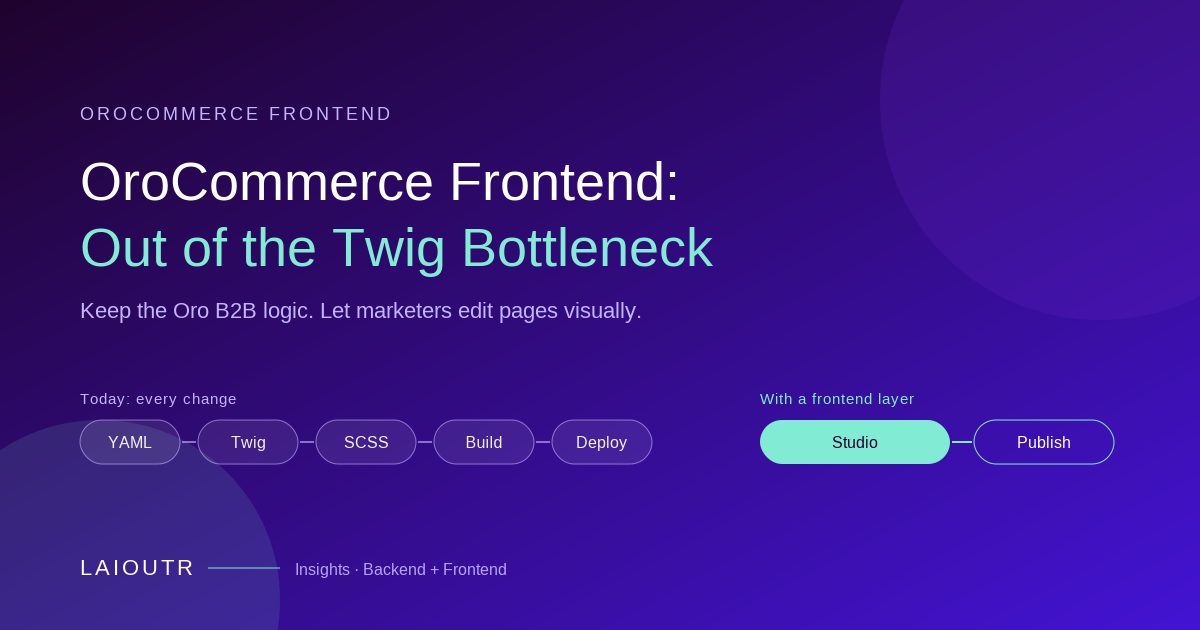OroCommerce Frontend: Out of the Twig and Layouts Bottleneck
The OroCommerce frontend is a server-rendered storefront built from Symfony bundles, OroLayouts and …](https://www.laioutr.com/en/blog/orocommerce-frontend-twig-layouts-bottleneck)
[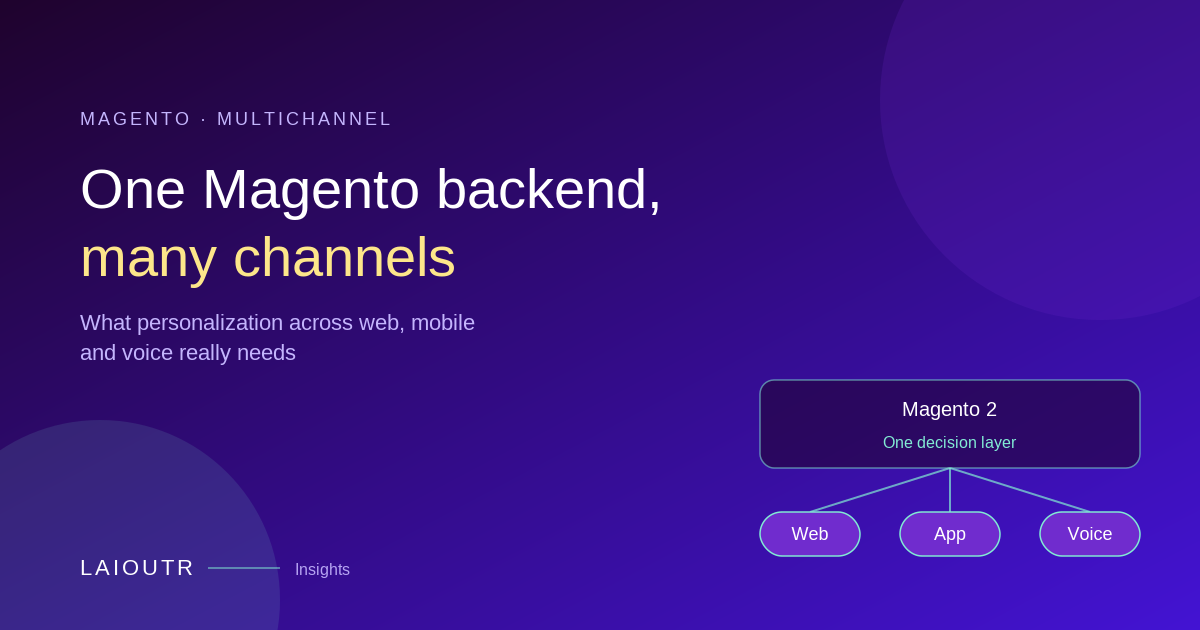One Magento Backend, Many Channels: Personalization in Practice
Personalization across web, mobile and voice on a single Magento backend does not start with a featu…](https://www.laioutr.com/en/blog/magento-multichannel-personalization-web-mobile-voice-2026)
[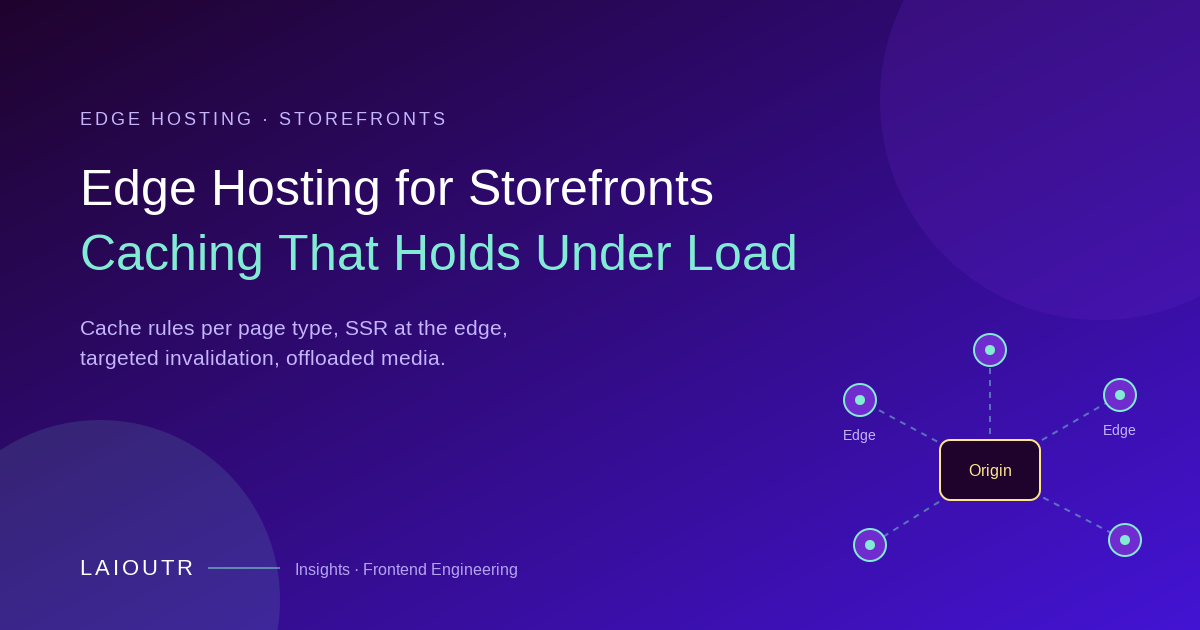Edge Hosting for Storefronts: Caching That Holds Under Peak Load
Edge hosting keeps a storefront fast under load when most requests never reach the origin: pages and…](https://www.laioutr.com/en/blog/edge-hosting-storefronts-peak-traffic-caching-2026)
[Composable Commerce 2027: What Shifted and What Comes Next
Composable commerce enters 2027 with a different agenda than a year ago. The architecture question i…](https://www.laioutr.com/en/blog/composable-commerce-2027-outlook)
[AI Engagement and Conversion: Personalization on the Frontend
AI-driven engagement and conversion on the frontend rests on five mechanics: segments decide who see…](https://www.laioutr.com/en/blog/ai-engagement-conversion-frontend-personalization)
## Apps for the Laioutr platform
[View all apps](https://www.laioutr.com/en/apps)
[](https://www.laioutr.com/en/apps/shopify)
Laioutr
[Shopify](https://www.laioutr.com/en/apps/shopify)
Shopify is a commerce platform for selling online and in physical retail.
[](https://www.laioutr.com/en/apps/shopware)
Laioutr
[Shopware](https://www.laioutr.com/en/apps/shopware)
Shopware is a flexible ecommerce platform from Europe for product catalogs and omnichannel commerce.
[](https://www.laioutr.com/en/apps/adobe-commerce)
Laioutr
[Adobe Commerce](https://www.laioutr.com/en/apps/adobe-commerce)
Adobe Commerce is an enterprise commerce platform for complex, global B2C and B2B scenarios.
Planned
[](https://www.laioutr.com/en/apps/b2b-sellers)
Laioutr
[B2Bsellers](https://www.laioutr.com/en/apps/b2b-sellers)
B2B suite for Shopware that turns an online store into a professional B2B commerce platform.
Planned
[](https://www.laioutr.com/en/apps/commerce-layer)
Laioutr
[Commerce Layer](https://www.laioutr.com/en/apps/commerce-layer)
Commerce Layer is a headless commerce platform for making inventory and catalogs available online.
[](https://www.laioutr.com/en/apps/commercetools)
Laioutr
[Commercetools](https://www.laioutr.com/en/apps/commercetools)
Commercetools is a SaaS-based headless ecommerce platform used worldwide.
[](https://www.laioutr.com/en/apps/emporix)
Laioutr
[Emporix](https://www.laioutr.com/en/apps/emporix)
Emporix is a composable, API-first commerce platform for scalable B2B and B2C scenarios.
Planned
[](https://www.laioutr.com/en/apps/hcl-software)
Laioutr
[HCL Software](https://www.laioutr.com/en/apps/hcl-software)
Enterprise suite for digital commerce and experience with extensive configurability.
Planned
[](https://www.laioutr.com/en/apps/intershop)
Laioutr
[Intershop](https://www.laioutr.com/en/apps/intershop)
Enterprise commerce platform for complex B2B and B2C business models.
Planned
[](https://www.laioutr.com/en/apps/magento-2)
Laioutr
[Magento 2](https://www.laioutr.com/en/apps/magento-2)
Widely used, extensible commerce platform for B2C and B2B scenarios.
[](https://www.laioutr.com/en/apps/oxid-eshop)
Laioutr
[OXID eShop](https://www.laioutr.com/en/apps/oxid-eshop)
OXID eShop is an extensible commerce platform for complex B2B and B2C requirements.
Planned
[](https://www.laioutr.com/en/apps/patchworks)
Laioutr
[Patchworks](https://www.laioutr.com/en/apps/patchworks)
Patchworks is a low-code iPaaS that connects ecommerce, ERP, WMS, 3PL, and marketplaces.
Planned
[](https://www.laioutr.com/en/apps/PrestaShop)
Laioutr
[Prestashop](https://www.laioutr.com/en/apps/PrestaShop)
Open-source commerce platform for small and midsize merchants in Europe and beyond.
Planned
[](https://www.laioutr.com/en/apps/saleor)
Laioutr
[Saleor](https://www.laioutr.com/en/apps/saleor)
Open-source, API-first commerce platform built on GraphQL for custom storefronts.
Planned
[](https://www.laioutr.com/en/apps/salesforce-commerce-cloud)
Laioutr
[Salesforce Commerce Cloud](https://www.laioutr.com/en/apps/salesforce-commerce-cloud)
Salesforce Commerce Cloud is a cloud-based enterprise commerce platform for businesses of any size.
Planned
[](https://www.laioutr.com/en/apps/sap-commerce-cloud)
Laioutr
[SAP Commerce Cloud](https://www.laioutr.com/en/apps/sap-commerce-cloud)
Enterprise commerce platform for complex catalogs, pricing models, and omnichannel journeys.
Planned
[](https://www.laioutr.com/en/apps/scayle)
Laioutr
[Scayle](https://www.laioutr.com/en/apps/scayle)
SCAYLE is a commerce engine that helps brands and retailers scale their business.
Planned
[](https://www.laioutr.com/en/apps/spryker)
Laioutr
[Spryker](https://www.laioutr.com/en/apps/spryker)
Composable commerce platform for sophisticated B2B and B2C business models.
[](https://www.laioutr.com/en/apps/sylius)
Laioutr
[Sylius](https://www.laioutr.com/en/apps/sylius)
Sylius is a developer-friendly ecommerce framework for B2C and B2B shopping experiences.
Planned
[](https://www.laioutr.com/en/apps/vendure)
Laioutr
[Vendure](https://www.laioutr.com/en/apps/vendure)
Vendure is a headless commerce platform for businesses with complex requirements.
Coming Soon
[](https://www.laioutr.com/en/apps/vtex)
Laioutr
[VTEX](https://www.laioutr.com/en/apps/vtex)
Cloud-native, composable commerce platform for B2B and B2C at scale.
Planned
[](https://www.laioutr.com/en/apps/websale)
Laioutr
[Websale](https://www.laioutr.com/en/apps/websale)
Stable, enterprise-ready commerce backend for complex retail environments.
Strategy call
## The frontend as a control layer
A conversation about stack, roadmap and replatforming scenario. The outcome: a clear picture of how Laioutr fits, what it costs and how fast the go-live can happen.
*"After 30 minutes, we knew Laioutr makes our replatforming feasible."*
*Daniel B., CEO,* [*hygibox.de*](https://hygibox.de)
[Book a demo](https://www.laioutr.com/en/contact)
## Structured Data
```json
{
"@context": "https://schema.org",
"@graph": [
{
"@type": "Organization",
"@id": "https://www.laioutr.com/#identity",
"name": "Laioutr",
"legalName": "Laioutr GmbH",
"url": "https://www.laioutr.com/",
"logo": {
"@type": "ImageObject",
"url": "https://www.laioutr.com/laioutr-logo.png",
"width": 400,
"height": 400
},
"email": "info@laioutr.com",
"telephone": "+49 30 75435715",
"address": {
"@type": "PostalAddress",
"streetAddress": "Münchweilersteig 5",
"postalCode": "12559",
"addressLocality": "Berlin",
"addressCountry": "DE"
},
"vatID": "DE450905846",
"sameAs": [
"https://www.linkedin.com/company/laioutr",
"https://www.youtube.com/@Laioutr",
"https://x.com/laioutr"
]
},
{
"@type": "WebSite",
"@id": "https://www.laioutr.com/en/#website",
"url": "https://www.laioutr.com/en/",
"name": "Laioutr",
"inLanguage": "en",
"publisher": {
"@id": "https://www.laioutr.com/#identity"
}
},
{
"@type": "BlogPosting",
"@id": "https://www.laioutr.com/en/blog/eliminate-developer-bottlenecks#article",
"headline": "The Hidden Cost of Developer Bottlenecks: Why Decoupling Wins in the New Era of Product Velocity",
"description": "Developer bottlenecks tax business agility. See why decoupling the frontend wins in the new era of product velocity.",
"image": [
"https://eu-west-2.graphassets.com/cmii2mlqi0dux06l5543v7nkc/cmnucypviw8mi07mgmwsd5asa"
],
"datePublished": "2026-06-30T17:25:39.399785+00:00",
"dateModified": "2026-06-30T17:25:39.052861+00:00",
"inLanguage": "en",
"articleSection": "Insights",
"keywords": "Frontend Management",
"author": {
"@type": "Person",
"name": "Marcel Thiesies",
"jobTitle": "Co-Founder & CEO, Laioutr",
"image": "https://eu-west-2.graphassets.com/cmii2mlqi0dux06l5543v7nkc/cmj01b962364n07lb0iguvts5"
},
"publisher": {
"@id": "https://www.laioutr.com/#identity"
},
"mainEntityOfPage": {
"@id": "https://www.laioutr.com/en/blog/eliminate-developer-bottlenecks#webpage"
},
"isPartOf": {
"@id": "https://www.laioutr.com/en/#website"
}
},
{
"@type": "WebPage",
"@id": "https://www.laioutr.com/en/blog/eliminate-developer-bottlenecks#webpage",
"url": "https://www.laioutr.com/en/blog/eliminate-developer-bottlenecks",
"name": "The Hidden Cost of Developer Bottlenecks: Why Decoupling Wins in the New Era of Product Velocity",
"description": "Developer bottlenecks tax business agility. See why decoupling the frontend wins in the new era of product velocity.",
"inLanguage": "en",
"isPartOf": {
"@id": "https://www.laioutr.com/en/#website"
},
"breadcrumb": {
"@id": "https://www.laioutr.com/en/blog/eliminate-developer-bottlenecks#breadcrumb"
},
"primaryImageOfPage": {
"@type": "ImageObject",
"url": "https://eu-west-2.graphassets.com/cmii2mlqi0dux06l5543v7nkc/cmnucypviw8mi07mgmwsd5asa"
},
"datePublished": "2026-06-30T17:25:39.399785+00:00",
"dateModified": "2026-06-30T17:25:39.052861+00:00",
"mainEntity": {
"@id": "https://www.laioutr.com/en/blog/eliminate-developer-bottlenecks#article"
}
},
{
"@type": "BreadcrumbList",
"@id": "https://www.laioutr.com/en/blog/eliminate-developer-bottlenecks#breadcrumb",
"itemListElement": [
{
"@type": "ListItem",
"position": 1,
"name": "Laioutr",
"item": "https://www.laioutr.com/en/"
},
{
"@type": "ListItem",
"position": 2,
"name": "Insights",
"item": "https://www.laioutr.com/en/blogs/insights"
},
{
"@type": "ListItem",
"position": 3,
"name": "The Hidden Cost of Developer Bottlenecks: Why Decoupling Wins in the New Era of Product Velocity"
}
]
}
]
}
```