---
title: "Beyond the AI Tool Graveyard"
canonical_url: "https://www.laioutr.com/en/blog/escaping-ai-adoption-paradox"
locale: en
meta:
description: "Why smart organizations choose AI integration over accumulation, escaping the quarterly AI tool graveyard."
"og:description": "Why smart organizations choose AI integration over accumulation, escaping the quarterly AI tool graveyard."
"og:title": "Beyond the AI Tool Graveyard"
---

# Beyond the AI Tool Graveyard: Why Smart Organizations Choose Integration Over Accumulation
Table of contents
1. [1.The Illusion of Progress](#the-illusion-of-progress)
2. [2.Why We Keep Building Tower of Babel Technology Stacks](#why-we-keep-building-tower-of-babel-technology-stacks)
3. [3.The Executive Perception Gap](#the-executive-perception-gap)
4. [4.What Separates High-Impact Organizations from the Rest](#what-separates-high-impact-organizations-from-the-rest)
5. [5.The Path Forward: Integration as Strategy](#the-path-forward-integration-as-strategy)
Every quarter, another promising AI platform lands in your marketing tech stack. Analytics dashboards. Content optimization engines. Lead scoring systems. Predictive analytics. Each one arrived with impressive demo videos and promises of transformation. Yet your team still spends Friday afternoons manually copying data between systems. Your data analysts remain your biggest bottleneck. And nobody really knows which numbers to trust.
You're not alone. This is the quiet crisis facing most organizations today: the AI adoption paradox. We've invested billions in cutting-edge technology, yet we're less efficient than we were five years ago. Teams are drowning in tool options while starving for actionable insight. Leadership believes everything is running smoothly. The practitioners know better.
This isn't a story about bad technology. Most of these tools work exactly as advertised. The problem isn't the tools themselves. It's what happens when organizations treat AI adoption like collecting rare coins instead of building a coherent system.
## The Illusion of Progress
Here's what the data tells us: organizations are genuinely deploying AI at record rates. Adoption curves are steep. Investment is real. Yet the promised productivity gains remain stubbornly elusive. Why?
The answer lies in a fundamental misunderstanding of what "adoption" means. Too many organizations interpret adoption as deployment. We installed the tool, therefore we adopted it. Our team has licenses, therefore we've adopted it. We ran the initial training, therefore it's integrated into our workflow.
This is implementation theater. It feels like progress because there's measurable activity: budget allocated, software licenses purchased, teams trained, features toggled on. From the executive dashboard, everything looks transformational. Boxes have been checked. The technology is in place.
But look closer at the actual workflow. Data still moves manually between systems. Insights still require human translation before they become actionable. Teams still context-switch between platforms to complete a single task. The AI tool sits in your stack like a shiny kitchen gadget: technically advanced, barely used, taking up space.
The real adoption paradox emerges here: organizations can simultaneously have high AI tool adoption and extremely low AI impact adoption. You can have the best tools in the world deployed across your organization while your actual workflows remain almost unchanged. The technology exists. The problems persist.
## Why We Keep Building Tower of Babel Technology Stacks
When you look at why this pattern repeats, you find a series of understandable but ultimately counterproductive choices.
First, there's the point-solution mentality. A problem emerges: "We need better lead scoring." A solution appears: "There's an AI tool for that." It solves the immediate pain with minimal organizational disruption. No need to redesign anything. No need to negotiate with other teams. Just implement the new tool for this specific use case.
Multiply this across dozens of use cases, dozens of teams, dozens of business functions. Each solved independently. Each tool optimized for its narrow purpose. Each operating in partial isolation from the others.
The result is what we call a "data archipelago": islands of capability separated by choppy waters of data translation, manual handoffs, and process friction. Your content team has one AI tool. Your analytics team has another. Your customer data platform serves a third. Your email marketing team maintains yet another. Each island has its own data models, its own update schedules, its own user interface paradigms.
Sending a message across the archipelago requires a boat captain. That captain is usually a person: a data analyst, a systems engineer, an operations manager. Manual data movement becomes endemic. The people tasked with moving data between systems become the bottleneck. You haven't automated your workflow. You've just transformed it into a "human API" that connects your islands of capability.
The second driver is what we call "tool shopping while standing in line." Organizations evaluate point solutions under pressure, with limited time and limited context about the full system. A team says "We need this solved by Q2." So you evaluate the top three vendors in that category, pick the one with the best demo and the most reasonable contract, and implement it. You're rarely evaluating it as part of a larger strategic architecture. You're evaluating it against the immediate pain point.
This is rational at the individual decision level. But systemically, it's catastrophic. Each purchase decision is locally optimized while globally suboptimized. Over time, you end up with a collection of tools that work independently but create friction when they touch.
The third driver is organizational inertia. Redesigning workflows is hard. It requires cross-functional alignment. It demands that people work differently. It creates risk. Implementing a new tool in the existing workflow is straightforward by comparison. You're not asking anyone to change how they work. You're just adding something new to the mix.
This is why "integration" remains the perpetual promise and the perpetual disappointment. Every new tool promises to "integrate with your existing systems." What it usually means is: we can read from and write to your other systems via API. Which is technically true but strategically incomplete. The tool integrates with your systems. But your team still needs to manually trigger the integration, interpret the results, translate the insights, and act on the data.
True integration means the data flows automatically, the insights are presented in context where people actually work, and the downstream actions happen without human translation. Most organizations don't have that. They have API connections between tools.
## The Executive Perception Gap
Here's a troubling metric: when surveyed about marketing cycle speed and efficiency, executives report twice the satisfaction level of the teams doing the actual work. Leadership thinks the machine is humming. The practitioners know it's sputtering.
This perception gap exists for logical reasons. Executives evaluate success through budget allocation, deployment metrics, and strategic reporting. Did we buy the tools? Did we implement them? Are they deployed across the organization? Yes, yes, yes. Success metrics satisfied.
Practitioners evaluate success through time to insight, accuracy of insight, and workflow friction. Can we get reliable data without asking the analyst? Does the AI recommendation match reality? How many clicks does it take to act on what we learned? These metrics often tell a different story.
This gap matters because it prevents the problem from being solved. If leadership believes the system is working, there's no mandate to redesign it. If practitioners know it's not working but can't convince leadership to believe them, the problem gets labeled as a "user adoption" issue rather than a system design issue. So leadership doubles down on training and change management, assuming the tools themselves are sound and the humans just need to learn to use them better.
This is precisely backward. The tools aren't the problem. The system architecture is. You can train people to be more efficient in an inefficient system, but you hit a ceiling. Some problems are structural, not behavioral.
## What Separates High-Impact Organizations from the Rest
The organizations that actually achieve meaningful AI impact tend to share a distinct pattern. They don't optimize for tool count. They don't judge success by adoption rates. They organize around outcomes, not features.
Their approach has several characteristics.
First, they treat data integration as a strategic priority, not a technical footnote. Rather than layering new tools onto existing fragmented data sources, they invest in consolidating data access. Sometimes this means a data warehouse. Sometimes it means a unified customer data platform. Sometimes it means careful API orchestration. The specific mechanism varies. The principle remains constant: one source of truth, accessible across the organization, updated in real time or near real time.
This is not free work. It requires investment and organizational effort. But it's the prerequisite to actual AI impact. You cannot build intelligent workflows on top of fragmented, unreliable, slow-to-update data. If your data is spread across islands, your AI tools become island-specific and lose their potential to surface cross-system insights.
Second, they redesign workflows before implementing new tools. They ask: What does the team actually need to accomplish? What information do they need? When do they need it? Where do they work? Then they architect a solution around those answers. Often, the architecture involves multiple tools, but the tools serve a unified workflow, not discrete use cases.
This is harder than point-solution implementation. It's slower. It requires more stakeholder alignment. But it's what actually moves the needle on efficiency.
Third, they measure what matters. Not adoption rates. Not feature usage. They measure outcome velocity: time from question to answer, confidence in the answer, and time from insight to action. These metrics reveal whether the system is actually working.
Fourth, and perhaps most importantly, they protect against tool proliferation by creating high bars for new additions. Not "Is this useful?" but "Does this integrate cleanly into our unified workflow?" Not "Do we have a budget?" but "Will this reduce friction or add it?" This doesn't mean they never add tools. It means they're deliberate about it. They understand that each tool creates integration work, organizational learning work, and ongoing maintenance work. They don't absorb that cost lightly.
## The Path Forward: Integration as Strategy
The AI adoption paradox isn't a reason to abandon AI initiatives. It's a call to be smarter about how we approach them. The solution isn't fewer tools. The solution is smarter integration, which starts with asking harder questions before implementation.
Before implementing a new AI platform, ask: How does this connect to the data we already have? Who actually needs to use this? Where will they be when they need to use it? How will they know the system's recommendation is trustworthy? What happens after they act on the insight? How will success actually look different from the current workflow?
These aren't questions the vendor can answer. These are questions your organization needs to answer about itself.
Build your technology strategy around workflow outcomes, not tool features. Invest in data integration infrastructure even when it feels like it's not delivering immediate feature value. Create organizational governance that treats tool proliferation as a real cost, not a free option.
The organizations winning with AI aren't the ones with the most sophisticated tools. They're the ones who managed to get their data, their workflows, and their tools to work together. That's harder. It's less glamorous. It doesn't generate exciting press releases about new capability deployments.
But it actually changes how work gets done. It actually moves the needle. It actually escapes the adoption paradox.
That's the difference between having AI tools and having AI that works.
*Written by Laioutr GmbH Marketing Team*
### **More from the Laioutr Platform**
- [Agentic Frontend Management Platform](https://www.laioutr.com/en/agentic-frontend-management-platform)
- [SEO and GEO](https://www.laioutr.com/en/product/seo-and-geo)
- [Composable Digital Experience Platform](https://www.laioutr.com/en/composable-digital-experience-platform)
Related reading: [ChatGPT Instant Checkout Stalled at 30 Merchants - 2026](https://www.laioutr.com/en/blog/chatgpt-instant-checkout-merchant-adoption-agentic-readiness-2026) and [What Really Changes After Composable Adoption: An Honest Effect Analysis](https://www.laioutr.com/en/blog/real-effects-after-composable-adoption).
---
Share this article
[Share on Facebook](https://www.facebook.com/sharer/sharer.php?u=https%3A%2F%2Fwww.laioutr.com%2Fen%2Fblog%2Fescaping-ai-adoption-paradox) [Share on X](https://x.com/intent/post?url=https%3A%2F%2Fwww.laioutr.com%2Fen%2Fblog%2Fescaping-ai-adoption-paradox&text=) [Share on LinkedIn](https://www.linkedin.com/sharing/share-offsite/?url=https%3A%2F%2Fwww.laioutr.com%2Fen%2Fblog%2Fescaping-ai-adoption-paradox) [Share on Pinterest](https://pinterest.com/pin/create/button/?url=https%3A%2F%2Fwww.laioutr.com%2Fen%2Fblog%2Fescaping-ai-adoption-paradox&description=) [Share via email](mailto:?subject=&body=%0A%0Ahttps%3A%2F%2Fwww.laioutr.com%2Fen%2Fblog%2Fescaping-ai-adoption-paradox)
## More articles on frontend and headless
Practical know-how for frontend development, smart agents, and headless
[To the blog](https://www.laioutr.com/en/blogs/insights)
[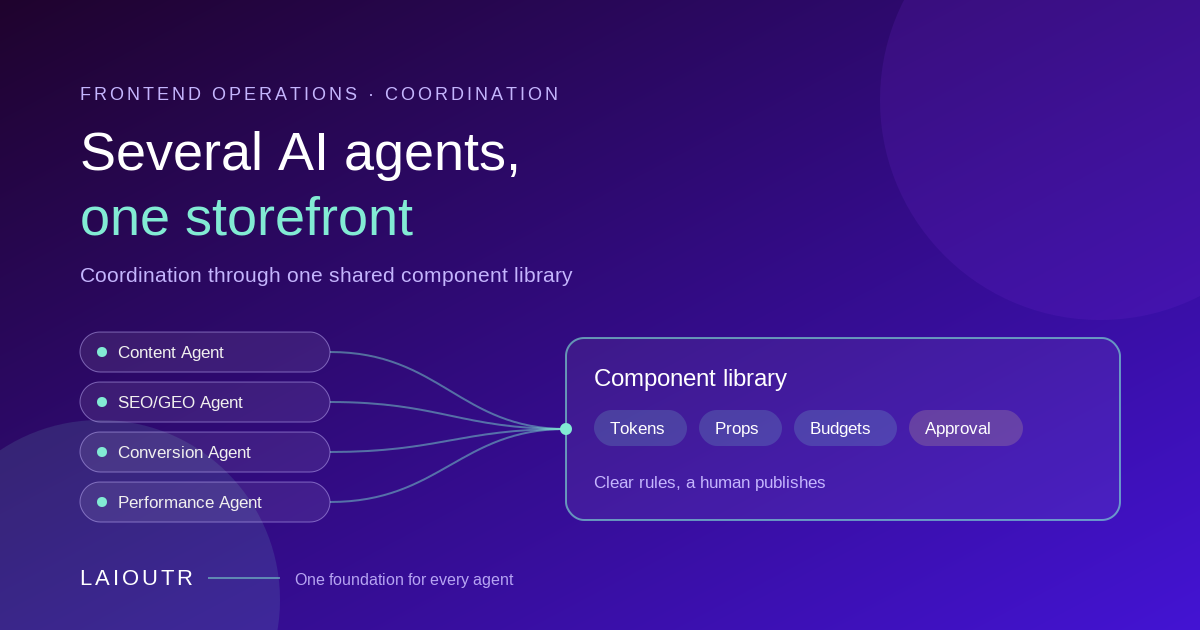Several AI Agents, One Storefront: Coordination Without Collisions
When several AI agents work on the same storefront, conflicts rarely happen between the agents thems…](https://www.laioutr.com/en/blog/frontend-operations-multi-agent-coordination-storefront-2026)
[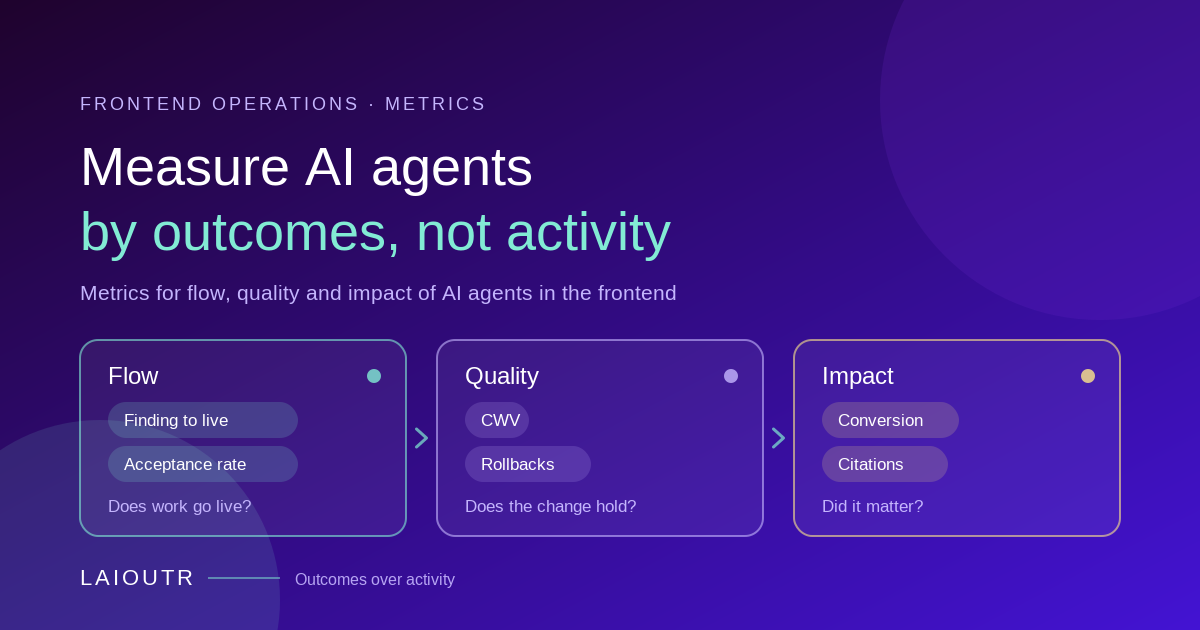Measuring AI Agents by Outcomes: Agentic Frontend Management Metrics
AI agents in the frontend should be measured by outcomes, not by activity. The number of prompts, ge…](https://www.laioutr.com/en/blog/frontend-operations-measuring-ai-agents-outcomes-2026)
[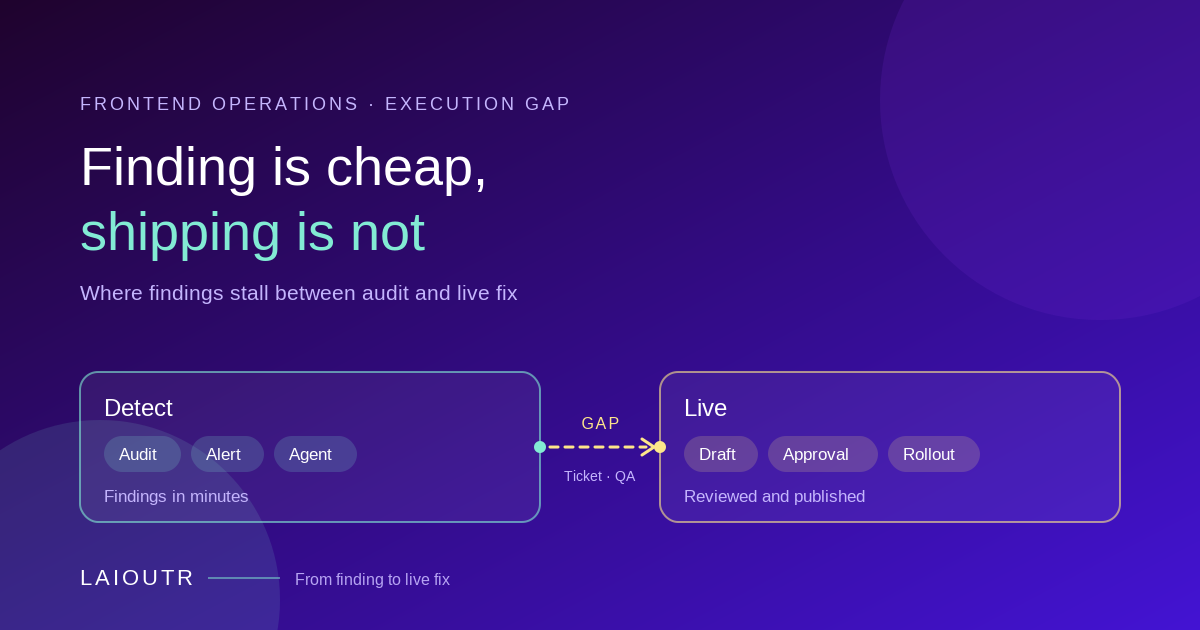The Execution Gap in the Frontend: Finding Is Cheap, Shipping Is Not
The execution gap in the frontend is the time, and the number of handoffs, between "we know wha…](https://www.laioutr.com/en/blog/frontend-operations-execution-gap-detect-vs-deploy-2026)
[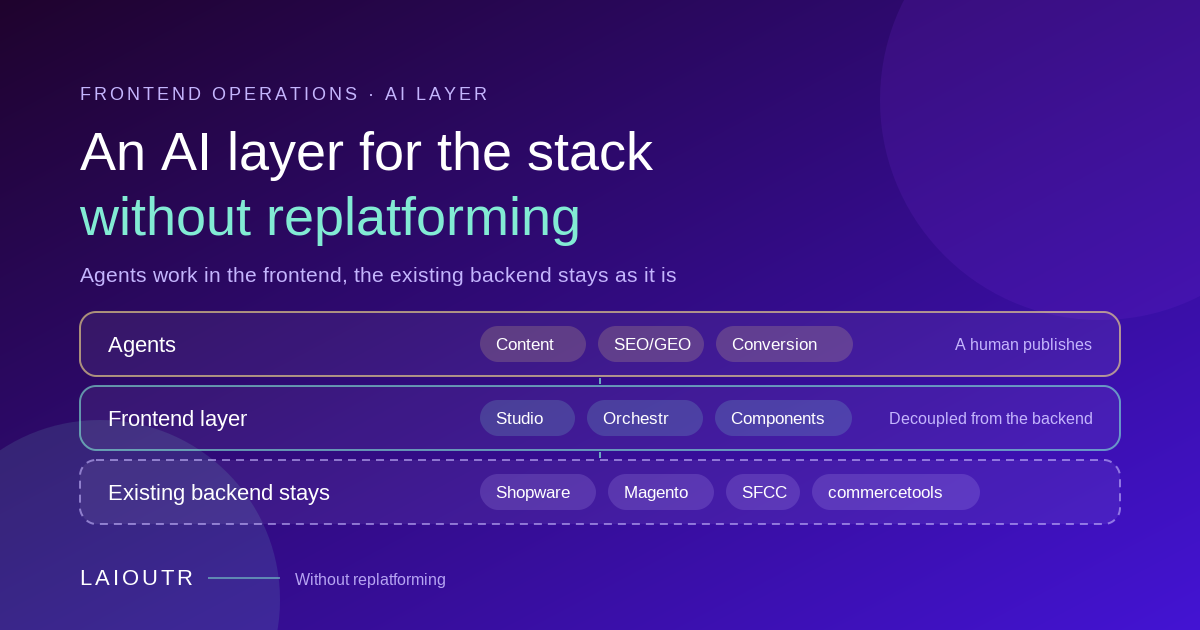Adding an AI Layer to an Existing Commerce Stack Without Replatforming
An AI layer can be added to an existing commerce stack without replacing the shop system. The most p…](https://www.laioutr.com/en/blog/frontend-operations-ai-layer-existing-stack-without-replatforming-2026)
[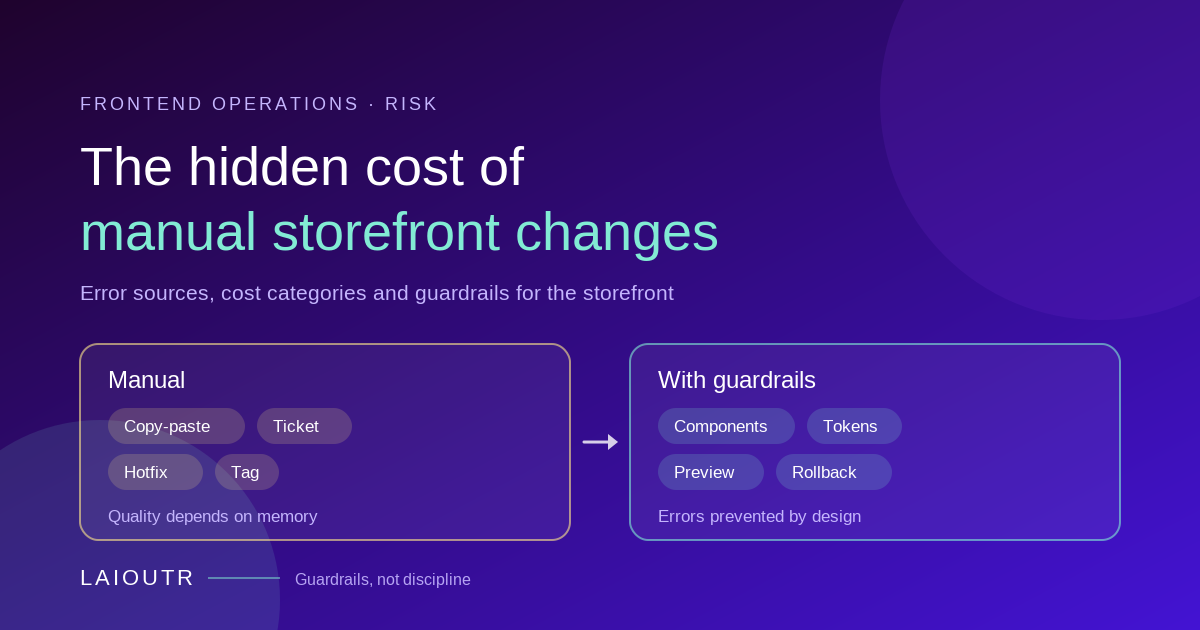The Hidden Cost of Manual Storefront Changes and How to Cut It
Manual frontend changes are the many small edits that keep a storefront running day to day: a new ba…](https://www.laioutr.com/en/blog/frontend-operations-hidden-cost-manual-storefront-changes-2026)
[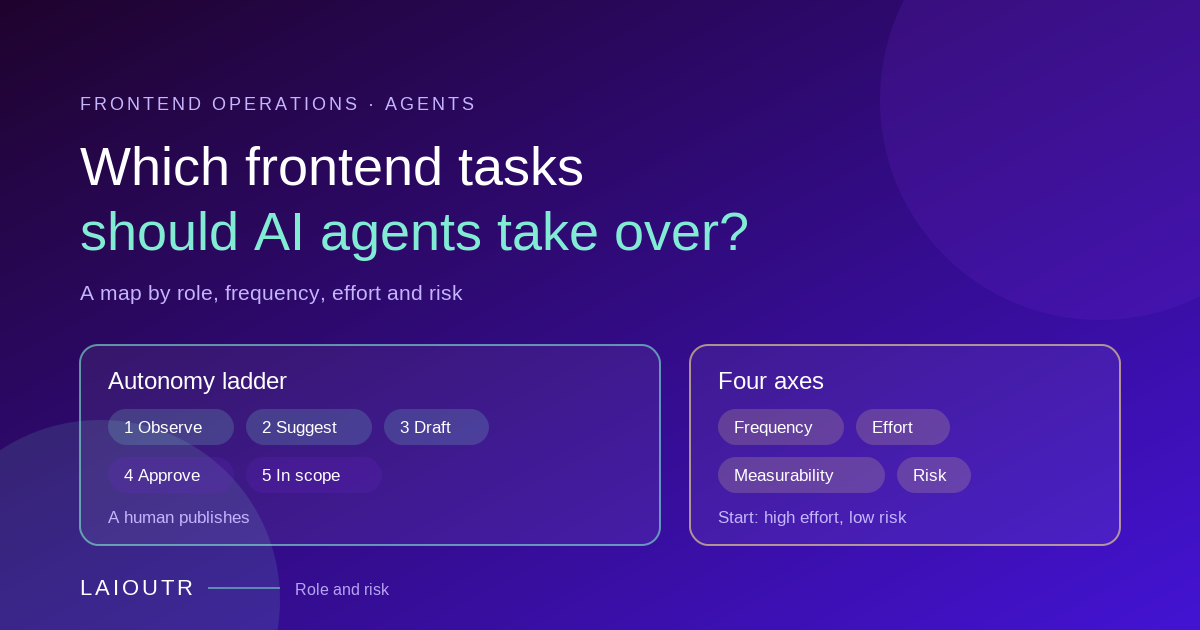Which Frontend Tasks Should AI Agents Take Over? Role and Risk Map
AI agents should first take over the frontend tasks that come up often, involve a lot of manual work…](https://www.laioutr.com/en/blog/frontend-operations-agent-task-map-role-risk-2026)
[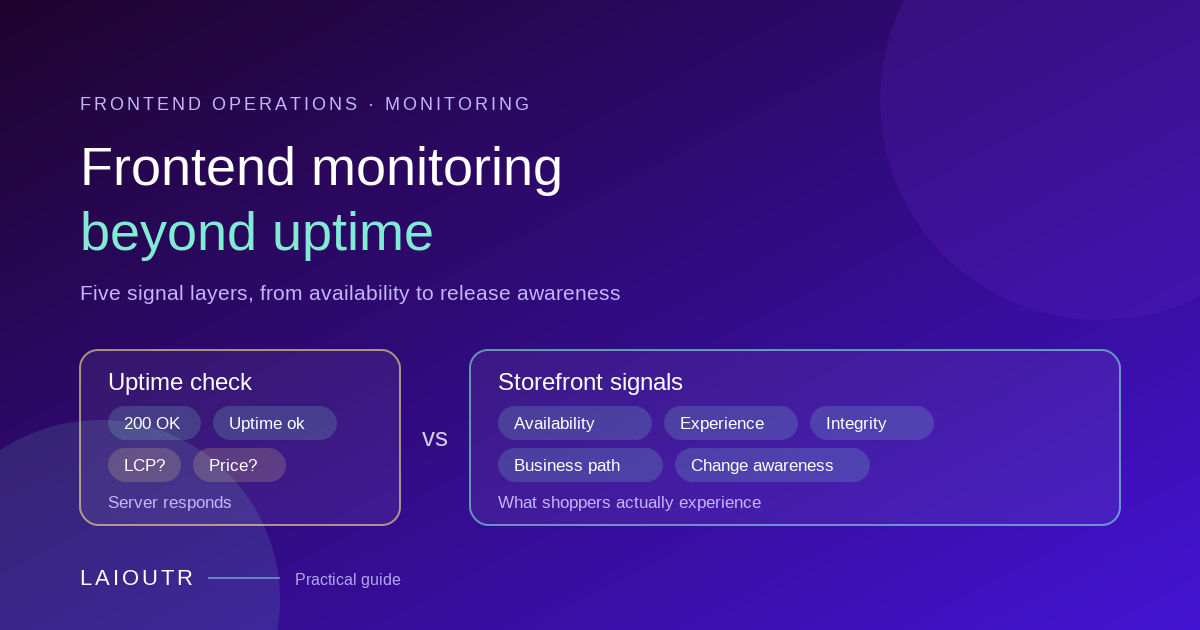Frontend Monitoring Beyond Uptime: Signals a Storefront Needs
Frontend monitoring beyond uptime means checking a storefront not only for availability but for what…](https://www.laioutr.com/en/blog/frontend-operations-monitoring-beyond-uptime-2026)
[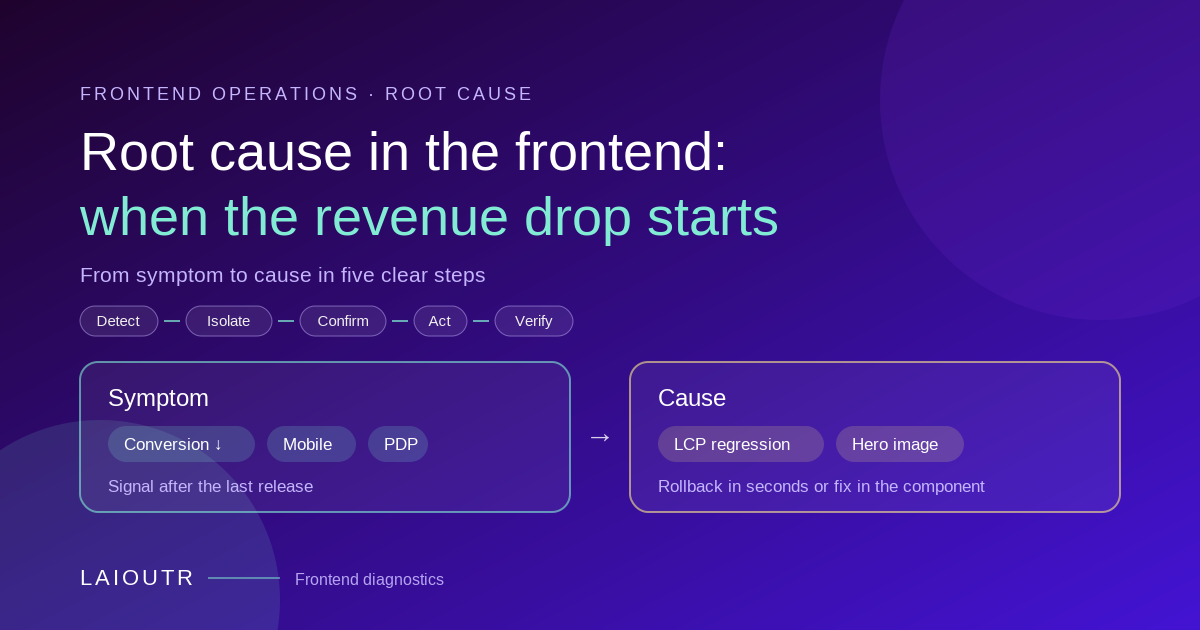Root Cause in the Frontend: When Revenue Drops Start in the Storefront
When revenue or conversion rate drops suddenly, the cause often is not traffic, pricing or the comme…](https://www.laioutr.com/en/blog/frontend-operations-root-cause-revenue-drop-storefront-2026)
[Laioutr Academy Is Live: The Video Manual for Laioutr
Since October 15, 2026, the Laioutr Academy has been live at academy.laioutr.com. It is the user man…](https://www.laioutr.com/en/blog/laioutr-academy-launch-video-manual-certification)
[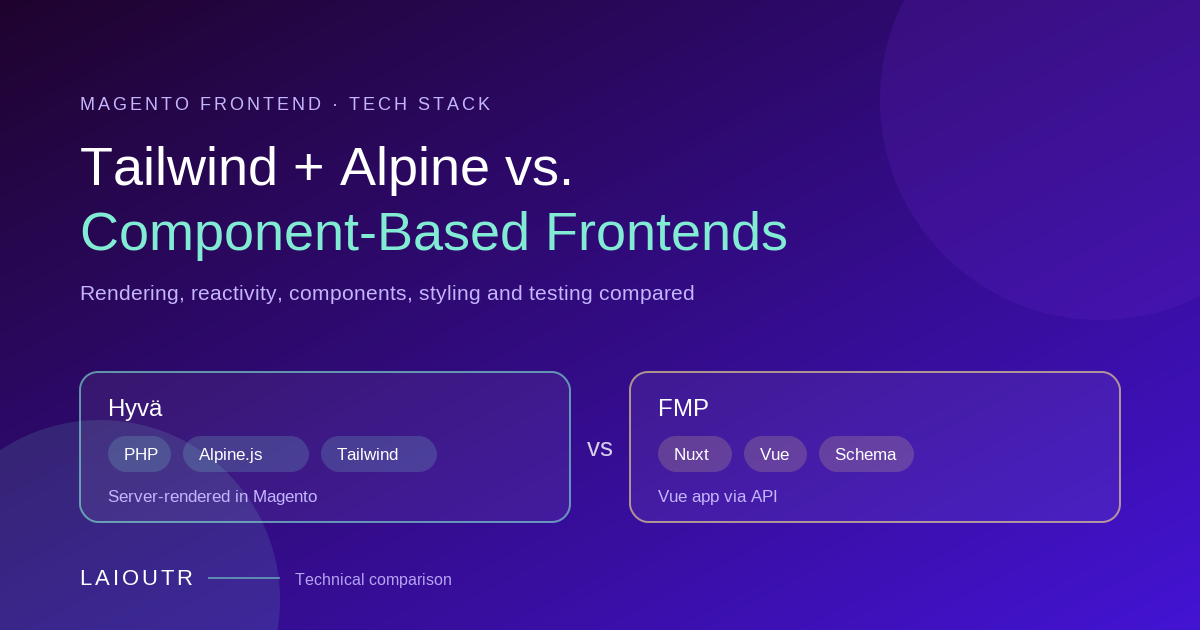Tailwind + Alpine vs. Component-Based Frontends for Magento
Hyvä renders Magento pages on the server with PHP templates and layout XML, adds interactivity throu…](https://www.laioutr.com/en/blog/tailwind-alpine-magento-vs-component-based-frontend-2026)
[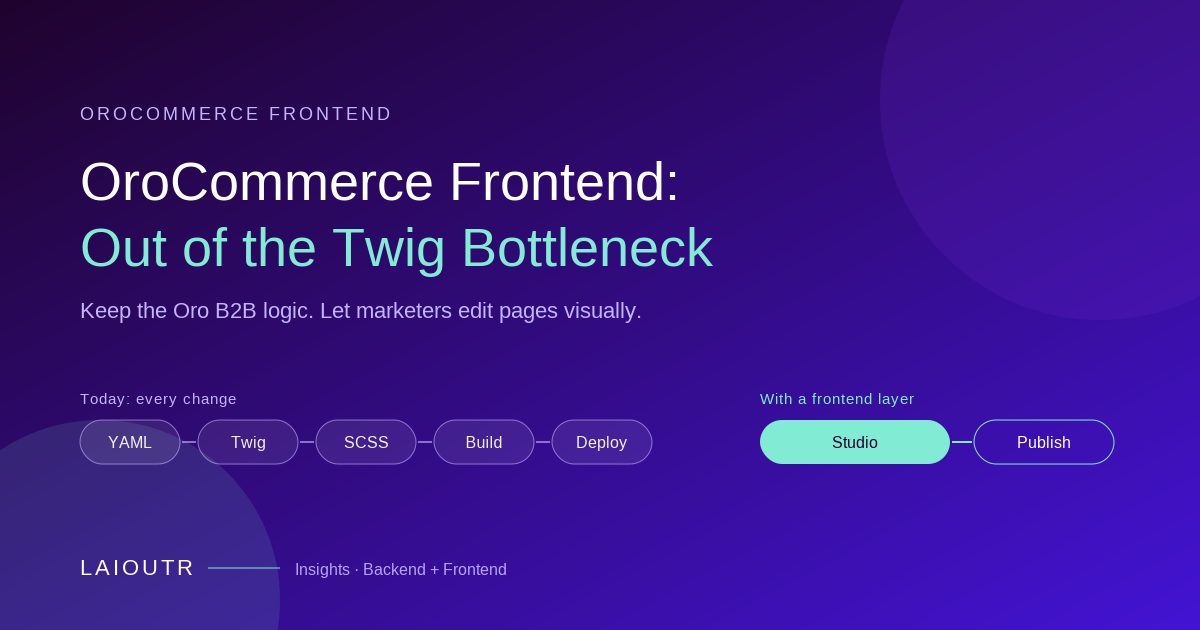OroCommerce Frontend: Out of the Twig and Layouts Bottleneck
The OroCommerce frontend is a server-rendered storefront built from Symfony bundles, OroLayouts and …](https://www.laioutr.com/en/blog/orocommerce-frontend-twig-layouts-bottleneck)
[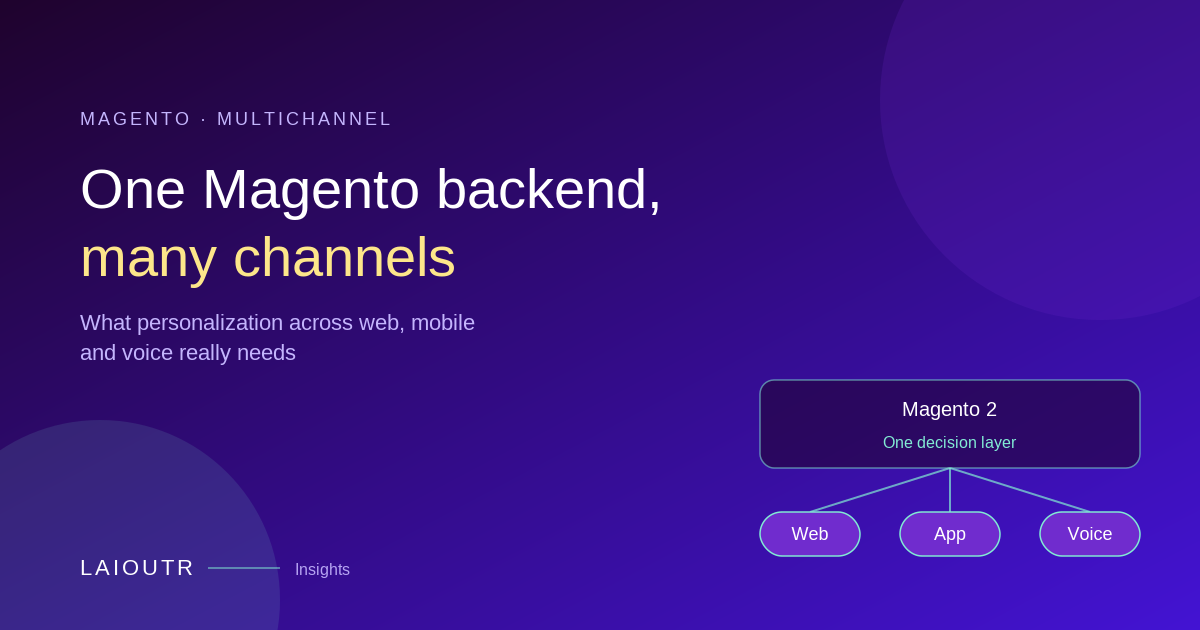One Magento Backend, Many Channels: Personalization in Practice
Personalization across web, mobile and voice on a single Magento backend does not start with a featu…](https://www.laioutr.com/en/blog/magento-multichannel-personalization-web-mobile-voice-2026)
[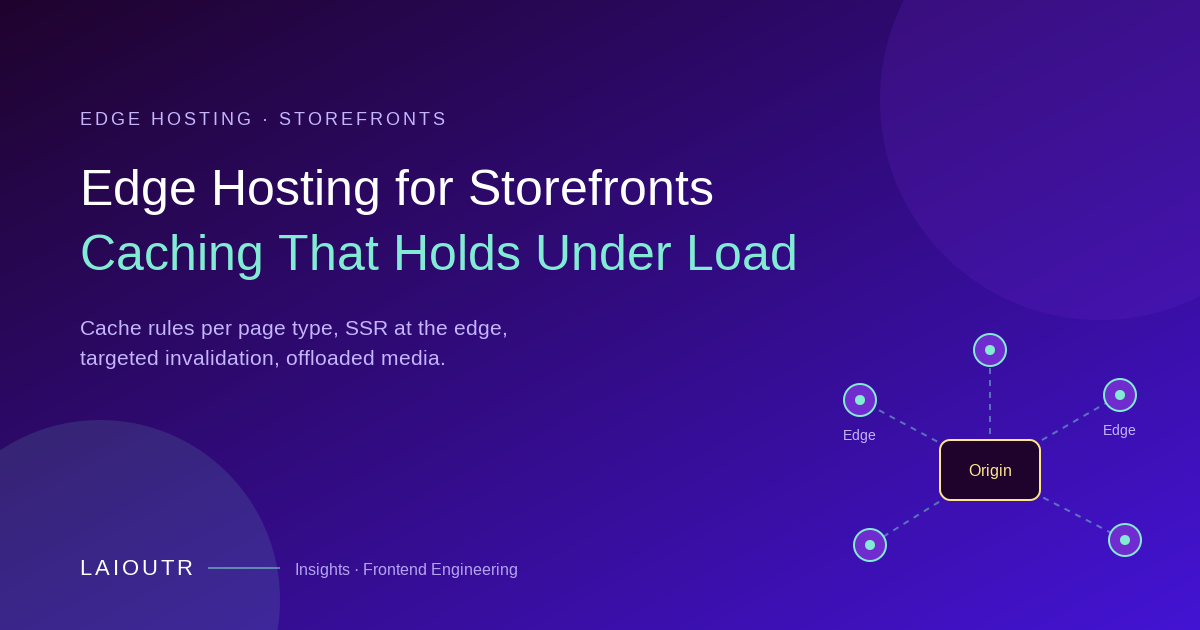Edge Hosting for Storefronts: Caching That Holds Under Peak Load
Edge hosting keeps a storefront fast under load when most requests never reach the origin: pages and…](https://www.laioutr.com/en/blog/edge-hosting-storefronts-peak-traffic-caching-2026)
[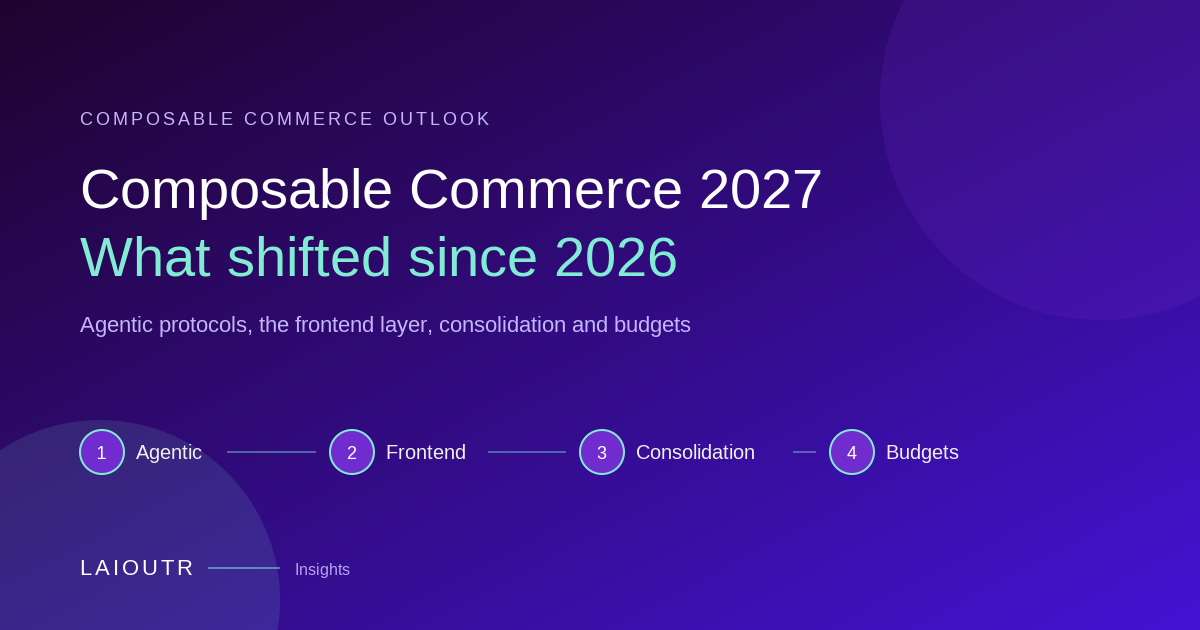Composable Commerce 2027: What Shifted and What Comes Next
Composable commerce enters 2027 with a different agenda than a year ago. The architecture question i…](https://www.laioutr.com/en/blog/composable-commerce-2027-outlook)
[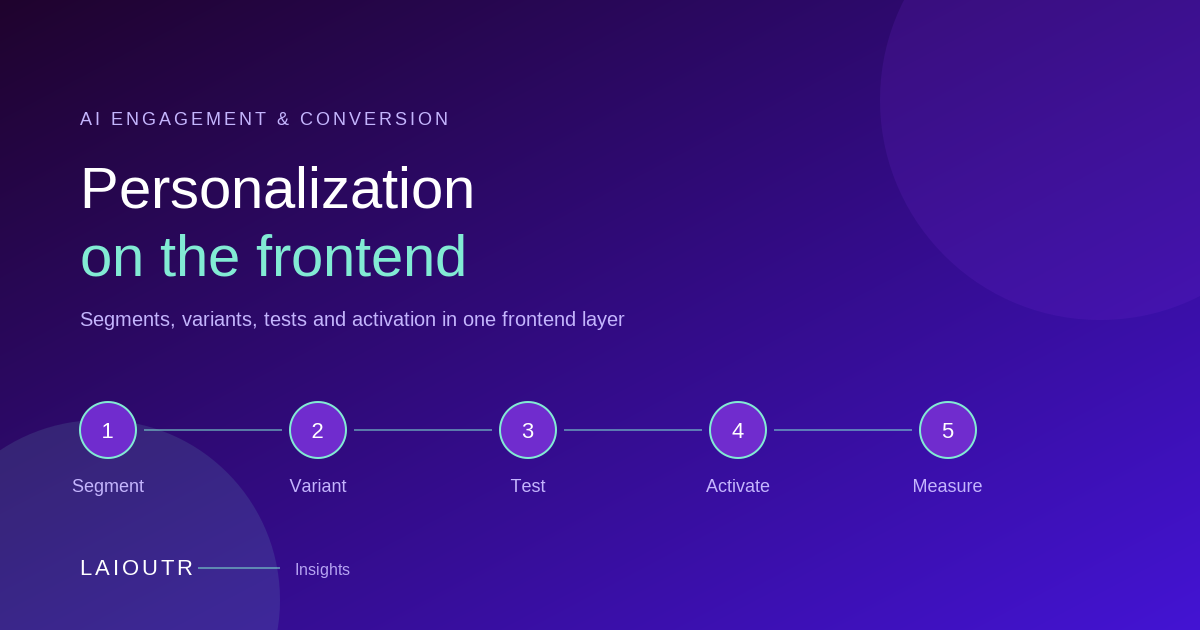AI Engagement and Conversion: Personalization on the Frontend
AI-driven engagement and conversion on the frontend rests on five mechanics: segments decide who see…](https://www.laioutr.com/en/blog/ai-engagement-conversion-frontend-personalization)
## Apps for the Laioutr platform
[View all apps](https://www.laioutr.com/en/apps)
[](https://www.laioutr.com/en/apps/shopify)
Laioutr
[Shopify](https://www.laioutr.com/en/apps/shopify)
Shopify is a commerce platform for selling online and in physical retail.
[](https://www.laioutr.com/en/apps/shopware)
Laioutr
[Shopware](https://www.laioutr.com/en/apps/shopware)
Shopware is a flexible ecommerce platform from Europe for product catalogs and omnichannel commerce.
[](https://www.laioutr.com/en/apps/adobe-commerce)
Laioutr
[Adobe Commerce](https://www.laioutr.com/en/apps/adobe-commerce)
Adobe Commerce is an enterprise commerce platform for complex, global B2C and B2B scenarios.
Planned
[](https://www.laioutr.com/en/apps/b2b-sellers)
Laioutr
[B2Bsellers](https://www.laioutr.com/en/apps/b2b-sellers)
B2B suite for Shopware that turns an online store into a professional B2B commerce platform.
Planned
[](https://www.laioutr.com/en/apps/commerce-layer)
Laioutr
[Commerce Layer](https://www.laioutr.com/en/apps/commerce-layer)
Commerce Layer is a headless commerce platform for making inventory and catalogs available online.
[](https://www.laioutr.com/en/apps/commercetools)
Laioutr
[Commercetools](https://www.laioutr.com/en/apps/commercetools)
Commercetools is a SaaS-based headless ecommerce platform used worldwide.
[](https://www.laioutr.com/en/apps/emporix)
Laioutr
[Emporix](https://www.laioutr.com/en/apps/emporix)
Emporix is a composable, API-first commerce platform for scalable B2B and B2C scenarios.
Planned
[](https://www.laioutr.com/en/apps/hcl-software)
Laioutr
[HCL Software](https://www.laioutr.com/en/apps/hcl-software)
Enterprise suite for digital commerce and experience with extensive configurability.
Planned
[](https://www.laioutr.com/en/apps/intershop)
Laioutr
[Intershop](https://www.laioutr.com/en/apps/intershop)
Enterprise commerce platform for complex B2B and B2C business models.
Planned
[](https://www.laioutr.com/en/apps/magento-2)
Laioutr
[Magento 2](https://www.laioutr.com/en/apps/magento-2)
Widely used, extensible commerce platform for B2C and B2B scenarios.
[](https://www.laioutr.com/en/apps/oxid-eshop)
Laioutr
[OXID eShop](https://www.laioutr.com/en/apps/oxid-eshop)
OXID eShop is an extensible commerce platform for complex B2B and B2C requirements.
Planned
[](https://www.laioutr.com/en/apps/patchworks)
Laioutr
[Patchworks](https://www.laioutr.com/en/apps/patchworks)
Patchworks is a low-code iPaaS that connects ecommerce, ERP, WMS, 3PL, and marketplaces.
Planned
[](https://www.laioutr.com/en/apps/PrestaShop)
Laioutr
[Prestashop](https://www.laioutr.com/en/apps/PrestaShop)
Open-source commerce platform for small and midsize merchants in Europe and beyond.
Planned
[](https://www.laioutr.com/en/apps/saleor)
Laioutr
[Saleor](https://www.laioutr.com/en/apps/saleor)
Open-source, API-first commerce platform built on GraphQL for custom storefronts.
Planned
[](https://www.laioutr.com/en/apps/salesforce-commerce-cloud)
Laioutr
[Salesforce Commerce Cloud](https://www.laioutr.com/en/apps/salesforce-commerce-cloud)
Salesforce Commerce Cloud is a cloud-based enterprise commerce platform for businesses of any size.
Planned
[](https://www.laioutr.com/en/apps/sap-commerce-cloud)
Laioutr
[SAP Commerce Cloud](https://www.laioutr.com/en/apps/sap-commerce-cloud)
Enterprise commerce platform for complex catalogs, pricing models, and omnichannel journeys.
Planned
[](https://www.laioutr.com/en/apps/scayle)
Laioutr
[Scayle](https://www.laioutr.com/en/apps/scayle)
SCAYLE is a commerce engine that helps brands and retailers scale their business.
Planned
[](https://www.laioutr.com/en/apps/spryker)
Laioutr
[Spryker](https://www.laioutr.com/en/apps/spryker)
Composable commerce platform for sophisticated B2B and B2C business models.
[](https://www.laioutr.com/en/apps/sylius)
Laioutr
[Sylius](https://www.laioutr.com/en/apps/sylius)
Sylius is a developer-friendly ecommerce framework for B2C and B2B shopping experiences.
Planned
[](https://www.laioutr.com/en/apps/vendure)
Laioutr
[Vendure](https://www.laioutr.com/en/apps/vendure)
Vendure is a headless commerce platform for businesses with complex requirements.
Coming Soon
[](https://www.laioutr.com/en/apps/vtex)
Laioutr
[VTEX](https://www.laioutr.com/en/apps/vtex)
Cloud-native, composable commerce platform for B2B and B2C at scale.
Planned
[](https://www.laioutr.com/en/apps/websale)
Laioutr
[Websale](https://www.laioutr.com/en/apps/websale)
Stable, enterprise-ready commerce backend for complex retail environments.
Strategy call
## The frontend as a control layer
A conversation about stack, roadmap and replatforming scenario. The outcome: a clear picture of how Laioutr fits, what it costs and how fast the go-live can happen.
*"After 30 minutes, we knew Laioutr makes our replatforming feasible."*
*Daniel B., CEO,* [*hygibox.de*](https://hygibox.de)
[Book a demo](https://www.laioutr.com/en/contact)
## Structured Data
```json
{
"@context": "https://schema.org",
"@graph": [
{
"@type": "Organization",
"@id": "https://www.laioutr.com/#identity",
"name": "Laioutr",
"legalName": "Laioutr GmbH",
"url": "https://www.laioutr.com/",
"logo": {
"@type": "ImageObject",
"url": "https://www.laioutr.com/laioutr-logo.png",
"width": 400,
"height": 400
},
"email": "info@laioutr.com",
"telephone": "+49 30 75435715",
"address": {
"@type": "PostalAddress",
"streetAddress": "Münchweilersteig 5",
"postalCode": "12559",
"addressLocality": "Berlin",
"addressCountry": "DE"
},
"vatID": "DE450905846",
"sameAs": [
"https://www.linkedin.com/company/laioutr",
"https://www.youtube.com/@Laioutr",
"https://x.com/laioutr"
]
},
{
"@type": "WebSite",
"@id": "https://www.laioutr.com/en/#website",
"url": "https://www.laioutr.com/en/",
"name": "Laioutr",
"inLanguage": "en",
"publisher": {
"@id": "https://www.laioutr.com/#identity"
}
},
{
"@type": "BlogPosting",
"@id": "https://www.laioutr.com/en/blog/escaping-ai-adoption-paradox#article",
"headline": "Beyond the AI Tool Graveyard: Why Smart Organizations Choose Integration Over Accumulation",
"description": "Why smart organizations choose AI integration over accumulation, escaping the quarterly AI tool graveyard.",
"image": [
"https://eu-west-2.graphassets.com/cmii2mlqi0dux06l5543v7nkc/cmnucypviw8mi07mgmwsd5asa"
],
"datePublished": "2026-06-30T17:27:16.57584+00:00",
"dateModified": "2026-06-30T17:27:16.207551+00:00",
"inLanguage": "en",
"articleSection": "Insights",
"keywords": "Industry & Trends",
"author": {
"@type": "Person",
"name": "Marcel Thiesies",
"jobTitle": "Co-Founder & CEO, Laioutr",
"image": "https://eu-west-2.graphassets.com/cmii2mlqi0dux06l5543v7nkc/cmj01b962364n07lb0iguvts5"
},
"publisher": {
"@id": "https://www.laioutr.com/#identity"
},
"mainEntityOfPage": {
"@id": "https://www.laioutr.com/en/blog/escaping-ai-adoption-paradox#webpage"
},
"isPartOf": {
"@id": "https://www.laioutr.com/en/#website"
}
},
{
"@type": "WebPage",
"@id": "https://www.laioutr.com/en/blog/escaping-ai-adoption-paradox#webpage",
"url": "https://www.laioutr.com/en/blog/escaping-ai-adoption-paradox",
"name": "Beyond the AI Tool Graveyard: Why Smart Organizations Choose Integration Over Accumulation",
"description": "Why smart organizations choose AI integration over accumulation, escaping the quarterly AI tool graveyard.",
"inLanguage": "en",
"isPartOf": {
"@id": "https://www.laioutr.com/en/#website"
},
"breadcrumb": {
"@id": "https://www.laioutr.com/en/blog/escaping-ai-adoption-paradox#breadcrumb"
},
"primaryImageOfPage": {
"@type": "ImageObject",
"url": "https://eu-west-2.graphassets.com/cmii2mlqi0dux06l5543v7nkc/cmnucypviw8mi07mgmwsd5asa"
},
"datePublished": "2026-06-30T17:27:16.57584+00:00",
"dateModified": "2026-06-30T17:27:16.207551+00:00",
"mainEntity": {
"@id": "https://www.laioutr.com/en/blog/escaping-ai-adoption-paradox#article"
}
},
{
"@type": "BreadcrumbList",
"@id": "https://www.laioutr.com/en/blog/escaping-ai-adoption-paradox#breadcrumb",
"itemListElement": [
{
"@type": "ListItem",
"position": 1,
"name": "Laioutr",
"item": "https://www.laioutr.com/en/"
},
{
"@type": "ListItem",
"position": 2,
"name": "Insights",
"item": "https://www.laioutr.com/en/blogs/insights"
},
{
"@type": "ListItem",
"position": 3,
"name": "Beyond the AI Tool Graveyard: Why Smart Organizations Choose Integration Over Accumulation"
}
]
}
]
}
```