---
title: "Experience Modeling in Composable DXPs"
canonical_url: "https://www.laioutr.com/en/blog/experience-modeling-composable-dxps"
locale: en
meta:
description: "Experience modeling is the hidden layer in composable architectures. Why technology alone falls short without it."
"og:description": "Experience modeling is the hidden layer in composable architectures. Why technology alone falls short without it."
"og:title": "Experience Modeling in Composable DXPs"
---

# Experience Modeling as the Hidden Layer in Composable Architectures: Why Technology Alone Falls Short
Table of contents
1. [1.The Composability Paradox: Why Decoupled Technology Often Feels More Tightly Coupled](#the-composability-paradox-why-decoupled-technology-often-feels-more-tightly-coupled)
2. [2.Experience Modeling: Making the Invisible Visible](#experience-modeling-making-the-invisible-visible)
3. [3.The Business Case: Beyond Cycle Time](#the-business-case-beyond-cycle-time)
4. [4.The Integration Challenge: Why Experience Modeling Requires Architectural Intention](#the-integration-challenge-why-experience-modeling-requires-architectural-intention)
5. [5.The Hidden Cost of Ignoring Experience Modeling](#the-hidden-cost-of-ignoring-experience-modeling)
6. [6.Experience Modeling Beyond the Digital Channel](#experience-modeling-beyond-the-digital-channel)
7. [7.The Strategic Implication: Architecture Follows Experience](#the-strategic-implication-architecture-follows-experience)
8. [8.Building Experience Modeling Capability](#building-experience-modeling-capability)
9. [9.Conclusion: Composable Is a Means, Not an End](#conclusion-composable-is-a-means-not-an-end)
The promise of composable technology has captivated enterprise organizations for half a decade now. Modular infrastructure. Microservices. Decoupled systems. Flexibility at every turn. The narrative is intoxicating: adopt a headless CMS, stitch together best-of-breed tools, and suddenly your organization becomes an agile powerhouse capable of responding to market shifts within days instead of quarters.
Yet somewhere between the architecture diagrams and quarterly reviews, many organizations discover a painful truth: their sophisticated, expensive composable stack has become a bottleneck rather than an accelerator. Marketing teams wait weeks for developer bandwidth. Product changes require technical specifications and pull requests. The technology that promised freedom has instead created new constraints.
This gap between technological capability and actual business agility is not a flaw in composable architectures themselves. It is a design blindspot that most organizations systematically overlook.
## The Composability Paradox: Why Decoupled Technology Often Feels More Tightly Coupled
When organizations migrate toward composable architectures, they typically focus on one dimension: technical decoupling. The business logic of one system should not depend on the implementation details of another. Data flows through APIs. Components are replaceable. This is architecturally sound.
But this technical decoupling creates an unexpected social coupling. When no single system owns the full user experience, responsibility becomes ambiguous. A homepage redesign requires coordination between the CMS team, the personalization platform, the analytics system, the e-commerce backend, and potentially half a dozen other tools. Each team guards its own system's integrity. Each system requires special knowledge to modify.
The result: governance gets tighter, processes get longer, and the promised agility evaporates.
This is not a technical problem that more APIs or better middleware can solve. It is a human and organizational problem masquerading as a technology problem.
## Experience Modeling: Making the Invisible Visible
Experience modeling is the practice of making the complete customer journey visible, manageable, and modifiable outside of code. Rather than asking "what can our technical systems do," it asks "what experience do we want to deliver, and how do we represent that experience in a way our entire team can collaborate on?"
At its core, experience modeling addresses three organizational challenges that composable architectures inadvertently create:
**First: The visibility problem.** In a decoupled system, no single dashboard shows you how changes in one component affect the overall user experience. You modify the content CMS without understanding how that change cascades through personalization rules and affects conversion behavior. You adjust the cart experience without seeing how that impacts mobile conversion rates across different geographic segments. The experience becomes invisible.
Experience modeling makes this invisible complexity explicit. It creates a shared representation that shows how systems interact, how context flows between components, and how individual changes ripple across the entire user journey.
**Second: The collaboration problem.** Composable architectures distribute technical knowledge across specialized teams. One person understands the CMS, another the personalization platform, another the analytics layer. But marketing decisions require integration of all this knowledge. Experience modeling creates a language that bridges specialized expertise, allowing marketers, designers, product managers, and developers to work with a shared understanding of the customer journey.
**Third: The velocity problem.** Without experience modeling, every meaningful change requires assembly of a cross-functional group, specification of technical requirements, and developer implementation cycles. With experience modeling, marketing teams gain the ability to configure and test experiences within guardrails designed by technical architects, dramatically reducing the feedback cycle.
## The Business Case: Beyond Cycle Time
Organizations often measure the success of composable implementations in purely technical terms: API response times, deployment frequency, system uptime. These metrics matter, but they do not drive business value.
The actual business impact of experience modeling emerges when we measure what matters to executives: speed to insight, conversion improvement, and revenue per marketing dollar spent.
When a marketing team can test a new checkout flow without waiting for developer resources, they can run twice as many experiments. When they can see in real time which experience variants are driving engagement, they can make informed decisions faster. When they can adjust personalization rules based on current performance data, they respond to market shifts in days rather than weeks.
These are not trivial efficiency gains. They represent the difference between strategic advantage and competitive vulnerability in markets that move fast.
Consider the difference between a scenario where a product team observes a 12% dip in mobile conversion rates and must log a ticket with engineering, wait for prioritization and development cycles, and deploy a fix weeks later. Compare that to a scenario where the same observation triggers immediate action through experience modeling tools: the team identifies which page element is causing the issue, adjusts the responsive behavior through a visual editor, and validates the change against real traffic within hours.
That difference is organizational velocity. And velocity, over time, becomes competitive advantage.
## The Integration Challenge: Why Experience Modeling Requires Architectural Intention
Experience modeling is not a bolt-on feature. It is not something that emerges automatically from assembling APIs and microservices. It requires deliberate architectural decisions at the point of system design.
The first decision: defining the surface area of control. Which aspects of the user experience can non-technical teams modify? Which aspects require code changes and architectural review? Answering this question requires collaboration between technical architects and business leaders.
Consider a personalization scenario. Should marketing teams be able to create entirely new personalization rules? Or should they be constrained to applying pre-built rules defined by engineers? The answer depends on your organization's risk tolerance, your team's capabilities, and your system's complexity. But the answer must be intentional, not accidental.
The second decision: modeling the data and context that flows through the experience. What customer profile attributes affect experience decisions? What behavioral signals matter? What real-time context influences decisions? Documenting and structuring this context is prerequisite work for experience modeling tools to function.
The third decision: establishing the governance layer. When multiple tools and teams can modify the experience, how do you prevent conflicting changes? How do you maintain brand consistency? How do you ensure that performance optimizations from one team do not inadvertently break another team's functionality? These governance questions must be answered in the experience model itself.
## The Hidden Cost of Ignoring Experience Modeling
Organizations that deploy composable architectures without implementing experience modeling often experience a predictable trajectory. Year one: excitement about technical capability and flexibility. Year two: frustration that flexibility has not translated to business agility. Year three: adding process and governance to manage the complexity that decoupled systems create.
By year four, organizations often find themselves with equally complex governance structures, but now the governance is distributed across multiple teams and systems rather than consolidated in a single traditional CMS. The technical debt accumulates. The process burden grows. The promised agility remains theoretical.
The alternative trajectory is steeper but shorter. Years one through two involve the difficult work of defining experience models, establishing governance, and building tools that make those models actionable. But by year three, teams have discovered a stable pattern. Experience modeling becomes business as usual. Changes that once required weeks cycle through in days. Teams collaborate across domains with clarity rather than confusion.
## Experience Modeling Beyond the Digital Channel
The strategic value of experience modeling extends beyond the typical digital marketing use cases. Organizations running complex omnichannel operations face multiplicative coordination challenges when channels have different technical ownership.
A retail organization with independent digital commerce, in-store technology, and mobile app teams benefits enormously from experience modeling. The organization can define a consistent customer journey that spans channels, identify where each channel should take different approaches, and coordinate changes without demanding perfect synchronization of technical systems that operate on different release cycles.
A financial services organization managing customer journeys across banking platforms, investment platforms, and advisory services benefits from experience modeling for different reasons: regulatory compliance and risk management become easier when the experience flow is explicitly documented and governed.
These scenarios push experience modeling beyond design convenience into business necessity.
## The Strategic Implication: Architecture Follows Experience
This perspective inverts the typical technology-first approach to composable systems. Most organizations start with the question: "What composable tools should we assemble?"
The more useful question is: "What experience do we want to deliver, and how should our composable architecture be structured to enable that experience?"
This is not a subtle distinction. It changes which technologies you select, how you integrate them, what governance you establish, and how you measure success.
When experience drives architecture rather than architecture driving experience, several changes cascade through the organization:
Vendor selection criteria shift. Tools are evaluated not just on their technical capabilities but on their support for experience modeling patterns and their ability to operate within cross-team governance structures.
Team structure shifts. Organizations recognize that composable architectures require dedicated roles focused on experience integration, not just system specialization.
Success metrics shift. Implementation success is measured not in API calls or deployment frequency but in the reduction of experience-to-market cycles and the quality of cross-team collaboration.
## Building Experience Modeling Capability
Implementing experience modeling does not require acquiring new software as much as it requires developing new thinking.
Start by mapping the current customer journeys your organization delivers. Document the systems involved at each stage. Identify the decision points. Note which decisions are currently made by code and which could be made by configuration.
Work with your business stakeholders to define what changes they need to make frequently. What hypotheses do you test regularly? What customer segments require different experiences? Where do personalization and dynamic content matter most?
This analysis reveals the components of your experience model. Not everything needs to be modeled immediately. Start with the highest-impact, highest-frequency change scenarios.
From there, the implementation work becomes clear: structuring data and context so that business teams can make decisions, building tools or choosing platforms that enable configuration, and establishing governance that maintains consistency while enabling velocity.
## Conclusion: Composable Is a Means, Not an End
Composable architectures represent a genuine architectural advance. The ability to assemble purpose-built solutions instead of accepting one-size-fits-all limitations is real progress. But architectural progress is not the same as business progress.
Experience modeling is how organizations convert architectural capability into business value. It is how they translate technical flexibility into marketing velocity, how they turn decoupled systems into coordinated customer experiences, and how they ensure that expensive technology investments deliver measurable returns.
The organizations that succeed with composable systems are not the ones with the most sophisticated technical infrastructure. They are the ones that intentionally, deliberately invest in making experiences visible, manageable, and actionable for their teams. They treat experience modeling not as a feature but as a foundational element of their operating model.
In markets where competitive advantage increasingly derives from the ability to respond quickly to customer needs and market changes, experience modeling is not optional. It is the hidden layer that separates composable technology investments that deliver value from those that simply add complexity.
The future belongs not to organizations with the most sophisticated technology stacks, but to organizations that have optimized the experience of managing those stacks. Experience modeling is how you get there.
### **More from the Laioutr Platform**
- [Composable Headless Frontend](https://www.laioutr.com/en/composable-headless-frontend)
- [SEO and GEO](https://www.laioutr.com/en/product/seo-and-geo)
- [Agentic Frontend Management Platform](https://www.laioutr.com/en/agentic-frontend-management-platform)
Related reading: [Breaking Free from Monolithic Legacy: Why Composable DXPs Are Your Strategic Advantage in Technology Evolution](https://www.laioutr.com/en/blog/composable-dxps-simplify-migrations) and [Building at Scale Without Breaking the Bank: Why Reusable Components Are Your Competitive Edge](https://www.laioutr.com/en/blog/reusability-composable-dxps-scaling).
---
Share this article
[Share on Facebook](https://www.facebook.com/sharer/sharer.php?u=https%3A%2F%2Fwww.laioutr.com%2Fen%2Fblog%2Fexperience-modeling-composable-dxps) [Share on X](https://x.com/intent/post?url=https%3A%2F%2Fwww.laioutr.com%2Fen%2Fblog%2Fexperience-modeling-composable-dxps&text=) [Share on LinkedIn](https://www.linkedin.com/sharing/share-offsite/?url=https%3A%2F%2Fwww.laioutr.com%2Fen%2Fblog%2Fexperience-modeling-composable-dxps) [Share on Pinterest](https://pinterest.com/pin/create/button/?url=https%3A%2F%2Fwww.laioutr.com%2Fen%2Fblog%2Fexperience-modeling-composable-dxps&description=) [Share via email](mailto:?subject=&body=%0A%0Ahttps%3A%2F%2Fwww.laioutr.com%2Fen%2Fblog%2Fexperience-modeling-composable-dxps)
## More articles on frontend and headless
Practical know-how for frontend development, smart agents, and headless
[To the blog](https://www.laioutr.com/en/blogs/insights)
[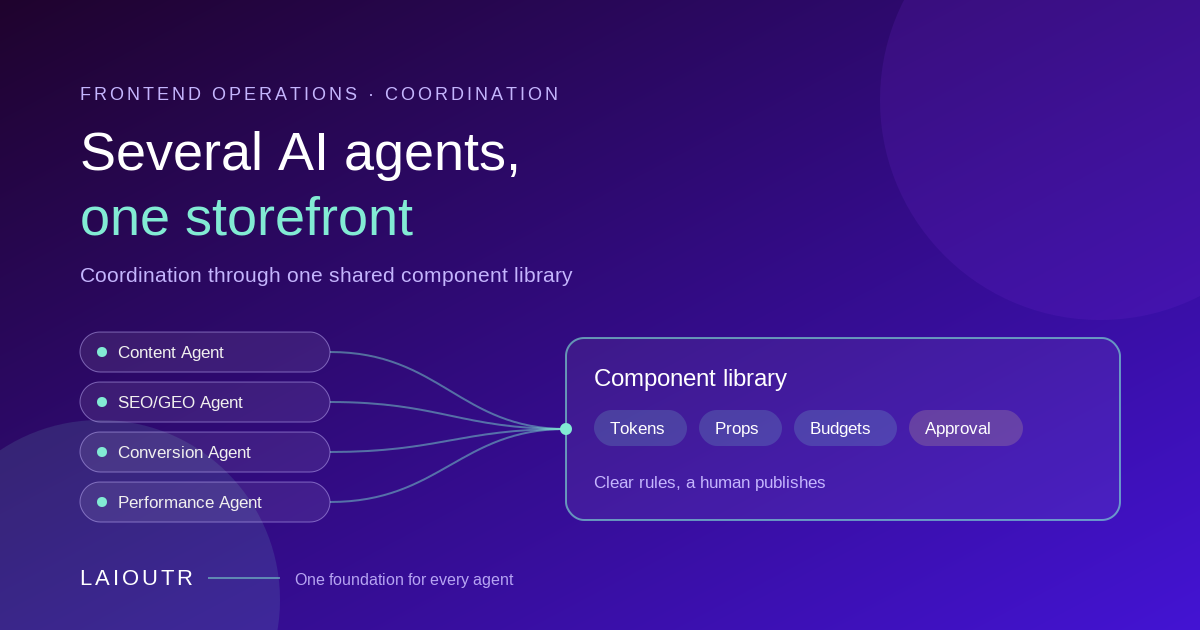Several AI Agents, One Storefront: Coordination Without Collisions
When several AI agents work on the same storefront, conflicts rarely happen between the agents thems…](https://www.laioutr.com/en/blog/frontend-operations-multi-agent-coordination-storefront-2026)
[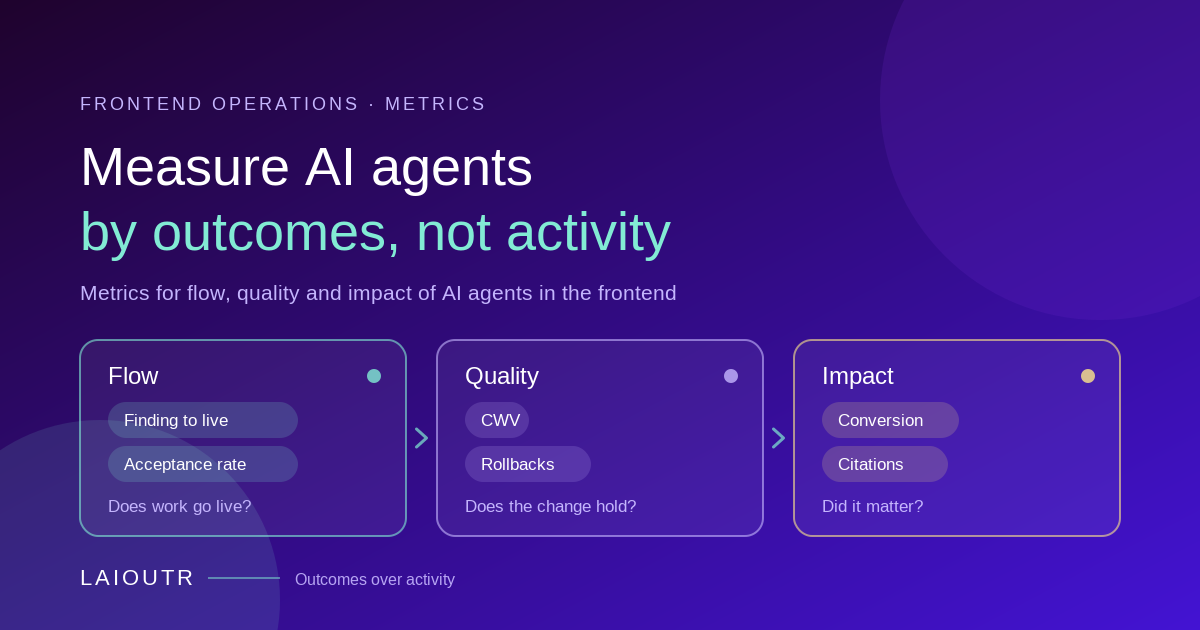Measuring AI Agents by Outcomes: Agentic Frontend Management Metrics
AI agents in the frontend should be measured by outcomes, not by activity. The number of prompts, ge…](https://www.laioutr.com/en/blog/frontend-operations-measuring-ai-agents-outcomes-2026)
[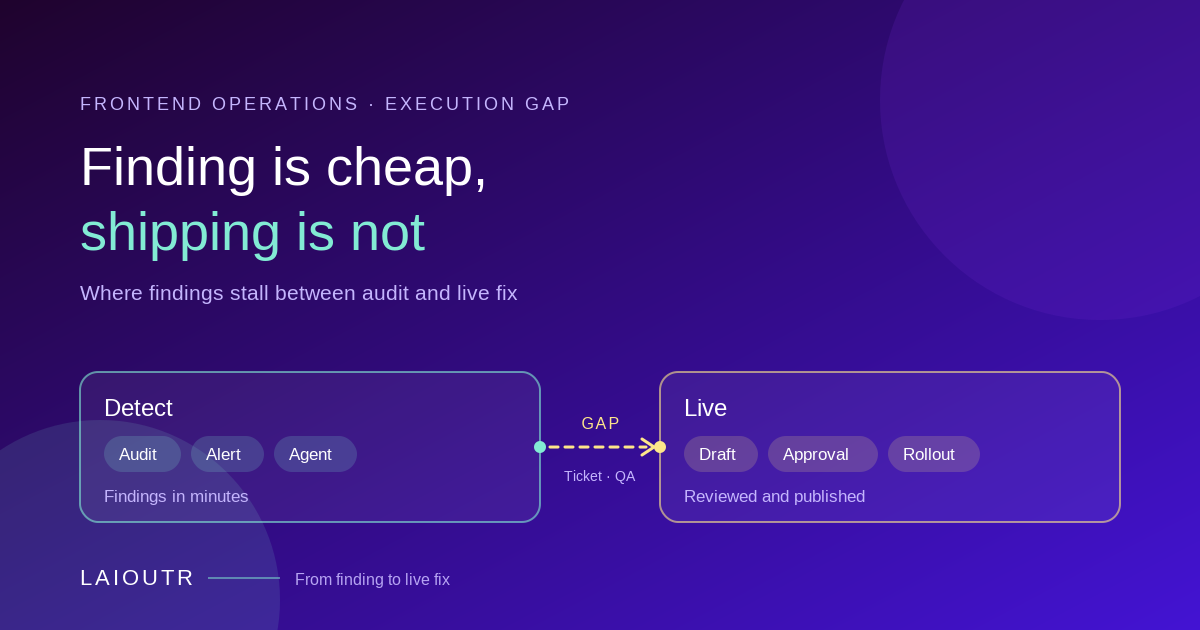The Execution Gap in the Frontend: Finding Is Cheap, Shipping Is Not
The execution gap in the frontend is the time, and the number of handoffs, between "we know wha…](https://www.laioutr.com/en/blog/frontend-operations-execution-gap-detect-vs-deploy-2026)
[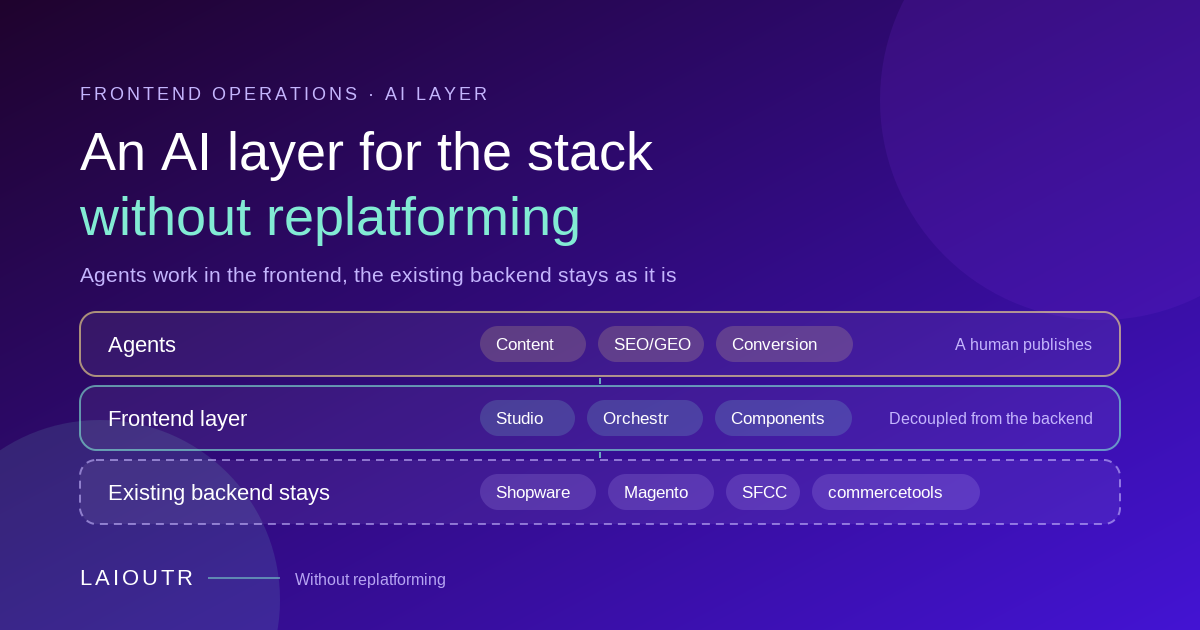Adding an AI Layer to an Existing Commerce Stack Without Replatforming
An AI layer can be added to an existing commerce stack without replacing the shop system. The most p…](https://www.laioutr.com/en/blog/frontend-operations-ai-layer-existing-stack-without-replatforming-2026)
[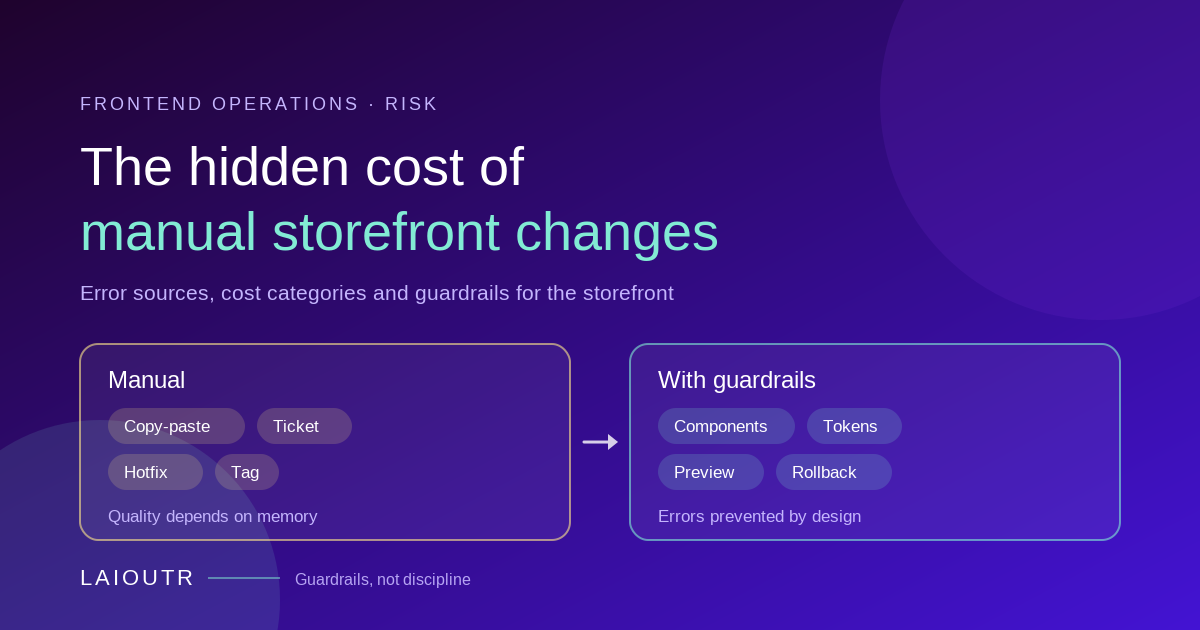The Hidden Cost of Manual Storefront Changes and How to Cut It
Manual frontend changes are the many small edits that keep a storefront running day to day: a new ba…](https://www.laioutr.com/en/blog/frontend-operations-hidden-cost-manual-storefront-changes-2026)
[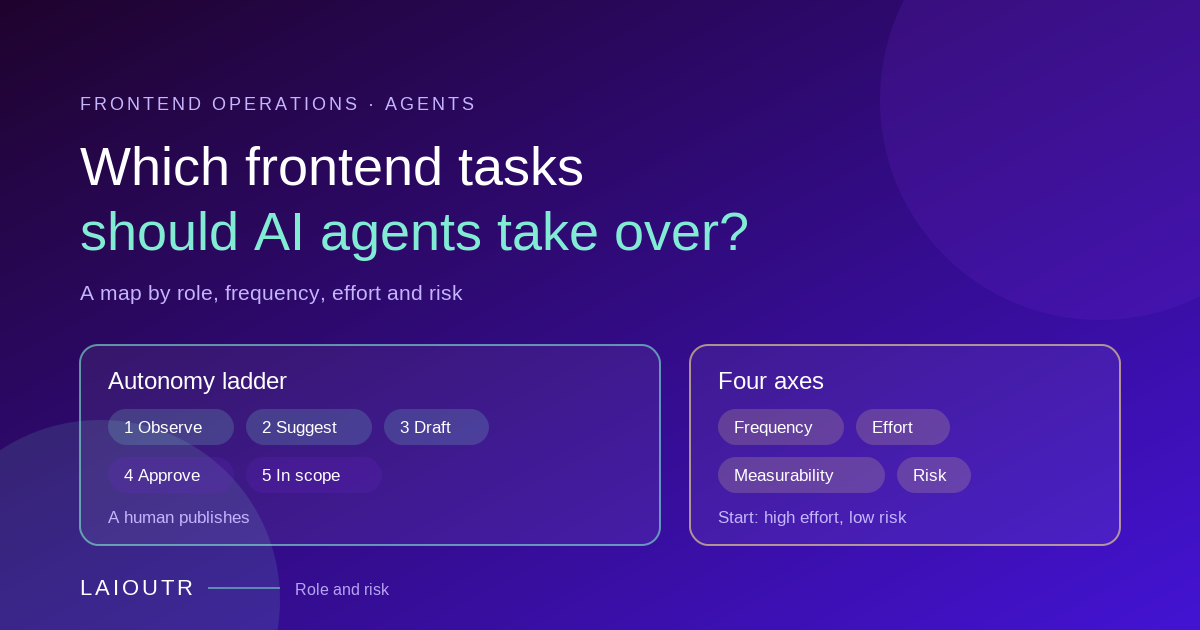Which Frontend Tasks Should AI Agents Take Over? Role and Risk Map
AI agents should first take over the frontend tasks that come up often, involve a lot of manual work…](https://www.laioutr.com/en/blog/frontend-operations-agent-task-map-role-risk-2026)
[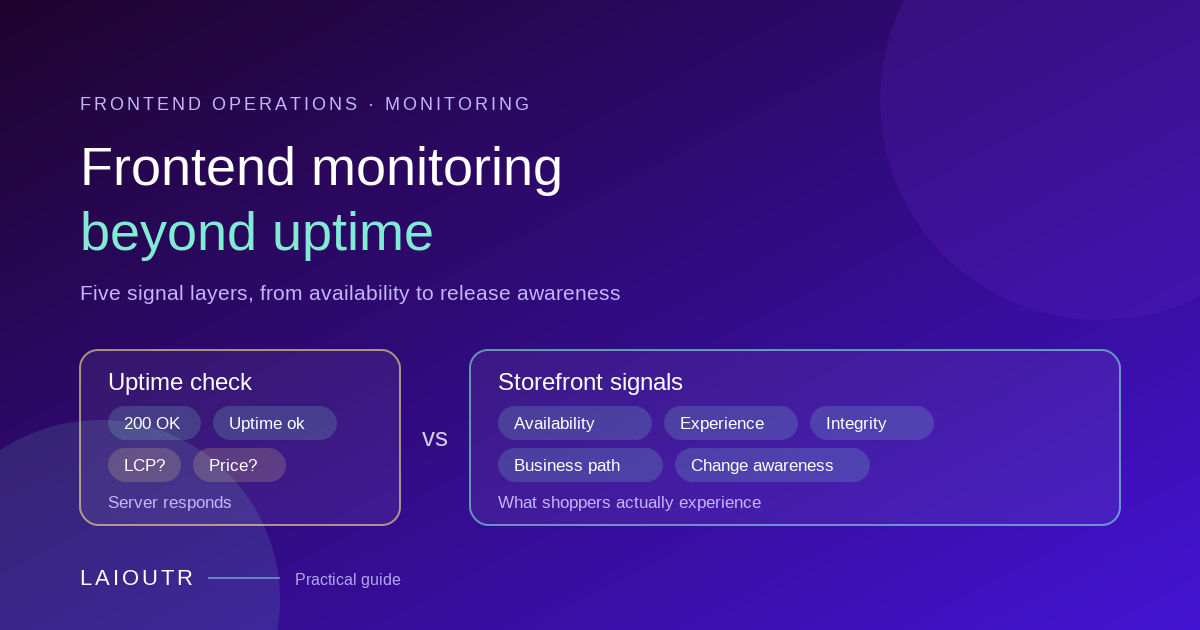Frontend Monitoring Beyond Uptime: Signals a Storefront Needs
Frontend monitoring beyond uptime means checking a storefront not only for availability but for what…](https://www.laioutr.com/en/blog/frontend-operations-monitoring-beyond-uptime-2026)
[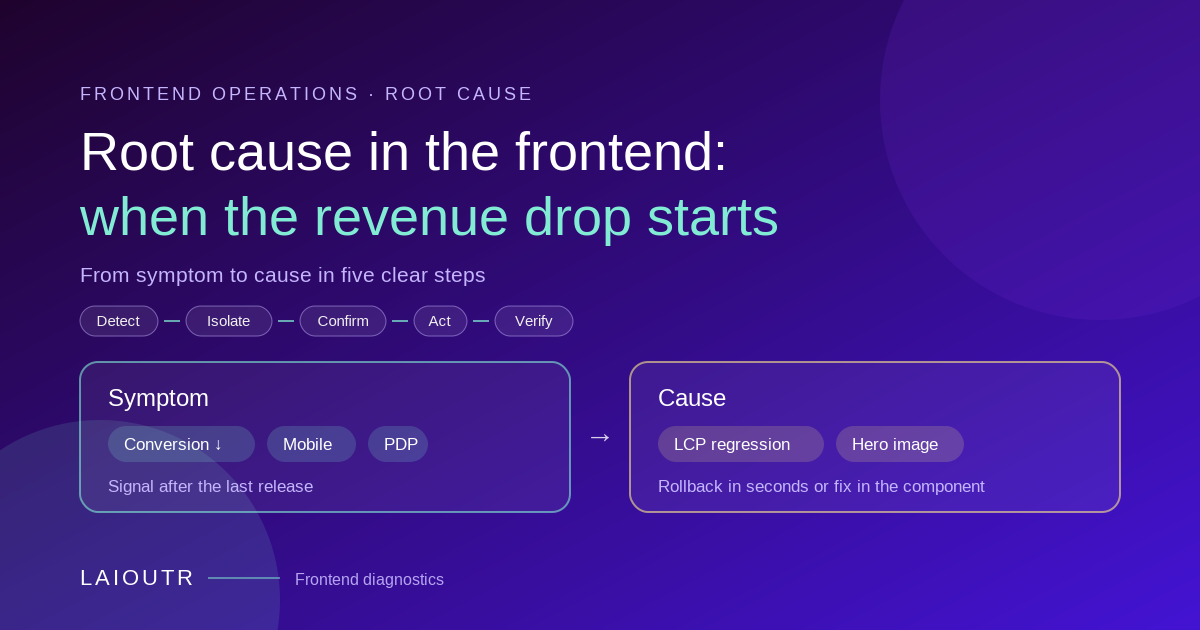Root Cause in the Frontend: When Revenue Drops Start in the Storefront
When revenue or conversion rate drops suddenly, the cause often is not traffic, pricing or the comme…](https://www.laioutr.com/en/blog/frontend-operations-root-cause-revenue-drop-storefront-2026)
[Laioutr Academy Is Live: The Video Manual for Laioutr
Since October 15, 2026, the Laioutr Academy has been live at academy.laioutr.com. It is the user man…](https://www.laioutr.com/en/blog/laioutr-academy-launch-video-manual-certification)
[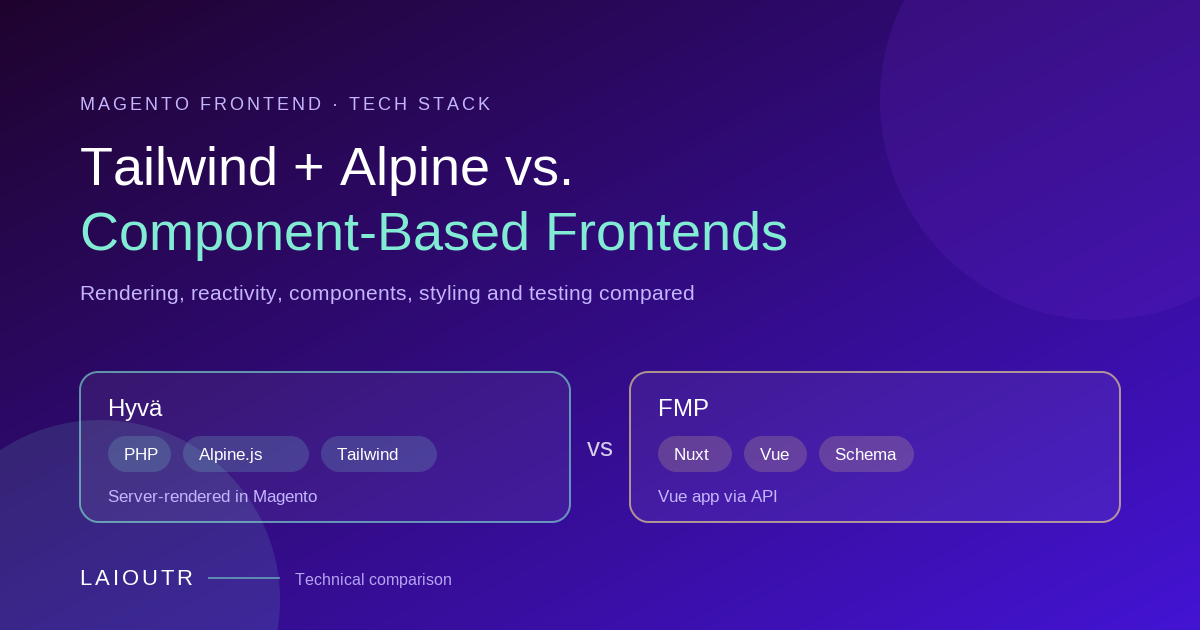Tailwind + Alpine vs. Component-Based Frontends for Magento
Hyvä renders Magento pages on the server with PHP templates and layout XML, adds interactivity throu…](https://www.laioutr.com/en/blog/tailwind-alpine-magento-vs-component-based-frontend-2026)
[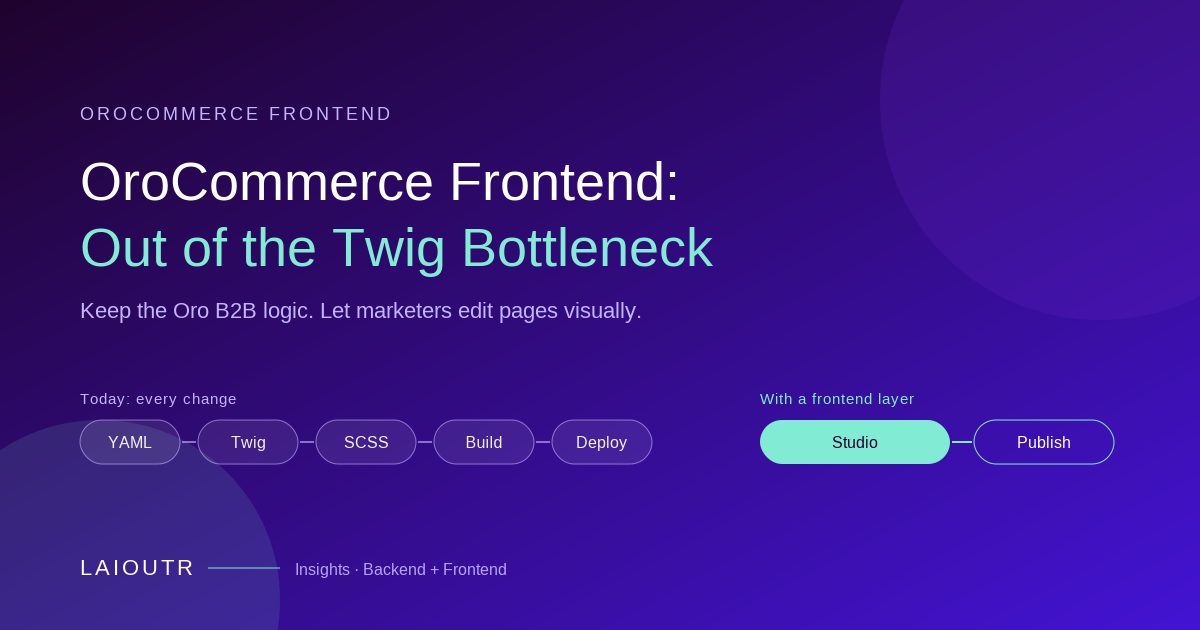OroCommerce Frontend: Out of the Twig and Layouts Bottleneck
The OroCommerce frontend is a server-rendered storefront built from Symfony bundles, OroLayouts and …](https://www.laioutr.com/en/blog/orocommerce-frontend-twig-layouts-bottleneck)
[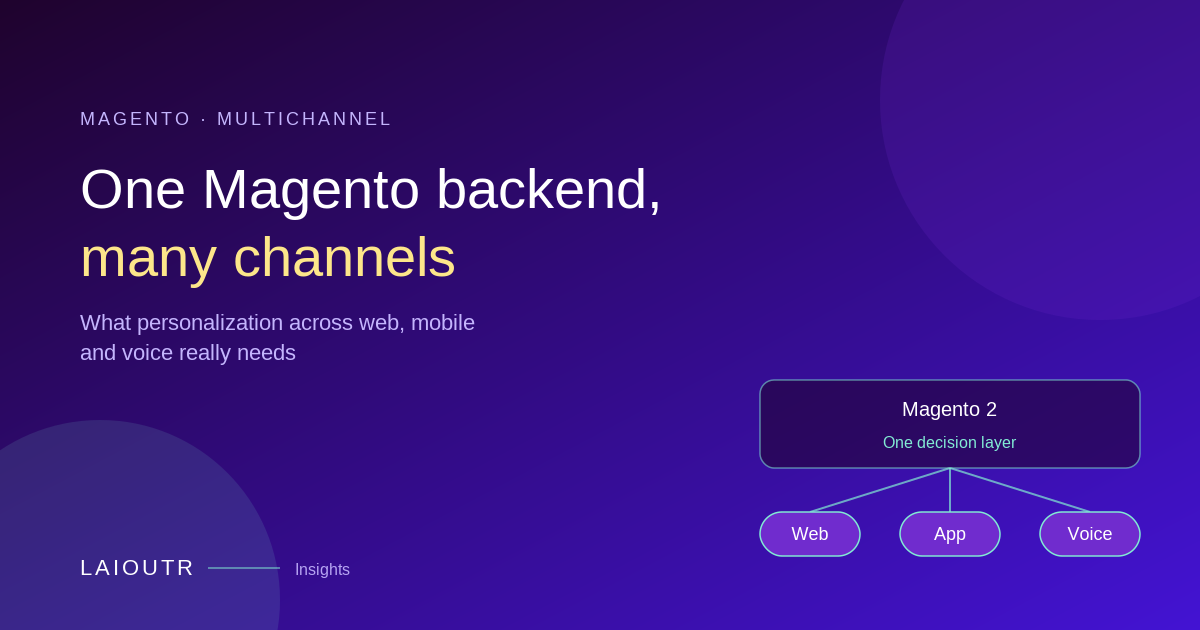One Magento Backend, Many Channels: Personalization in Practice
Personalization across web, mobile and voice on a single Magento backend does not start with a featu…](https://www.laioutr.com/en/blog/magento-multichannel-personalization-web-mobile-voice-2026)
[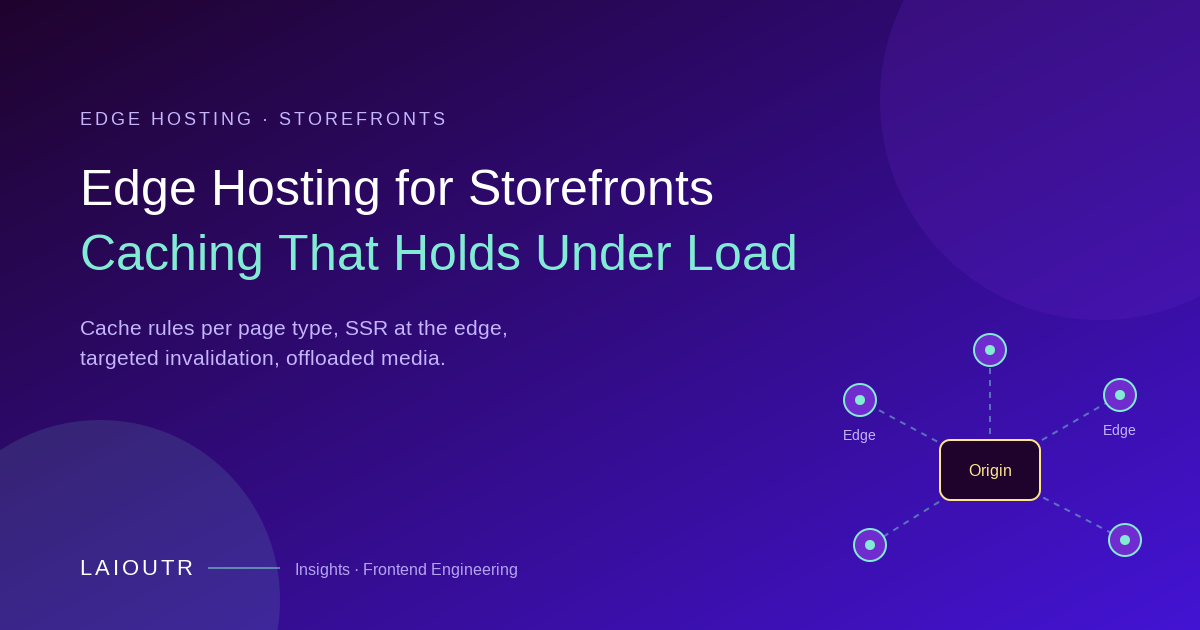Edge Hosting for Storefronts: Caching That Holds Under Peak Load
Edge hosting keeps a storefront fast under load when most requests never reach the origin: pages and…](https://www.laioutr.com/en/blog/edge-hosting-storefronts-peak-traffic-caching-2026)
[Composable Commerce 2027: What Shifted and What Comes Next
Composable commerce enters 2027 with a different agenda than a year ago. The architecture question i…](https://www.laioutr.com/en/blog/composable-commerce-2027-outlook)
[AI Engagement and Conversion: Personalization on the Frontend
AI-driven engagement and conversion on the frontend rests on five mechanics: segments decide who see…](https://www.laioutr.com/en/blog/ai-engagement-conversion-frontend-personalization)
## Apps for the Laioutr platform
[View all apps](https://www.laioutr.com/en/apps)
[](https://www.laioutr.com/en/apps/shopify)
Laioutr
[Shopify](https://www.laioutr.com/en/apps/shopify)
Shopify is a commerce platform for selling online and in physical retail.
[](https://www.laioutr.com/en/apps/shopware)
Laioutr
[Shopware](https://www.laioutr.com/en/apps/shopware)
Shopware is a flexible ecommerce platform from Europe for product catalogs and omnichannel commerce.
[](https://www.laioutr.com/en/apps/adobe-commerce)
Laioutr
[Adobe Commerce](https://www.laioutr.com/en/apps/adobe-commerce)
Adobe Commerce is an enterprise commerce platform for complex, global B2C and B2B scenarios.
Planned
[](https://www.laioutr.com/en/apps/b2b-sellers)
Laioutr
[B2Bsellers](https://www.laioutr.com/en/apps/b2b-sellers)
B2B suite for Shopware that turns an online store into a professional B2B commerce platform.
Planned
[](https://www.laioutr.com/en/apps/commerce-layer)
Laioutr
[Commerce Layer](https://www.laioutr.com/en/apps/commerce-layer)
Commerce Layer is a headless commerce platform for making inventory and catalogs available online.
[](https://www.laioutr.com/en/apps/commercetools)
Laioutr
[Commercetools](https://www.laioutr.com/en/apps/commercetools)
Commercetools is a SaaS-based headless ecommerce platform used worldwide.
[](https://www.laioutr.com/en/apps/emporix)
Laioutr
[Emporix](https://www.laioutr.com/en/apps/emporix)
Emporix is a composable, API-first commerce platform for scalable B2B and B2C scenarios.
Planned
[](https://www.laioutr.com/en/apps/hcl-software)
Laioutr
[HCL Software](https://www.laioutr.com/en/apps/hcl-software)
Enterprise suite for digital commerce and experience with extensive configurability.
Planned
[](https://www.laioutr.com/en/apps/intershop)
Laioutr
[Intershop](https://www.laioutr.com/en/apps/intershop)
Enterprise commerce platform for complex B2B and B2C business models.
Planned
[](https://www.laioutr.com/en/apps/magento-2)
Laioutr
[Magento 2](https://www.laioutr.com/en/apps/magento-2)
Widely used, extensible commerce platform for B2C and B2B scenarios.
[](https://www.laioutr.com/en/apps/oxid-eshop)
Laioutr
[OXID eShop](https://www.laioutr.com/en/apps/oxid-eshop)
OXID eShop is an extensible commerce platform for complex B2B and B2C requirements.
Planned
[](https://www.laioutr.com/en/apps/patchworks)
Laioutr
[Patchworks](https://www.laioutr.com/en/apps/patchworks)
Patchworks is a low-code iPaaS that connects ecommerce, ERP, WMS, 3PL, and marketplaces.
Planned
[](https://www.laioutr.com/en/apps/PrestaShop)
Laioutr
[Prestashop](https://www.laioutr.com/en/apps/PrestaShop)
Open-source commerce platform for small and midsize merchants in Europe and beyond.
Planned
[](https://www.laioutr.com/en/apps/saleor)
Laioutr
[Saleor](https://www.laioutr.com/en/apps/saleor)
Open-source, API-first commerce platform built on GraphQL for custom storefronts.
Planned
[](https://www.laioutr.com/en/apps/salesforce-commerce-cloud)
Laioutr
[Salesforce Commerce Cloud](https://www.laioutr.com/en/apps/salesforce-commerce-cloud)
Salesforce Commerce Cloud is a cloud-based enterprise commerce platform for businesses of any size.
Planned
[](https://www.laioutr.com/en/apps/sap-commerce-cloud)
Laioutr
[SAP Commerce Cloud](https://www.laioutr.com/en/apps/sap-commerce-cloud)
Enterprise commerce platform for complex catalogs, pricing models, and omnichannel journeys.
Planned
[](https://www.laioutr.com/en/apps/scayle)
Laioutr
[Scayle](https://www.laioutr.com/en/apps/scayle)
SCAYLE is a commerce engine that helps brands and retailers scale their business.
Planned
[](https://www.laioutr.com/en/apps/spryker)
Laioutr
[Spryker](https://www.laioutr.com/en/apps/spryker)
Composable commerce platform for sophisticated B2B and B2C business models.
[](https://www.laioutr.com/en/apps/sylius)
Laioutr
[Sylius](https://www.laioutr.com/en/apps/sylius)
Sylius is a developer-friendly ecommerce framework for B2C and B2B shopping experiences.
Planned
[](https://www.laioutr.com/en/apps/vendure)
Laioutr
[Vendure](https://www.laioutr.com/en/apps/vendure)
Vendure is a headless commerce platform for businesses with complex requirements.
Coming Soon
[](https://www.laioutr.com/en/apps/vtex)
Laioutr
[VTEX](https://www.laioutr.com/en/apps/vtex)
Cloud-native, composable commerce platform for B2B and B2C at scale.
Planned
[](https://www.laioutr.com/en/apps/websale)
Laioutr
[Websale](https://www.laioutr.com/en/apps/websale)
Stable, enterprise-ready commerce backend for complex retail environments.
Strategy call
## The frontend as a control layer
A conversation about stack, roadmap and replatforming scenario. The outcome: a clear picture of how Laioutr fits, what it costs and how fast the go-live can happen.
*"After 30 minutes, we knew Laioutr makes our replatforming feasible."*
*Daniel B., CEO,* [*hygibox.de*](https://hygibox.de)
[Book a demo](https://www.laioutr.com/en/contact)
## Structured Data
```json
{
"@context": "https://schema.org",
"@graph": [
{
"@type": "Organization",
"@id": "https://www.laioutr.com/#identity",
"name": "Laioutr",
"legalName": "Laioutr GmbH",
"url": "https://www.laioutr.com/",
"logo": {
"@type": "ImageObject",
"url": "https://www.laioutr.com/laioutr-logo.png",
"width": 400,
"height": 400
},
"email": "info@laioutr.com",
"telephone": "+49 30 75435715",
"address": {
"@type": "PostalAddress",
"streetAddress": "Münchweilersteig 5",
"postalCode": "12559",
"addressLocality": "Berlin",
"addressCountry": "DE"
},
"vatID": "DE450905846",
"sameAs": [
"https://www.linkedin.com/company/laioutr",
"https://www.youtube.com/@Laioutr",
"https://x.com/laioutr"
]
},
{
"@type": "WebSite",
"@id": "https://www.laioutr.com/en/#website",
"url": "https://www.laioutr.com/en/",
"name": "Laioutr",
"inLanguage": "en",
"publisher": {
"@id": "https://www.laioutr.com/#identity"
}
},
{
"@type": "BlogPosting",
"@id": "https://www.laioutr.com/en/blog/experience-modeling-composable-dxps#article",
"headline": "Experience Modeling as the Hidden Layer in Composable Architectures: Why Technology Alone Falls Short",
"description": "Experience modeling is the hidden layer in composable architectures. Why technology alone falls short without it.",
"image": [
"https://eu-west-2.graphassets.com/cmii2mlqi0dux06l5543v7nkc/cmnucypviw8mi07mgmwsd5asa"
],
"datePublished": "2026-06-30T17:25:52.314049+00:00",
"dateModified": "2026-06-30T17:25:52.055964+00:00",
"inLanguage": "en",
"articleSection": "Insights",
"keywords": "Industry & Trends",
"author": {
"@type": "Person",
"name": "Marcel Thiesies",
"jobTitle": "Co-Founder & CEO, Laioutr",
"image": "https://eu-west-2.graphassets.com/cmii2mlqi0dux06l5543v7nkc/cmj01b962364n07lb0iguvts5"
},
"publisher": {
"@id": "https://www.laioutr.com/#identity"
},
"mainEntityOfPage": {
"@id": "https://www.laioutr.com/en/blog/experience-modeling-composable-dxps#webpage"
},
"isPartOf": {
"@id": "https://www.laioutr.com/en/#website"
}
},
{
"@type": "WebPage",
"@id": "https://www.laioutr.com/en/blog/experience-modeling-composable-dxps#webpage",
"url": "https://www.laioutr.com/en/blog/experience-modeling-composable-dxps",
"name": "Experience Modeling as the Hidden Layer in Composable Architectures: Why Technology Alone Falls Short",
"description": "Experience modeling is the hidden layer in composable architectures. Why technology alone falls short without it.",
"inLanguage": "en",
"isPartOf": {
"@id": "https://www.laioutr.com/en/#website"
},
"breadcrumb": {
"@id": "https://www.laioutr.com/en/blog/experience-modeling-composable-dxps#breadcrumb"
},
"primaryImageOfPage": {
"@type": "ImageObject",
"url": "https://eu-west-2.graphassets.com/cmii2mlqi0dux06l5543v7nkc/cmnucypviw8mi07mgmwsd5asa"
},
"datePublished": "2026-06-30T17:25:52.314049+00:00",
"dateModified": "2026-06-30T17:25:52.055964+00:00",
"mainEntity": {
"@id": "https://www.laioutr.com/en/blog/experience-modeling-composable-dxps#article"
}
},
{
"@type": "BreadcrumbList",
"@id": "https://www.laioutr.com/en/blog/experience-modeling-composable-dxps#breadcrumb",
"itemListElement": [
{
"@type": "ListItem",
"position": 1,
"name": "Laioutr",
"item": "https://www.laioutr.com/en/"
},
{
"@type": "ListItem",
"position": 2,
"name": "Insights",
"item": "https://www.laioutr.com/en/blogs/insights"
},
{
"@type": "ListItem",
"position": 3,
"name": "Experience Modeling as the Hidden Layer in Composable Architectures: Why Technology Alone Falls Short"
}
]
}
]
}
```