---
title: "Frontend as a Service Explained"
canonical_url: "https://www.laioutr.com/en/blog/frontend-as-a-service"
locale: en
meta:
description: "Frontend as a Service treats your storefront as managed infrastructure, the missing layer in a truly composable commerce stack."
"og:description": "Frontend as a Service treats your storefront as managed infrastructure, the missing layer in a truly composable commerce stack."
"og:title": "Frontend as a Service Explained"
---

# Frontend as a Service: The Missing Layer in Your Composable Stack
Table of contents
1. [1.What Happened to the Frontend: A Brief History of Bad Choices](#what-happened-to-the-frontend-a-brief-history-of-bad-choices)
2. [2.The FEaaS Model: Recognizing Frontend as Infrastructure](#the-feaas-model-recognizing-frontend-as-infrastructure)
3. [3.Why FEaaS Matters in Composable Commerce](#why-feaas-matters-in-composable-commerce)
4. [4.FEaaS vs. Custom Frontend Development: The Real Cost Comparison](#feaas-vs-custom-frontend-development-the-real-cost-comparison)
5. [5.FEaaS vs. Monolithic Platforms: Breaking Free Without Building](#feaas-vs-monolithic-platforms-breaking-free-without-building)
6. [6.How to Evaluate a FEaaS Provider](#how-to-evaluate-a-feaas-provider)
7. [7.The Business Case for FEaaS in 2026](#the-business-case-for-feaas-in-2026)
8. [8.The Strategic Shift Required](#the-strategic-shift-required)
9. [9.Building Your Frontend as a Service Architecture](#building-your-frontend-as-a-service-architecture)
10. [10.Laioutr: Frontend as a Service for Composable Commerce](#laioutr-frontend-as-a-service-for-composable-commerce)
11. [11.The Frontend Is Your Revenue Layer](#the-frontend-is-your-revenue-layer)
The conversation about composable commerce has a blind spot.
For the past several years, digital strategists and architects have focused almost exclusively on the backend: decoupling the commerce engine, swapping in best-of-breed commerce platforms, modularizing product information management, separating content systems. This focus makes sense. The backend is where business logic lives. It's where inventory is managed, orders are processed, payments are orchestrated.
But here's what keeps getting overlooked: revenue is made or lost on the frontend. A customer never sees your commerce engine. They don't experience your PIM or your order management system. They experience your storefront. They interact with your search, your product pages, your checkout. The entire relationship between your business and your customer happens on the frontend.
So why does the frontend remain the last frontier of in-house, custom development? Why are teams still building storefronts from scratch, wrestling with component libraries, managing design system drift, maintaining their own infrastructure, and shipping frontend updates as if we haven't learned better ways?
The answer is that most organizations haven't yet discovered Frontend as a Service.
FEaaS is a new category of infrastructure designed specifically for this gap. It acknowledges that your frontend isn't custom to your business in the way your order management logic is. The search experience, the product page layout, the checkout flow: these follow patterns that every ecommerce business shares. Building them from scratch for every property is like building your own payment processor instead of using Stripe. It's possible. It's occasionally necessary. It's almost always a mistake.
This post explains what Frontend as a Service actually is, why it matters for composable commerce, and how it changes the ROI calculation for modern ecommerce businesses.
## What Happened to the Frontend: A Brief History of Bad Choices
To understand FEaaS, it helps to understand the problem it solves.
Ten years ago, nearly every ecommerce company built custom storefronts. You selected a platform (Shopify, Magento, WooCommerce) and that platform came with a frontend. You customized it, built themes, hired frontend engineers to extend it. The platform provided the entire stack: commerce engine, storefront, hosting, operations. You traded flexibility for speed. You got a business online quickly at the cost of architectural constraints you'd bump into later.
As companies grew, the constraints became friction. Your customized Shopify theme wasn't flexible enough. Your Magento installation was too expensive to operate. You wanted to move the frontend to a different technology, decouple from the platform, run experiments. So the industry invented headless commerce.
Headless commerce decoupled the backend from the frontend. You could use Shopify's commerce engine but build your own frontend with React. Or use Commercetools on the backend and Gatsby on the frontend. The architectural flexibility was real. Freedom from platform constraints was finally available.
But it came with a hidden cost.
Now every organization that wanted a custom frontend had to build, maintain, and operate it. If you were a mid-size company, you hired senior frontend engineers. If you were large, you hired many of them. You built your own design systems, your own component libraries, your own component testing infrastructure. You managed frontend deployments, frontend monitoring, frontend performance optimization. You owned the entire frontend stack.
The promise of headless commerce was flexibility. The reality was that the flexibility came at the cost of significant engineering investment. Many organizations discovered that building a competitive storefront required just as many engineering resources as building a commerce platform from scratch.
This created a new problem: fragmentation. Large organizations with multiple brands or regions had to decide: do we build a unified frontend codebase that all brands customize? Or do we allow each region and brand to build their own storefront? The first approach reduces work but constrains customization. The second approach provides flexibility but multiplies effort. By the time you had five brands running five different custom storefronts, your frontend engineering team had tripled, and your time-to-market for new features had declined.
Neither path was satisfying. Both felt expensive. And both treated the frontend as if it were as unique to your business as your sourcing networks or your customer service operations. It's not.
## The FEaaS Model: Recognizing Frontend as Infrastructure
Frontend as a Service starts with a different premise: your storefront is infrastructure, not a competitive differentiator.
Don't misunderstand. Your storefront's conversion rate is absolutely a competitive differentiator. Your user experience matters enormously. But the underlying architecture: the component system, the design tokens, the API orchestration, the hosting infrastructure, the performance optimization, the monitoring and observability. This is infrastructure. It's table stakes. Building it from scratch and maintaining it in-house makes about as much sense as running your own DNS servers.
A FEaaS platform provides this infrastructure as a managed service. Rather than hiring engineers to build and operate a storefront from scratch, you use a FEaaS platform as your foundation. You get:
**Pre-built, production-ready components** that implement common ecommerce patterns: product listings, shopping cart, checkout, order history, customer accounts. These aren't opinionated or locked to a single design. They're designed to be customizable and composable. You can use them as-is if they fit your needs, or extend them if they don't. But you're not starting from zero.
**API orchestration** that sits between your frontend and your backend systems. Your storefront doesn't talk directly to your commerce platform, your inventory system, your fulfillment provider, and your CMS. It talks to a unified API layer that handles coordination. The FEaaS platform manages these integrations, handles authentication, manages rate limiting and caching. Your frontend is insulated from backend complexity.
**A design system and component library** that's pre-built and production-ready, with accessibility built in, responsive design by default, and a philosophy of customization through configuration, not forking. You use the library's components, customize them with theme tokens, and ensure consistency across all your properties without maintaining the library yourself.
**Cloud infrastructure and hosting** tuned for frontend performance. CDN distribution, edge computing, image optimization, lazy loading, code splitting: all of this is handled by the platform. You don't think about where your code runs or how it scales. You push updates and the platform handles the rest.
**Unified design and content editing** that doesn't require engineers. Product teams and content creators can modify storefront layouts, experiment with checkout flows, change promotional banners, all without writing code or deploying new versions.
**Observability and monitoring** that's built in. You understand how your storefront performs, where users drop off, how different variations affect conversion. The platform provides insights that span your entire frontend infrastructure.
All of this is managed and operated by the FEaaS provider. It evolves with best practices. When a new browser breaks something, the platform fixes it. When security vulnerabilities emerge in dependencies, the platform patches them. When new performance optimization techniques emerge, the platform implements them.
## Why FEaaS Matters in Composable Commerce
Composable commerce (the architecture where you choose best-of-breed solutions for each layer) has become the dominant model for enterprise ecommerce. You run Commercetools or Fabric for commerce, Contentful for content, Algolia for search, Stripe for payments. Each system is optimized for its domain.
But there's been a gap in this architecture: the frontend.
In a truly composable system, the frontend should be as flexible and decoupled as the commerce engine. You should be able to upgrade your commerce platform without rewriting your storefront. You should be able to add a new fulfillment provider without touching frontend code. You should be able to run multiple storefronts with a shared codebase and unified visual identity, but with region-specific or brand-specific customizations.
Most teams that embrace composable commerce on the backend still approach the frontend with monolithic thinking. They build a custom React application, hire engineers to maintain it, and treat it as a centralized system that needs to do everything.
FEaaS inverts this. It provides a flexible, composable frontend infrastructure that works in harmony with a composable backend. Your storefronts become thin layers on top of FEaaS, orchestrating content and commerce from wherever your backend systems live. Your frontend stays lightweight. Customization is achieved through configuration and component composition, not through custom code. Multiple brands can share the same frontend infrastructure while maintaining distinct experiences.
This changes the economics significantly. Instead of hiring four frontend engineers per brand to build and maintain custom storefronts, you can operate multiple brands with a single frontend team using FEaaS as the foundation. The frontend team shifts from building to orchestrating, from custom development to configuration. Time-to-market for new storefronts collapses from months to weeks.
## FEaaS vs. Custom Frontend Development: The Real Cost Comparison
Every organization considering FEaaS asks the same question: could we just build this ourselves?
Technically, yes. You could hire experienced frontend engineers, build a component library, develop design system tooling, set up hosting infrastructure, establish monitoring and observability, and over the course of 12-18 months, you could have something approximating a FEaaS platform.
But let's do the math.
A senior frontend engineer in a major tech market costs approximately 150k-200k in salary and benefits. A team capable of building and maintaining a serious frontend infrastructure is at minimum 4-5 engineers. That's 600k-1M annually, before tools, infrastructure, and management overhead.
Over five years, that's 3-5M in direct cost. Add infrastructure costs, add the opportunity cost of slower feature delivery and higher time-to-market for new properties, and the real cost is substantially higher.
A FEaaS platform that provides the same capability, operated as a managed service, costs a fraction of this. The fixed cost is distributed across many customers. The platform benefits from economies of scale. The infrastructure is continually optimized and improved without additional work from you.
More importantly, with FEaaS, you don't have to decide: will we build a frontend platform and become exceptional at it, or will we accept a basic frontend solution? The FEaaS platform is exceptional, and you inherit that capability without building it.
There's a secondary cost to custom development that's harder to quantify: opportunity cost. If your frontend engineers are building and maintaining infrastructure, they're not building features that improve conversion. They're not experimenting with new checkout flows. They're not optimizing the search experience. They're operating a system instead of advancing your business.
FEaaS returns this attention to what matters: the business outcomes that depend on frontend excellence, not the infrastructure that enables them.
## FEaaS vs. Monolithic Platforms: Breaking Free Without Building
The other common alternative to FEaaS is staying with a monolithic platform, keeping everything with Shopify, WooCommerce, or Magento.
Monolithic platforms include frontend infrastructure by default. Shopify provides a complete storefront. WooCommerce operates within WordPress. You don't have to build a frontend or maintain infrastructure. Everything works together because everything is integrated.
But you also accept the platform's opinions about how your frontend should work. You're constrained by the platform's design system, the platform's component patterns, the platform's hosting options. When you want to do something outside the platform's assumptions, you're fighting the system.
FEaaS provides a middle ground: infrastructure and components like a monolithic platform, but true flexibility in customization. You get the benefits of a pre-built system without the constraints of a monolithic platform.
More importantly, FEaaS integrates with composable backends. Your storefront can orchestrate commerce from Shopify, Commercetools, Fabric, or any commerce platform with an API. Your content can come from any CMS. Your search can use any search engine. You're not locked into a single vendor's ecosystem. You have the freedom of headless with the operational efficiency of managed infrastructure.
## How to Evaluate a FEaaS Provider
Not all FEaaS platforms are created equal. Here's what to look for:
**Component Flexibility.** Can you customize components to match your brand? Can you extend them if the base component doesn't fit your needs? Good FEaaS platforms provide component composition as a first-class feature, not an afterthought. You should be able to build custom storefronts with configuration and component combination, not by forking code.
**Backend Agnostic Integration.** Does the platform require you to use specific commerce engines, payment processors, or other backends? True FEaaS can integrate with any system that exposes an API. You shouldn't be locked into using Shopify or Commercetools or any specific backend just because you chose this frontend platform.
**Design System and Theming.** How easily can you apply your brand? A mature FEaaS platform should support design system tokens, theme configuration, and visual customization without requiring deep code changes. Content and design teams should be able to update the storefront without engineering involvement.
**Performance at Scale.** Does the platform provide edge computing, image optimization, caching strategies, and CDN distribution out of the box? Does it handle traffic spikes without degradation? Can you verify performance improvements independently?
**Observability and Insights.** What visibility do you have into frontend performance, user behavior, and conversion funnels? Can you integrate your own analytics tools? Does the platform provide experimentation capabilities so you can test variations?
**Multi-Brand and Multi-Region Support.** Can you operate multiple storefronts with shared infrastructure and configuration, but distinct customizations? This is critical for enterprises. It's the difference between simplicity and fragmentation.
**Vendor Lock-In Minimization.** How portable is your storefront code if you decide to switch platforms? Can you export your customizations? Does the platform use standard technologies (React, Next.js) or is it proprietary? The more standard, the less locked-in you are.
**Support and SLAs.** Is there genuine enterprise support available? Are uptime and performance guarantees contractually guaranteed? Or are you getting what amounts to a hosted hobby project?
## The Business Case for FEaaS in 2026
The ecommerce landscape has changed dramatically from even five years ago. What worked in 2021 (building custom storefronts in-house, maintaining dedicated frontend teams, running your own infrastructure) is increasingly expensive and strategically questionable.
Composable commerce has won as an architecture. Most enterprises now operate best-of-breed solutions rather than monolithic platforms. But the frontend layer has lagged behind. Teams are still building custom React applications as if they're special unique snowflakes. They're not.
FEaaS changes this. It acknowledges that the frontend, while critical to revenue, is not a source of competitive advantage the way your customer experience strategy or your merchandising engine is. The frontend is infrastructure. And infrastructure should be managed infrastructure.
For enterprises managing multiple brands, this is transformational. Instead of maintaining separate frontend teams for each brand, you can operate a unified frontend infrastructure across all properties. Instead of each region running its own storefront, you can run a single storefront with regional and brand customizations. Instead of spending months launching a new brand digitally, you launch in weeks.
For mid-market companies wanting to escape monolithic platforms without building custom infrastructure, FEaaS is finally a viable path. You get composable freedom without composable complexity.
For organizations trying to accelerate feature delivery and reduce engineering costs, FEaaS returns your senior engineers to strategic work (improving conversion, experimenting with new checkout flows, optimizing the customer journey) instead of maintaining infrastructure.
## The Strategic Shift Required
Adopting FEaaS requires letting go of the assumption that your storefront must be built in-house to be truly yours.
This is a psychological shift more than a technical one. Ecommerce teams have spent a decade adopting custom development as the path to competitive advantage. Headless commerce promised freedom. But freedom became responsibility. The freedom to build anything became the requirement to build everything.
FEaaS says: you can have architectural freedom without building the foundation yourself. You can have a storefront that's truly yours (customized to your brand, optimized for your business, integrated with your systems) without owning every line of code and every piece of infrastructure.
This is how infrastructure has evolved in every technology domain. You don't run your own DNS servers. You don't maintain your own database. You don't operate your own email infrastructure. You use managed services, choose the right provider, and focus on your business.
The same evolution is happening with storefronts.
## Building Your Frontend as a Service Architecture
If you're ready to move to FEaaS, here's what the transition looks like:
**Assess your current state.** How many storefronts are you running? How many frontend engineers are maintaining them? What's your current time-to-market for new properties? What customizations matter to your business, and what's just infrastructure?
**Define your integration requirements.** Which backend systems must your frontend integrate with? What's your required level of API flexibility? Do you need custom payment flows, specialized checkout logic, or region-specific features?
**Identify your design system.** What's your brand identity? What patterns repeat across all your storefronts? What elements are unique to specific regions or brands?
**Evaluate FEaaS providers.** Which platforms support your backend systems? Which offer the component flexibility you need? Which provide the support and SLAs your business requires?
**Plan your migration.** If you're moving from custom development, what code can you preserve? What needs to be reimplemented? What's the transition plan for your existing teams?
**Optimize and iterate.** Once you're on a FEaaS platform, you're not done. The goal is to continuously improve conversion, experiment with new experiences, and expand your reach. The platform is now your foundation. Use it to accelerate, not just to replace.
## Laioutr: Frontend as a Service for Composable Commerce
If you're exploring FEaaS platforms for your enterprise, Laioutr is built specifically to solve this challenge.
Laioutr provides a complete frontend infrastructure designed for composable commerce:
- **Storefront** offers a headless, composable frontend that integrates with any commerce engine: Shopify, Commercetools, Fabric, or custom systems. It's built on modern technology (React, Next.js) and fully customizable.
- **Laioutr UI** is a production-ready component library specifically designed for ecommerce. Pre-built components for products, carts, checkout, and accounts. Fully accessible, responsive, and customizable through design tokens.
- **Orchestr** handles API orchestration and middleware. Your frontend connects to a unified API layer that coordinates across commerce engines, inventory systems, fulfillment providers, and payment processors. You don't manage the backend complexity; the platform does.
- **Studio** provides visual editing for content teams. Modify layouts, update promotional content, experiment with variations, all without code. Non-technical team members can drive storefront changes.
- **Laioutr Cloud** is the hosting and infrastructure layer. CDN, edge computing, image optimization, performance monitoring. Your storefront scales automatically, and you have visibility into every performance metric.
**Multi-brand and multi-region** are first-class features. Manage multiple storefronts with shared infrastructure, unified design systems, and distinct brand customizations. Launch new regions in weeks, not months.
We integrate with any backend system that exposes an API. We're agnostic about your commerce platform, your CMS, your payment processor. You maintain architectural flexibility while benefiting from managed infrastructure.
Learn more about how Laioutr works as a [Frontend as a Service](https://www.laioutr.com/en/ "https://www.laioutr.com/en/"), explore our approach to [API orchestration with Orchestr](https://www.laioutr.com/en/agentic-frontend-management-platform "https://www.laioutr.com/en/agentic-frontend-management-platform"), or review the [Storefront](https://www.laioutr.com/en/composable-headless-frontend "https://www.laioutr.com/en/composable-headless-frontend") and [component library](https://www.laioutr.com/en/composable-headless-frontend "https://www.laioutr.com/en/composable-headless-frontend") in detail.
## The Frontend Is Your Revenue Layer
Here's the thing about Frontend as a Service: it's not really about the frontend.
It's about recognizing that your storefront is where business happens. It's where customers land, discover products, make decisions, and transact. The engineering that goes into building and optimizing your storefront directly impacts your bottom line.
But that engineering doesn't have to be infrastructure engineering. It doesn't have to be custom development from scratch. It doesn't have to require a team of senior engineers maintaining code that's not differentiated from competitors' implementations.
FEaaS shifts the conversation. Instead of asking "How do we build a storefront?" you ask "How do we optimize the customer journey?" Instead of "How do we maintain this codebase?" you ask "How do we improve conversion?" Instead of "How do we scale this infrastructure?" you ask "How do we expand into new markets?"
These are the questions that matter. These are where your competitive advantage lives. Everything else is infrastructure.
And infrastructure should be managed by professionals whose job it is to be excellent at infrastructure. That's what FEaaS does. It handles the infrastructure so you can focus on the business.
In 2026, that's not a luxury. It's how competitive ecommerce businesses operate.
### **More from the Laioutr Platform**
- [Composable Digital Experience Platform](https://www.laioutr.com/en/composable-digital-experience-platform)
- [Agentic Frontend Management Platform](https://www.laioutr.com/en/agentic-frontend-management-platform)
- [Personalization](https://www.laioutr.com/en/product/personalization)
- [Composable Visual Page Builder](https://www.laioutr.com/en/composable-visual-page-builder)
Related reading: [B2B Self-Service: 5 Frontend Patterns That Cut Sales Tickets](https://www.laioutr.com/en/blog/b2b-self-service-frontend-patterns-2026) and [B2B Self-Service 2026: What Mid-Market Learns From DTC](https://www.laioutr.com/en/blog/b2b-self-service-portal-2026-was-maschinenbau-vom-konsumenten-commerce-lernt).
---
Share this article
[Share on Facebook](https://www.facebook.com/sharer/sharer.php?u=https%3A%2F%2Fwww.laioutr.com%2Fen%2Fblog%2Ffrontend-as-a-service) [Share on X](https://x.com/intent/post?url=https%3A%2F%2Fwww.laioutr.com%2Fen%2Fblog%2Ffrontend-as-a-service&text=) [Share on LinkedIn](https://www.linkedin.com/sharing/share-offsite/?url=https%3A%2F%2Fwww.laioutr.com%2Fen%2Fblog%2Ffrontend-as-a-service) [Share on Pinterest](https://pinterest.com/pin/create/button/?url=https%3A%2F%2Fwww.laioutr.com%2Fen%2Fblog%2Ffrontend-as-a-service&description=) [Share via email](mailto:?subject=&body=%0A%0Ahttps%3A%2F%2Fwww.laioutr.com%2Fen%2Fblog%2Ffrontend-as-a-service)
## More articles on frontend and headless
Practical know-how for frontend development, smart agents, and headless
[To the blog](https://www.laioutr.com/en/blogs/insights)
[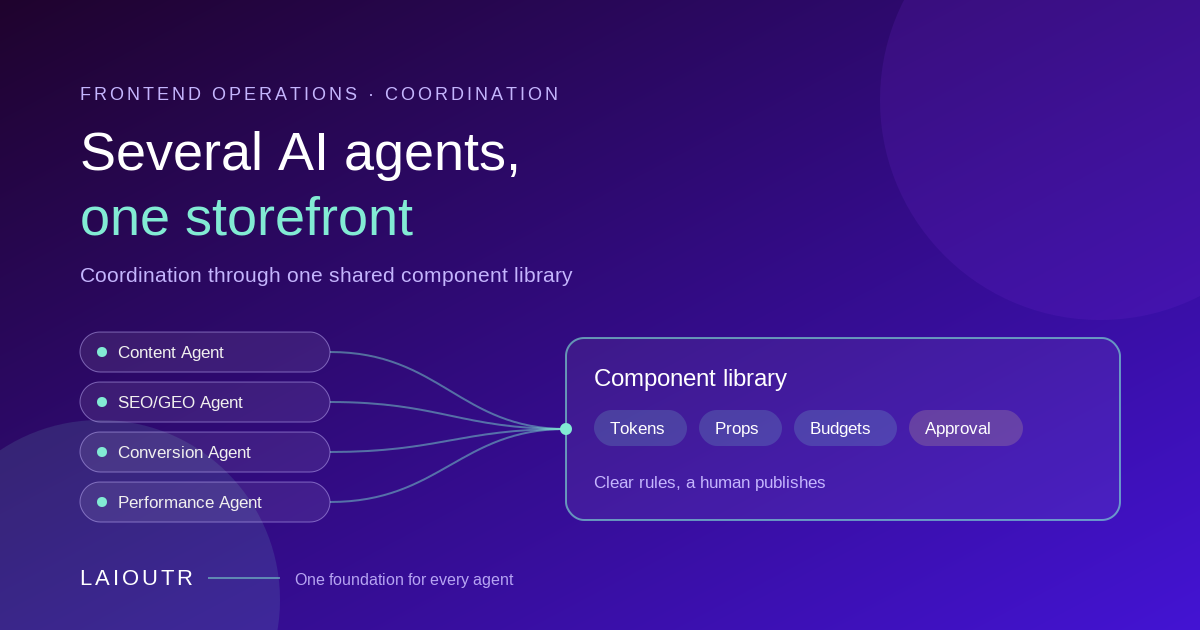Several AI Agents, One Storefront: Coordination Without Collisions
When several AI agents work on the same storefront, conflicts rarely happen between the agents thems…](https://www.laioutr.com/en/blog/frontend-operations-multi-agent-coordination-storefront-2026)
[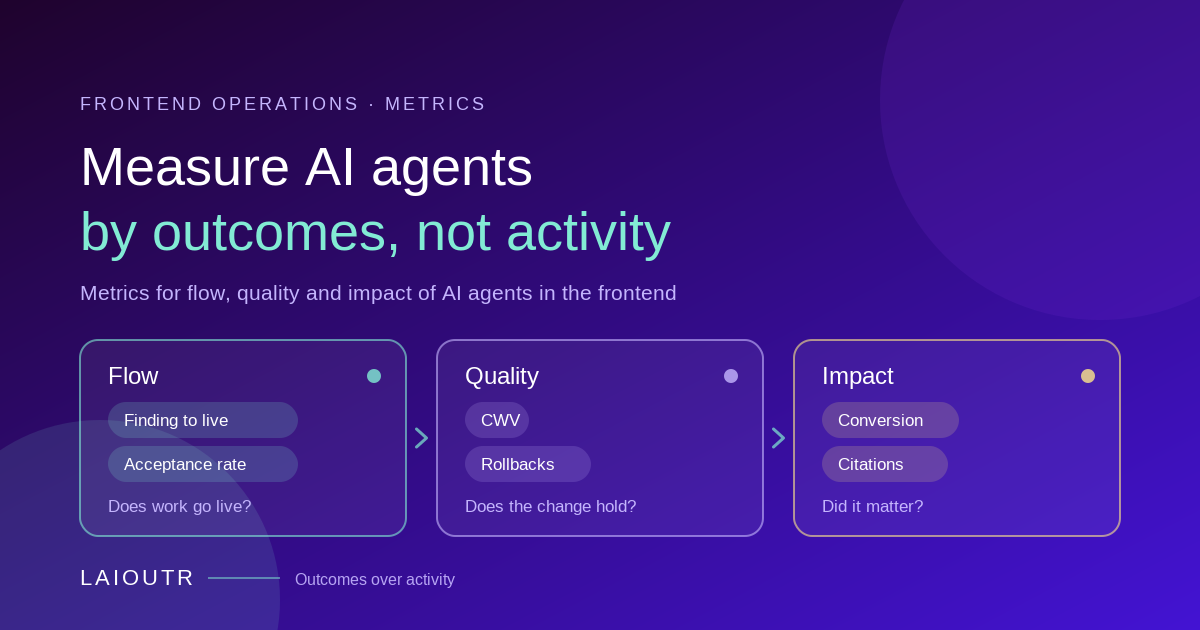Measuring AI Agents by Outcomes: Agentic Frontend Management Metrics
AI agents in the frontend should be measured by outcomes, not by activity. The number of prompts, ge…](https://www.laioutr.com/en/blog/frontend-operations-measuring-ai-agents-outcomes-2026)
[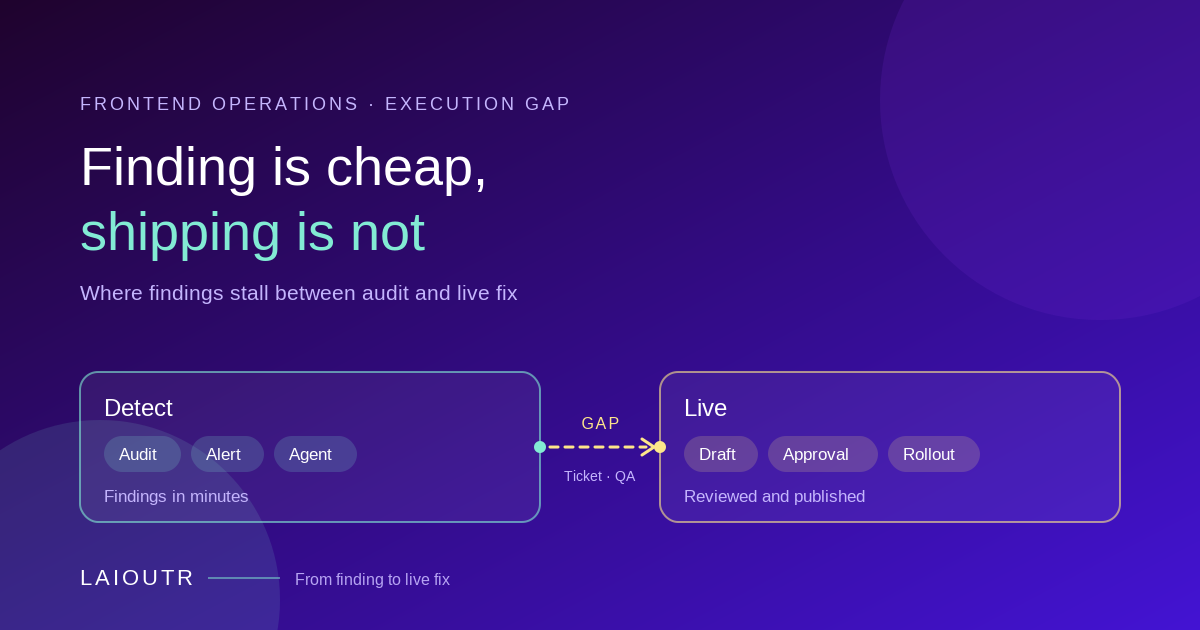The Execution Gap in the Frontend: Finding Is Cheap, Shipping Is Not
The execution gap in the frontend is the time, and the number of handoffs, between "we know wha…](https://www.laioutr.com/en/blog/frontend-operations-execution-gap-detect-vs-deploy-2026)
[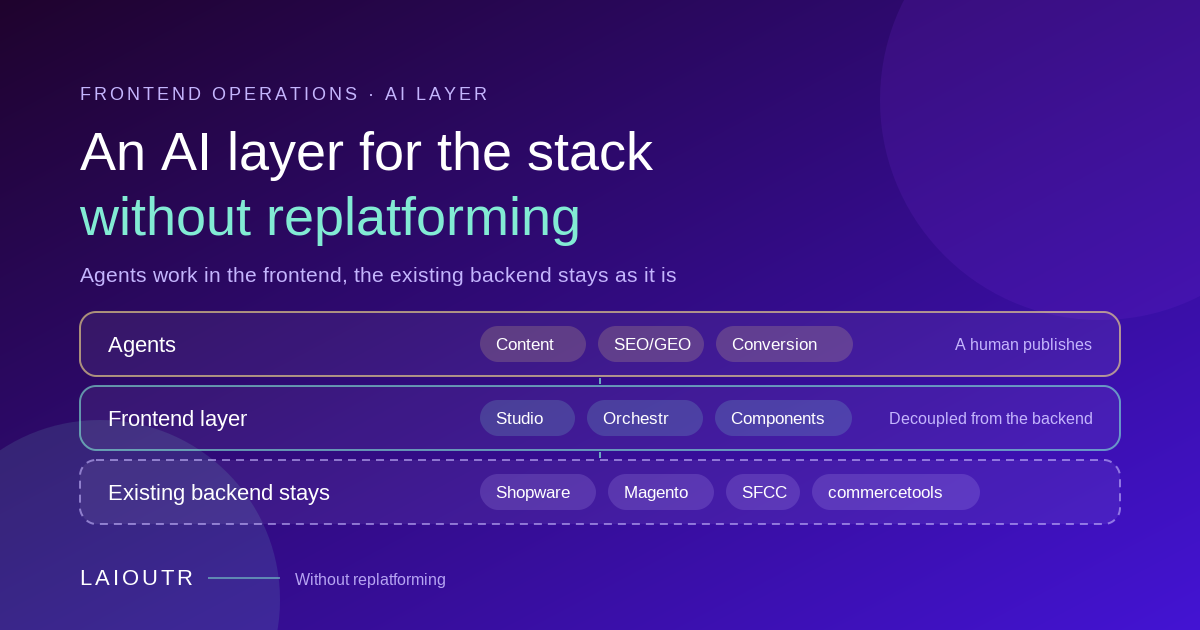Adding an AI Layer to an Existing Commerce Stack Without Replatforming
An AI layer can be added to an existing commerce stack without replacing the shop system. The most p…](https://www.laioutr.com/en/blog/frontend-operations-ai-layer-existing-stack-without-replatforming-2026)
[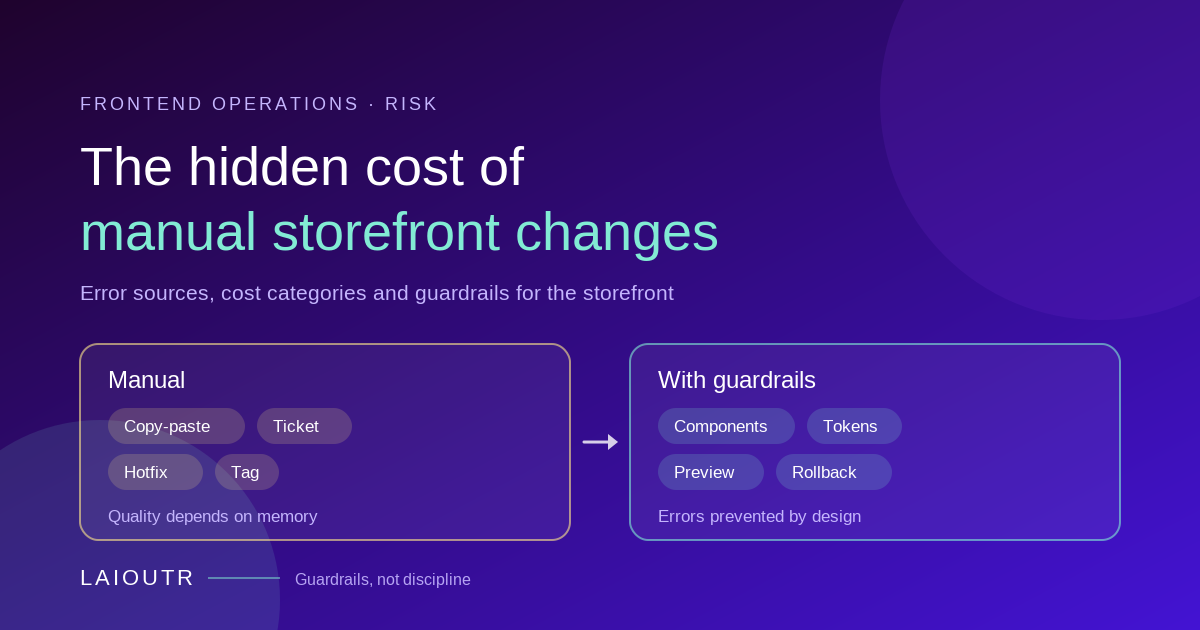The Hidden Cost of Manual Storefront Changes and How to Cut It
Manual frontend changes are the many small edits that keep a storefront running day to day: a new ba…](https://www.laioutr.com/en/blog/frontend-operations-hidden-cost-manual-storefront-changes-2026)
[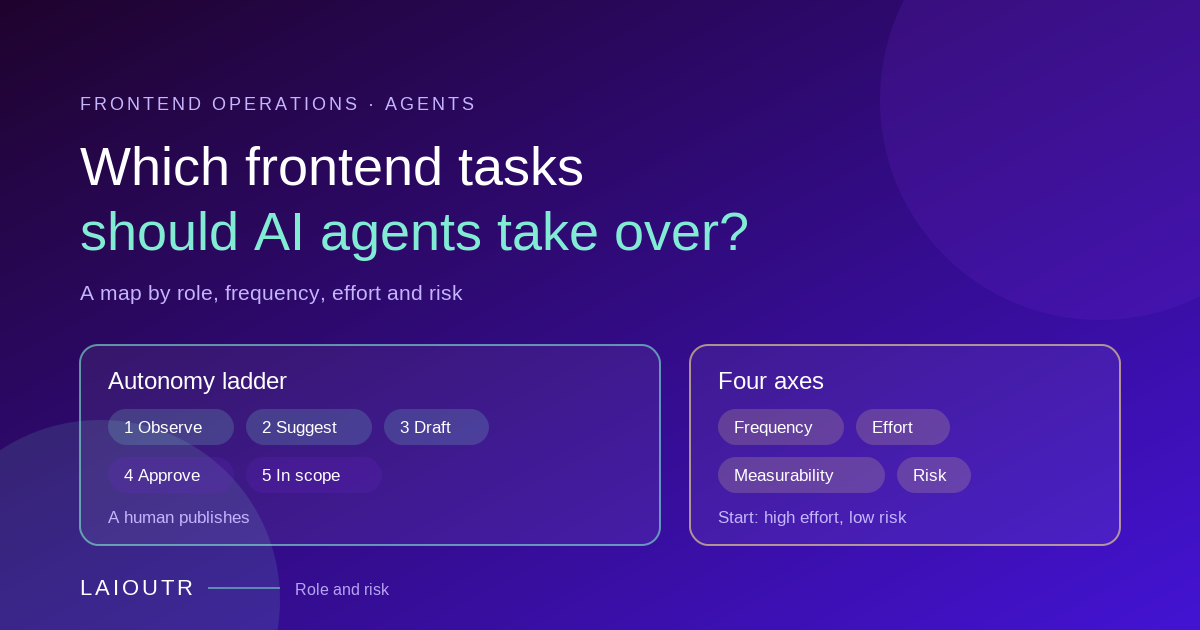Which Frontend Tasks Should AI Agents Take Over? Role and Risk Map
AI agents should first take over the frontend tasks that come up often, involve a lot of manual work…](https://www.laioutr.com/en/blog/frontend-operations-agent-task-map-role-risk-2026)
[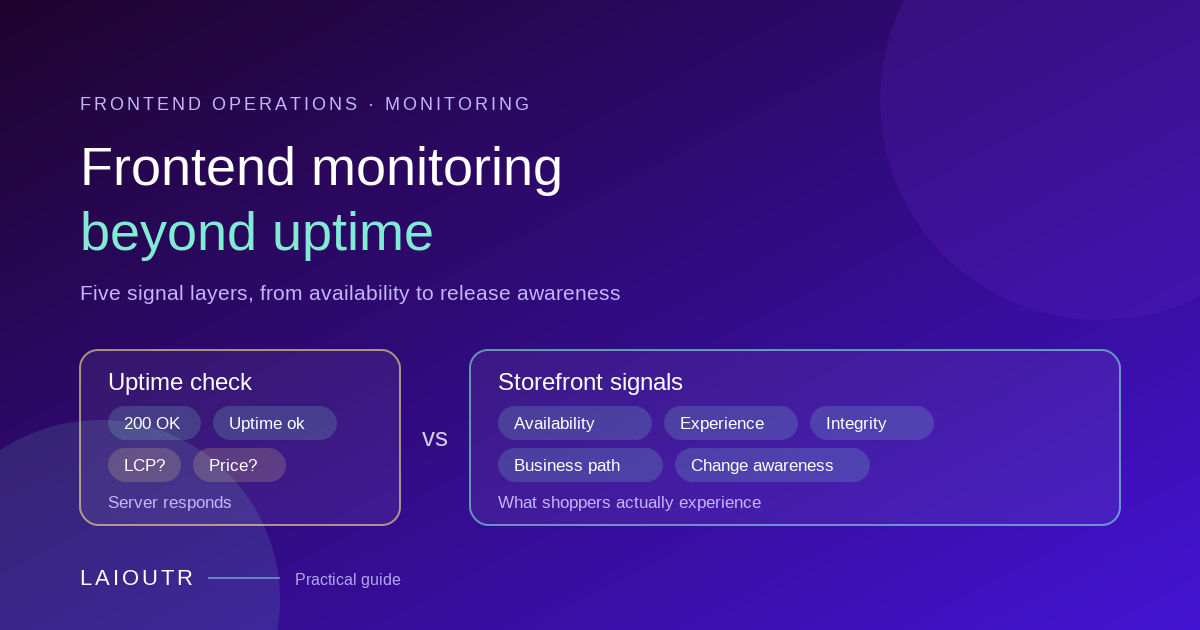Frontend Monitoring Beyond Uptime: Signals a Storefront Needs
Frontend monitoring beyond uptime means checking a storefront not only for availability but for what…](https://www.laioutr.com/en/blog/frontend-operations-monitoring-beyond-uptime-2026)
[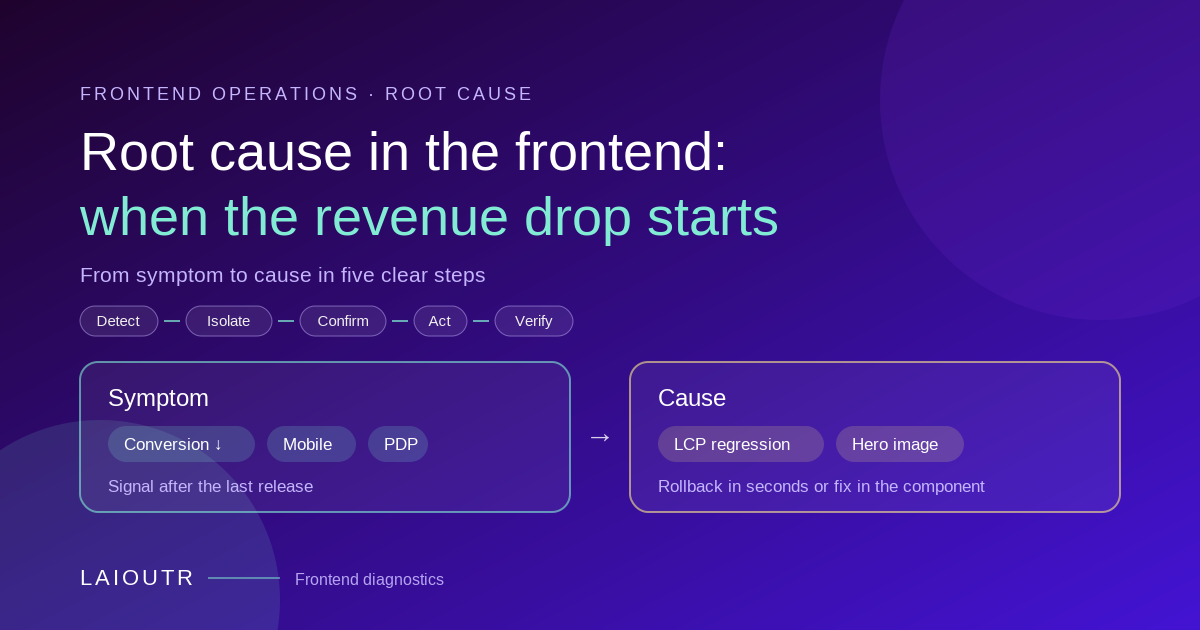Root Cause in the Frontend: When Revenue Drops Start in the Storefront
When revenue or conversion rate drops suddenly, the cause often is not traffic, pricing or the comme…](https://www.laioutr.com/en/blog/frontend-operations-root-cause-revenue-drop-storefront-2026)
[Laioutr Academy Is Live: The Video Manual for Laioutr
Since October 15, 2026, the Laioutr Academy has been live at academy.laioutr.com. It is the user man…](https://www.laioutr.com/en/blog/laioutr-academy-launch-video-manual-certification)
[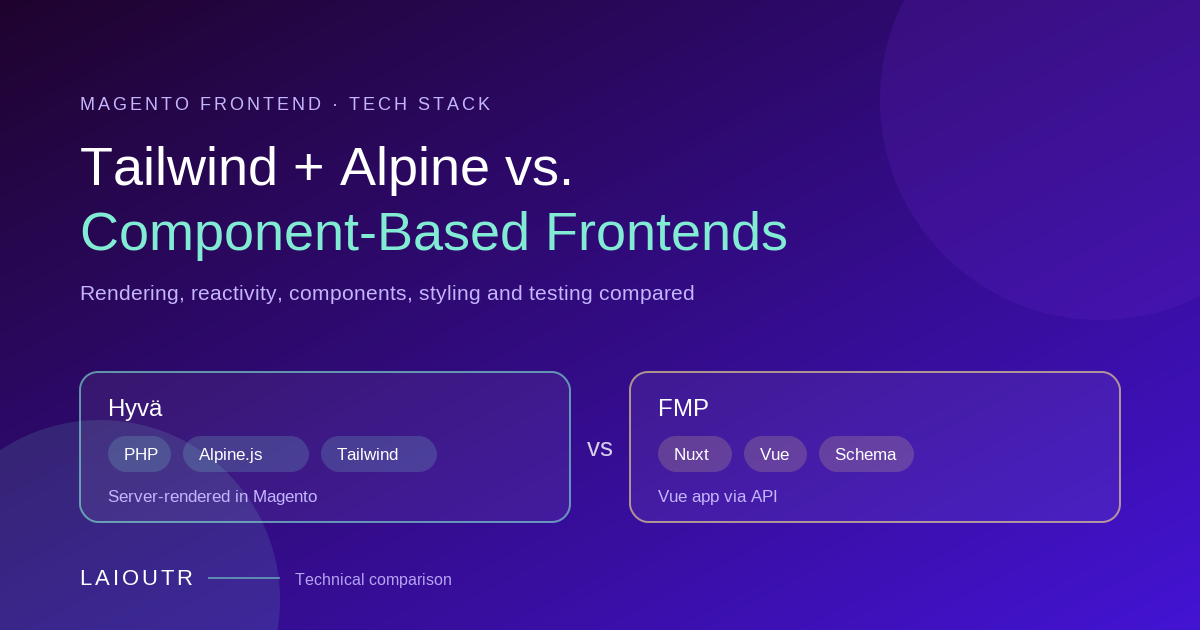Tailwind + Alpine vs. Component-Based Frontends for Magento
Hyvä renders Magento pages on the server with PHP templates and layout XML, adds interactivity throu…](https://www.laioutr.com/en/blog/tailwind-alpine-magento-vs-component-based-frontend-2026)
[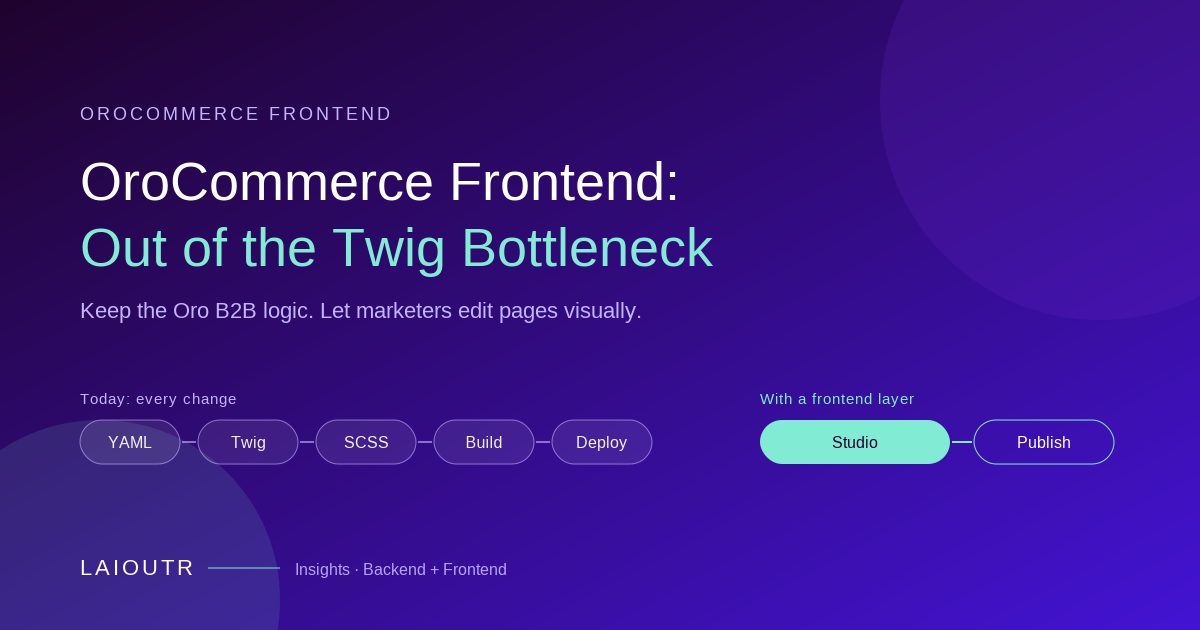OroCommerce Frontend: Out of the Twig and Layouts Bottleneck
The OroCommerce frontend is a server-rendered storefront built from Symfony bundles, OroLayouts and …](https://www.laioutr.com/en/blog/orocommerce-frontend-twig-layouts-bottleneck)
[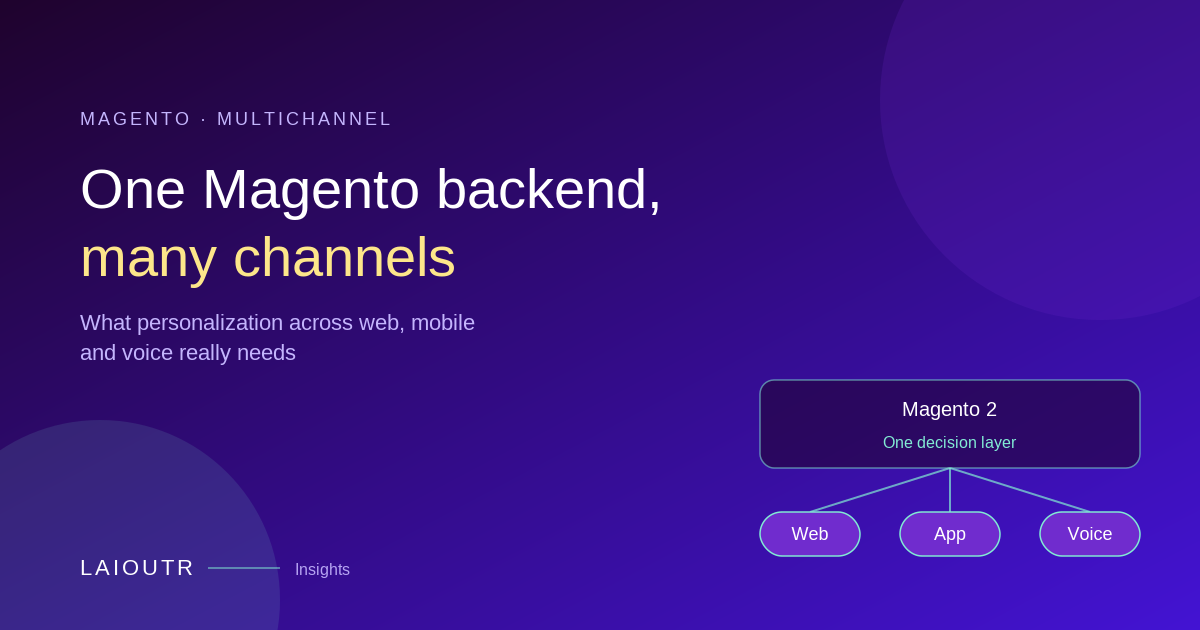One Magento Backend, Many Channels: Personalization in Practice
Personalization across web, mobile and voice on a single Magento backend does not start with a featu…](https://www.laioutr.com/en/blog/magento-multichannel-personalization-web-mobile-voice-2026)
[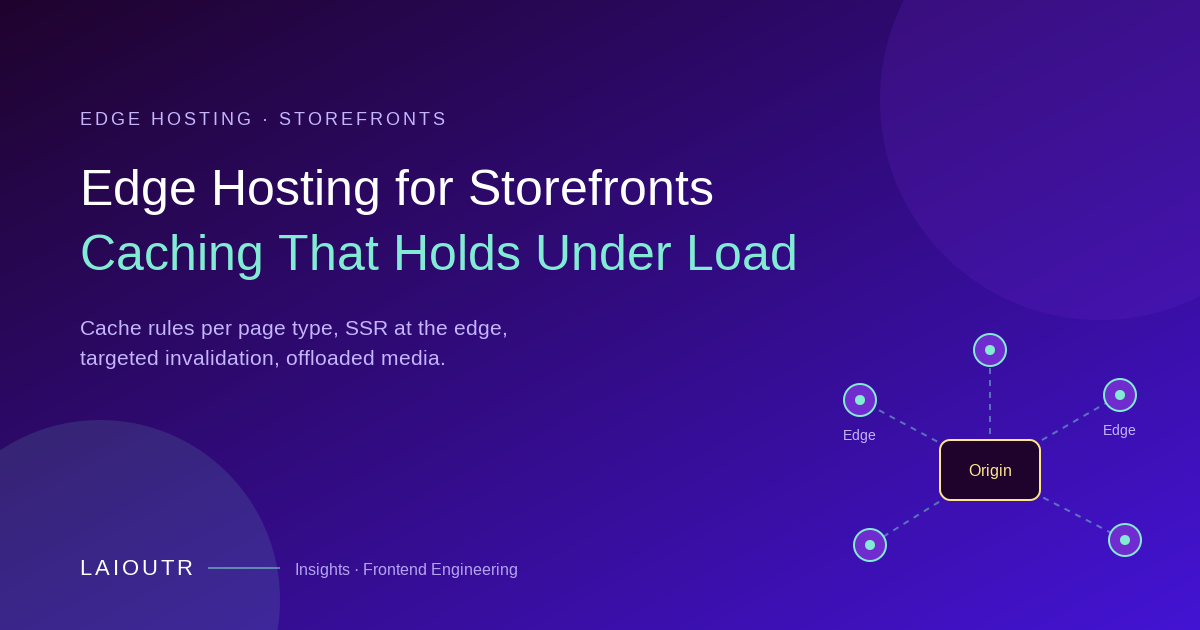Edge Hosting for Storefronts: Caching That Holds Under Peak Load
Edge hosting keeps a storefront fast under load when most requests never reach the origin: pages and…](https://www.laioutr.com/en/blog/edge-hosting-storefronts-peak-traffic-caching-2026)
[Composable Commerce 2027: What Shifted and What Comes Next
Composable commerce enters 2027 with a different agenda than a year ago. The architecture question i…](https://www.laioutr.com/en/blog/composable-commerce-2027-outlook)
[AI Engagement and Conversion: Personalization on the Frontend
AI-driven engagement and conversion on the frontend rests on five mechanics: segments decide who see…](https://www.laioutr.com/en/blog/ai-engagement-conversion-frontend-personalization)
## Apps for the Laioutr platform
[View all apps](https://www.laioutr.com/en/apps)
[](https://www.laioutr.com/en/apps/shopify)
Laioutr
[Shopify](https://www.laioutr.com/en/apps/shopify)
Shopify is a commerce platform for selling online and in physical retail.
[](https://www.laioutr.com/en/apps/shopware)
Laioutr
[Shopware](https://www.laioutr.com/en/apps/shopware)
Shopware is a flexible ecommerce platform from Europe for product catalogs and omnichannel commerce.
[](https://www.laioutr.com/en/apps/adobe-commerce)
Laioutr
[Adobe Commerce](https://www.laioutr.com/en/apps/adobe-commerce)
Adobe Commerce is an enterprise commerce platform for complex, global B2C and B2B scenarios.
Planned
[](https://www.laioutr.com/en/apps/b2b-sellers)
Laioutr
[B2Bsellers](https://www.laioutr.com/en/apps/b2b-sellers)
B2B suite for Shopware that turns an online store into a professional B2B commerce platform.
Planned
[](https://www.laioutr.com/en/apps/commerce-layer)
Laioutr
[Commerce Layer](https://www.laioutr.com/en/apps/commerce-layer)
Commerce Layer is a headless commerce platform for making inventory and catalogs available online.
[](https://www.laioutr.com/en/apps/commercetools)
Laioutr
[Commercetools](https://www.laioutr.com/en/apps/commercetools)
Commercetools is a SaaS-based headless ecommerce platform used worldwide.
[](https://www.laioutr.com/en/apps/emporix)
Laioutr
[Emporix](https://www.laioutr.com/en/apps/emporix)
Emporix is a composable, API-first commerce platform for scalable B2B and B2C scenarios.
Planned
[](https://www.laioutr.com/en/apps/hcl-software)
Laioutr
[HCL Software](https://www.laioutr.com/en/apps/hcl-software)
Enterprise suite for digital commerce and experience with extensive configurability.
Planned
[](https://www.laioutr.com/en/apps/intershop)
Laioutr
[Intershop](https://www.laioutr.com/en/apps/intershop)
Enterprise commerce platform for complex B2B and B2C business models.
Planned
[](https://www.laioutr.com/en/apps/magento-2)
Laioutr
[Magento 2](https://www.laioutr.com/en/apps/magento-2)
Widely used, extensible commerce platform for B2C and B2B scenarios.
[](https://www.laioutr.com/en/apps/oxid-eshop)
Laioutr
[OXID eShop](https://www.laioutr.com/en/apps/oxid-eshop)
OXID eShop is an extensible commerce platform for complex B2B and B2C requirements.
Planned
[](https://www.laioutr.com/en/apps/patchworks)
Laioutr
[Patchworks](https://www.laioutr.com/en/apps/patchworks)
Patchworks is a low-code iPaaS that connects ecommerce, ERP, WMS, 3PL, and marketplaces.
Planned
[](https://www.laioutr.com/en/apps/PrestaShop)
Laioutr
[Prestashop](https://www.laioutr.com/en/apps/PrestaShop)
Open-source commerce platform for small and midsize merchants in Europe and beyond.
Planned
[](https://www.laioutr.com/en/apps/saleor)
Laioutr
[Saleor](https://www.laioutr.com/en/apps/saleor)
Open-source, API-first commerce platform built on GraphQL for custom storefronts.
Planned
[](https://www.laioutr.com/en/apps/salesforce-commerce-cloud)
Laioutr
[Salesforce Commerce Cloud](https://www.laioutr.com/en/apps/salesforce-commerce-cloud)
Salesforce Commerce Cloud is a cloud-based enterprise commerce platform for businesses of any size.
Planned
[](https://www.laioutr.com/en/apps/sap-commerce-cloud)
Laioutr
[SAP Commerce Cloud](https://www.laioutr.com/en/apps/sap-commerce-cloud)
Enterprise commerce platform for complex catalogs, pricing models, and omnichannel journeys.
Planned
[](https://www.laioutr.com/en/apps/scayle)
Laioutr
[Scayle](https://www.laioutr.com/en/apps/scayle)
SCAYLE is a commerce engine that helps brands and retailers scale their business.
Planned
[](https://www.laioutr.com/en/apps/spryker)
Laioutr
[Spryker](https://www.laioutr.com/en/apps/spryker)
Composable commerce platform for sophisticated B2B and B2C business models.
[](https://www.laioutr.com/en/apps/sylius)
Laioutr
[Sylius](https://www.laioutr.com/en/apps/sylius)
Sylius is a developer-friendly ecommerce framework for B2C and B2B shopping experiences.
Planned
[](https://www.laioutr.com/en/apps/vendure)
Laioutr
[Vendure](https://www.laioutr.com/en/apps/vendure)
Vendure is a headless commerce platform for businesses with complex requirements.
Coming Soon
[](https://www.laioutr.com/en/apps/vtex)
Laioutr
[VTEX](https://www.laioutr.com/en/apps/vtex)
Cloud-native, composable commerce platform for B2B and B2C at scale.
Planned
[](https://www.laioutr.com/en/apps/websale)
Laioutr
[Websale](https://www.laioutr.com/en/apps/websale)
Stable, enterprise-ready commerce backend for complex retail environments.
Strategy call
## The frontend as a control layer
A conversation about stack, roadmap and replatforming scenario. The outcome: a clear picture of how Laioutr fits, what it costs and how fast the go-live can happen.
*"After 30 minutes, we knew Laioutr makes our replatforming feasible."*
*Daniel B., CEO,* [*hygibox.de*](https://hygibox.de)
[Book a demo](https://www.laioutr.com/en/contact)
## Structured Data
```json
{
"@context": "https://schema.org",
"@graph": [
{
"@type": "Organization",
"@id": "https://www.laioutr.com/#identity",
"name": "Laioutr",
"legalName": "Laioutr GmbH",
"url": "https://www.laioutr.com/",
"logo": {
"@type": "ImageObject",
"url": "https://www.laioutr.com/laioutr-logo.png",
"width": 400,
"height": 400
},
"email": "info@laioutr.com",
"telephone": "+49 30 75435715",
"address": {
"@type": "PostalAddress",
"streetAddress": "Münchweilersteig 5",
"postalCode": "12559",
"addressLocality": "Berlin",
"addressCountry": "DE"
},
"vatID": "DE450905846",
"sameAs": [
"https://www.linkedin.com/company/laioutr",
"https://www.youtube.com/@Laioutr",
"https://x.com/laioutr"
]
},
{
"@type": "WebSite",
"@id": "https://www.laioutr.com/en/#website",
"url": "https://www.laioutr.com/en/",
"name": "Laioutr",
"inLanguage": "en",
"publisher": {
"@id": "https://www.laioutr.com/#identity"
}
},
{
"@type": "BlogPosting",
"@id": "https://www.laioutr.com/en/blog/frontend-as-a-service#article",
"headline": "Frontend as a Service: The Missing Layer in Your Composable Stack",
"description": "Frontend as a Service treats your storefront as managed infrastructure, the missing layer in a truly composable commerce stack.",
"image": [
"https://eu-west-2.graphassets.com/cmii2mlqi0dux06l5543v7nkc/cmnucypviw8mi07mgmwsd5asa"
],
"datePublished": "2026-10-26T10:59:32.550868+00:00",
"dateModified": "2026-10-26T10:59:32.028415+00:00",
"inLanguage": "en",
"articleSection": "Insights",
"keywords": "Frontend Management, commercetools, Magento 2, Shopify",
"author": {
"@type": "Person",
"name": "Marcel Thiesies",
"jobTitle": "Co-Founder & CEO, Laioutr",
"image": "https://eu-west-2.graphassets.com/cmii2mlqi0dux06l5543v7nkc/cmj01b962364n07lb0iguvts5"
},
"publisher": {
"@id": "https://www.laioutr.com/#identity"
},
"mainEntityOfPage": {
"@id": "https://www.laioutr.com/en/blog/frontend-as-a-service#webpage"
},
"isPartOf": {
"@id": "https://www.laioutr.com/en/#website"
}
},
{
"@type": "WebPage",
"@id": "https://www.laioutr.com/en/blog/frontend-as-a-service#webpage",
"url": "https://www.laioutr.com/en/blog/frontend-as-a-service",
"name": "Frontend as a Service: The Missing Layer in Your Composable Stack",
"description": "Frontend as a Service treats your storefront as managed infrastructure, the missing layer in a truly composable commerce stack.",
"inLanguage": "en",
"isPartOf": {
"@id": "https://www.laioutr.com/en/#website"
},
"breadcrumb": {
"@id": "https://www.laioutr.com/en/blog/frontend-as-a-service#breadcrumb"
},
"primaryImageOfPage": {
"@type": "ImageObject",
"url": "https://eu-west-2.graphassets.com/cmii2mlqi0dux06l5543v7nkc/cmnucypviw8mi07mgmwsd5asa"
},
"datePublished": "2026-10-26T10:59:32.550868+00:00",
"dateModified": "2026-10-26T10:59:32.028415+00:00",
"mainEntity": {
"@id": "https://www.laioutr.com/en/blog/frontend-as-a-service#article"
}
},
{
"@type": "BreadcrumbList",
"@id": "https://www.laioutr.com/en/blog/frontend-as-a-service#breadcrumb",
"itemListElement": [
{
"@type": "ListItem",
"position": 1,
"name": "Laioutr",
"item": "https://www.laioutr.com/en/"
},
{
"@type": "ListItem",
"position": 2,
"name": "Insights",
"item": "https://www.laioutr.com/en/blogs/insights"
},
{
"@type": "ListItem",
"position": 3,
"name": "Frontend as a Service: The Missing Layer in Your Composable Stack"
}
]
}
]
}
```