---
title: "Headless CMS Personalization in E-Commerce"
canonical_url: "https://www.laioutr.com/en/blog/headless-cms-personalization-in-e-commerce-architecture-patterns-for-hyper-personalized-shopping-experiences"
locale: en
meta:
description: "Architecture patterns for delivering dynamic, contextualized shopping experiences at scale with a headless CMS in e-commerce."
"og:description": "Architecture patterns for delivering dynamic, contextualized shopping experiences at scale with a headless CMS in e-commerce."
"og:title": "Headless CMS Personalization in E-Commerce"
---
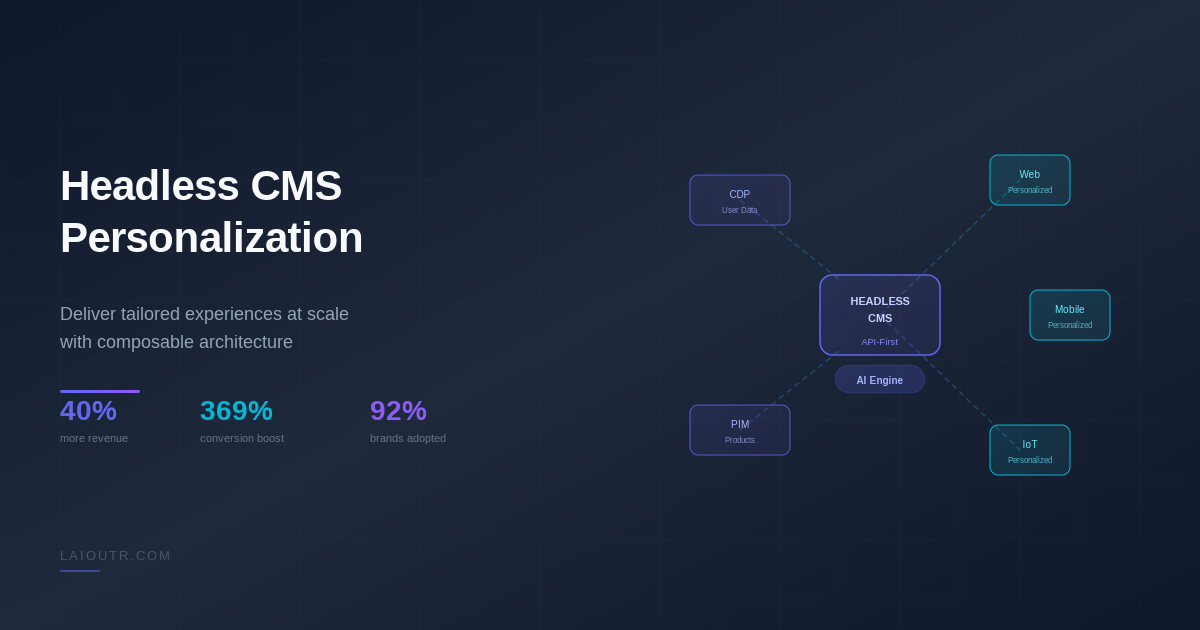
# Headless CMS Personalization in E-Commerce: Architecture Patterns for Hyper-Personalized Shopping Experiences
Table of contents
1. [1.The Architecture Gap: Why Monolithic Systems Fall Short](#the-architecture-gap-why-monolithic-systems-fall-short)
2. [2.Understanding Headless CMS Architecture for Personalization](#understanding-headless-cms-architecture-for-personalization)
3. [3.The Composability Advantage: Why MACH Architecture Matters for Personalization](#the-composability-advantage-why-mach-architecture-matters-for-personalization)
4. [4.Integration Patterns: Making Headless Personalization Work at Scale](#integration-patterns-making-headless-personalization-work-at-scale)
5. [5.Build vs. Buy: The Personalization Decision Framework](#build-vs-buy-the-personalization-decision-framework)
6. [6.Practical Implementation: Visual Editing and Content Author Enablement](#practical-implementation-visual-editing-and-content-author-enablement)
7. [7.Performance and Scale: Why Headless Architecture Wins](#performance-and-scale-why-headless-architecture-wins)
8. [8.Addressing Security and Compliance Considerations](#addressing-security-and-compliance-considerations)
9. [9.Common Pitfalls and How to Avoid Them](#common-pitfalls-and-how-to-avoid-them)
10. [10.The Future: AI-Driven Personalization and Headless CMS](#the-future-ai-driven-personalization-and-headless-cms)
11. [11.Designing Your Transition Plan](#designing-your-transition-plan)
12. [12.Conclusion: Headless CMS as Strategic Differentiator](#conclusion-headless-cms-as-strategic-differentiator)
The e-commerce landscape has fundamentally shifted. Today's consumers don't just expect personalized experiences; they demand them. A 2025 study found that AI-driven personalization can boost conversion rates by up to 369 percent, yet most e-commerce platforms still struggle to deliver truly dynamic, contextualized content at scale.
The bottleneck? Traditional monolithic architectures lock content, commerce logic, and presentation layers together in rigid structures that weren't designed for the real-time personalization requirements of modern shoppers. This is where headless CMS personalization becomes not just an optimization tactic, but a fundamental architectural necessity.
This guide walks through the technical decision-making framework for CTOs, technical leads, and commerce architects considering a shift toward headless CMS-driven personalization. We'll explore how decoupled content systems unlock new possibilities for personalization, examine the integration patterns that make it work, and help you evaluate whether building custom personalization engines or leveraging composed solutions makes sense for your organization.
## The Architecture Gap: Why Monolithic Systems Fall Short
Before diving into headless solutions, let's understand what's broken about traditional monolithic e-commerce platforms when it comes to personalization.
In a monolithic system, the CMS, commerce engine, and presentation layer are tightly coupled. When your marketing team wants to show different product descriptions to VIP customers versus first-time buyers, that logic lives embedded in the application code. When you want to adjust personalization rules based on real-time inventory levels or seasonal trends, you're coordinating changes across multiple interconnected systems.
The consequences compound:
**Slow Time to Market**: A personalization change that should take minutes requires backend development cycles. Your marketing team is blocked waiting for engineers.
**Limited Experimentation**: Testing different personalization strategies means deploying new code versions. A/B testing personalized content variants requires infrastructure changes, not content changes.
**Performance Bottlenecks**: Monolithic systems typically personalize at the page level. That means rendering entire pages for each user segment. At scale, this creates database query explosions and server load spikes that directly impact conversion rates. Every additional second of load time costs approximately 2 percent in conversions.
**Fragmented Content Management**: Your product information lives in one system, marketing content in another, user behavior data in a third. Creating truly personalized experiences requires stitching these sources together in real-time, and monolithic architectures make that integration expensive and fragile.
Headless CMS platforms fundamentally solve these problems by decoupling content from presentation, allowing personalization to happen independently across your entire commerce ecosystem.
## Understanding Headless CMS Architecture for Personalization
A headless CMS is simply a content management system without a built-in frontend. Instead of storing content in a format tied to a specific presentation layer (like HTML templates), headless systems expose content as structured data via APIs.
For e-commerce personalization, this architectural choice unlocks three critical capabilities:
**1. Content-First Personalization Logic**
In a headless environment, personalization rules are content. Your product variant logic, promotional messaging, and content variants are all managed as discrete, API-accessible objects. A customer service representative can create and publish new personalized content variants without touching code. Your engineering team focuses on the personalization engine itself, not on embedding personalization business logic throughout the application.
**2. Component-Level Personalization vs. Page-Level**
This is where headless CMS truly differentiates. Traditional systems personalize at page granularity: you either show page A or page B to a user. Headless CMS enables component-level personalization. Imagine a product listing page where the hero banner, product tiles, recommendations section, and sidebar all personalize independently based on different user attributes.
A VIP customer sees a hero banner highlighting exclusive access, product tiles sorted by margin optimization, and recommendations based on browsing history. A first-time visitor sees an educational hero banner, tiles sorted by popularity, and recommendations based on trending items in their category. The same page template renders both experiences, but every component adapts independently.
This approach creates richer personalization without the infrastructure costs of managing hundreds of page variants.
**3. Real-Time Content Updates Without Deployment**
Because content lives outside your application code, your commerce team can update personalization rules, add new content variants, or adjust targeting logic without triggering application deployments. Changes propagate immediately through your API layer to all consumer applications simultaneously.
## The Composability Advantage: Why MACH Architecture Matters for Personalization
Headless CMS becomes exponentially more powerful when integrated into a broader MACH (Microservices, API-first, Cloud-native, Headless) architecture. Understanding this relationship is essential for making the right personalization decision.
MACH architecture treats each capability (content, commerce, customer data, recommendations) as a independent, composable service. Rather than forcing all these functions into a monolithic product, you assemble the best-of-breed solution for each need and integrate them through APIs.
For personalization specifically, this means:
**Headless CMS + Customer Data Platform (CDP)**
Your CMS manages content variants and rules. Your CDP tracks user behavior, preferences, and segment membership in real-time. The two systems communicate via APIs. When a customer lands on your site, the personalization engine queries both the CDP (to understand who the user is) and the CMS (to fetch appropriate content variants), then composes the response in microseconds.
This separation means you can upgrade your CDP without touching your CMS. You can rebuild your content authoring interface without disrupting your recommendation engine. Each system evolves independently while maintaining integration points.
**Headless CMS + Product Information Management (PIM)**
E-commerce personalization often depends on product attributes: inventory levels, price tiers, margin data, seasonal relevance. A PIM system manages this structured product data. Your headless CMS references product data via API, allowing you to create rules like "show this premium variant only to customers with high purchase history" or "highlight this item if inventory is below 20 units."
The PIM owns the single source of truth for product data. Your CMS layers contextual content on top. When product attributes change, all personalized experiences automatically reflect that change.
**Headless CMS + Recommendation Engine**
Modern recommendation engines are sophisticated, AI-driven systems requiring substantial computational resources and data infrastructure. Rather than building recommendations into your CMS, your CMS becomes a content aggregation layer. The recommendation engine identifies relevant products; the CMS fetches rich, personalized descriptions and marketing copy for those products before serving them to the customer.
This division of responsibilities means your recommender system can optimize for accuracy without worrying about content delivery. Your CMS can focus on content quality without bearing the computational load of machine learning inference.
## Integration Patterns: Making Headless Personalization Work at Scale
The architectural advantages of headless CMS only matter if you can actually implement them reliably. Here's how leading organizations structure their integration layers:
### Pattern 1: Edge-Computing-Powered Personalization
Modern commerce expects responses in milliseconds. Querying multiple APIs sequentially to assemble a personalized response introduces latency. The solution? Edge computing.
By running a lightweight personalization logic layer at edge nodes (distributed servers located geographically near your users), you can fetch user segments, fetch content variants, apply personalization rules, and compose responses before they reach your origin servers. This reduces latency from hundreds of milliseconds to dozens.
Your headless CMS integrates into this edge layer by caching content variants and providing structured data optimized for rapid access. API responses are optimized for minimal payload size. Personalization rules are compiled into efficient decision trees that execute in microseconds.
Companies using this pattern report 40 percent improvements in time-to-interactive metrics and corresponding conversion improvements.
### Pattern 2: Real-Time Data Integration via CDP Webhooks
Rather than synchronously querying your CDP during each request, your CDP pushes user segment updates to your personalization layer via webhooks. When a customer's behavior crosses a threshold (reached VIP status, abandoned their cart, completed a purchase), the CDP sends a webhook that updates in-memory segment data.
Your headless CMS queries this pre-computed segment data rather than making expensive CDP lookups. This approach reduces dependency on synchronous API calls and allows more aggressive caching.
### Pattern 3: Content Staging and Progressive Enhancement
Not all personalization requires real-time computation. A three-tier approach works well:
**Tier 1: Static Personalization** rendered at build time or first request for performance-critical pages. Segments with consistent behavior patterns get pre-rendered content variants.
**Tier 2: Server-Side Personalization** computed for requests from known users where sufficient context exists to make personalization decisions quickly.
**Tier 3: Client-Side Personalization** for edge cases requiring real-time behavioral data or advanced logic that's impossible to execute server-side in time budget.
Your headless CMS content structure supports this progression. The same content object can be served statically, rendered server-side, or enhanced client-side depending on context.
## Build vs. Buy: The Personalization Decision Framework
Organizations implementing headless CMS personalization face a critical question: should we build a custom personalization engine or implement a composed solution using existing tools?
There's no universal answer, but here's a framework for deciding:
### Build Custom Personalization If:
- Your personalization requirements are highly specific to your business domain. Example: A B2B marketplace with complex multi-party negotiations and role-based personalization logic that existing solutions don't handle.
- You have significant in-house ML expertise and want to develop proprietary recommender algorithms.
- You operate at massive scale where even small improvements in efficiency translate to millions in infrastructure savings.
- Your competitive advantage depends directly on personalization capabilities.
**Build investment**: 6-18 months of engineering effort, $500K-$2M+. Long-term maintenance burden and scaling challenges as behavior patterns evolve.
### Buy or Compose Solutions If:
- Your personalization needs follow standard e-commerce patterns: product recommendations, behavioral segmentation, A/B testing, content variants.
- Your team lacks ML expertise but wants to implement sophisticated personalization.
- Time to market matters more than custom optimization.
- You want to leverage AI-driven personalization without building your own ML infrastructure.
**Compose investment**: 2-4 months of integration work, $50K-$300K+. Lower maintenance burden. Faster access to AI innovations as vendors update their platforms.
In 2025, the market has shifted decisively toward composition. The headless CMS market is projected to grow from $2.11B to $5.49B by 2030 at a 21.1 percent compound annual growth rate, driven primarily by organizations composing best-of-breed solutions rather than building monoliths.
92 percent of U.S. brands have adopted modular, API-driven systems. The infrastructure for headless personalization is mature. Unless you have very specialized requirements, buying and composing is almost always the better choice.
## Practical Implementation: Visual Editing and Content Author Enablement
A major challenge with headless CMS implementations has historically been content author experience. Without a visual page builder, non-technical content teams struggled to understand how their content would actually appear to customers.
2026 has largely resolved this problem through AI-native visual editors. Modern headless CMS platforms now include AI-powered editors that understand your component structure, generate visual previews from your headless content, and allow non-technical authors to create and personalize content without touching code.
This shift matters tremendously for personalization adoption. Your marketing team can now independently create personalized content variants, configure targeting rules, and test different personalization strategies without requiring engineering support.
Implementation considerations:
- Invest in editor training. Visual editing tools are intuitive, but your team needs to understand the relationship between content components and how they compose across channels.
- Define component schemas upfront. The quality of your content preview and editing experience directly correlates with the quality of your component data models.
- Implement governance frameworks. Without proper controls, decentralized content authoring can lead to inconsistent personalization rules and brand violations.
## Performance and Scale: Why Headless Architecture Wins
Let's make the performance case concrete with numbers.
Monolithic personalization typically requires a full page render per user segment. For an e-commerce site with 10 primary segments, this means rendering and caching 10 page variants. With hundreds of pages, you're managing thousands of variants. Page weight increases. Cache efficiency decreases. Memory consumption explodes.
Headless component-level personalization with edge computing works differently. You cache content components (100-500 bytes each for structured data). A single product page might comprise 20-30 components. On request, your edge layer fetches the appropriate components based on user segment, composes them into a response, and sends to the customer. Total response size: 10-50KB instead of 200KB-1MB for pre-rendered pages.
Latency improvement: 200-400ms instead of 1-3 seconds. That's a 6-15 percent conversion increase from latency improvement alone, before accounting for better personalization relevance.
## Addressing Security and Compliance Considerations
Personalization requires customer data. In an era of GDPR, CCPA, and evolving privacy regulations, your architecture must handle sensitive information correctly.
Headless CMS architecture actually improves security posture:
- **Data Minimization**: By separating content (public) from customer data (private), you reduce the attack surface. Your CMS doesn't hold sensitive customer information. It coordinates with your CDP and commerce platform through API calls with appropriate access controls.
- **Audit and Compliance**: API-driven architectures create clear audit trails. You can see exactly which systems access which customer data when. Compliance teams can validate that personalization respects consent and preference settings.
- **Encryption and Access Control**: Headless APIs support encryption in transit and at rest. You can implement fine-grained access controls restricting which personalization engines can access which customer segments.
Implement these practices:
- Use attribute-based encryption for sensitive customer segments. Only the personalization engine that needs segment information can decrypt it.
- Log all data access. Maintain detailed records of which system accessed what customer data when.
- Implement consent management at the API layer. Before your CMS coordinates with the CDP to fetch segment data, verify that the customer has consented to that personalization use case.
## Common Pitfalls and How to Avoid Them
Organizations implementing headless CMS personalization frequently encounter these challenges:
**Pitfall 1: Insufficient Content Structure**
If your content isn't properly structured as discrete, reusable components, you can't effectively personalize at component level. You end up with monolithic content blocks that can't be composed differently for different audiences.
*Solution*: Invest in content modeling upfront. Work with your content strategy and design teams to define components at the right granularity. A component should be meaningful to your content authors, reusable across multiple contexts, and independently personalizable.
**Pitfall 2: Treating Personalization as a Technology Problem**
Headless CMS is the tool. But personalization strategy is a business problem. Without clear business logic defining how content should vary for different segments, your technical implementation will be pointless.
*Solution*: Before implementing headless CMS, define your personalization strategy. Which customer segments matter? What should change for each segment? How will you measure success? Only then design your technical architecture to support that strategy.
**Pitfall 3: Underestimating Integration Complexity**
Composing headless CMS with CDP, PIM, and recommendation engines looks straightforward in diagrams. In practice, integration work involves handling API rate limits, caching strategy, data synchronization timing, error handling, and fallback behaviors.
*Solution*: Budget for integration work. Allocate 30-40 percent of your implementation timeline to integration and testing. Build error handling and fallback content for scenarios where your CDN or API endpoints become unavailable.
**Pitfall 4: Ignoring Performance Implications of Personalization Rules**
Complex personalization rules can slow down content fetching. If you're making 10 separate API calls to make personalization decisions, your latency explodes regardless of your architecture.
*Solution*: Model your personalization logic for performance. Prefer rules that can be evaluated against cached segment data over rules requiring real-time data lookups. Use feature flags to enable sophisticated personalization only for specific audiences while simpler logic serves the majority.
## The Future: AI-Driven Personalization and Headless CMS
Looking ahead, the intersection of AI and headless CMS personalization is expanding rapidly. Large language models are beginning to power:
- **Dynamic Content Generation**: Rather than managing static content variants, your headless CMS becomes a coordinate system for AI-generated content. You define parameters (tone, key messages, audience), and the system generates personalized copy dynamically.
- **Behavioral Prediction**: AI models trained on customer data can predict which personalization variants will resonate before you test them, accelerating your learning cycle.
- **Cross-Channel Consistency**: AI systems can ensure that personalization rules applied in your e-commerce experience align with personalization in your email, mobile app, and social channels, all coordinated through your headless CMS.
The key challenge: ensuring these AI systems operate within guardrails. [LLM Guardrails for E-Commerce](https://claude.ai/blogs/insights/llm-guardrails-for-e-commerce-building-trust-into-your-ai-powered-commerce-stack "https://claude.ai/blogs/insights/llm-guardrails-for-e-commerce-building-trust-into-your-ai-powered-commerce-stack") become essential as you scale AI-driven personalization.
## Designing Your Transition Plan
If you're running a monolithic system and considering headless CMS personalization, here's a phased approach that minimizes risk:
**Phase 1: Proof of Concept (Months 1-3)**
- Select a single personalization use case. Example: Show different hero banners to VIP versus new customers.
- Implement a headless CMS with that single use case.
- Measure impact on conversion and engagement metrics.
- Validate that your team can author and manage personalized content through the new system.
**Phase 2: Expansion (Months 4-9)**
- Extend personalization to additional product categories and customer segments.
- Integrate with your CDP for real-time segment data.
- Implement edge computing layer for performance optimization.
- Build out component library and content models for your entire product experience.
**Phase 3: Full Migration (Months 10-18)**
- Migrate remaining pages and experiences to headless architecture.
- Sunset monolithic CMS.
- Optimize performance and personalization rules based on Phase 1-2 learnings.
This phased approach limits risk because you can validate business value before committing to full migration.
## Conclusion: Headless CMS as Strategic Differentiator
Headless CMS personalization has evolved from a technical novelty to a business imperative. The market data is clear: organizations leveraging AI-driven personalization are seeing 40 percent revenue improvements. Enterprise organizations are adopting headless approaches at 64 percent penetration.
But the real strategic advantage isn't the technology. It's the business agility. When your marketing team can independently create and test personalization strategies. When you can experiment with new segments and content variants without engineering cycles. When your organization can move at the speed of customer preference changes instead of development cycles.
That's what headless CMS personalization delivers.
The architectural patterns are proven. The integration frameworks exist. Visual editing tools have matured. The question isn't whether headless CMS personalization works. It's whether your organization can afford not to implement it while your competitors accelerate.
### Ready to Build Your Personalization Strategy?
If you're exploring headless CMS architecture for your e-commerce platform, we recommend starting with these foundational guides:
- [MACH Architecture Guide](https://claude.ai/blogs/insights/mach-architecture-in-e-commerce-a-practical-guide-for-technology-leaders "https://claude.ai/blogs/insights/mach-architecture-in-e-commerce-a-practical-guide-for-technology-leaders") - understand the broader architectural patterns.
- [Composable Commerce Migration](https://claude.ai/blogs/insights/composable-commerce-migration-moving-from-monolith-to-mach-architecture "https://claude.ai/blogs/insights/composable-commerce-migration-moving-from-monolith-to-mach-architecture") - plan your transition strategy.
- [Dynamic Content Personalization](https://claude.ai/blogs/insights/dynamic-content-personalization-in-e-commerce "https://claude.ai/blogs/insights/dynamic-content-personalization-in-e-commerce") - dive deeper into personalization tactics.
- [API-First Commerce](https://claude.ai/blogs/insights/api-first-commerce-the-architecture-powering-modern-e-commerce-platforms "https://claude.ai/blogs/insights/api-first-commerce-the-architecture-powering-modern-e-commerce-platforms") - understand how API-first design enables personalization at scale.
Laioutr specializes in composable commerce architecture and MACH implementations. If you're ready to design your personalization strategy, let's start the conversation.
Related: [Personalization on Laioutr](https://www.laioutr.com/en/product/personalization).
Related: [AI content management](https://www.laioutr.com/en/product/content-management).
Related resources: [Composable Headless Frontend](https://www.laioutr.com/en/composable-headless-frontend).
---
Share this article
[Share on Facebook](https://www.facebook.com/sharer/sharer.php?u=https%3A%2F%2Fwww.laioutr.com%2Fen%2Fblog%2Fheadless-cms-personalization-in-e-commerce-architecture-patterns-for-hyper-personalized-shopping-experiences) [Share on X](https://x.com/intent/post?url=https%3A%2F%2Fwww.laioutr.com%2Fen%2Fblog%2Fheadless-cms-personalization-in-e-commerce-architecture-patterns-for-hyper-personalized-shopping-experiences&text=) [Share on LinkedIn](https://www.linkedin.com/sharing/share-offsite/?url=https%3A%2F%2Fwww.laioutr.com%2Fen%2Fblog%2Fheadless-cms-personalization-in-e-commerce-architecture-patterns-for-hyper-personalized-shopping-experiences) [Share on Pinterest](https://pinterest.com/pin/create/button/?url=https%3A%2F%2Fwww.laioutr.com%2Fen%2Fblog%2Fheadless-cms-personalization-in-e-commerce-architecture-patterns-for-hyper-personalized-shopping-experiences&description=) [Share via email](mailto:?subject=&body=%0A%0Ahttps%3A%2F%2Fwww.laioutr.com%2Fen%2Fblog%2Fheadless-cms-personalization-in-e-commerce-architecture-patterns-for-hyper-personalized-shopping-experiences)
## More articles on frontend and headless
Practical know-how for frontend development, smart agents, and headless
[To the blog](https://www.laioutr.com/en/blogs/insights)
[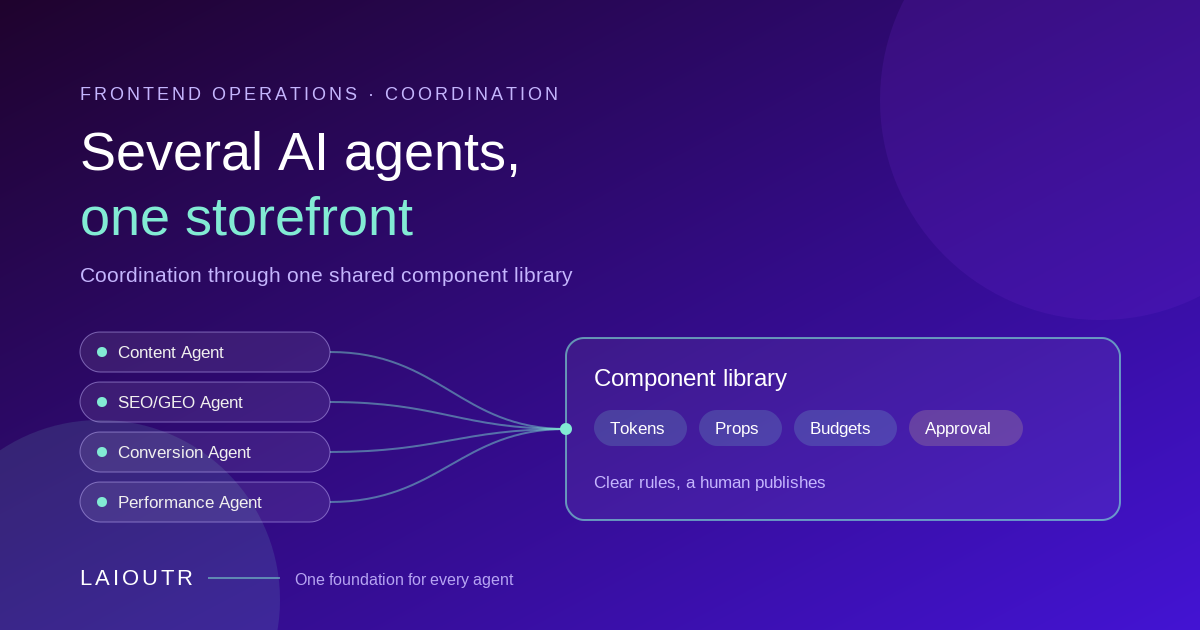Several AI Agents, One Storefront: Coordination Without Collisions
When several AI agents work on the same storefront, conflicts rarely happen between the agents thems…](https://www.laioutr.com/en/blog/frontend-operations-multi-agent-coordination-storefront-2026)
[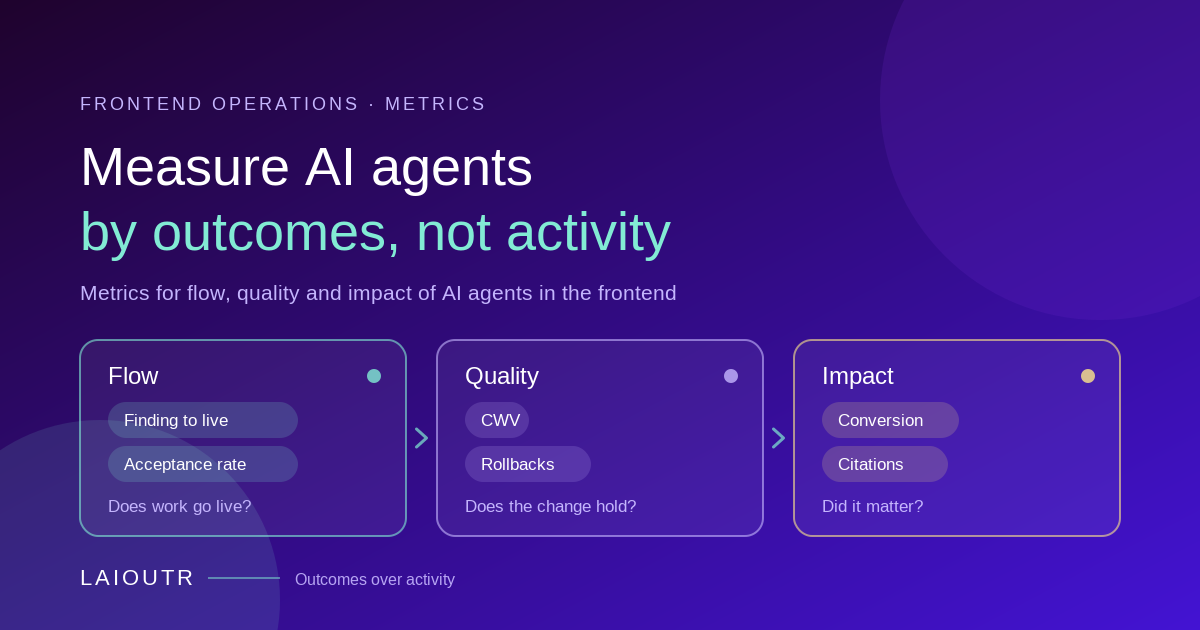Measuring AI Agents by Outcomes: Agentic Frontend Management Metrics
AI agents in the frontend should be measured by outcomes, not by activity. The number of prompts, ge…](https://www.laioutr.com/en/blog/frontend-operations-measuring-ai-agents-outcomes-2026)
[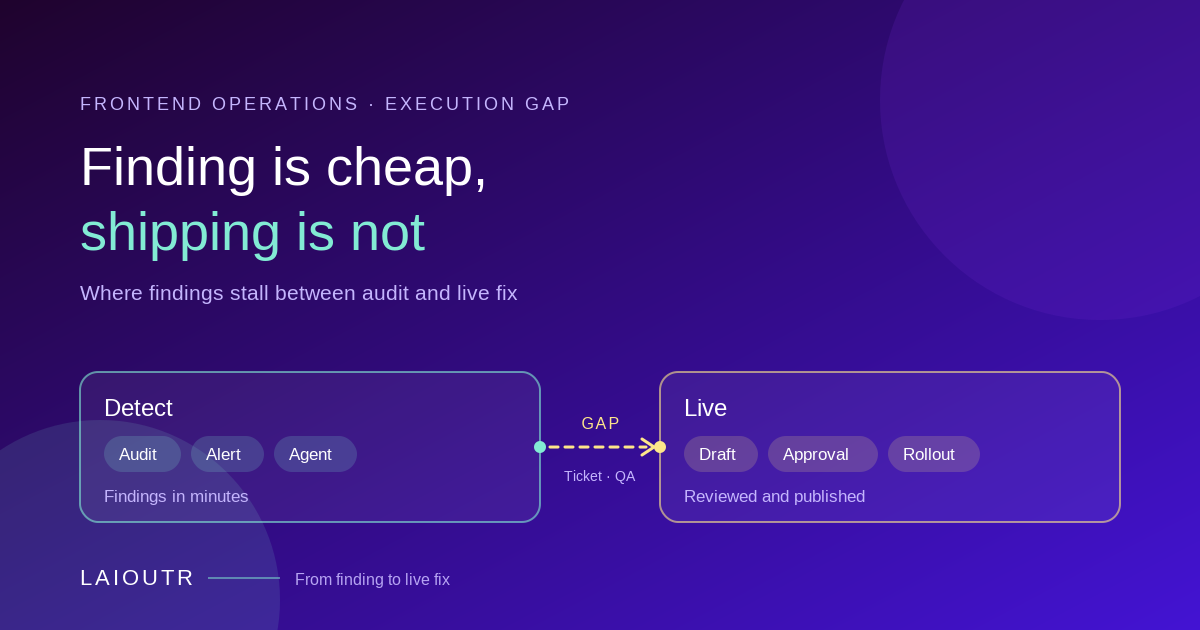The Execution Gap in the Frontend: Finding Is Cheap, Shipping Is Not
The execution gap in the frontend is the time, and the number of handoffs, between "we know wha…](https://www.laioutr.com/en/blog/frontend-operations-execution-gap-detect-vs-deploy-2026)
[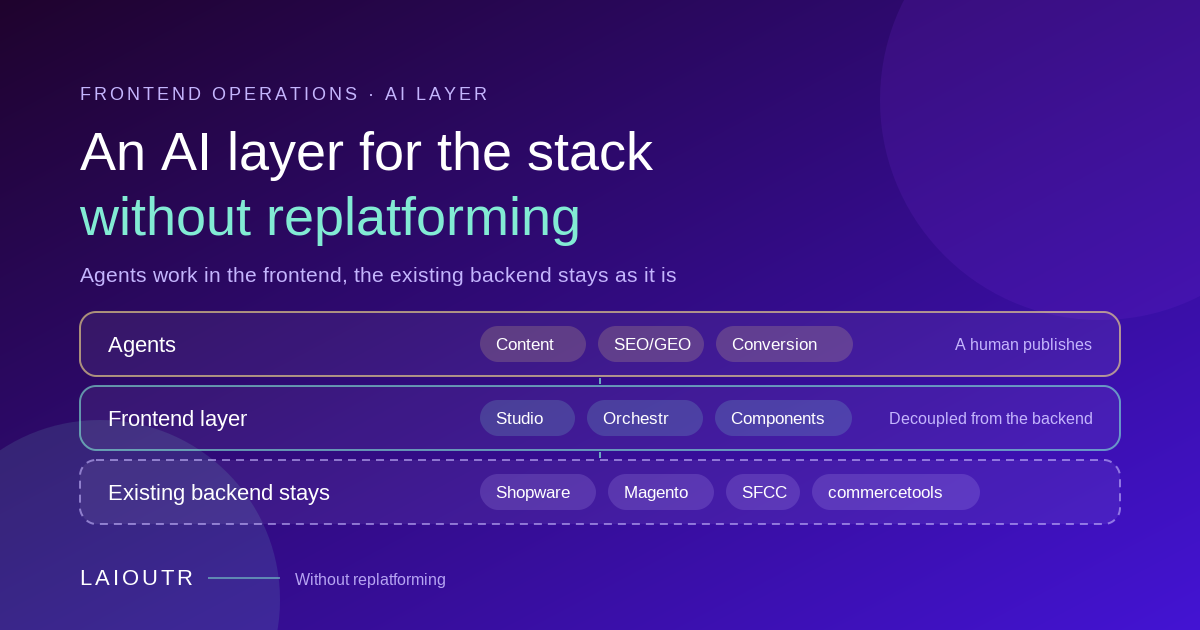Adding an AI Layer to an Existing Commerce Stack Without Replatforming
An AI layer can be added to an existing commerce stack without replacing the shop system. The most p…](https://www.laioutr.com/en/blog/frontend-operations-ai-layer-existing-stack-without-replatforming-2026)
[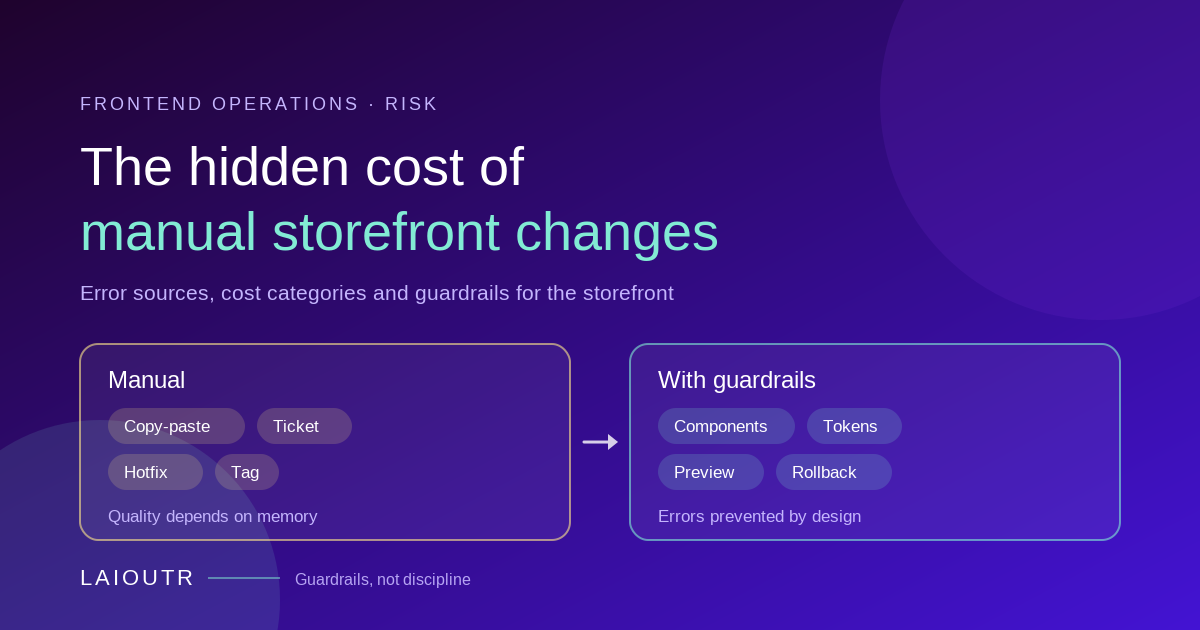The Hidden Cost of Manual Storefront Changes and How to Cut It
Manual frontend changes are the many small edits that keep a storefront running day to day: a new ba…](https://www.laioutr.com/en/blog/frontend-operations-hidden-cost-manual-storefront-changes-2026)
[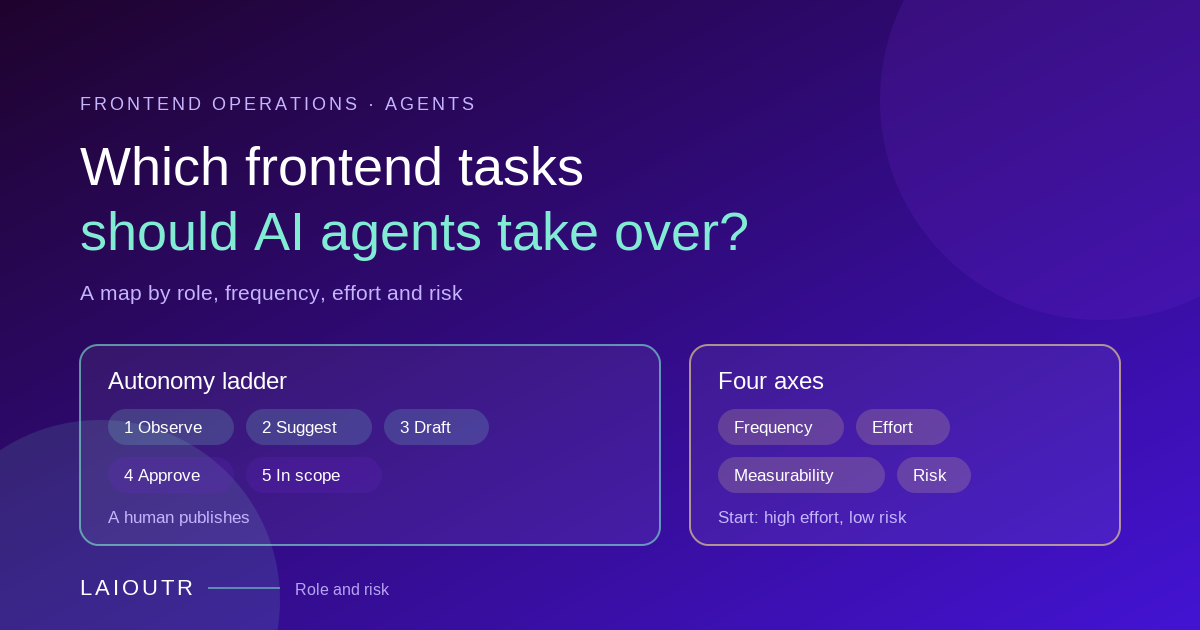Which Frontend Tasks Should AI Agents Take Over? Role and Risk Map
AI agents should first take over the frontend tasks that come up often, involve a lot of manual work…](https://www.laioutr.com/en/blog/frontend-operations-agent-task-map-role-risk-2026)
[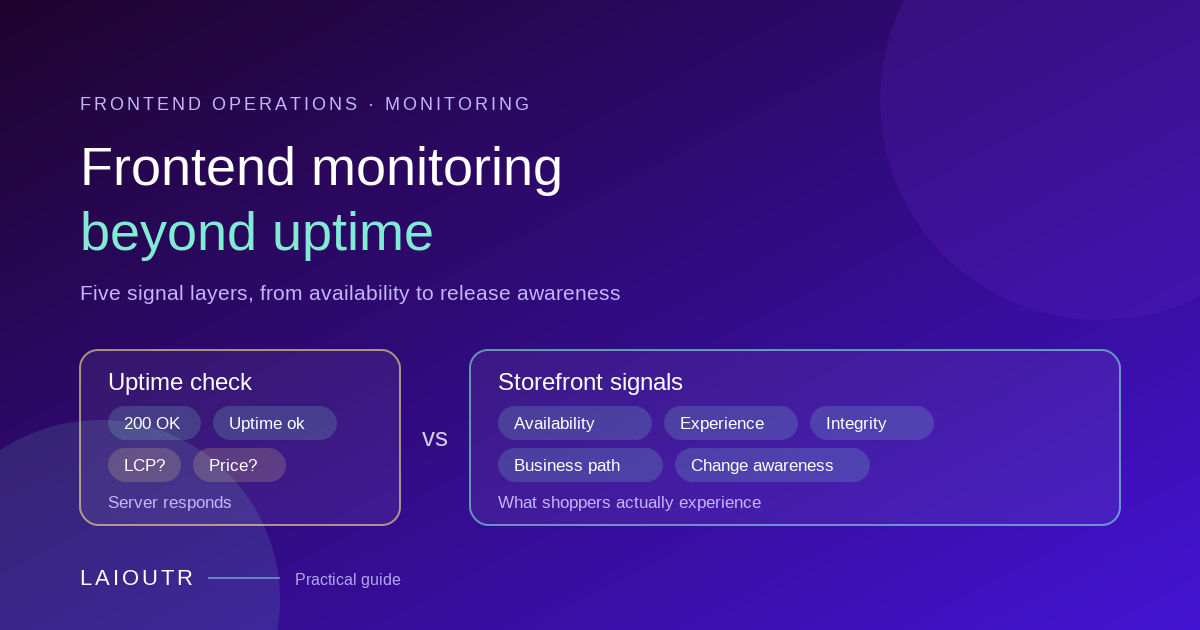Frontend Monitoring Beyond Uptime: Signals a Storefront Needs
Frontend monitoring beyond uptime means checking a storefront not only for availability but for what…](https://www.laioutr.com/en/blog/frontend-operations-monitoring-beyond-uptime-2026)
[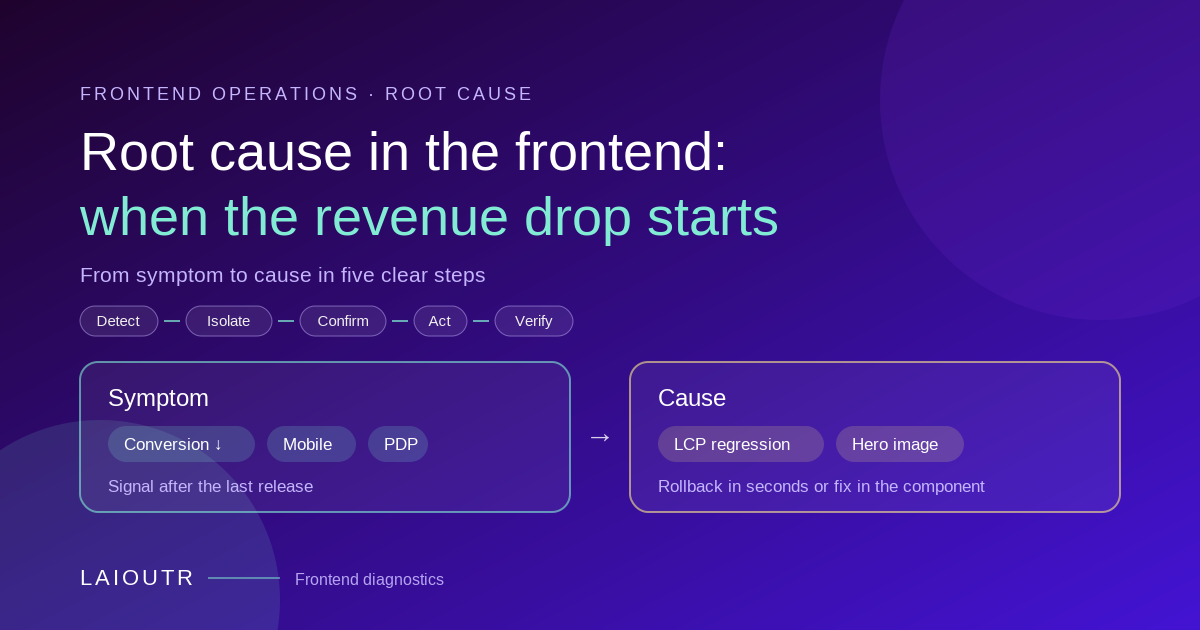Root Cause in the Frontend: When Revenue Drops Start in the Storefront
When revenue or conversion rate drops suddenly, the cause often is not traffic, pricing or the comme…](https://www.laioutr.com/en/blog/frontend-operations-root-cause-revenue-drop-storefront-2026)
[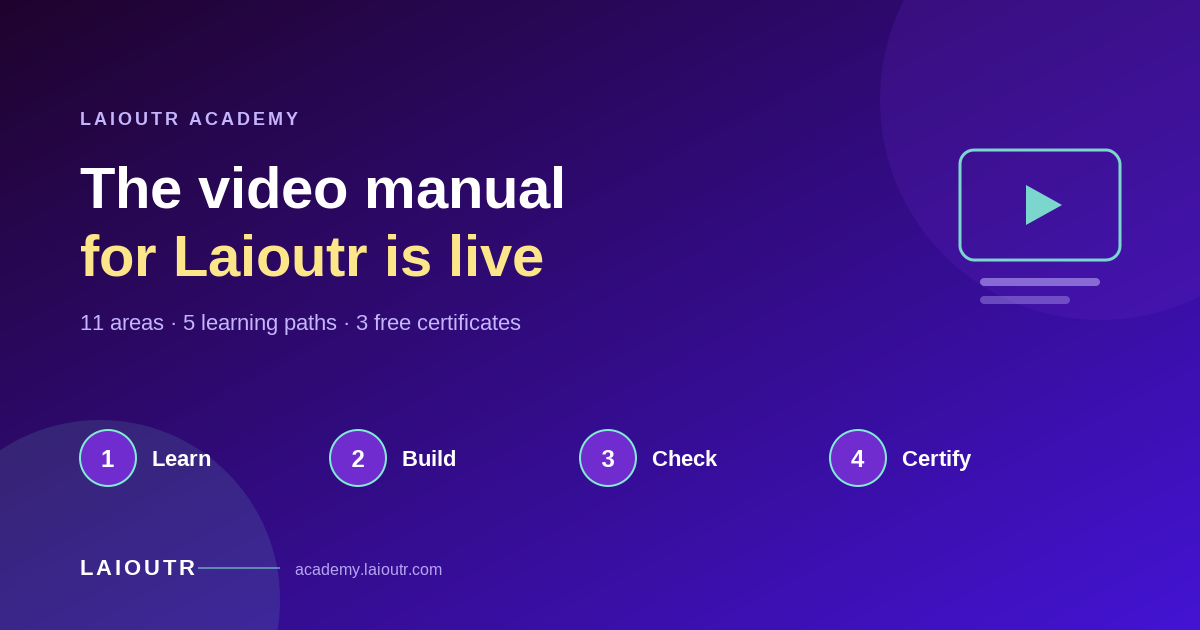Laioutr Academy Is Live: The Video Manual for Laioutr
Since October 15, 2026, the Laioutr Academy has been live at academy.laioutr.com. It is the user man…](https://www.laioutr.com/en/blog/laioutr-academy-launch-video-manual-certification)
[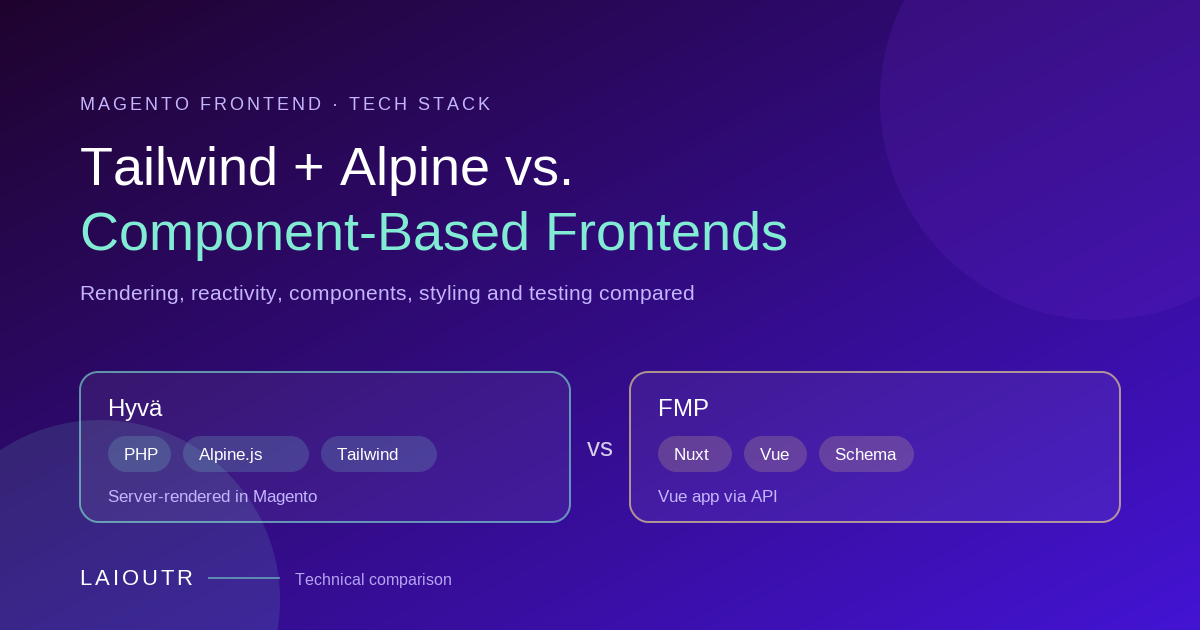Tailwind + Alpine vs. Component-Based Frontends for Magento
Hyvä renders Magento pages on the server with PHP templates and layout XML, adds interactivity throu…](https://www.laioutr.com/en/blog/tailwind-alpine-magento-vs-component-based-frontend-2026)
[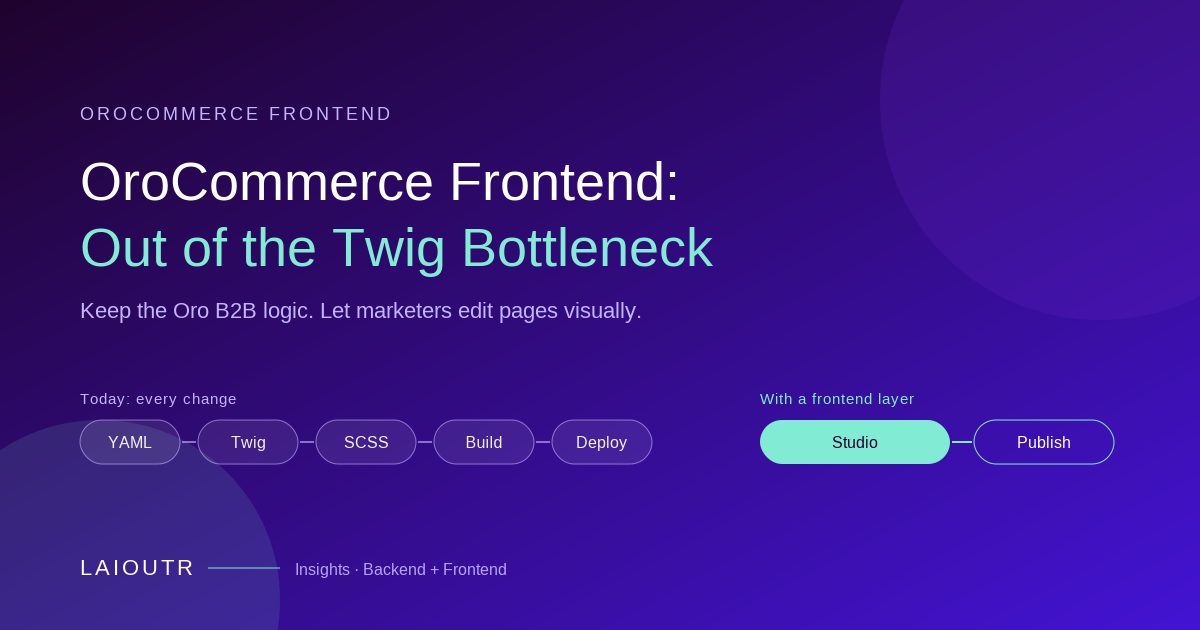OroCommerce Frontend: Out of the Twig and Layouts Bottleneck
The OroCommerce frontend is a server-rendered storefront built from Symfony bundles, OroLayouts and …](https://www.laioutr.com/en/blog/orocommerce-frontend-twig-layouts-bottleneck)
[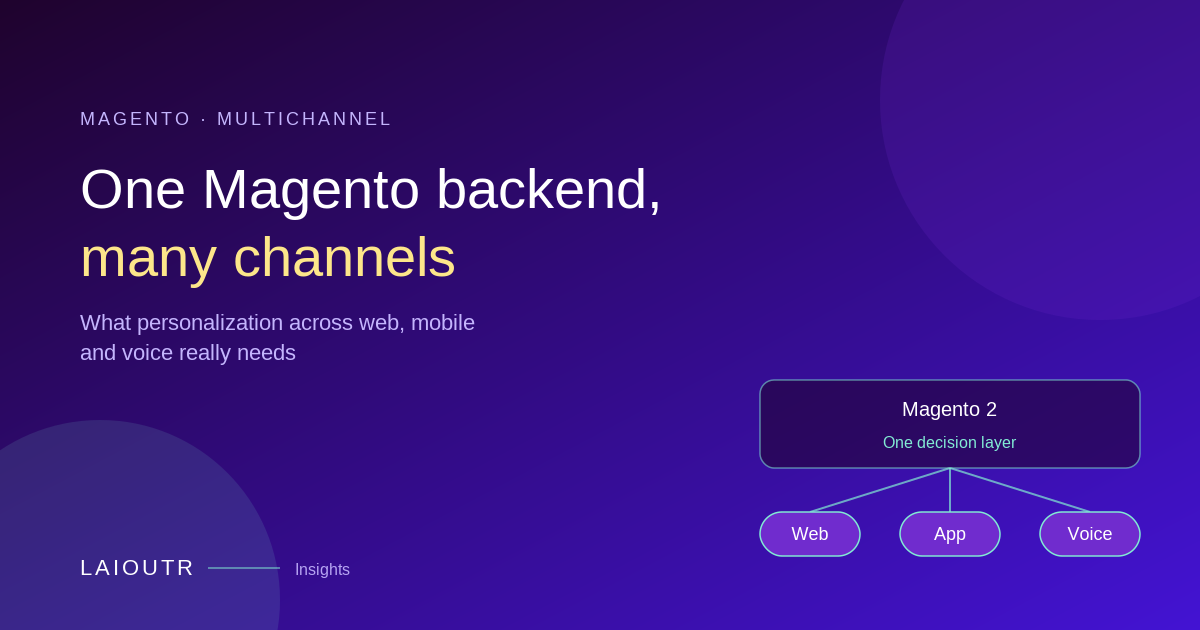One Magento Backend, Many Channels: Personalization in Practice
Personalization across web, mobile and voice on a single Magento backend does not start with a featu…](https://www.laioutr.com/en/blog/magento-multichannel-personalization-web-mobile-voice-2026)
[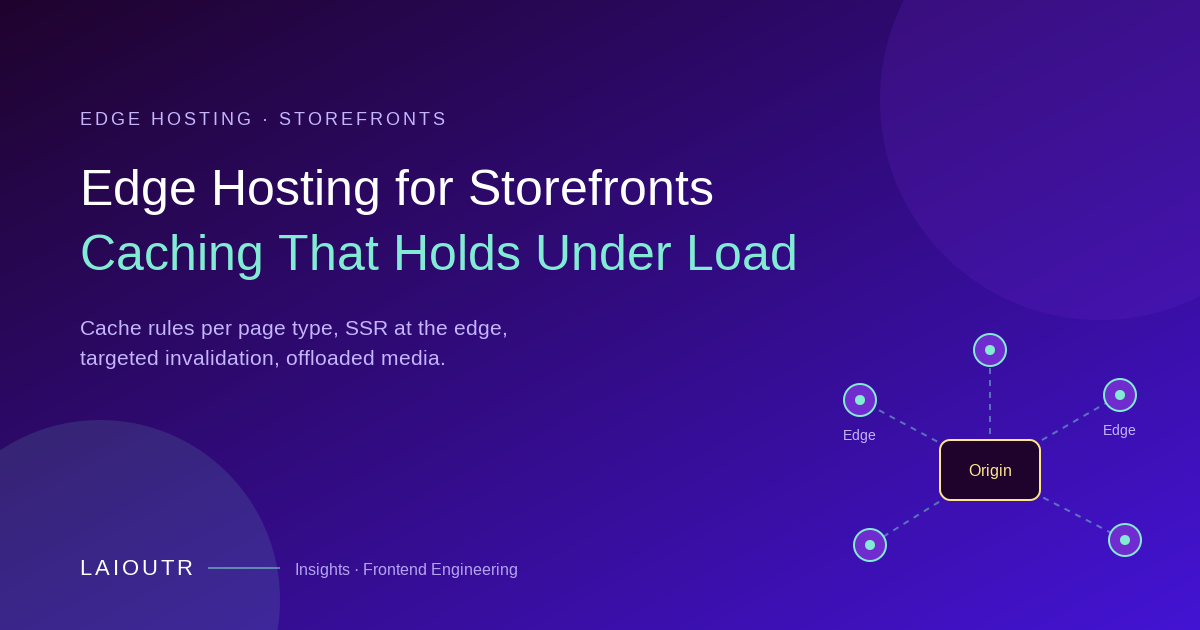Edge Hosting for Storefronts: Caching That Holds Under Peak Load
Edge hosting keeps a storefront fast under load when most requests never reach the origin: pages and…](https://www.laioutr.com/en/blog/edge-hosting-storefronts-peak-traffic-caching-2026)
[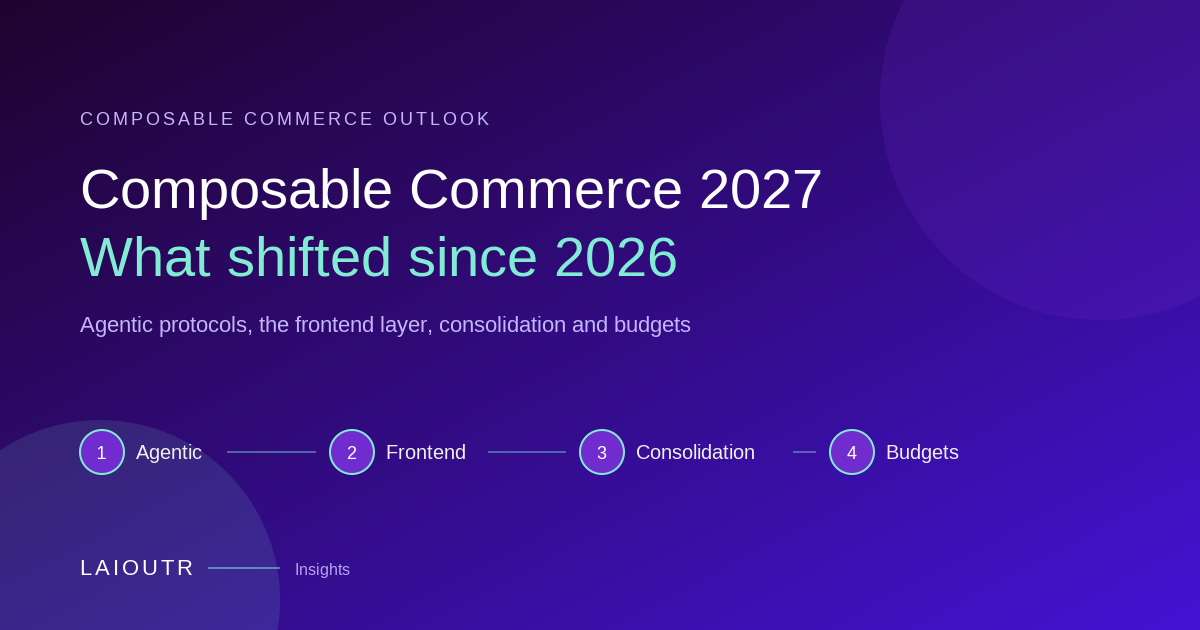Composable Commerce 2027: What Shifted and What Comes Next
Composable commerce enters 2027 with a different agenda than a year ago. The architecture question i…](https://www.laioutr.com/en/blog/composable-commerce-2027-outlook)
[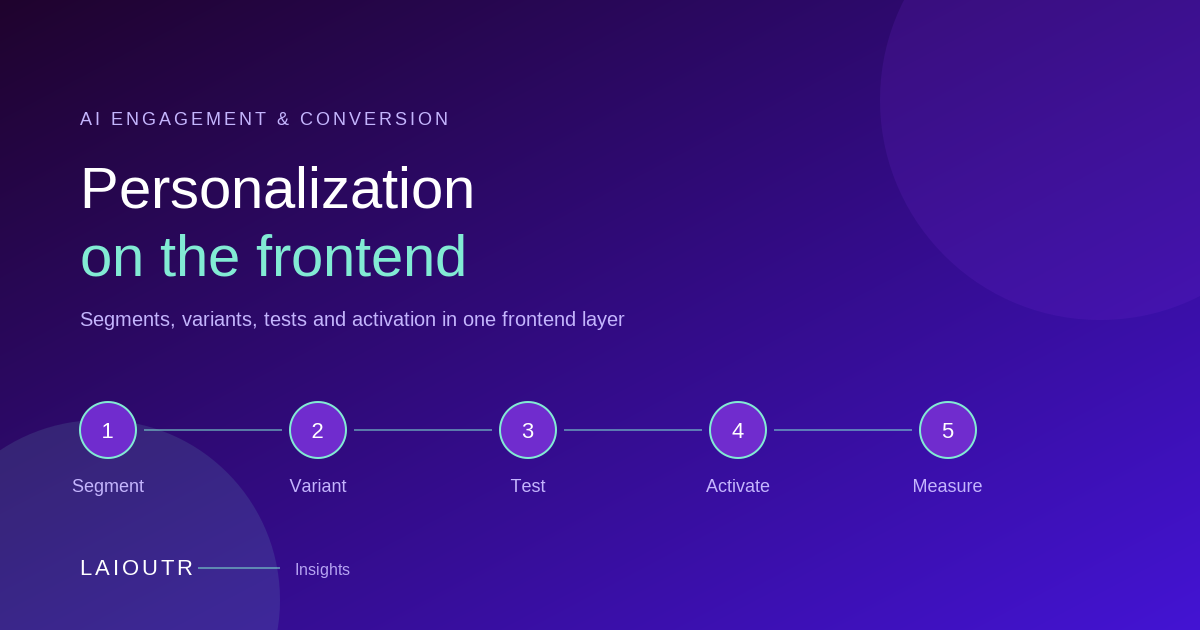AI Engagement and Conversion: Personalization on the Frontend
AI-driven engagement and conversion on the frontend rests on five mechanics: segments decide who see…](https://www.laioutr.com/en/blog/ai-engagement-conversion-frontend-personalization)
## Apps for the Laioutr platform
[View all apps](https://www.laioutr.com/en/apps)
[](https://www.laioutr.com/en/apps/shopify)
Laioutr
[Shopify](https://www.laioutr.com/en/apps/shopify)
Shopify is a commerce platform for selling online and in physical retail.
[](https://www.laioutr.com/en/apps/shopware)
Laioutr
[Shopware](https://www.laioutr.com/en/apps/shopware)
Shopware is a flexible ecommerce platform from Europe for product catalogs and omnichannel commerce.
[](https://www.laioutr.com/en/apps/adobe-commerce)
Laioutr
[Adobe Commerce](https://www.laioutr.com/en/apps/adobe-commerce)
Adobe Commerce is an enterprise commerce platform for complex, global B2C and B2B scenarios.
Planned
[](https://www.laioutr.com/en/apps/b2b-sellers)
Laioutr
[B2Bsellers](https://www.laioutr.com/en/apps/b2b-sellers)
B2B suite for Shopware that turns an online store into a professional B2B commerce platform.
Planned
[](https://www.laioutr.com/en/apps/commerce-layer)
Laioutr
[Commerce Layer](https://www.laioutr.com/en/apps/commerce-layer)
Commerce Layer is a headless commerce platform for making inventory and catalogs available online.
[](https://www.laioutr.com/en/apps/commercetools)
Laioutr
[Commercetools](https://www.laioutr.com/en/apps/commercetools)
Commercetools is a SaaS-based headless ecommerce platform used worldwide.
[](https://www.laioutr.com/en/apps/emporix)
Laioutr
[Emporix](https://www.laioutr.com/en/apps/emporix)
Emporix is a composable, API-first commerce platform for scalable B2B and B2C scenarios.
Planned
[](https://www.laioutr.com/en/apps/hcl-software)
Laioutr
[HCL Software](https://www.laioutr.com/en/apps/hcl-software)
Enterprise suite for digital commerce and experience with extensive configurability.
Planned
[](https://www.laioutr.com/en/apps/intershop)
Laioutr
[Intershop](https://www.laioutr.com/en/apps/intershop)
Enterprise commerce platform for complex B2B and B2C business models.
Planned
[](https://www.laioutr.com/en/apps/magento-2)
Laioutr
[Magento 2](https://www.laioutr.com/en/apps/magento-2)
Widely used, extensible commerce platform for B2C and B2B scenarios.
[](https://www.laioutr.com/en/apps/oxid-eshop)
Laioutr
[OXID eShop](https://www.laioutr.com/en/apps/oxid-eshop)
OXID eShop is an extensible commerce platform for complex B2B and B2C requirements.
Planned
[](https://www.laioutr.com/en/apps/patchworks)
Laioutr
[Patchworks](https://www.laioutr.com/en/apps/patchworks)
Patchworks is a low-code iPaaS that connects ecommerce, ERP, WMS, 3PL, and marketplaces.
Planned
[](https://www.laioutr.com/en/apps/PrestaShop)
Laioutr
[Prestashop](https://www.laioutr.com/en/apps/PrestaShop)
Open-source commerce platform for small and midsize merchants in Europe and beyond.
Planned
[](https://www.laioutr.com/en/apps/saleor)
Laioutr
[Saleor](https://www.laioutr.com/en/apps/saleor)
Open-source, API-first commerce platform built on GraphQL for custom storefronts.
Planned
[](https://www.laioutr.com/en/apps/salesforce-commerce-cloud)
Laioutr
[Salesforce Commerce Cloud](https://www.laioutr.com/en/apps/salesforce-commerce-cloud)
Salesforce Commerce Cloud is a cloud-based enterprise commerce platform for businesses of any size.
Planned
[](https://www.laioutr.com/en/apps/sap-commerce-cloud)
Laioutr
[SAP Commerce Cloud](https://www.laioutr.com/en/apps/sap-commerce-cloud)
Enterprise commerce platform for complex catalogs, pricing models, and omnichannel journeys.
Planned
[](https://www.laioutr.com/en/apps/scayle)
Laioutr
[Scayle](https://www.laioutr.com/en/apps/scayle)
SCAYLE is a commerce engine that helps brands and retailers scale their business.
Planned
[](https://www.laioutr.com/en/apps/spryker)
Laioutr
[Spryker](https://www.laioutr.com/en/apps/spryker)
Composable commerce platform for sophisticated B2B and B2C business models.
[](https://www.laioutr.com/en/apps/sylius)
Laioutr
[Sylius](https://www.laioutr.com/en/apps/sylius)
Sylius is a developer-friendly ecommerce framework for B2C and B2B shopping experiences.
Planned
[](https://www.laioutr.com/en/apps/vendure)
Laioutr
[Vendure](https://www.laioutr.com/en/apps/vendure)
Vendure is a headless commerce platform for businesses with complex requirements.
Coming Soon
[](https://www.laioutr.com/en/apps/vtex)
Laioutr
[VTEX](https://www.laioutr.com/en/apps/vtex)
Cloud-native, composable commerce platform for B2B and B2C at scale.
Planned
[](https://www.laioutr.com/en/apps/websale)
Laioutr
[Websale](https://www.laioutr.com/en/apps/websale)
Stable, enterprise-ready commerce backend for complex retail environments.
Strategy call
## The frontend as a control layer
A conversation about stack, roadmap and replatforming scenario. The outcome: a clear picture of how Laioutr fits, what it costs and how fast the go-live can happen.
*"After 30 minutes, we knew Laioutr makes our replatforming feasible."*
*Daniel B., CEO,* [*hygibox.de*](https://hygibox.de)
[Book a demo](https://www.laioutr.com/en/contact)
## Structured Data
```json
{
"@context": "https://schema.org",
"@graph": [
{
"@type": "Organization",
"@id": "https://www.laioutr.com/#identity",
"name": "Laioutr",
"legalName": "Laioutr GmbH",
"url": "https://www.laioutr.com/",
"logo": {
"@type": "ImageObject",
"url": "https://www.laioutr.com/laioutr-logo.png",
"width": 400,
"height": 400
},
"email": "info@laioutr.com",
"telephone": "+49 30 75435715",
"address": {
"@type": "PostalAddress",
"streetAddress": "Münchweilersteig 5",
"postalCode": "12559",
"addressLocality": "Berlin",
"addressCountry": "DE"
},
"vatID": "DE450905846",
"sameAs": [
"https://www.linkedin.com/company/laioutr",
"https://www.youtube.com/@Laioutr",
"https://x.com/laioutr"
]
},
{
"@type": "WebSite",
"@id": "https://www.laioutr.com/en/#website",
"url": "https://www.laioutr.com/en/",
"name": "Laioutr",
"inLanguage": "en",
"publisher": {
"@id": "https://www.laioutr.com/#identity"
}
},
{
"@type": "BlogPosting",
"@id": "https://www.laioutr.com/en/blog/headless-cms-personalization-in-e-commerce-architecture-patterns-for-hyper-personalized-shopping-experiences#article",
"headline": "Headless CMS Personalization in E-Commerce: Architecture Patterns for Hyper-Personalized Shopping Experiences",
"description": "Architecture patterns for delivering dynamic, contextualized shopping experiences at scale with a headless CMS in e-commerce.",
"image": [
"https://eu-west-2.graphassets.com/cmii2mlqi0dux06l5543v7nkc/cmny66dpshceu07mbq1gcn1zl"
],
"datePublished": "2026-06-30T17:33:05.651732+00:00",
"dateModified": "2026-06-30T17:33:05.380887+00:00",
"inLanguage": "en",
"articleSection": "Insights",
"keywords": "MACH, Headless CMS, Headless Commerce, Composable, Personalization",
"author": {
"@type": "Person",
"name": "Marcel Thiesies",
"jobTitle": "Co-Founder & CEO, Laioutr",
"image": "https://eu-west-2.graphassets.com/cmii2mlqi0dux06l5543v7nkc/cmj01b962364n07lb0iguvts5"
},
"publisher": {
"@id": "https://www.laioutr.com/#identity"
},
"mainEntityOfPage": {
"@id": "https://www.laioutr.com/en/blog/headless-cms-personalization-in-e-commerce-architecture-patterns-for-hyper-personalized-shopping-experiences#webpage"
},
"isPartOf": {
"@id": "https://www.laioutr.com/en/#website"
}
},
{
"@type": "WebPage",
"@id": "https://www.laioutr.com/en/blog/headless-cms-personalization-in-e-commerce-architecture-patterns-for-hyper-personalized-shopping-experiences#webpage",
"url": "https://www.laioutr.com/en/blog/headless-cms-personalization-in-e-commerce-architecture-patterns-for-hyper-personalized-shopping-experiences",
"name": "Headless CMS Personalization in E-Commerce: Architecture Patterns for Hyper-Personalized Shopping Experiences",
"description": "Architecture patterns for delivering dynamic, contextualized shopping experiences at scale with a headless CMS in e-commerce.",
"inLanguage": "en",
"isPartOf": {
"@id": "https://www.laioutr.com/en/#website"
},
"breadcrumb": {
"@id": "https://www.laioutr.com/en/blog/headless-cms-personalization-in-e-commerce-architecture-patterns-for-hyper-personalized-shopping-experiences#breadcrumb"
},
"primaryImageOfPage": {
"@type": "ImageObject",
"url": "https://eu-west-2.graphassets.com/cmii2mlqi0dux06l5543v7nkc/cmny66dpshceu07mbq1gcn1zl"
},
"datePublished": "2026-06-30T17:33:05.651732+00:00",
"dateModified": "2026-06-30T17:33:05.380887+00:00",
"mainEntity": {
"@id": "https://www.laioutr.com/en/blog/headless-cms-personalization-in-e-commerce-architecture-patterns-for-hyper-personalized-shopping-experiences#article"
}
},
{
"@type": "BreadcrumbList",
"@id": "https://www.laioutr.com/en/blog/headless-cms-personalization-in-e-commerce-architecture-patterns-for-hyper-personalized-shopping-experiences#breadcrumb",
"itemListElement": [
{
"@type": "ListItem",
"position": 1,
"name": "Laioutr",
"item": "https://www.laioutr.com/en/"
},
{
"@type": "ListItem",
"position": 2,
"name": "Insights",
"item": "https://www.laioutr.com/en/blogs/insights"
},
{
"@type": "ListItem",
"position": 3,
"name": "Headless CMS Personalization in E-Commerce: Architecture Patterns for Hyper-Personalized Shopping Experiences"
}
]
}
]
}
```