---
title: "Why Most AI Experience Projects Fail and How to Build"
canonical_url: "https://www.laioutr.com/en/blog/practical-roadmap-ai-digital-experiences"
locale: en
meta:
description: "A reality check on why most AI digital experience projects fail and how to build sustainable ones."
"og:description": "A reality check on why most AI digital experience projects fail and how to build sustainable ones."
"og:title": "Why Most AI Experience Projects Fail and How to Build"
---

# The Reality Check: Why Most AI Digital Experience Projects Fail and How to Build Sustainable Solutions
Table of contents
1. [1.The Myth of Plug-and-Play AI](#the-myth-of-plug-and-play-ai)
2. [2.Where AI Actually Creates Value in Digital Experiences](#where-ai-actually-creates-value-in-digital-experiences)
3. [3.The Architecture Problem No One Wants to Discuss](#the-architecture-problem-no-one-wants-to-discuss)
4. [4.Building AI Governance Before You Build AI Features](#building-ai-governance-before-you-build-ai-features)
5. [5.The Maturity Path That Actually Works](#the-maturity-path-that-actually-works)
6. [6.When Not to Use AI in Your Digital Experience](#when-not-to-use-ai-in-your-digital-experience)
7. [7.The Real Competitive Advantage](#the-real-competitive-advantage)
8. [8.Moving Forward](#moving-forward)
The enthusiasm around artificial intelligence in digital experiences has reached a fever pitch. Organizations are announcing AI initiatives faster than their teams can actually implement them. Venture capitalists are flooding the market with AI-focused tools. Marketing departments are scrambling to inject "AI-powered" messaging into every campaign.
Yet behind these headlines lies a quieter, more troubling reality: many organizations are discovering that their hastily implemented AI solutions are creating more problems than they solve. They're burning budgets on experimental features that users don't understand. They're dealing with inconsistent outputs that damage brand credibility. They're building complex systems that only a handful of specialists can maintain.
At Laioutr, we work with organizations across industries trying to move beyond the AI hype and build sustainable digital experiences that actually create competitive advantage. What we've learned challenges much of the optimistic narrative you hear in the market.
## The Myth of Plug-and-Play AI
When most organizations talk about implementing AI in their digital experiences, they picture something simple: integrate an API, flip a switch, watch the magic happen.
The reality is messier.
We see organizations adopting third-party AI tools expecting immediate productivity gains, only to discover that these tools operate as black boxes. When outputs miss the mark, teams have no way to understand why or adjust behavior. When things go wrong, there's no audit trail. When you need specialized capabilities (like domain-specific content generation or adaptive recommendation logic), you're back to custom development anyway.
The fundamental problem is that most AI tools are built for horizontal use cases. They optimize for general-purpose text generation, image creation, or basic classification. But your digital experience is vertical. It has specific customer segments, industry context, brand constraints, and business rules that generic AI simply doesn't understand.
Layering a horizontal AI tool on top of a vertical business problem creates a coordination problem. Your team has to manually prompt-engineer work-arounds. Marketers spend hours iterating with AI systems that don't "get" your audience. Customer success teams are coaching users on how to work with AI rather than with your actual product.
This is not AI-enhanced digital experience. This is technology theater.
## Where AI Actually Creates Value in Digital Experiences
The organizations we work with that have successfully deployed AI aren't the ones that got excited about the technology first. They're the ones who started with a specific business problem and worked backward to determine whether AI could help.
This distinction matters more than it might seem at first.
When your starting point is "we need to reduce customer churn," AI becomes a tool to analyze behavioral patterns and identify at-risk segments. When your starting point is "how can we use AI," you end up with a generative chatbot that answers your FAQ, which is something your help center could have done better.
Consider a B2B SaaS company we work with that sells project management software to enterprises. They identified a genuine pain point: new users struggle to set up their workspace during onboarding. Most abandon during this phase. The company explored AI as part of a solution.
Their initial instinct was to build an AI assistant that would "help" users through setup. In practice, this meant more interaction, more complexity, more cognitive load for an already frustrated user.
Instead, they used AI differently. They analyzed historical onboarding data to predict which configuration choices aligned with user role, company size, and industry vertical. They built an intelligent wizard that anticipated choices and reduced decision complexity. The AI worked in the background. The user experience became simpler, not smarter. Completion rates increased 34%.
This is the distinction between adding AI as a feature versus using AI to solve a problem.
## The Architecture Problem No One Wants to Discuss
Here's what tends to happen when organizations try to integrate AI into digital experiences without rethinking their underlying architecture:
You start with an existing website, app, or digital platform. You add AI capabilities on top. Now you have new dependency chains. Your AI system needs real-time data from your CMS. It needs current inventory from your e-commerce platform. It needs customer context from your CRM. It needs to write data back to multiple systems.
This creates a coordination nightmare. If any upstream system changes its API, your AI pipeline breaks. If your CMS goes down, your AI-powered recommendations fail. If your AI service experiences latency, your customer-facing experience degrades.
Most organizations try to solve this with middleware layers, data synchronization, and increasingly complex orchestration. They end up building integration plumbing instead of focusing on customer problems.
The better approach requires architectural rethinking, and it's uncomfortable because it sometimes means questioning technology decisions that were made years ago.
We've found that organizations with the most success integrating AI into digital experiences have three architectural characteristics in common:
First, they operate with clearly defined API contracts between systems. Not because they're following microservices dogma, but because clean interfaces make it possible to route data through AI enrichment layers reliably.
Second, they maintain a data layer that's independent from their presentation layer. This sounds obvious, but you'd be surprised how many organizations have customer context scattered across seven different systems with no single source of truth. You can't build effective AI-driven personalization if you're not sure who your customer actually is.
Third, they treat AI as a service that runs parallel to their core systems, not as a replacement for them. They don't say "let AI handle customer support" and shut down their help desk. They say "let AI help triage and prioritize tickets so our team can focus on what matters."
## Building AI Governance Before You Build AI Features
One of the most dangerous moments in an organization's AI journey is right before it becomes obvious that AI requires governance.
This typically manifests as: your team deploys an AI feature, it gets customer attention, and then someone asks "how do we ensure our customers don't get offended?" or "how do we maintain our brand voice?" or "how do we ensure accurate information?"
By then, you've already embedded the AI in production.
We recommend reversing this sequence. Before you deploy AI features, you need governance frameworks. Not compliance theater. Not bureaucracy for its own sake. But clear, structured thinking about:
How do we ensure our AI outputs align with brand voice and values? This isn't just about tone. It's about ensuring that your AI system won't generate recommendations or content that contradict your stated values.
What's our validation process? You can't release AI-generated content without human review, but you need to be thoughtful about where in the workflow review happens. Review everything upfront and you kill scalability. Review nothing and you risk accuracy.
How do we handle edge cases? AI systems behave unpredictably at boundaries. You need protocols for when outputs don't make sense, when they're offensive, when they're factually wrong.
What's our transparency policy? Customers increasingly expect to understand why they're seeing something. "Our AI algorithm decided" is not a sufficient explanation in most industries.
How do we measure impact? Deployment isn't success. Success is proving that AI features actually drive business outcomes. Most organizations skip this step, which means they can't defend their AI investment if questioned.
The organizations that invested in governance first and feature deployment second have been able to scale their AI capabilities much more rapidly. They don't hit surprising problems in production. They don't have to do emergency launches of new controls and policies.
## The Maturity Path That Actually Works
Most discussions about AI maturity frameworks focus on technical sophistication. As your AI capabilities mature, you graduate from basic integrations to autonomous agents to self-tuning systems.
This misses what actually matters in business context.
A more useful maturity framework focuses on the relationship between your team and your AI systems.
**Stage One: AI as Experiment.** You're testing ideas. You expect some to fail. You're learning what's possible and what's not. Success is insight, not revenue. You should be running 5-10 small experiments, expecting half to fail, and harvesting learnings from all of them.
**Stage Two: AI as Efficiency Multiplier.** You've found capabilities that work. Now you're scaling them to handle more volume. A generative AI tool that was helping your content team write 10 articles is now helping them write 100. An AI classifier that was manually reviewed 100% is now manually reviewed 20% with 80% auto-approved. The goal is amplifying what your team already does.
**Stage Three: AI as Capability Expansion.** You're building capabilities that didn't exist before. These usually emerge after you've gone through stages one and two. You understand the tool well enough to think creatively about new use cases. You've built organizational maturity to implement them. This is where you start seeing real competitive advantage.
**Stage Four: AI as Business Model Change.** This is relatively rare, but it's where AI becomes fundamental to how you operate. Perhaps you've shifted from selling products to selling personalized experiences powered by AI. Or you've eliminated an entire job category and redistributed that work through AI-augmented roles.
Most organizations should spend 1-2 years in stage one, 1-2 years in stage two, and then consider whether they're ready to move into stages three and four.
The trap is trying to skip ahead. Organizations that jump from experimentation directly to capability expansion usually fail because they lack the organizational learning and operational discipline to handle complex systems. They end up with sophisticated technology and disappointing business outcomes.
## When Not to Use AI in Your Digital Experience
This might be the most important section in this post, so I'm going to be direct: there are many situations where AI is not the right answer.
Do not use AI when a static solution works. If your problem is "users don't understand how to find documentation," the answer is probably better information architecture, not an AI chatbot. If your problem is "customers don't know what products to buy," you might need better category structure, not an AI recommendation engine.
Do not use AI when your data is unreliable. If you don't have confidence in your customer data, demographic information, or content accuracy, feeding that into an AI system will just amplify those problems.
Do not use AI when you can't explain the decision to your customer. Some decisions just can't be delegated to algorithms. If a customer asks "why am I seeing this?" and you can't give them a coherent explanation, that's a signal that AI isn't appropriate for that decision.
Do not use AI when the stakes are too high for reliability concerns. Medical recommendations, financial advice, legal guidance, safety-critical decisions. AI is not ready to own these.
Do not use AI just because competitors are. This is perhaps the most common mistake. You see a competitor launch an AI feature and feel pressure to respond. Resist. The organizations that win long-term are the ones that deploy AI where it creates sustainable advantage, not where it creates perceived parity.
## The Real Competitive Advantage
Here's what we see differentiate organizations that successfully integrate AI into their digital experiences from those that don't:
They've invested in understanding their customer problems deeply. Not through surveys or personas, but through close observation and conversation. They know what actually frustrates their customers because they've spent time in that world.
They've chosen to evolve their technology stack intentionally rather than react to hype cycles. They haven't ripped out their old systems because someone said "AI requires a new architecture." They've thoughtfully extended their systems to support AI capabilities.
They've given their teams permission to think critically rather than just execute orders. When an AI implementation isn't working, they ask why rather than just trying harder. They're willing to kill ideas that seemed promising in theory.
They measure impact obsessively. They can articulate exactly what changed when they deployed an AI feature. They can defend their investment in financial terms. They can course-correct when results disappoint.
Most importantly, they've maintained healthy skepticism. They read the hype, they see the excitement, and they think: "That's interesting. Does that solve a problem we have?" instead of "We need to do that because everyone else is."
## Moving Forward
The next 2-3 years will likely see a significant correction in AI hype. Some of the tools that seem revolutionary today will look quaint in retrospect. Some of the companies that are betting their future on AI will recalibrate. The venture capital enthusiasm will cool.
That's actually good news for the organizations that were already being thoughtful and systematic about AI adoption.
You won't be trying to extract value from a declining hype cycle. You'll be managing a mature, integrated set of AI capabilities that actually move your business forward. Your team will have developed the organizational muscle to integrate new capabilities without drama. You'll have governance frameworks that work. You'll have accumulated specific knowledge about what works in your context that's hard for competitors to copy.
The organizations that win with AI over the next decade won't be the ones that jumped in first. They'll be the ones that stayed intentional, built systematically, and focused relentlessly on customer value rather than technology metrics.
That's a longer, less exciting journey than "we're an AI company now." But it leads somewhere real.
*What's your biggest challenge in integrating AI into your digital experience? We're always curious to learn what problems organizations are actually trying to solve.*
### **More from the Laioutr Platform**
- [Agentic Frontend Management Platform](https://www.laioutr.com/en/agentic-frontend-management-platform)
- [SEO and GEO](https://www.laioutr.com/en/product/seo-and-geo)
- [Composable Digital Experience Platform](https://www.laioutr.com/en/composable-digital-experience-platform)
Related reading: [How AI is Reshaping Digital Experience Management for Small Businesses in 2026](https://www.laioutr.com/en/blog/ai-changing-smb-digital-experiences) and [CDNs and Composable Commerce: Accelerating Digital Experiences at Global Scale](https://www.laioutr.com/en/blog/cdn-digital-experiences).
---
Share this article
[Share on Facebook](https://www.facebook.com/sharer/sharer.php?u=https%3A%2F%2Fwww.laioutr.com%2Fen%2Fblog%2Fpractical-roadmap-ai-digital-experiences) [Share on X](https://x.com/intent/post?url=https%3A%2F%2Fwww.laioutr.com%2Fen%2Fblog%2Fpractical-roadmap-ai-digital-experiences&text=) [Share on LinkedIn](https://www.linkedin.com/sharing/share-offsite/?url=https%3A%2F%2Fwww.laioutr.com%2Fen%2Fblog%2Fpractical-roadmap-ai-digital-experiences) [Share on Pinterest](https://pinterest.com/pin/create/button/?url=https%3A%2F%2Fwww.laioutr.com%2Fen%2Fblog%2Fpractical-roadmap-ai-digital-experiences&description=) [Share via email](mailto:?subject=&body=%0A%0Ahttps%3A%2F%2Fwww.laioutr.com%2Fen%2Fblog%2Fpractical-roadmap-ai-digital-experiences)
## More interesting articles
Practical know-how for frontend development, smart agents, and headless
[To the blog](https://www.laioutr.com/en/blogs)
[iPhone Duo and Ecommerce: What Merchants Need to Know Now
iPhone Duo goes on sale on October 23, 2026. Online stores don't need a dedicated app or a custo…](https://www.laioutr.com/en/blog/iphone-duo-ecommerce-foldable-storefront)
[Structured Product Data: How It Shows Up in Your Storefront
Structured product data means every product fact lives in a typed attribute with a unit, a stable id…](https://www.laioutr.com/en/blog/structured-product-data-pim-frontend-2026)
[44% Decide via Trial or PoC: How to Run a Storefront PoC in DACH
In DACH, software decisions are increasingly made hands-on: in the study "Software Buying in DA…](https://www.laioutr.com/en/blog/storefront-proof-of-concept-dach-buyers-2026)
[Frontend Management Platform Comparison: How to Choose the Right FMP
Choosing a frontend management platform (FMP) is less about feature lists and more about where your …](https://www.laioutr.com/en/blog/frontend-management-platform-comparison-how-to-choose-2026)
[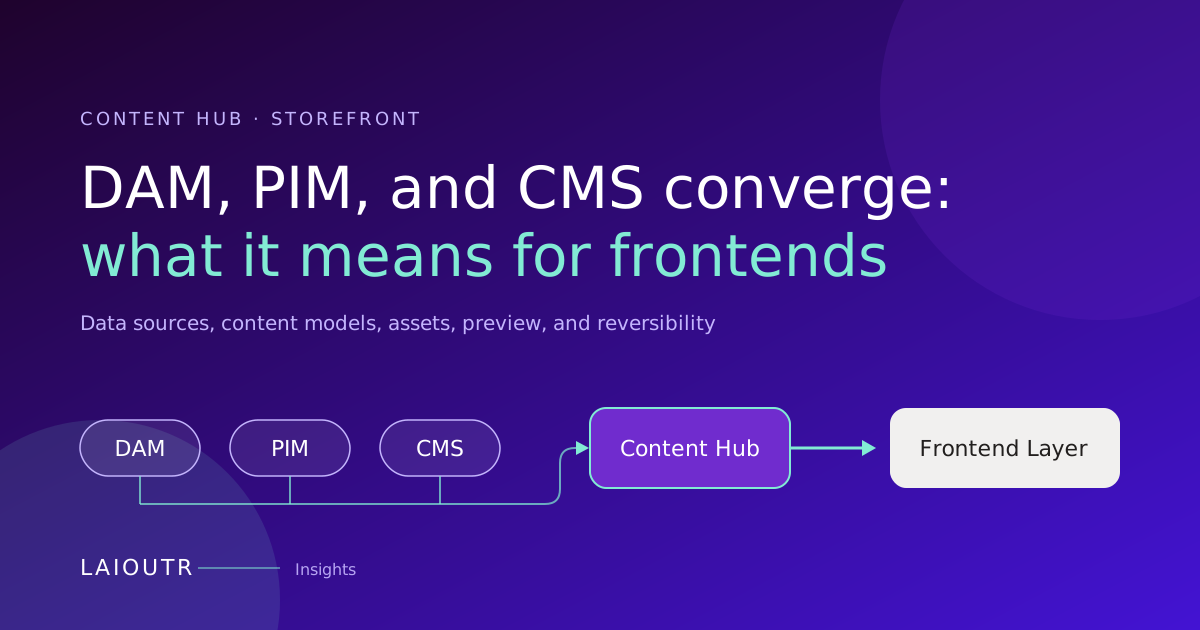DAM, PIM, and CMS Are Converging: What It Means for Your Storefront
DAM, PIM, and CMS vendors are moving into each other's territory, and more teams now evaluate on…](https://www.laioutr.com/en/blog/dam-pim-cms-convergence-content-hub-storefront-2026)
[Contentful Live Preview: What Your Frontend Has to Deliver
Contentful Live Preview lets editors see a draft right next to the entry editor and watch changes ap…](https://www.laioutr.com/en/blog/contentful-live-preview-frontend-perspective-2026)
[Content Governance at Scale: Product Content and Brand Assets
Content governance at scale means that roles, approvals, brand rules, asset rights and translations …](https://www.laioutr.com/en/blog/content-governance-product-content-brand-assets-frontend-2026)
[AI Agents as Frontend Operators: Architecture and Control Model
An AI agent becomes a frontend operator when it watches the running storefront, spots concrete issue…](https://www.laioutr.com/en/blog/ai-agents-as-frontend-operators-2026)
[Shopping Agents Read Your Feed: What Agentic Commerce Changes
Agentic commerce adds a new reader to your product data: shopping agents in ChatGPT, Google AI Mode,…](https://www.laioutr.com/en/blog/shopping-agents-product-feeds-agentic-data-distribution-2026)
[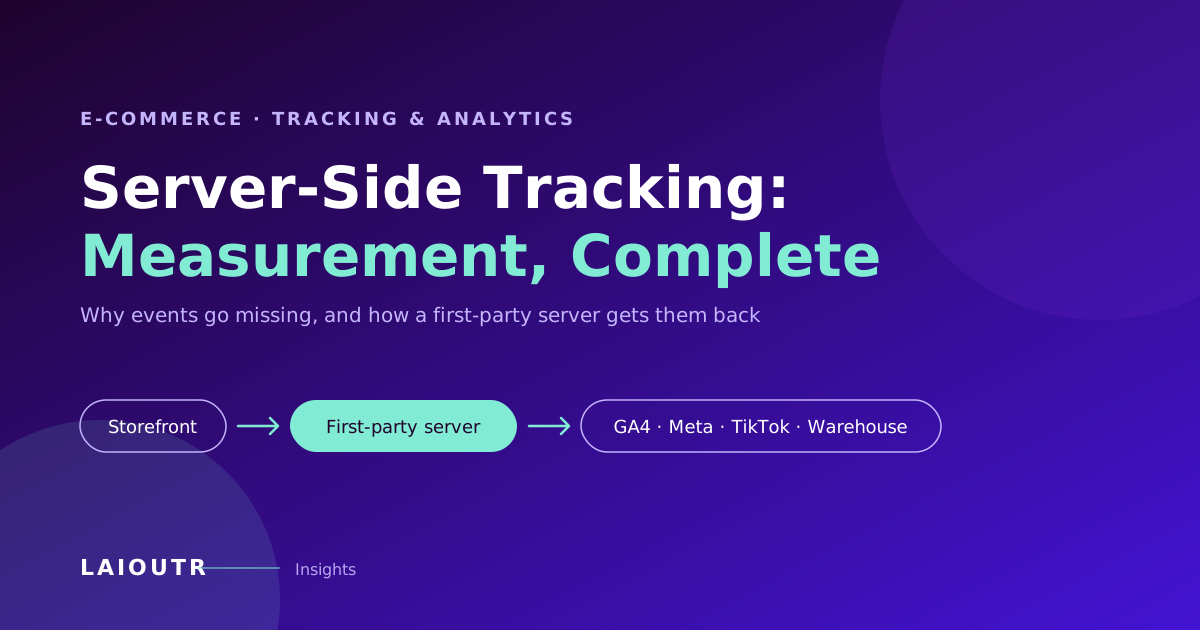Server-Side Tracking in E-Commerce: Making Measurement Complete Again
Server-side tracking moves the forwarding of analytics and conversion events from the visitor's …](https://www.laioutr.com/en/blog/server-side-tracking-ecommerce-complete-measurement-2026)
[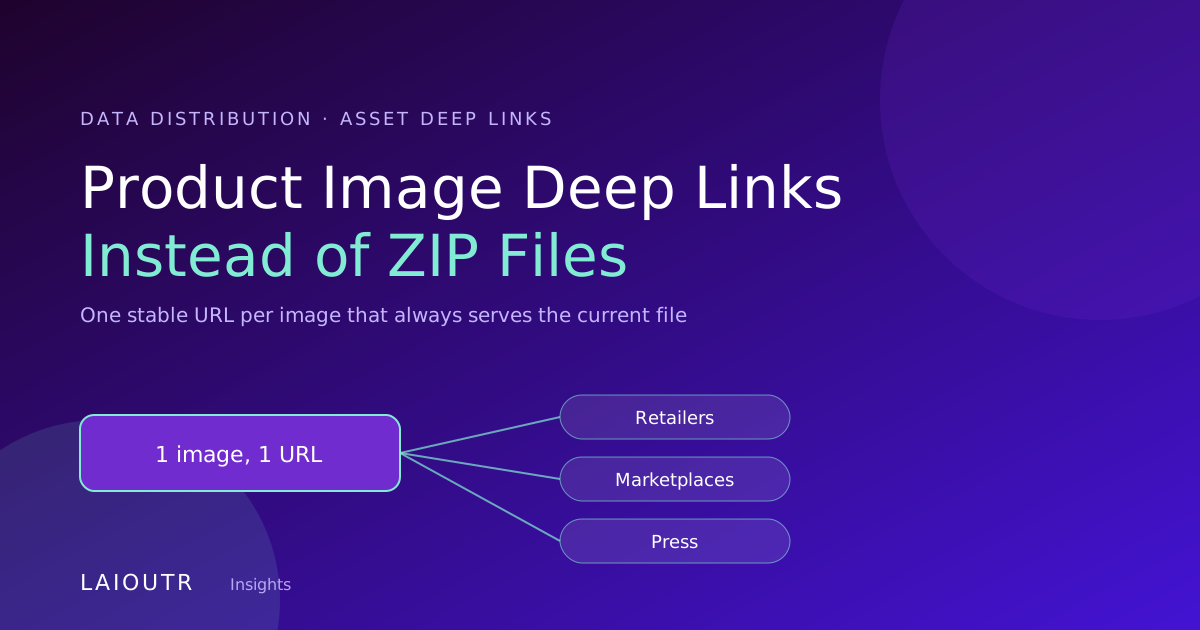Product Image Deep Links, Not ZIP Files: Assets That Stay Current
If you still send product images to retailers, marketplaces and press as ZIP files, every package st…](https://www.laioutr.com/en/blog/product-image-deeplinks-asset-distribution-2026)
[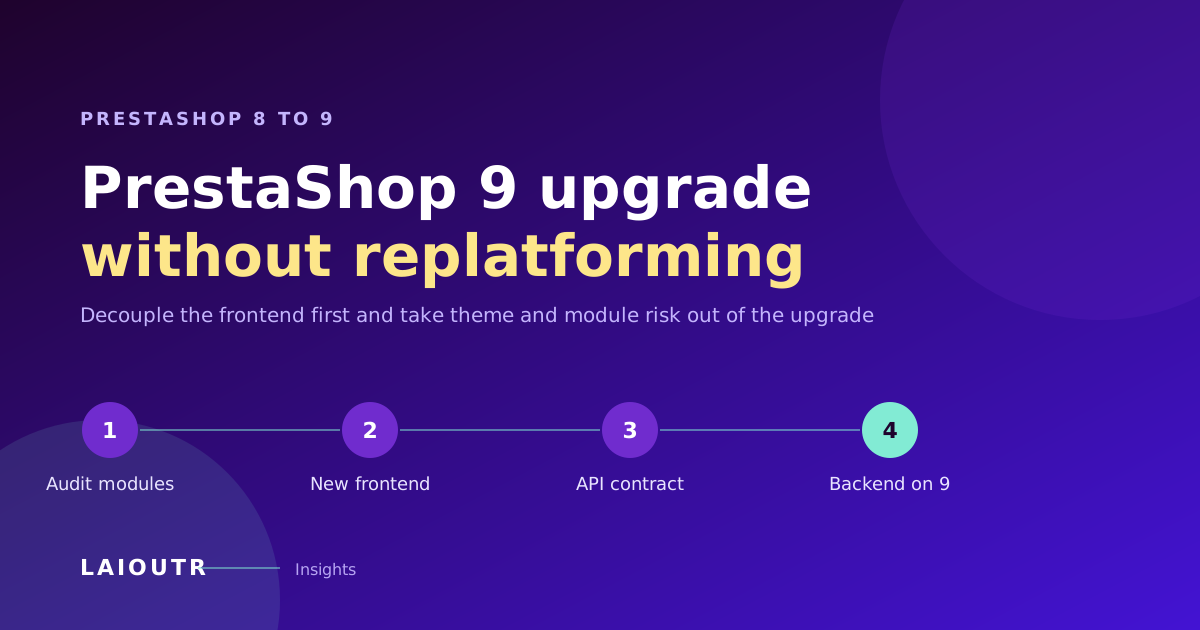PrestaShop 8 to 9 Upgrade Without Replatforming: Decouple the Frontend
You can take most of the risk out of the PrestaShop 8 to 9 upgrade by moving the storefront off the …](https://www.laioutr.com/en/blog/prestashop-8-to-9-upgrade-without-replatforming-2026)
[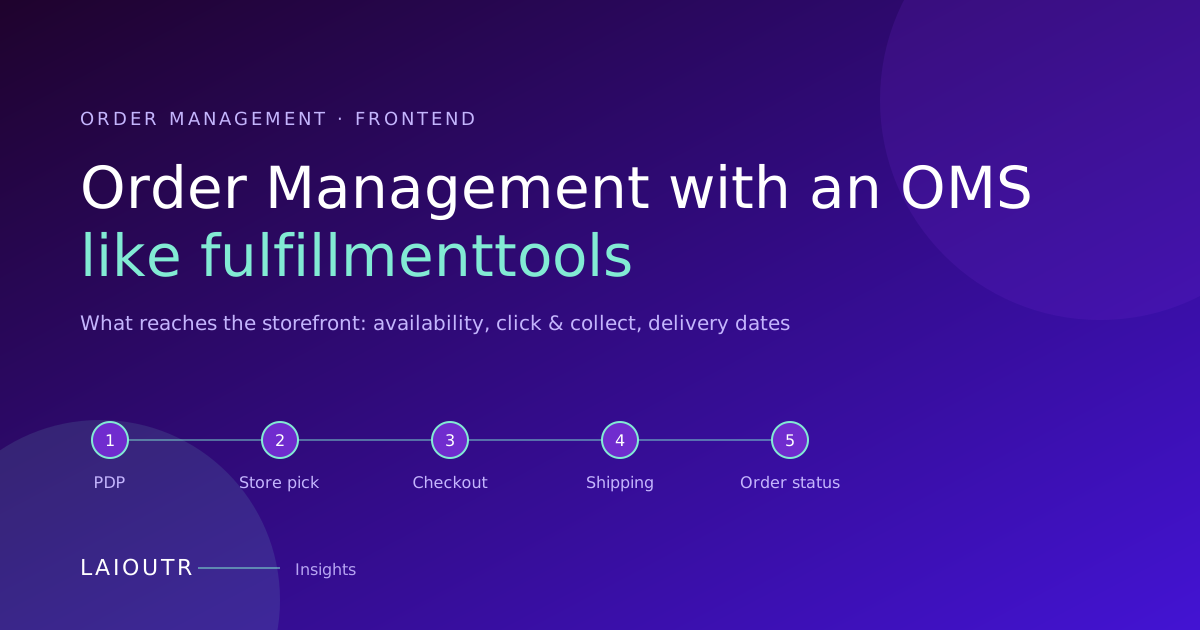Order Management With an OMS Like fulfillmenttools: The Frontend View
An efficient order management system decides which location fulfills an order, how much stock is rea…](https://www.laioutr.com/en/blog/order-management-fulfillmenttools-oms-frontend-2026)
[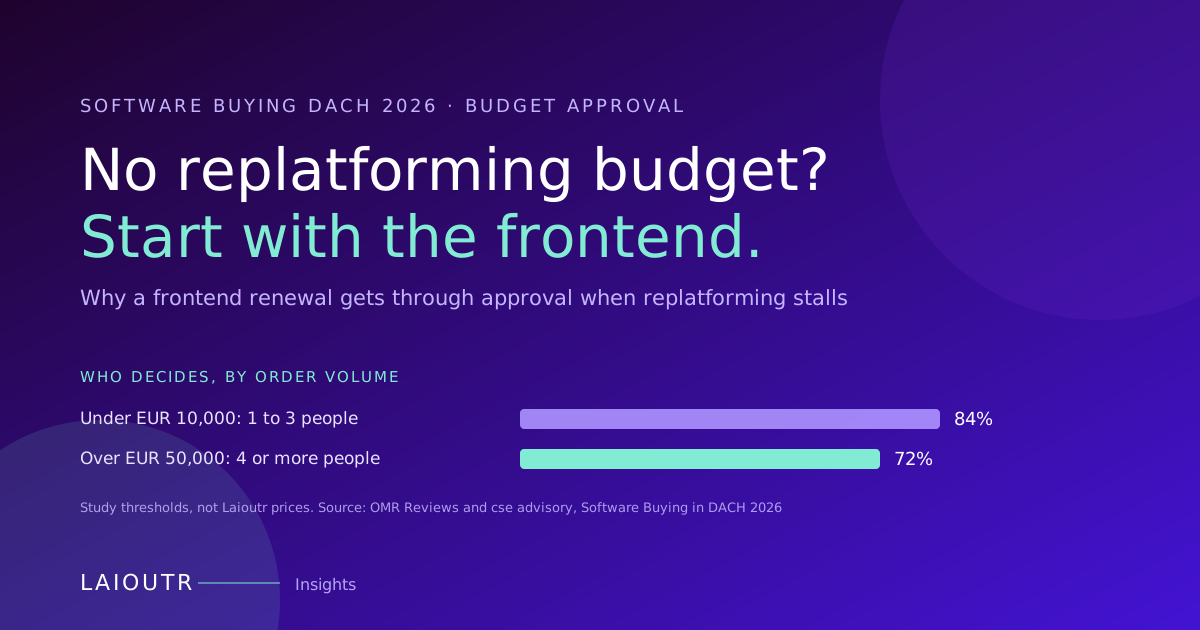No Replatforming Budget in 2026? Why the Frontend Gets Approved
If your 2026 budget has no room for a replatforming project, you are not alone, and you do not have …](https://www.laioutr.com/en/blog/no-replatforming-budget-frontend-project-approval-2026)
[Garden Retail Order Management: What Your Storefront Must Show
In garden and DIY retail, one cart can hold a parcel item, a patio set that ships by freight, live p…](https://www.laioutr.com/en/blog/garden-retail-order-management-seasonal-frontend-2026)
[](https://www.laioutr.com/en/apps/shopify)
Laioutr
[Shopify](https://www.laioutr.com/en/apps/shopify)
Shopify is a commerce platform for selling online and in physical retail.
[](https://www.laioutr.com/en/apps/shopware)
Laioutr
[Shopware](https://www.laioutr.com/en/apps/shopware)
Shopware is a flexible ecommerce platform from Europe for product catalogs and omnichannel commerce.
[](https://www.laioutr.com/en/apps/adobe-commerce)
Laioutr
[Adobe Commerce](https://www.laioutr.com/en/apps/adobe-commerce)
Adobe Commerce is an enterprise commerce platform for complex, global B2C and B2B scenarios.
Planned
[](https://www.laioutr.com/en/apps/b2b-sellers)
Laioutr
[B2Bsellers](https://www.laioutr.com/en/apps/b2b-sellers)
B2B suite for Shopware that turns an online store into a professional B2B commerce platform.
Planned
[](https://www.laioutr.com/en/apps/commerce-layer)
Laioutr
[Commerce Layer](https://www.laioutr.com/en/apps/commerce-layer)
Commerce Layer is a headless commerce platform for making inventory and catalogs available online.
[](https://www.laioutr.com/en/apps/commercetools)
Laioutr
[Commercetools](https://www.laioutr.com/en/apps/commercetools)
Commercetools is a SaaS-based headless ecommerce platform used worldwide.
[](https://www.laioutr.com/en/apps/emporix)
Laioutr
[Emporix](https://www.laioutr.com/en/apps/emporix)
Emporix is a composable, API-first commerce platform for scalable B2B and B2C scenarios.
Planned
[](https://www.laioutr.com/en/apps/hcl-software)
Laioutr
[HCL Software](https://www.laioutr.com/en/apps/hcl-software)
Enterprise suite for digital commerce and experience with extensive configurability.
Planned
[](https://www.laioutr.com/en/apps/intershop)
Laioutr
[Intershop](https://www.laioutr.com/en/apps/intershop)
Enterprise commerce platform for complex B2B and B2C business models.
Planned
[](https://www.laioutr.com/en/apps/magento-2)
Laioutr
[Magento 2](https://www.laioutr.com/en/apps/magento-2)
Widely used, extensible commerce platform for B2C and B2B scenarios.
[](https://www.laioutr.com/en/apps/oxid-eshop)
Laioutr
[OXID eShop](https://www.laioutr.com/en/apps/oxid-eshop)
OXID eShop is an extensible commerce platform for complex B2B and B2C requirements.
Planned
[](https://www.laioutr.com/en/apps/patchworks)
Laioutr
[Patchworks](https://www.laioutr.com/en/apps/patchworks)
Patchworks is a low-code iPaaS that connects ecommerce, ERP, WMS, 3PL, and marketplaces.
Planned
[](https://www.laioutr.com/en/apps/PrestaShop)
Laioutr
[Prestashop](https://www.laioutr.com/en/apps/PrestaShop)
Open-source commerce platform for small and midsize merchants in Europe and beyond.
Planned
[](https://www.laioutr.com/en/apps/saleor)
Laioutr
[Saleor](https://www.laioutr.com/en/apps/saleor)
Open-source, API-first commerce platform built on GraphQL for custom storefronts.
Planned
[](https://www.laioutr.com/en/apps/salesforce-commerce-cloud)
Laioutr
[Salesforce Commerce Cloud](https://www.laioutr.com/en/apps/salesforce-commerce-cloud)
Salesforce Commerce Cloud is a cloud-based enterprise commerce platform for businesses of any size.
Planned
[](https://www.laioutr.com/en/apps/sap-commerce-cloud)
Laioutr
[SAP Commerce Cloud](https://www.laioutr.com/en/apps/sap-commerce-cloud)
Enterprise commerce platform for complex catalogs, pricing models, and omnichannel journeys.
Planned
[](https://www.laioutr.com/en/apps/scayle)
Laioutr
[Scayle](https://www.laioutr.com/en/apps/scayle)
SCAYLE is a commerce engine that helps brands and retailers scale their business.
Planned
[](https://www.laioutr.com/en/apps/spryker)
Laioutr
[Spryker](https://www.laioutr.com/en/apps/spryker)
Composable commerce platform for sophisticated B2B and B2C business models.
[](https://www.laioutr.com/en/apps/sylius)
Laioutr
[Sylius](https://www.laioutr.com/en/apps/sylius)
Sylius is a developer-friendly ecommerce framework for B2C and B2B shopping experiences.
Planned
[](https://www.laioutr.com/en/apps/vendure)
Laioutr
[Vendure](https://www.laioutr.com/en/apps/vendure)
Vendure is a headless commerce platform for businesses with complex requirements.
Coming Soon
[](https://www.laioutr.com/en/apps/vtex)
Laioutr
[VTEX](https://www.laioutr.com/en/apps/vtex)
Cloud-native, composable commerce platform for B2B and B2C at scale.
Planned
[](https://www.laioutr.com/en/apps/websale)
Laioutr
[Websale](https://www.laioutr.com/en/apps/websale)
Stable, enterprise-ready commerce backend for complex retail environments.
Strategy call
## Ready to turn your frontend into a control layer?
Show us your stack, your roadmap, your replatforming scenario, and we'll show you how Laioutr fits, what it costs, and how fast you go live.
*"After 30 minutes, we knew Laioutr makes our replatforming feasible." - Daniel B., CEO,* [*hygibox.de*](https://hygibox.de)
[Book a demo](https://www.laioutr.com/en/contact)
## Structured Data
```json
{
"@context": "https://schema.org",
"@graph": [
{
"@type": "Organization",
"@id": "https://www.laioutr.com/#identity",
"name": "Laioutr",
"legalName": "Laioutr GmbH",
"url": "https://www.laioutr.com/",
"logo": {
"@type": "ImageObject",
"url": "https://www.laioutr.com/laioutr-logo.png",
"width": 400,
"height": 400
},
"email": "info@laioutr.com",
"telephone": "+49 30 75435715",
"address": {
"@type": "PostalAddress",
"streetAddress": "Münchweilersteig 5",
"postalCode": "12559",
"addressLocality": "Berlin",
"addressCountry": "DE"
},
"vatID": "DE450905846",
"sameAs": [
"https://www.linkedin.com/company/laioutr",
"https://www.youtube.com/@Laioutr",
"https://x.com/laioutr"
]
},
{
"@type": "WebSite",
"@id": "https://www.laioutr.com/en/#website",
"url": "https://www.laioutr.com/en/",
"name": "Laioutr",
"inLanguage": "en",
"publisher": {
"@id": "https://www.laioutr.com/#identity"
}
},
{
"@type": "BlogPosting",
"@id": "https://www.laioutr.com/en/blog/practical-roadmap-ai-digital-experiences#article",
"headline": "The Reality Check: Why Most AI Digital Experience Projects Fail and How to Build Sustainable Solutions",
"description": "A reality check on why most AI digital experience projects fail and how to build sustainable ones.",
"image": [
"https://eu-west-2.graphassets.com/cmii2mlqi0dux06l5543v7nkc/cmnucypviw8mi07mgmwsd5asa"
],
"datePublished": "2026-06-30T17:28:59.012794+00:00",
"dateModified": "2026-06-30T17:28:58.742706+00:00",
"inLanguage": "en",
"articleSection": "Insights",
"keywords": "Experience Operations, Performance",
"author": {
"@type": "Person",
"name": "Marcel Thiesies",
"jobTitle": "Co-Founder & CEO, Laioutr",
"image": "https://eu-west-2.graphassets.com/cmii2mlqi0dux06l5543v7nkc/cmj01b962364n07lb0iguvts5"
},
"publisher": {
"@id": "https://www.laioutr.com/#identity"
},
"mainEntityOfPage": {
"@id": "https://www.laioutr.com/en/blog/practical-roadmap-ai-digital-experiences#webpage"
},
"isPartOf": {
"@id": "https://www.laioutr.com/en/#website"
}
},
{
"@type": "WebPage",
"@id": "https://www.laioutr.com/en/blog/practical-roadmap-ai-digital-experiences#webpage",
"url": "https://www.laioutr.com/en/blog/practical-roadmap-ai-digital-experiences",
"name": "The Reality Check: Why Most AI Digital Experience Projects Fail and How to Build Sustainable Solutions",
"description": "A reality check on why most AI digital experience projects fail and how to build sustainable ones.",
"inLanguage": "en",
"isPartOf": {
"@id": "https://www.laioutr.com/en/#website"
},
"breadcrumb": {
"@id": "https://www.laioutr.com/en/blog/practical-roadmap-ai-digital-experiences#breadcrumb"
},
"primaryImageOfPage": {
"@type": "ImageObject",
"url": "https://eu-west-2.graphassets.com/cmii2mlqi0dux06l5543v7nkc/cmnucypviw8mi07mgmwsd5asa"
},
"datePublished": "2026-06-30T17:28:59.012794+00:00",
"dateModified": "2026-06-30T17:28:58.742706+00:00",
"mainEntity": {
"@id": "https://www.laioutr.com/en/blog/practical-roadmap-ai-digital-experiences#article"
}
},
{
"@type": "BreadcrumbList",
"@id": "https://www.laioutr.com/en/blog/practical-roadmap-ai-digital-experiences#breadcrumb",
"itemListElement": [
{
"@type": "ListItem",
"position": 1,
"name": "Laioutr",
"item": "https://www.laioutr.com/en/"
},
{
"@type": "ListItem",
"position": 2,
"name": "Insights",
"item": "https://www.laioutr.com/en/blogs/insights"
},
{
"@type": "ListItem",
"position": 3,
"name": "The Reality Check: Why Most AI Digital Experience Projects Fail and How to Build Sustainable Solutions"
}
]
}
]
}
```