---
title: "Questions to Ask DXP Vendors"
canonical_url: "https://www.laioutr.com/en/blog/questions-to-ask-dxp-vendors"
locale: en
meta:
description: "The strategic questions every enterprise should ask before choosing a digital experience platform."
"og:description": "The strategic questions every enterprise should ask before choosing a digital experience platform."
"og:title": "Questions to Ask DXP Vendors"
---

# The Strategic Questions Every Enterprise Should Ask Before Choosing a Digital Experience Platform
Table of contents
1. 1.Question 1: Can You Integrate With Services We Don't Currently Use, Without Custom Development?
2. [2.Question 2: Does Your Platform Reduce Our Dependency on Developers, or Merely Shift It to Different Functions?](#question-2-does-your-platform-reduce-our-dependency-on-developers-or-merely-shift-it-to-different-functions)
3. [3.Question 3: What Happens to Our Content and Data if We Decide to Switch Platforms?](#question-3-what-happens-to-our-content-and-data-if-we-decide-to-switch-platforms)
4. [4.Question 4: How Does Your Vendor Model Account for Increasing Complexity and Customization Over Time?](#question-4-how-does-your-vendor-model-account-for-increasing-complexity-and-customization-over-time)
5. [5.Question 5: Does Your Organization Possess Deep Expertise in Our Industry Vertical, or Do We Need to Become Your Industry Experts?](#question-5-does-your-organization-possess-deep-expertise-in-our-industry-vertical-or-do-we-need-to-become-your-industry-experts)
6. [6.The Deeper Pattern in Vendor Evaluation](#the-deeper-pattern-in-vendor-evaluation)
7. [7.Making the Final Decision](#making-the-final-decision)
Selecting a Digital Experience Platform is one of the most consequential technology decisions your organization will make. Unlike point solutions that solve narrow problems, a DXP becomes the foundation upon which your entire digital operation runs. Get this decision wrong, and you're not just adopting software; you're committing your organization to years of technical compromises, operational constraints, and escalating costs.
Yet most enterprises approach DXP selection reactively. They create requirements documents based on current pain points, evaluate based on feature checklists, and rarely ask the uncomfortable questions that reveal whether a vendor genuinely solves your problems or merely defers them into the future.
At Laioutr, we've observed countless organizations pursue DXP implementations only to discover that the platform they selected was far less flexible than promised, far more expensive to customize than expected, and ultimately incapable of evolving as their business needs changed. The pattern repeats because enterprises aren't asking the right questions during vendor evaluation.
This post addresses the strategic questions you should ask before committing to any DXP vendor. These aren't feature questions. They're architecture questions. They're business model questions. And they're questions that separate vendors genuinely committed to your long-term success from vendors optimizing for short-term deal closure.
## Question 1: Can You Integrate With Services We Don't Currently Use, Without Custom Development?
This is perhaps the most critical question you can ask, yet it's frequently glossed over in vendor conversations.
Most enterprises operate with a diverse technology ecosystem. You might use Salesforce for CRM, Shopify for commerce, Monday.com for project management, and specialized analytics tools for behavioral insights. Your DXP doesn't exist in isolation; it must orchestrate data and experiences across these systems.
When you ask a vendor about integration capabilities, listen carefully to how they answer. Vendors with genuinely flexible architectures emphasize their ability to connect with any external service through standard APIs and protocols. They talk about their integration frameworks, their webhook capabilities, their support for custom connectors. They acknowledge that new services emerge constantly, and their platform is designed to accommodate integrations that don't exist yet.
Vendors with less flexible architectures often respond by listing their certified integrations. They'll tell you they support "over 500 integrations" and position this as comprehensive. What they're actually saying is that those 500 integrations work well, but anything outside that list requires custom development, which means consulting fees, time delays, and ongoing maintenance burden.
The cost difference between these two approaches is staggering. A vendor with genuine integration flexibility might enable you to connect a new customer data platform in weeks. A vendor requiring custom development might require months of consulting engagement and hundreds of thousands in professional services fees.
Ask specifically: "How would we integrate with a service that you don't currently have a certified connector for?" If the answer involves significant custom development, engineering resources, or extended timelines, you're looking at a vendor whose platform is less flexible than it appears.
## Question 2: Does Your Platform Reduce Our Dependency on Developers, or Merely Shift It to Different Functions?
One of the central promises of modern DXP platforms is empowerment. Marketers, content teams, and business users should be able to create and manage experiences without waiting for development resources. But this promise manifests very differently depending on the vendor.
Some vendors genuinely deliver this through sophisticated visual interfaces, configuration-driven architecture, and declarative content models. These platforms reduce developer dependency across the entire experience lifecycle, from content creation through campaign execution to analytics interpretation.
Other vendors create the appearance of reduced developer dependency while actually creating new bottlenecks. They might offer powerful visual editing tools for marketers, but those tools rely on a carefully architected underlying system that only developers can modify. They might promise "low-code" experiences while actually delivering systems where non-technical users can assemble pre-built components but cannot create anything outside those constraints.
The distinction matters profoundly for your operational model. True developer independence means your marketing and content teams can move quickly, iterate rapidly, and respond to market opportunities without waiting for engineering sprints. Apparent developer independence that masks underlying developer dependencies means your teams can move quickly only within carefully constrained boundaries, and any deviation requires escalating to engineering.
Ask your vendor: "Walk me through a specific workflow where a marketer would create a personalized experience. At what points in that workflow would we need a developer?" Then ask the same question about modifying the behavior of that experience based on performance data. Then ask about integrating new data sources into that personalization. The answers reveal whether you're genuinely reducing developer dependency or simply shifting it to different functions.
## Question 3: What Happens to Our Content and Data if We Decide to Switch Platforms?
This question makes many vendors visibly uncomfortable, and their discomfort is instructive.
Your organization will accumulate significant value within your DXP over time: content libraries, personalization rules, customer data models, campaign templates, audience segments, and behavioral patterns. You're making a multi-year bet that this platform will remain optimal for your needs, even as your business evolves and new technologies emerge.
But technology doesn't stand still. A platform that's ideal for your current situation might be poorly suited for your needs five years from now. Vendor lock-in isn't usually intentional on the vendor's part; it's simply the natural consequence of how tightly their platform binds your data, content, and logic to their specific systems.
Vendors genuinely committed to your long-term success should be transparent about data portability. They should clearly articulate how your content can be extracted in standard formats. They should explain how your customer data can be exported in ways that other platforms can ingest. They should acknowledge that some customizations won't port perfectly to other systems, but the bulk of your value should be portable.
Vendors uncomfortable with this conversation often respond by emphasizing lock-in indirectly. They talk about the switching costs being so high that you'll never want to leave. They emphasize proprietary features that differentiate them from competitors. They discuss how migrations are extraordinarily complex.
These responses reveal vendors who are building business models based on customer lock-in rather than customer satisfaction. They're betting that you'll be so committed to your DXP that you'll accept increasing costs and decreasing flexibility rather than face migration complexity.
Specify your data portability requirements explicitly: "We need to be able to extract our content in standard formats, export our customer segments in ways that other platforms can use, and understand exactly what assets we can take if we switch platforms." Vendors with genuine confidence in their offerings will embrace this conversation. Vendors who view lock-in as a feature will avoid it.
## Question 4: How Does Your Vendor Model Account for Increasing Complexity and Customization Over Time?
This question addresses the economic reality of platform adoption that many enterprises learn too late.
When you first select a DXP vendor, you're evaluating their platform at a specific moment in time. You're assessing their current feature set, their current architecture, their current capability to solve your immediate problems. But your relationship with this vendor will span years, and your needs will change.
Over that timeframe, you'll likely pursue increasingly sophisticated initiatives. You'll want to integrate machine learning models. You'll want to personalize based on behavioral sequences, not just individual data points. You'll want to manage experiences across channels that didn't exist when you selected the platform. You'll want to run experiments at a scale that would have seemed impossible initially.
How does the vendor's economic model accommodate this complexity growth?
Some vendors have architected their platforms to handle increasing complexity without proportional cost increases. They've built extensible systems where additional sophistication leverages the same underlying infrastructure. They've invested in automation and tooling that keeps the cost of complexity down even as your use cases become more advanced.
Other vendors have architected their pricing around feature tiers. Basic personalization is included. Advanced personalization is an add-on. Behavioral sequencing is a premium add-on. Multivariant testing at scale requires additional licensing. What you initially evaluate as a moderately priced platform becomes increasingly expensive as your ambitions grow.
The most problematic vendors are those whose economic models actually punish complexity. They charge per experiment. They charge per personalization rule. They charge per API call. Their pricing structure incentivizes you to keep your implementation simple even when sophistication would serve your business better. You end up making technology decisions based on cost rather than strategic value.
Ask your vendor: "Show me the pricing impact if we scale our personalization rules from 100 to 1000. Show me the pricing impact if we increase our campaign volume. Show me the pricing impact if we want to run 50 concurrent experiments instead of 5." Their pricing methodology reveals whether they're partners in your growth or simply extracting maximum revenue as your ambitions expand.
## Question 5: Does Your Organization Possess Deep Expertise in Our Industry Vertical, or Do We Need to Become Your Industry Experts?
This question separates vendors who can genuinely accelerate your success from vendors who will consume your resources.
Digital experience platforms are sophisticated systems, and their optimal configuration depends heavily on your specific industry dynamics. Retail DXP configurations differ fundamentally from financial services DXP configurations. Healthcare personalization operates under completely different constraints than B2B SaaS personalization. The decisions you make about content models, data governance, and personalization logic should be informed by industry best practices, not generic software engineering principles.
Some vendors have invested deeply in industry expertise. They work extensively within specific verticals. They've internalized the regulatory constraints, the typical customer journeys, the competitive dynamics, and the organizational structures that define their focus industries. When you implement with them, they can guide you toward configurations that reflect industry-specific best practices. They help you avoid the mistakes that other companies in your industry have already made.
Other vendors operate in a vertical-agnostic manner. They've built flexible platforms capable of serving any industry, but they don't embed specific industry knowledge into their approach. When you work with them, you become responsible for translating your industry knowledge into platform configuration. If you have deep expertise internally, this works fine. If you don't, you're essentially asking a software company to become your consultant on how to approach digital experience management in your specific context.
The difference in implementation outcomes can be substantial. Vendors with vertical expertise typically deliver faster time-to-value, more sophisticated configurations, and fewer false starts. Vendors without vertical expertise often deliver more generic implementations that require significant internal expertise to optimize.
Ask potential vendors: "How many implementations have you completed in our industry? What specific best practices have you observed? What common mistakes do companies in our vertical make? How would you adjust the baseline configuration based on our industry dynamics?" Their depth of industry-specific insight reveals whether they're purely a software vendor or a genuine implementation partner.
## The Deeper Pattern in Vendor Evaluation
These five questions cluster around a fundamental distinction in vendor philosophy.
Some vendors view the DXP as a business model leveraging software. They optimize for deal closure, feature perception, and revenue expansion. They build lock-in where possible, because lock-in ensures recurring revenue even if customer satisfaction declines. They structure pricing to extract maximum revenue as customers become more ambitious. They operate vertically agnostic because optimizing for a specific industry requires deeper investment than pure-play software vendors want to make.
Other vendors view the DXP as a platform for your success. They optimize for your long-term outcomes, not their short-term revenue. They build genuine flexibility because flexible platforms outlive rigid competitors. They structure pricing to remain economically reasonable even as your ambitions grow. They invest in vertical expertise because truly serving you requires understanding your specific context.
The vendors in the first category are often easier to buy from initially. Their sales processes are well-oiled. Their promises are appealing. Their pricing for Year 1 is attractive. But the true cost of your relationship emerges over time as flexibility constraints force expensive customization, as pricing escalates as your needs grow, and as the platform becomes an increasingly limiting factor on your strategic options.
The vendors in the second category often require more rigorous evaluation during vendor selection. They're less likely to oversell. They're more likely to identify constraints and limitations. They're more likely to challenge your requirements and ask whether you're optimizing for the right outcomes. But the true value of the relationship emerges over time as their flexibility enables you to adapt, as their pricing remains reasonable even as you grow increasingly ambitious, and as the platform becomes a genuine asset to your organization.
## Making the Final Decision
Vendor selection is ultimately a judgment call based on incomplete information. You cannot know with certainty how a vendor will behave years into a relationship or whether their platform will remain relevant as your business evolves.
What you can do is ask the right questions and listen carefully to the answers. What you can do is examine the incentives embedded in their business model and pricing structure. What you can do is assess whether their expertise aligns with your context. What you can do is evaluate whether they're optimizing for your success or for their revenue extraction.
The vendors worthy of partnership will welcome these difficult questions. They'll answer them transparently. They'll acknowledge limitations and constraints rather than pretending their platform solves every problem. They'll position themselves as implementers of your vision rather than vendors selling a fixed solution.
Choose accordingly, because this decision will shape your organization's digital capabilities for years to come.
### **More from the Laioutr Platform**
- [Composable Digital Experience Platform](https://www.laioutr.com/en/composable-digital-experience-platform)
- [Agentic Frontend Management Platform](https://www.laioutr.com/en/agentic-frontend-management-platform)
- [Personalization](https://www.laioutr.com/en/product/personalization)
- [Composable Visual Page Builder](https://www.laioutr.com/en/composable-visual-page-builder)
- [Headless Frontend for Shopify](https://www.laioutr.com/en/headless-frontend-for-shopify)
Related reading: [Switching Commerce Vendors Without Full Replatforming: A Strategic Approach](https://www.laioutr.com/en/blog/switching-vendors-without-replatforming) and [3 Frontend Questions You Should Ask at Booth #37](https://www.laioutr.com/en/blog/commercetools-k5-berlin-2026-frontend-questions-booth).
---
Share this article
[Share on Facebook](https://www.facebook.com/sharer/sharer.php?u=https%3A%2F%2Fwww.laioutr.com%2Fen%2Fblog%2Fquestions-to-ask-dxp-vendors) [Share on X](https://x.com/intent/post?url=https%3A%2F%2Fwww.laioutr.com%2Fen%2Fblog%2Fquestions-to-ask-dxp-vendors&text=) [Share on LinkedIn](https://www.linkedin.com/sharing/share-offsite/?url=https%3A%2F%2Fwww.laioutr.com%2Fen%2Fblog%2Fquestions-to-ask-dxp-vendors) [Share on Pinterest](https://pinterest.com/pin/create/button/?url=https%3A%2F%2Fwww.laioutr.com%2Fen%2Fblog%2Fquestions-to-ask-dxp-vendors&description=) [Share via email](mailto:?subject=&body=%0A%0Ahttps%3A%2F%2Fwww.laioutr.com%2Fen%2Fblog%2Fquestions-to-ask-dxp-vendors)
## More articles on frontend and headless
Practical know-how for frontend development, smart agents, and headless
[To the blog](https://www.laioutr.com/en/blogs/insights)
[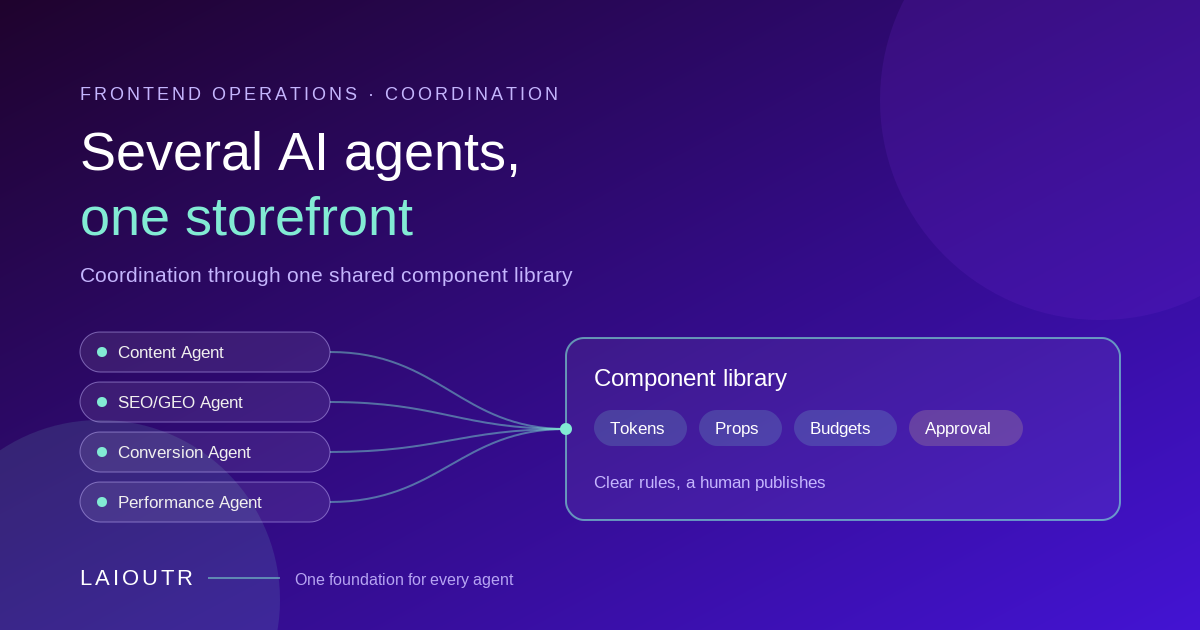Several AI Agents, One Storefront: Coordination Without Collisions
When several AI agents work on the same storefront, conflicts rarely happen between the agents thems…](https://www.laioutr.com/en/blog/frontend-operations-multi-agent-coordination-storefront-2026)
[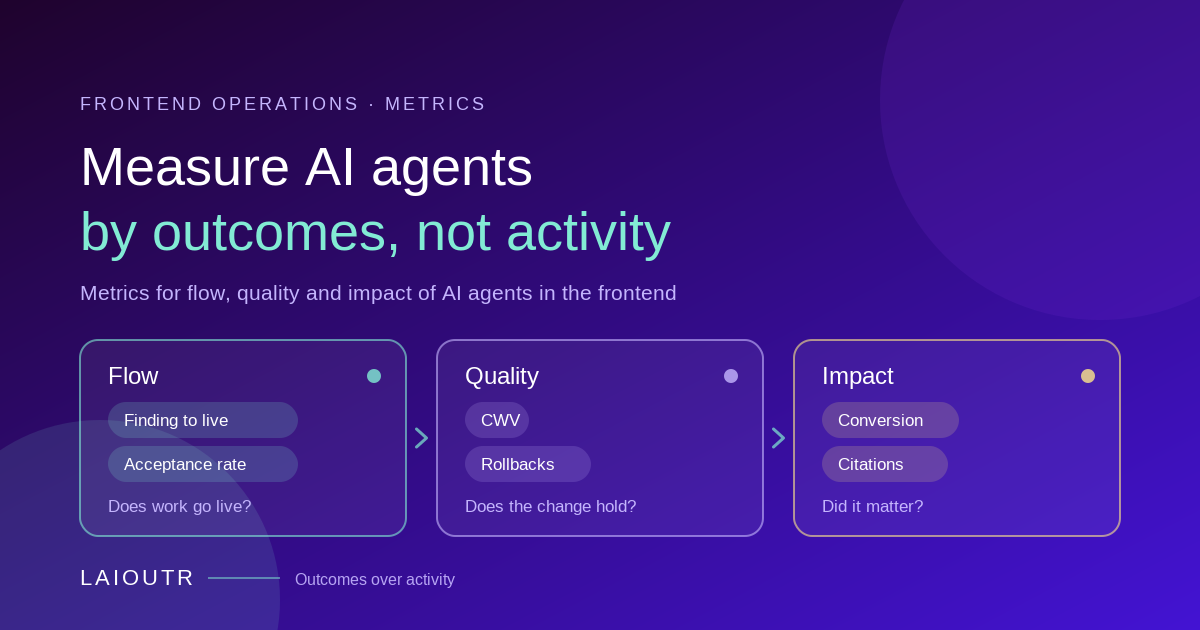Measuring AI Agents by Outcomes: Agentic Frontend Management Metrics
AI agents in the frontend should be measured by outcomes, not by activity. The number of prompts, ge…](https://www.laioutr.com/en/blog/frontend-operations-measuring-ai-agents-outcomes-2026)
[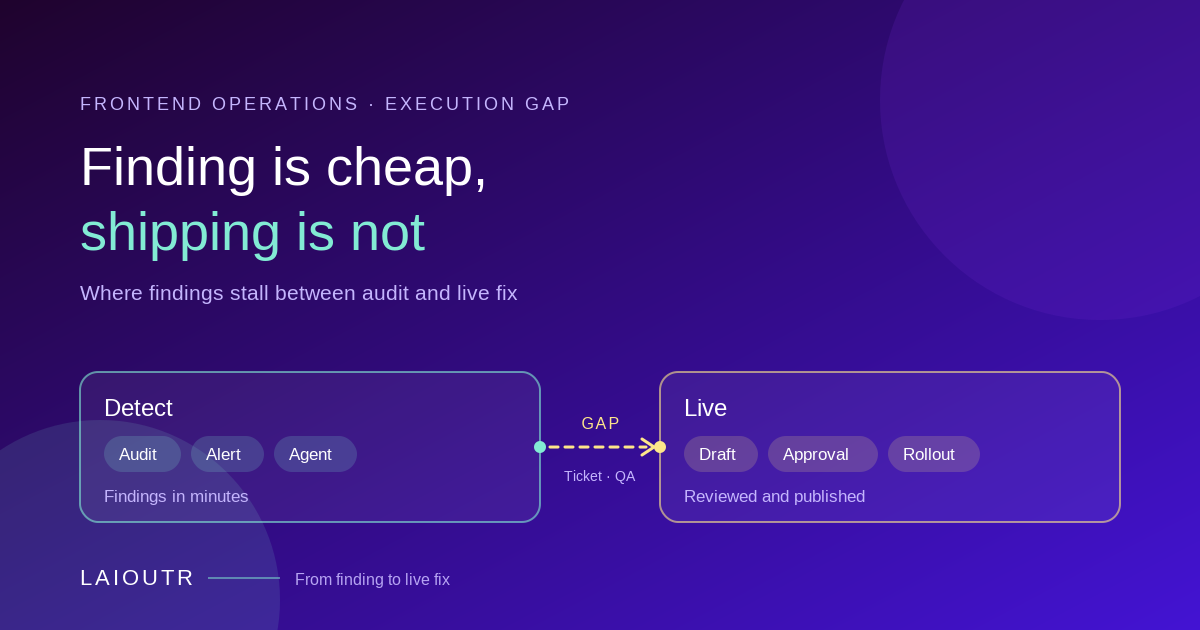The Execution Gap in the Frontend: Finding Is Cheap, Shipping Is Not
The execution gap in the frontend is the time, and the number of handoffs, between "we know wha…](https://www.laioutr.com/en/blog/frontend-operations-execution-gap-detect-vs-deploy-2026)
[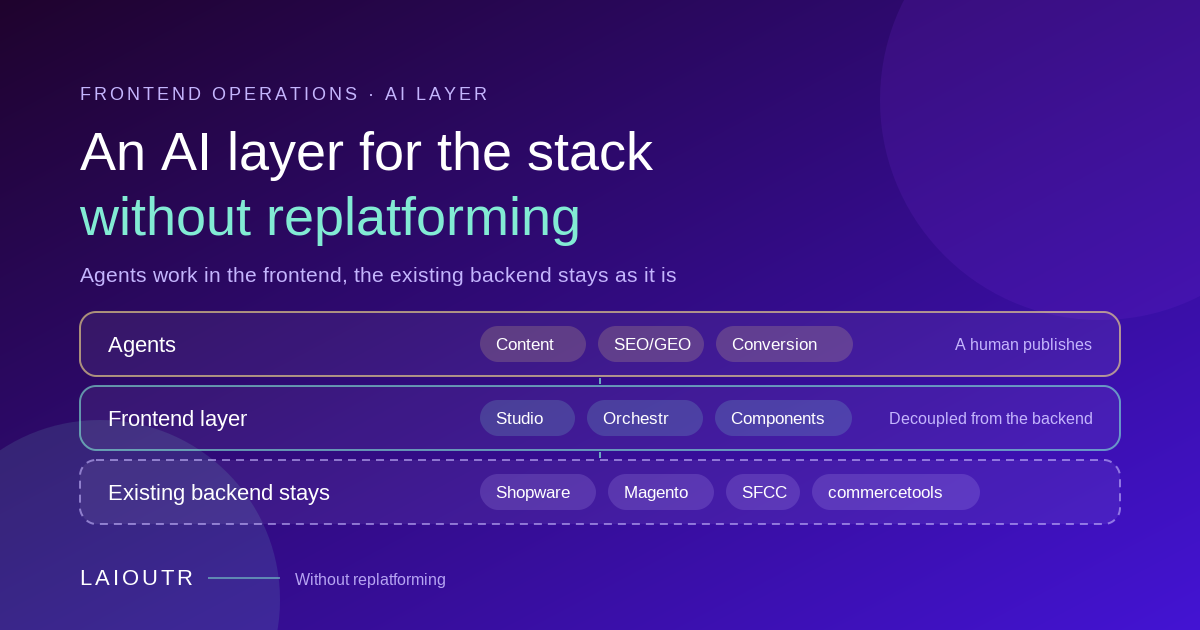Adding an AI Layer to an Existing Commerce Stack Without Replatforming
An AI layer can be added to an existing commerce stack without replacing the shop system. The most p…](https://www.laioutr.com/en/blog/frontend-operations-ai-layer-existing-stack-without-replatforming-2026)
[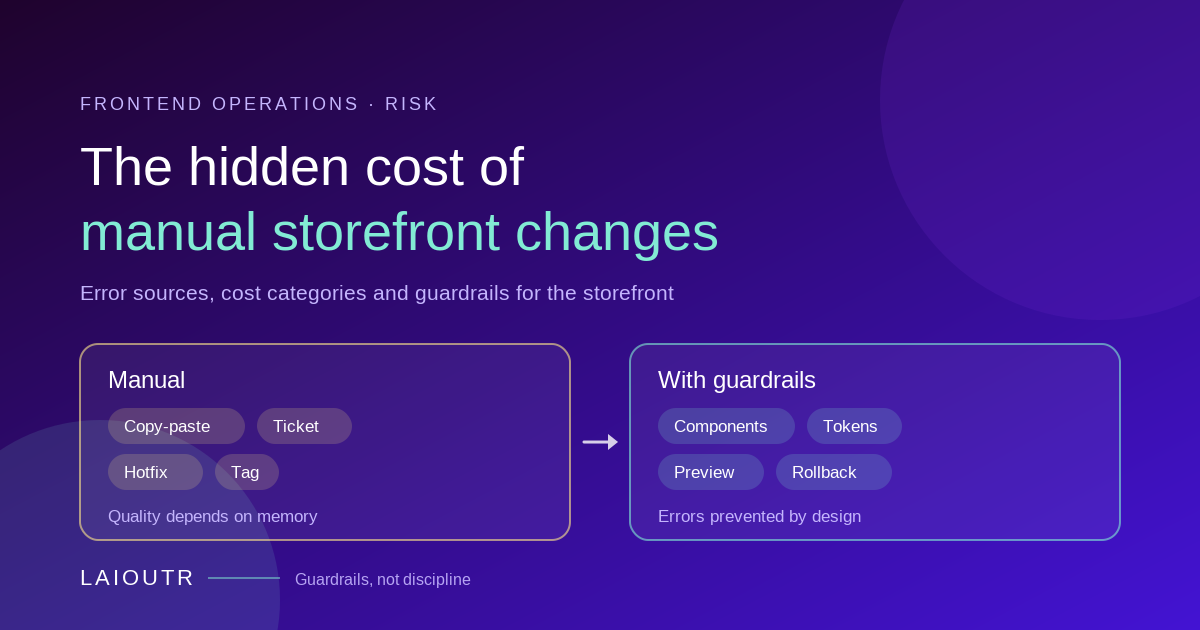The Hidden Cost of Manual Storefront Changes and How to Cut It
Manual frontend changes are the many small edits that keep a storefront running day to day: a new ba…](https://www.laioutr.com/en/blog/frontend-operations-hidden-cost-manual-storefront-changes-2026)
[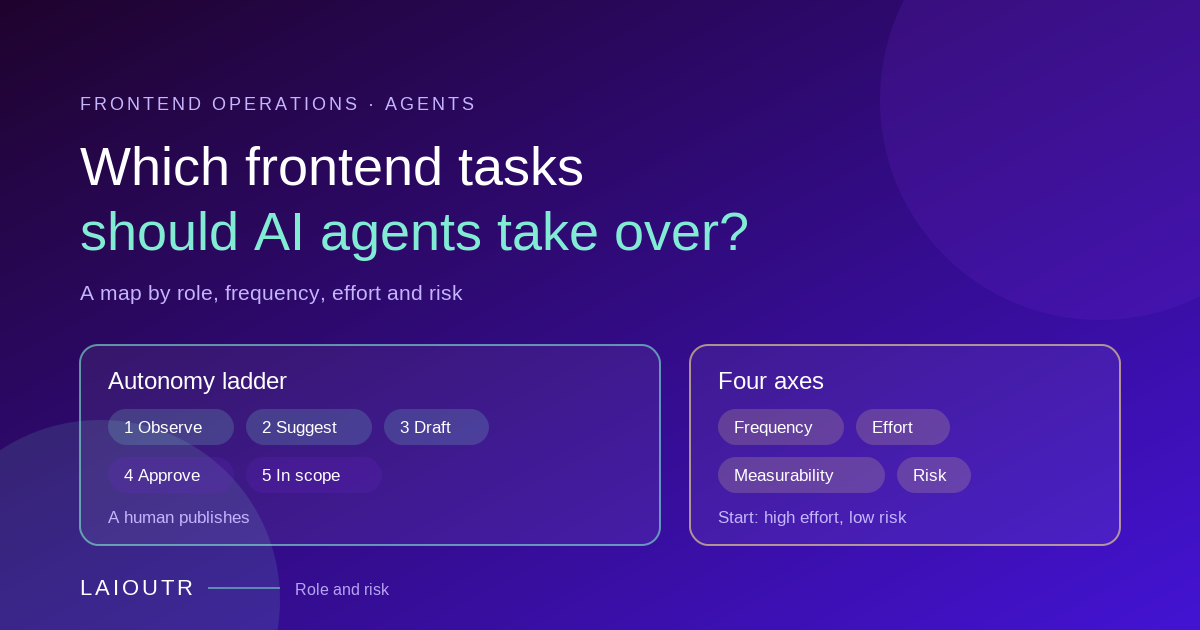Which Frontend Tasks Should AI Agents Take Over? Role and Risk Map
AI agents should first take over the frontend tasks that come up often, involve a lot of manual work…](https://www.laioutr.com/en/blog/frontend-operations-agent-task-map-role-risk-2026)
[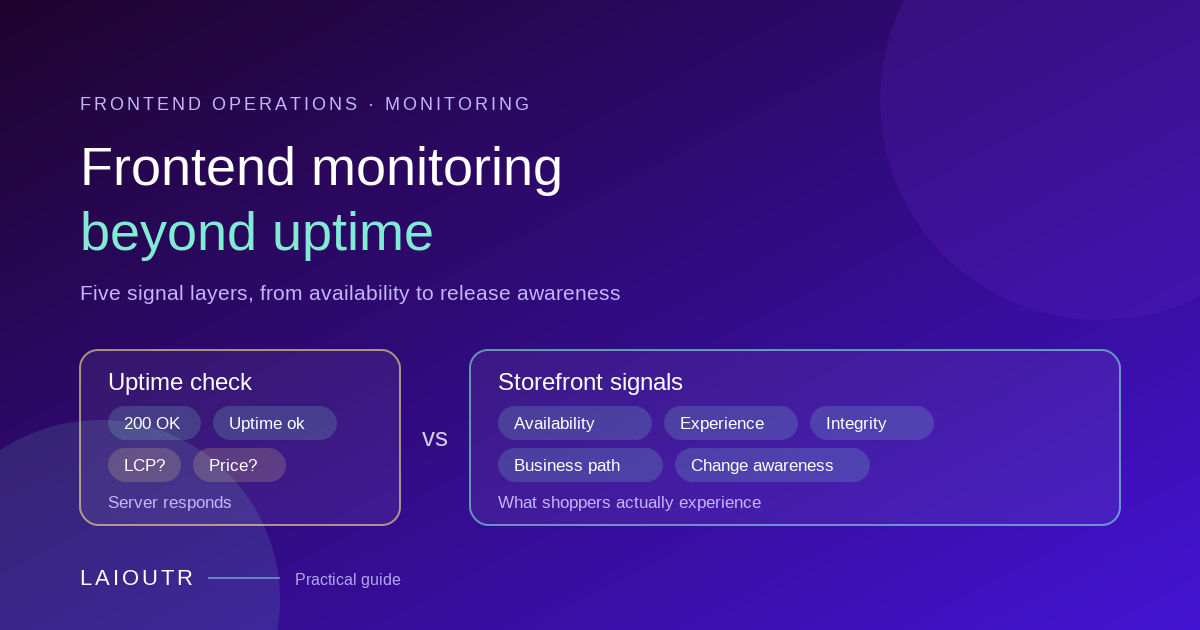Frontend Monitoring Beyond Uptime: Signals a Storefront Needs
Frontend monitoring beyond uptime means checking a storefront not only for availability but for what…](https://www.laioutr.com/en/blog/frontend-operations-monitoring-beyond-uptime-2026)
[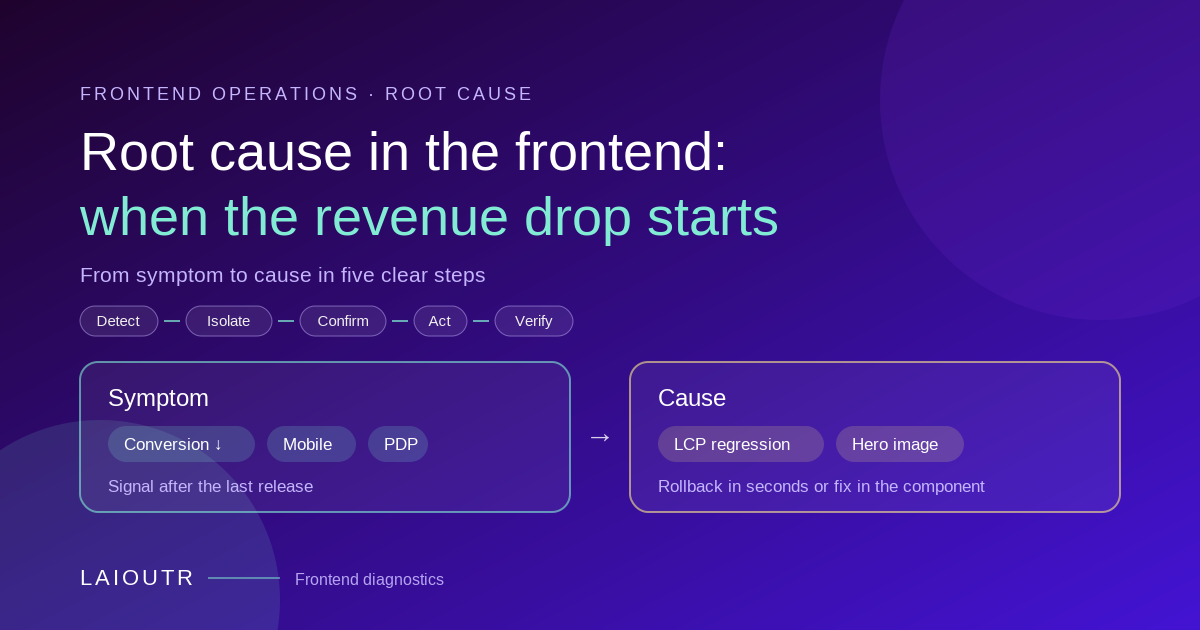Root Cause in the Frontend: When Revenue Drops Start in the Storefront
When revenue or conversion rate drops suddenly, the cause often is not traffic, pricing or the comme…](https://www.laioutr.com/en/blog/frontend-operations-root-cause-revenue-drop-storefront-2026)
[Laioutr Academy Is Live: The Video Manual for Laioutr
Since October 15, 2026, the Laioutr Academy has been live at academy.laioutr.com. It is the user man…](https://www.laioutr.com/en/blog/laioutr-academy-launch-video-manual-certification)
[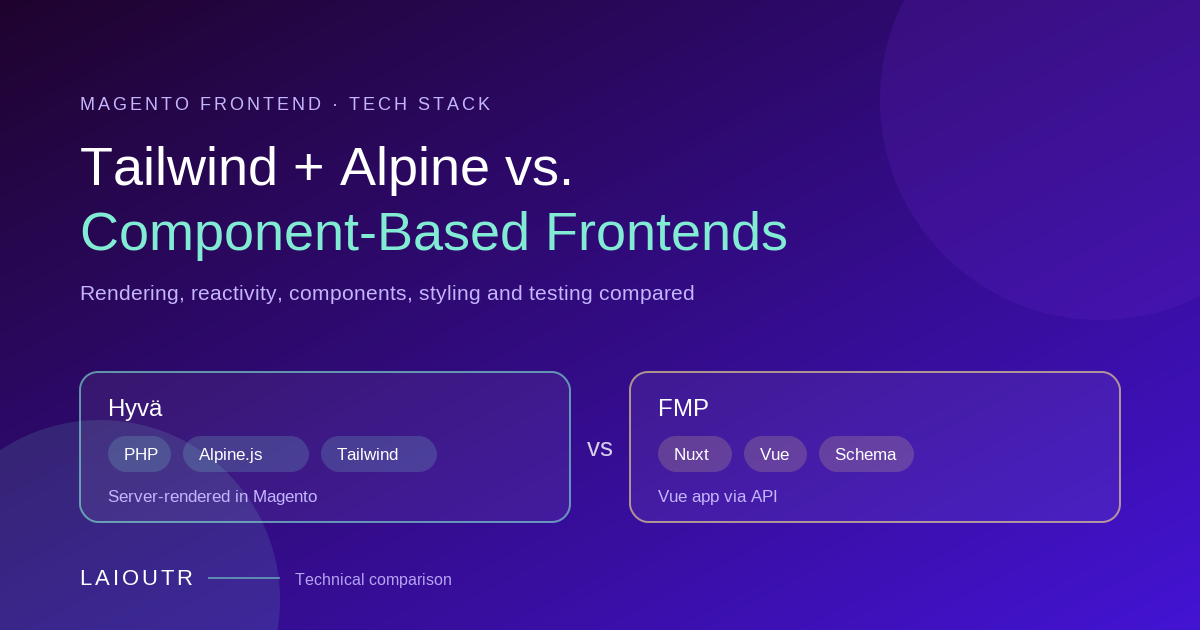Tailwind + Alpine vs. Component-Based Frontends for Magento
Hyvä renders Magento pages on the server with PHP templates and layout XML, adds interactivity throu…](https://www.laioutr.com/en/blog/tailwind-alpine-magento-vs-component-based-frontend-2026)
[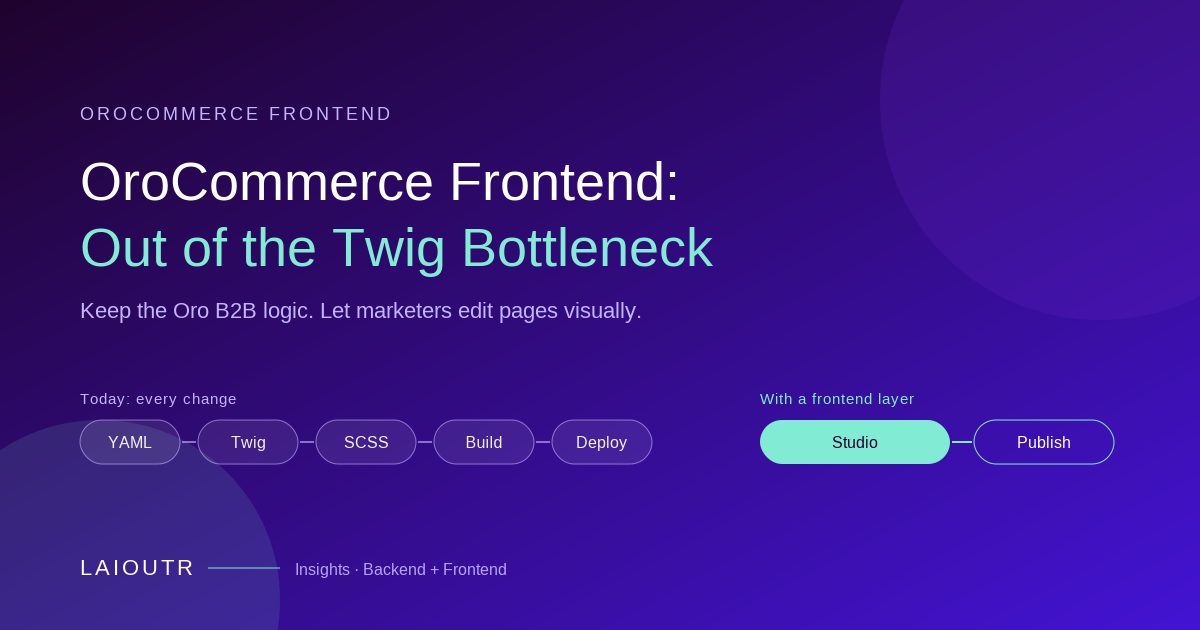OroCommerce Frontend: Out of the Twig and Layouts Bottleneck
The OroCommerce frontend is a server-rendered storefront built from Symfony bundles, OroLayouts and …](https://www.laioutr.com/en/blog/orocommerce-frontend-twig-layouts-bottleneck)
[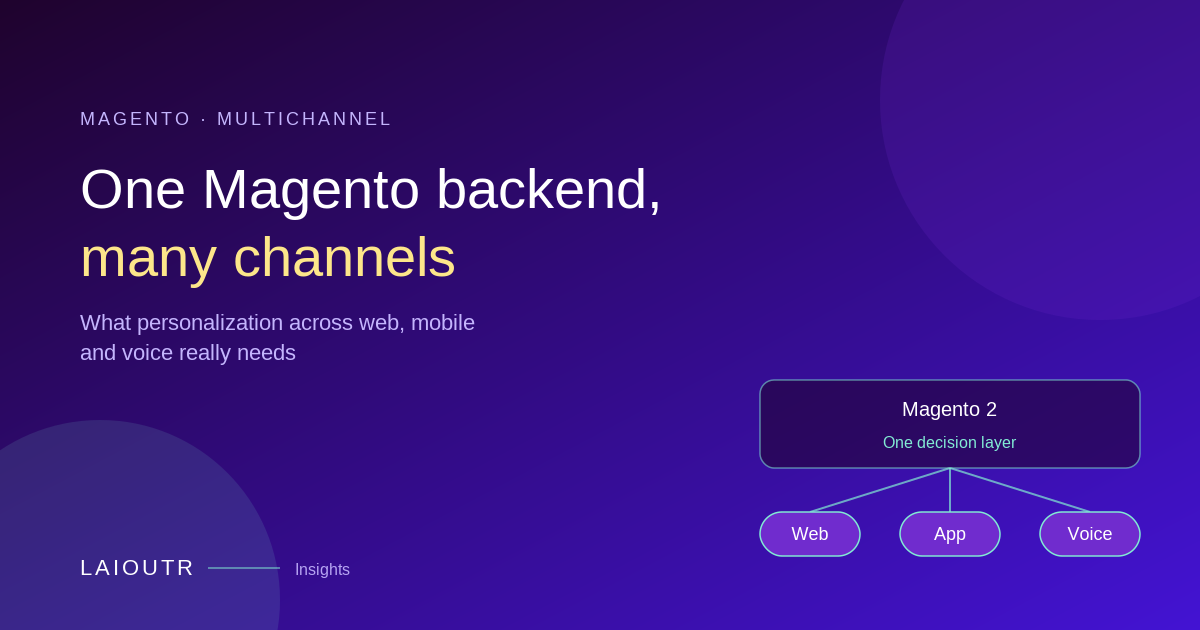One Magento Backend, Many Channels: Personalization in Practice
Personalization across web, mobile and voice on a single Magento backend does not start with a featu…](https://www.laioutr.com/en/blog/magento-multichannel-personalization-web-mobile-voice-2026)
[Edge Hosting for Storefronts: Caching That Holds Under Peak Load
Edge hosting keeps a storefront fast under load when most requests never reach the origin: pages and…](https://www.laioutr.com/en/blog/edge-hosting-storefronts-peak-traffic-caching-2026)
[Composable Commerce 2027: What Shifted and What Comes Next
Composable commerce enters 2027 with a different agenda than a year ago. The architecture question i…](https://www.laioutr.com/en/blog/composable-commerce-2027-outlook)
[AI Engagement and Conversion: Personalization on the Frontend
AI-driven engagement and conversion on the frontend rests on five mechanics: segments decide who see…](https://www.laioutr.com/en/blog/ai-engagement-conversion-frontend-personalization)
## Apps for the Laioutr platform
[View all apps](https://www.laioutr.com/en/apps)
[](https://www.laioutr.com/en/apps/shopify)
Laioutr
[Shopify](https://www.laioutr.com/en/apps/shopify)
Shopify is a commerce platform for selling online and in physical retail.
[](https://www.laioutr.com/en/apps/shopware)
Laioutr
[Shopware](https://www.laioutr.com/en/apps/shopware)
Shopware is a flexible ecommerce platform from Europe for product catalogs and omnichannel commerce.
[](https://www.laioutr.com/en/apps/adobe-commerce)
Laioutr
[Adobe Commerce](https://www.laioutr.com/en/apps/adobe-commerce)
Adobe Commerce is an enterprise commerce platform for complex, global B2C and B2B scenarios.
Planned
[](https://www.laioutr.com/en/apps/b2b-sellers)
Laioutr
[B2Bsellers](https://www.laioutr.com/en/apps/b2b-sellers)
B2B suite for Shopware that turns an online store into a professional B2B commerce platform.
Planned
[](https://www.laioutr.com/en/apps/commerce-layer)
Laioutr
[Commerce Layer](https://www.laioutr.com/en/apps/commerce-layer)
Commerce Layer is a headless commerce platform for making inventory and catalogs available online.
[](https://www.laioutr.com/en/apps/commercetools)
Laioutr
[Commercetools](https://www.laioutr.com/en/apps/commercetools)
Commercetools is a SaaS-based headless ecommerce platform used worldwide.
[](https://www.laioutr.com/en/apps/emporix)
Laioutr
[Emporix](https://www.laioutr.com/en/apps/emporix)
Emporix is a composable, API-first commerce platform for scalable B2B and B2C scenarios.
Planned
[](https://www.laioutr.com/en/apps/hcl-software)
Laioutr
[HCL Software](https://www.laioutr.com/en/apps/hcl-software)
Enterprise suite for digital commerce and experience with extensive configurability.
Planned
[](https://www.laioutr.com/en/apps/intershop)
Laioutr
[Intershop](https://www.laioutr.com/en/apps/intershop)
Enterprise commerce platform for complex B2B and B2C business models.
Planned
[](https://www.laioutr.com/en/apps/magento-2)
Laioutr
[Magento 2](https://www.laioutr.com/en/apps/magento-2)
Widely used, extensible commerce platform for B2C and B2B scenarios.
[](https://www.laioutr.com/en/apps/oxid-eshop)
Laioutr
[OXID eShop](https://www.laioutr.com/en/apps/oxid-eshop)
OXID eShop is an extensible commerce platform for complex B2B and B2C requirements.
Planned
[](https://www.laioutr.com/en/apps/patchworks)
Laioutr
[Patchworks](https://www.laioutr.com/en/apps/patchworks)
Patchworks is a low-code iPaaS that connects ecommerce, ERP, WMS, 3PL, and marketplaces.
Planned
[](https://www.laioutr.com/en/apps/PrestaShop)
Laioutr
[Prestashop](https://www.laioutr.com/en/apps/PrestaShop)
Open-source commerce platform for small and midsize merchants in Europe and beyond.
Planned
[](https://www.laioutr.com/en/apps/saleor)
Laioutr
[Saleor](https://www.laioutr.com/en/apps/saleor)
Open-source, API-first commerce platform built on GraphQL for custom storefronts.
Planned
[](https://www.laioutr.com/en/apps/salesforce-commerce-cloud)
Laioutr
[Salesforce Commerce Cloud](https://www.laioutr.com/en/apps/salesforce-commerce-cloud)
Salesforce Commerce Cloud is a cloud-based enterprise commerce platform for businesses of any size.
Planned
[](https://www.laioutr.com/en/apps/sap-commerce-cloud)
Laioutr
[SAP Commerce Cloud](https://www.laioutr.com/en/apps/sap-commerce-cloud)
Enterprise commerce platform for complex catalogs, pricing models, and omnichannel journeys.
Planned
[](https://www.laioutr.com/en/apps/scayle)
Laioutr
[Scayle](https://www.laioutr.com/en/apps/scayle)
SCAYLE is a commerce engine that helps brands and retailers scale their business.
Planned
[](https://www.laioutr.com/en/apps/spryker)
Laioutr
[Spryker](https://www.laioutr.com/en/apps/spryker)
Composable commerce platform for sophisticated B2B and B2C business models.
[](https://www.laioutr.com/en/apps/sylius)
Laioutr
[Sylius](https://www.laioutr.com/en/apps/sylius)
Sylius is a developer-friendly ecommerce framework for B2C and B2B shopping experiences.
Planned
[](https://www.laioutr.com/en/apps/vendure)
Laioutr
[Vendure](https://www.laioutr.com/en/apps/vendure)
Vendure is a headless commerce platform for businesses with complex requirements.
Coming Soon
[](https://www.laioutr.com/en/apps/vtex)
Laioutr
[VTEX](https://www.laioutr.com/en/apps/vtex)
Cloud-native, composable commerce platform for B2B and B2C at scale.
Planned
[](https://www.laioutr.com/en/apps/websale)
Laioutr
[Websale](https://www.laioutr.com/en/apps/websale)
Stable, enterprise-ready commerce backend for complex retail environments.
Strategy call
## The frontend as a control layer
A conversation about stack, roadmap and replatforming scenario. The outcome: a clear picture of how Laioutr fits, what it costs and how fast the go-live can happen.
*"After 30 minutes, we knew Laioutr makes our replatforming feasible."*
*Daniel B., CEO,* [*hygibox.de*](https://hygibox.de)
[Book a demo](https://www.laioutr.com/en/contact)
## Structured Data
```json
{
"@context": "https://schema.org",
"@graph": [
{
"@type": "Organization",
"@id": "https://www.laioutr.com/#identity",
"name": "Laioutr",
"legalName": "Laioutr GmbH",
"url": "https://www.laioutr.com/",
"logo": {
"@type": "ImageObject",
"url": "https://www.laioutr.com/laioutr-logo.png",
"width": 400,
"height": 400
},
"email": "info@laioutr.com",
"telephone": "+49 30 75435715",
"address": {
"@type": "PostalAddress",
"streetAddress": "Münchweilersteig 5",
"postalCode": "12559",
"addressLocality": "Berlin",
"addressCountry": "DE"
},
"vatID": "DE450905846",
"sameAs": [
"https://www.linkedin.com/company/laioutr",
"https://www.youtube.com/@Laioutr",
"https://x.com/laioutr"
]
},
{
"@type": "WebSite",
"@id": "https://www.laioutr.com/en/#website",
"url": "https://www.laioutr.com/en/",
"name": "Laioutr",
"inLanguage": "en",
"publisher": {
"@id": "https://www.laioutr.com/#identity"
}
},
{
"@type": "BlogPosting",
"@id": "https://www.laioutr.com/en/blog/questions-to-ask-dxp-vendors#article",
"headline": "The Strategic Questions Every Enterprise Should Ask Before Choosing a Digital Experience Platform",
"description": "The strategic questions every enterprise should ask before choosing a digital experience platform.",
"image": [
"https://eu-west-2.graphassets.com/cmii2mlqi0dux06l5543v7nkc/cmnucypviw8mi07mgmwsd5asa"
],
"datePublished": "2026-07-09T04:43:20.351985+00:00",
"dateModified": "2026-07-09T04:43:20.09012+00:00",
"inLanguage": "en",
"articleSection": "Insights",
"keywords": "Industry & Trends, Shopify",
"author": {
"@type": "Person",
"name": "Marcel Thiesies",
"jobTitle": "Co-Founder & CEO, Laioutr",
"image": "https://eu-west-2.graphassets.com/cmii2mlqi0dux06l5543v7nkc/cmj01b962364n07lb0iguvts5"
},
"publisher": {
"@id": "https://www.laioutr.com/#identity"
},
"mainEntityOfPage": {
"@id": "https://www.laioutr.com/en/blog/questions-to-ask-dxp-vendors#webpage"
},
"isPartOf": {
"@id": "https://www.laioutr.com/en/#website"
}
},
{
"@type": "WebPage",
"@id": "https://www.laioutr.com/en/blog/questions-to-ask-dxp-vendors#webpage",
"url": "https://www.laioutr.com/en/blog/questions-to-ask-dxp-vendors",
"name": "The Strategic Questions Every Enterprise Should Ask Before Choosing a Digital Experience Platform",
"description": "The strategic questions every enterprise should ask before choosing a digital experience platform.",
"inLanguage": "en",
"isPartOf": {
"@id": "https://www.laioutr.com/en/#website"
},
"breadcrumb": {
"@id": "https://www.laioutr.com/en/blog/questions-to-ask-dxp-vendors#breadcrumb"
},
"primaryImageOfPage": {
"@type": "ImageObject",
"url": "https://eu-west-2.graphassets.com/cmii2mlqi0dux06l5543v7nkc/cmnucypviw8mi07mgmwsd5asa"
},
"datePublished": "2026-07-09T04:43:20.351985+00:00",
"dateModified": "2026-07-09T04:43:20.09012+00:00",
"mainEntity": {
"@id": "https://www.laioutr.com/en/blog/questions-to-ask-dxp-vendors#article"
}
},
{
"@type": "BreadcrumbList",
"@id": "https://www.laioutr.com/en/blog/questions-to-ask-dxp-vendors#breadcrumb",
"itemListElement": [
{
"@type": "ListItem",
"position": 1,
"name": "Laioutr",
"item": "https://www.laioutr.com/en/"
},
{
"@type": "ListItem",
"position": 2,
"name": "Insights",
"item": "https://www.laioutr.com/en/blogs/insights"
},
{
"@type": "ListItem",
"position": 3,
"name": "The Strategic Questions Every Enterprise Should Ask Before Choosing a Digital Experience Platform"
}
]
}
]
}
```