---
title: "Shopify's Hidden Ceiling at Enterprise Scale"
canonical_url: "https://www.laioutr.com/en/blog/shopify-limitations-enterprise"
locale: en
meta:
description: "Why Shopify's simplicity becomes a constraint as brands add storefronts and markets, and where enterprise growth hits limits."
"og:description": "Why Shopify's simplicity becomes a constraint as brands add storefronts and markets, and where enterprise growth hits limits."
"og:title": "Shopify's Hidden Ceiling at Enterprise Scale"
---

# The Hidden Ceiling: Why Shopify's Strengths Become Constraints at Enterprise Scale
Table of contents
1. 1.1. The Composability Illusion: Hydrogen Doesn't Mean True Flexibility
2. [2.2. The Multibrand Problem: Isolated Storefronts, Fragmented Operations](#2-the-multibrand-problem-isolated-storefronts-fragmented-operations)
3. [3.3. B2B Depth: Where Shopify Runs Out of Road](#3-b2b-depth-where-shopify-runs-out-of-road)
4. [4.4. Governance and Audit: The Black Box Problem](#4-governance-and-audit-the-black-box-problem)
5. [5.5. App Ecosystem Risk: SMB-Designed Plugins in Enterprise Operations](#5-app-ecosystem-risk-smb-designed-plugins-in-enterprise-operations)
6. [6.6. Analytics: Storefront Metrics vs. Platform Observability](#6-analytics-storefront-metrics-vs-platform-observability)
7. [7.7. Vendor Lock-In: The Architecture Tax](#7-vendor-lock-in-the-architecture-tax)
8. 8.What Enterprises Actually Need: Beyond Shopify's Model
9. [9.The Composable Alternative](#the-composable-alternative)
10. [10.Making the Choice](#making-the-choice)
11. [11.Explore Composable Commerce at Laioutr](#explore-composable-commerce-at-laioutr)
Shopify has earned its position as the world's leading ecommerce platform. For small to mid-sized businesses, it's a masterclass in accessibility: a platform that turns first-time entrepreneurs into store operators within hours. The simplicity is genuine. The ecosystem is vibrant. The results speak for themselves.
But somewhere between your second storefront and your fifth market, something shifts. What once felt empowering starts to feel confining. What was an advantage becomes a bottleneck. And you're not alone in noticing it.
Enterprise merchants increasingly discover that Shopify's greatest strengths (simplicity, managed infrastructure, a curated app ecosystem) become structural constraints at scale. The platform wasn't designed for the complexity of multi-brand operations, intricate B2B workflows, or the level of control large organizations demand. And the workarounds? They're expensive, technical, and often feel like fighting the platform rather than leveraging it.
This isn't a criticism of Shopify. It's a reality check. If you're evaluating whether Shopify can serve your enterprise, or if you're already feeling the friction, this post maps the seven most critical limitations and what they mean for your business.
## 1. The Composability Illusion: Hydrogen Doesn't Mean True Flexibility
Shopify talks about composability. They launched Hydrogen as their answer to headless commerce, positioning it as the way to build custom frontends while staying within the Shopify ecosystem. On paper, this sounds like the architectural freedom enterprises need.
The reality is more constrained.
Hydrogen is a React framework that accelerates development within Shopify's sandbox. It's not true composability. You're still tethered to Shopify's APIs, Shopify's data model, and Shopify's release cycle. When Shopify makes a breaking change to their API, your custom frontend breaks. When you need to integrate a third-party service that Shopify doesn't expose endpoints for, you're blocked. When you want to switch payment providers or use a fulfillment system Shopify hasn't certified, workarounds multiply.
True composability means building a genuine separation between your frontend and backend. It means your storefront doesn't care whether commerce comes from Shopify, Commercetools, or Fabric. It means you choose your hosting, your infrastructure, your stack. Hydrogen doesn't deliver this. It optimizes development speed within Shopify's walled garden, which is different.
For enterprises running multiple brands, each with distinct tech requirements, this matters enormously. A truly composable approach lets you decouple storefronts from commerce logic entirely. A Hydrogen-based approach keeps you dependent on Shopify's commerce engine for every store you build.
## 2. The Multibrand Problem: Isolated Storefronts, Fragmented Operations
Most enterprise merchants operate multiple brands. Sometimes they inherited them through acquisition. Sometimes they built them strategically. Either way, managing them through Shopify means accepting architectural fragmentation that haunts your operations.
Shopify's answer for multi-brand is simple: create separate stores. Each brand gets its own Shopify instance. Separate admin, separate data, separate inventory systems, separate customer databases. On the surface, this offers isolation and independence.
The cost is operational chaos.
Your teams now maintain multiple admin interfaces. A change to shipping settings requires replication across every store. Inventory visibility becomes a stitching problem: you need to build your own dashboard to see aggregate stock. Customer data lives in silos: when a customer appears in multiple brands, you're manually deduplicating and cross-referencing. Promotions that span brands require custom apps to coordinate. Order visibility requires a custom layer.
At enterprise scale, this fragmentation is expensive. It demands custom development to create the unified views and cross-store operations that should be native. Your team spends time on integration overhead rather than innovation.
A composable platform handles multi-brand differently. A single admin layer manages multiple storefronts simultaneously. Inventory syncs across brands in real-time. Customer profiles are unified while storefront experiences remain distinct. Promotions, pricing rules, and workflows operate across brands as configuration, not custom code. This is fundamentally less expensive and more agile.
## 3. B2B Depth: Where Shopify Runs Out of Road
B2B is not retail. B2B requires features that Shopify simply doesn't provide at an enterprise level: punchout catalogs for procurement systems, tiered pricing by customer segment, approval workflows for orders above thresholds, role-based catalog access, custom quote flows, payment terms and net30/60/90 settlement. Shopify's B2B offerings exist, but they're thin.
You need punchout? You're integrating a third-party system and maintaining APIs. You need complex approval workflows? Custom app. You need role-based catalog visibility? Custom fields and logic. You need sophisticated pricing rules that account for customer history, segment, and negotiated terms? You're building this yourself.
For enterprises with significant B2B revenue, this isn't friction. It's architecture you have to rebuild from the ground up, then maintain. Every time Shopify updates their admin, you risk breaking your customizations. Every new B2B requirement triggers a development cycle.
A proper B2B commerce platform or a composable architecture where B2B features are native eliminates this category of work entirely. Approval workflows should be native. Punchout should be a checkbox. Role-based catalogs should be standard. When they're not, you're paying for custom work that enterprise competitors have solved years ago.
## 4. Governance and Audit: The Black Box Problem
Enterprise procurement teams don't just want to buy. They need visibility and control. Which payment method was used? Which fulfillment partner handled this order? Which tax rules applied? How was this price calculated? Can we audit the entire transaction path?
Shopify doesn't expose this layer. It's a platform, not a transparent system. You can't see which payment processor handled your transaction. You can't audit exactly which tax rules Shopify applied to an order. You can't choose your hosting region or choose a specific data center (relevant for GDPR, data residency). You can't see the exact requests and responses in your integration chain. You're using Shopify on Shopify's terms, and visibility is granted through their dashboard, not your own observability stack.
For industries with compliance requirements (healthcare, financial services, regulated commerce), this is a showstopper. You need to audit your stack. You need control over data residency. You need to know exactly which systems handled sensitive information. Shopify's transparency here is limited.
Composable platforms, by contrast, are transparent by design. Every API call is yours. Every data move can be logged and audited. You choose your infrastructure and data location. You integrate your observability stack directly. Your compliance team can audit the entire flow. This is non-negotiable for enterprises in regulated industries.
## 5. App Ecosystem Risk: SMB-Designed Plugins in Enterprise Operations
Shopify's app ecosystem is massive. Thousands of apps, countless use cases, easy installation. This is Shopify's strength. It's also its weakness at enterprise scale.
Most Shopify apps are designed for SMBs. They solve common problems for small retailers. They're maintained by small teams. Some have SLAs; most don't. When an app breaks your critical workflow, Shopify's responsibility is limited. They don't vet apps for performance at scale. They don't require SLAs for uptime or response time. They don't enforce security standards.
At enterprise scale, this is a risk you can't absorb. You're relying on a SMB-built app for a critical workflow, and if that vendor deprioritizes your use case or goes out of business, your operation is exposed. You need enterprise apps with enterprise support, performance guarantees, and security certifications. Shopify's ecosystem simply doesn't prioritize this level of reliability.
Many enterprise merchants solve this by building custom integrations for critical workflows rather than relying on third-party apps. But this trades ecosystem convenience for development cost.
## 6. Analytics: Storefront Metrics vs. Platform Observability
Shopify's analytics are merchant-focused: sales by product, conversion by channel, traffic sources. For retail operations, these are useful. For enterprises, they're insufficient.
Enterprise operations need different visibility: API performance, integration latency, data synchronization completeness, error rates across your tech stack, inventory accuracy metrics, fulfillment partner performance. You need to instrument every layer (your custom frontends, your integrations, your data flows) separately. Shopify doesn't provide this observability. You're building it yourself with third-party tools.
This fragmentation means you lack a unified operational picture. You have commerce metrics from Shopify, infrastructure metrics from your cloud provider, application metrics from your monitoring tools, and data metrics from somewhere else. They don't talk to each other. When something breaks, your investigation spans multiple systems and teams.
A composable platform architecture, built on modern infrastructure, provides integrated observability from day one. Your commerce layer, your frontend, your integrations, and your infrastructure are all instrumented within a single platform. When performance degrades, you see the entire system at once. When an integration fails, you see it immediately in the same dashboard where you see everything else.
## 7. Vendor Lock-In: The Architecture Tax
Every limitation above contributes to one larger cost: vendor lock-in. Moving off Shopify isn't just a data migration. It's a technical decomposition.
Your custom Hydrogen frontends need rewriting for a different platform. Your apps need replacement or rebuilding. Your workflows need reimplementation. Your integrations need adjustment. Your team has spent years learning Shopify's ways and your codebase is littered with Shopify-specific conventions.
This creates a cost that extends far beyond switching fees. It creates organizational inertia. You stay with Shopify not because it's the best choice, but because leaving is expensive. You stop evaluating alternatives. You stop pushing Shopify on limitations because you're committed to the platform. This is vendor lock-in by design, and it affects every strategic decision you make.
A composable architecture with standards-based APIs and portable frontends eliminates this tax. If your needs change, you can swap a single component without rebuilding your entire operation. You can switch payment processors without touching your storefront. You can move to a different commerce engine without rewriting your frontend. This architectural independence is foundational to enterprise agility.
## What Enterprises Actually Need: Beyond Shopify's Model
The pattern here is clear. Shopify excels at putting small merchants in business quickly. Its model (simplicity, managed infrastructure, app-driven extensibility) is optimized for this use case.
Enterprise commerce has different requirements:
**True composability** means decoupling frontends from commerce engines, choosing best-of-breed solutions for each layer, and maintaining technological independence as your needs evolve.
**Unified operations** across multiple brands, channels, and markets from a single administrative layer, not siloed storefronts.
**Native B2B features** including approval workflows, punchout, tiered pricing, and quote-to-cash processes, not SMB workarounds.
**Transparent, auditable infrastructure** where you control data residency, visibility, and compliance posture, not a black box.
**Enterprise-grade reliability** in every integration, with SLAs, support, and performance guarantees that matter to your business.
**Operational observability** across your entire stack (commerce, frontend, infrastructure, integrations), not fragmented dashboards.
**Architectural independence** from any single vendor, protecting your investments and your flexibility.
These aren't weaknesses in Shopify. They're differences in architecture and design philosophy. Shopify was built to serve SMBs exceptionally well. Enterprises are an afterthought, served through plugins and workarounds.
## The Composable Alternative
A truly composable ecommerce platform is built with these enterprise requirements as first-class concerns from the foundation. Rather than starting with a monolithic commerce engine and bolting on flexibility, a composable approach separates concerns architecturally:
Your **headless storefront** is completely independent from your commerce engine. You choose the technologies, you host the infrastructure, you control the user experience. You're not constrained by anyone's framework or API decisions.
Your **API orchestration layer** sits between your frontend and backend systems, coordinating across commerce engines, inventory systems, fulfillment providers, and payment processors. Your frontend never talks directly to these systems; it talks to a unified interface that you control.
Your **component library and design system** let your teams build consistently across all storefronts without rebuilding foundations for each property.
Your **cloud infrastructure** is under your control, selected for your compliance requirements, your scale, and your performance needs.
Your **data layer** is unified. Inventory visibility across brands, unified customer profiles, audit logs, compliance-ready architecture.
This is not Shopify with a veneer of composability. This is architecture that starts from enterprise needs and adds SMB-friendly tooling on top.
## Making the Choice
If you're a growing merchant evaluating your ecommerce platform, the question isn't "Is Shopify good?" (It is, for its intended audience.) The question is "Is Shopify's model right for our enterprise?"
Look at your multibrand operations. If they require a unified admin and cross-store coordination, Shopify's isolation is costly.
Look at your B2B workflows. If they include approval processes, complex pricing, or punchout catalogs, Shopify requires custom development you can avoid.
Look at your compliance requirements. If you need to audit and control your technology stack, Shopify's opacity is a liability.
Look at your team's velocity. If you're spending engineering cycles on integration work that should be platform-native, you're paying a tax that composable alternatives eliminate.
Shopify's strength is getting you to market fast. Its limitation is scaling operations at enterprise complexity. At some scale, these trade-offs invert. Simplicity stops being an advantage and becomes a constraint.
The path forward isn't necessarily abandoning Shopify entirely. It's moving to a composable architecture where your storefront, commerce logic, and operational tools are independently chosen and orchestrated. This requires a platform designed from the ground up for composability, not one bolted onto a monolithic foundation.
For enterprises ready to make this shift, the payoff is significant: reduced vendor lock-in, faster feature velocity, better operational control, and the ability to evolve your stack as your business evolves, not as a single vendor decides to evolve it for you.
## Explore Composable Commerce at Laioutr
If you're evaluating composable ecommerce architectures for your enterprise, Laioutr is built specifically for this use case. Our platform separates concerns across independent, best-of-breed components:
- **Storefront** provides a headless frontend you control, running on your infrastructure
- **Studio** offers visual editing for content teams without requiring engineering involvement
- **Orchestr** coordinates APIs across your commerce engine, inventory, fulfillment, and payments
- **Laioutr UI** gives you a production-ready component library for consistent design systems
- **Cloud** provides compliance-ready infrastructure with full data residency control
- **Performance Monitoring** gives you unified observability across your entire stack
We support complex B2B operations with native approval workflows and pricing flexibility. We handle multi-brand and multi-market requirements with unified administration. We're transparent by design, auditable by architecture, and composable from the foundation.
Learn more about [composable commerce architecture](https://www.laioutr.com/en/blog/mach-architecture-in-e-commerce-the-technical-blueprint-for-scalable-future-proof-commerce "https://www.laioutr.com/en/blog/mach-architecture-in-e-commerce-the-technical-blueprint-for-scalable-future-proof-commerce"), explore how Laioutr handles [B2B commerce](https://www.laioutr.com/en/solutions/b2b "https://www.laioutr.com/en/solutions/b2b"), or check out our approach to [multi-brand operations](https://www.laioutr.com/en/product/multi-brand-multi-market "https://www.laioutr.com/en/product/multi-brand-multi-market") and [international expansion](https://www.laioutr.com/en/product/multi-brand-multi-market "https://www.laioutr.com/en/product/multi-brand-multi-market").
Enterprise ecommerce shouldn't require accepting limitations built into your platform's foundation. Composability isn't a feature layer on top of monolithic architecture. It's how architecture should be designed from the start.
### **Related Insights**
- [Alternative to Shopify Plus: Why Enterprise Brands Are Switching to Laioutr](https://www.laioutr.com/en/blog/alternative-to-shopify-plus)
- [Why Your AI Wins Stay Small: The Hidden Architecture Barrier to Enterprise-Wide AI](https://www.laioutr.com/en/blog/why-your-ai-wins-stay-small-the-hidden-architecture-barrier-to-enterprise-wide-ai)
### **More from the Laioutr Platform**
- [Composable Digital Experience Platform](https://www.laioutr.com/en/composable-digital-experience-platform)
- [Headless Frontend for Shopify](https://www.laioutr.com/en/headless-frontend-for-shopify)
- [Personalization](https://www.laioutr.com/en/product/personalization)
- [Composable Visual Page Builder](https://www.laioutr.com/en/composable-visual-page-builder)
- [Headless Frontend for commercetools](https://www.laioutr.com/en/headless-frontend-for-commercetools)
---
Share this article
[Share on Facebook](https://www.facebook.com/sharer/sharer.php?u=https%3A%2F%2Fwww.laioutr.com%2Fen%2Fblog%2Fshopify-limitations-enterprise) [Share on X](https://x.com/intent/post?url=https%3A%2F%2Fwww.laioutr.com%2Fen%2Fblog%2Fshopify-limitations-enterprise&text=) [Share on LinkedIn](https://www.linkedin.com/sharing/share-offsite/?url=https%3A%2F%2Fwww.laioutr.com%2Fen%2Fblog%2Fshopify-limitations-enterprise) [Share on Pinterest](https://pinterest.com/pin/create/button/?url=https%3A%2F%2Fwww.laioutr.com%2Fen%2Fblog%2Fshopify-limitations-enterprise&description=) [Share via email](mailto:?subject=&body=%0A%0Ahttps%3A%2F%2Fwww.laioutr.com%2Fen%2Fblog%2Fshopify-limitations-enterprise)
## More articles on frontend and headless
Practical know-how for frontend development, smart agents, and headless
[To the blog](https://www.laioutr.com/en/blogs/insights)
[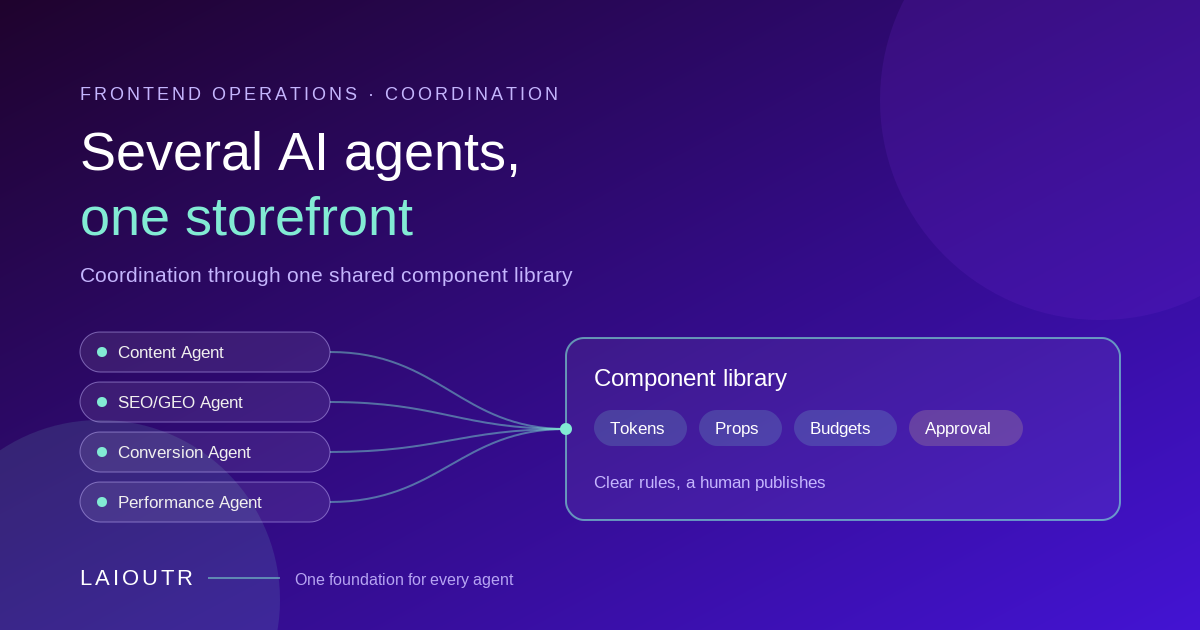Several AI Agents, One Storefront: Coordination Without Collisions
When several AI agents work on the same storefront, conflicts rarely happen between the agents thems…](https://www.laioutr.com/en/blog/frontend-operations-multi-agent-coordination-storefront-2026)
[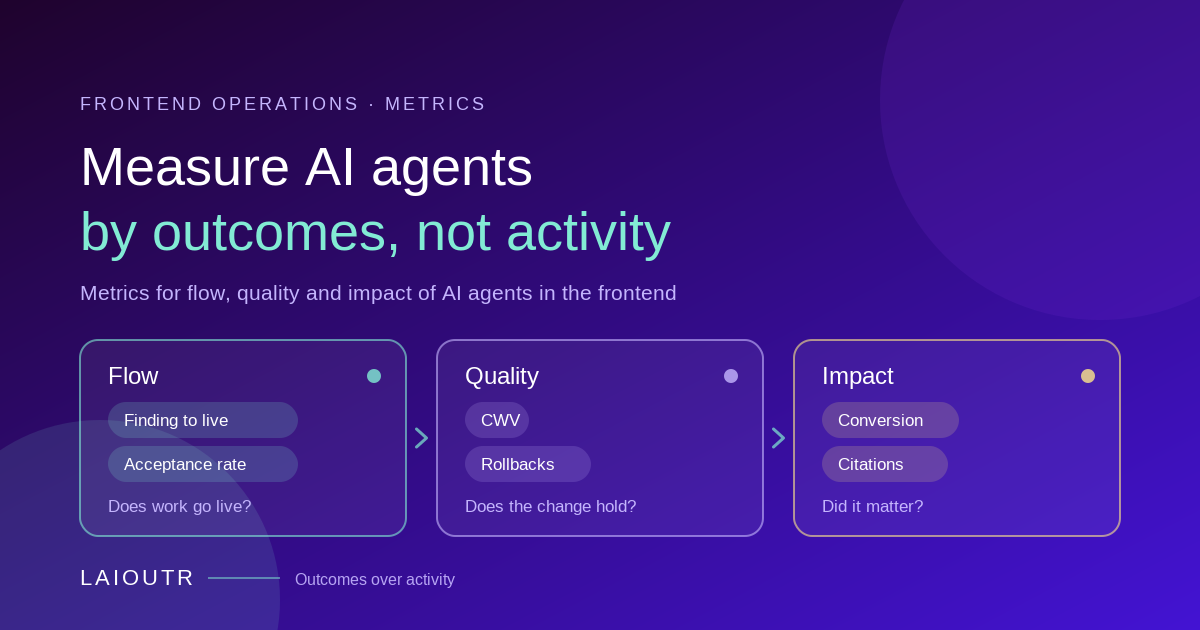Measuring AI Agents by Outcomes: Agentic Frontend Management Metrics
AI agents in the frontend should be measured by outcomes, not by activity. The number of prompts, ge…](https://www.laioutr.com/en/blog/frontend-operations-measuring-ai-agents-outcomes-2026)
[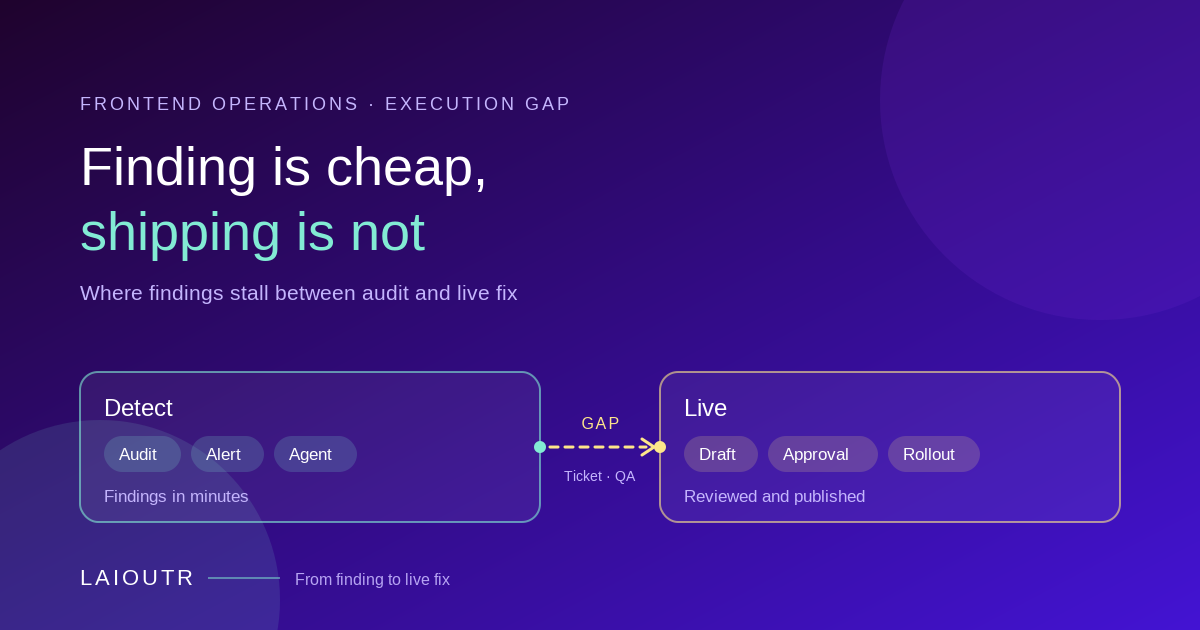The Execution Gap in the Frontend: Finding Is Cheap, Shipping Is Not
The execution gap in the frontend is the time, and the number of handoffs, between "we know wha…](https://www.laioutr.com/en/blog/frontend-operations-execution-gap-detect-vs-deploy-2026)
[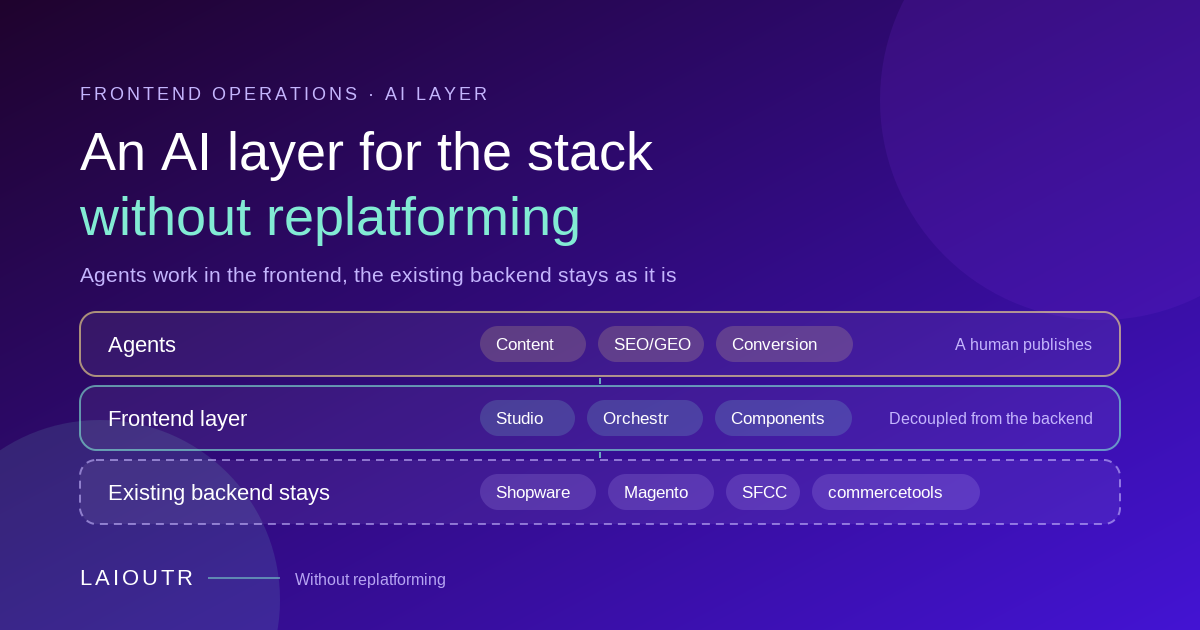Adding an AI Layer to an Existing Commerce Stack Without Replatforming
An AI layer can be added to an existing commerce stack without replacing the shop system. The most p…](https://www.laioutr.com/en/blog/frontend-operations-ai-layer-existing-stack-without-replatforming-2026)
[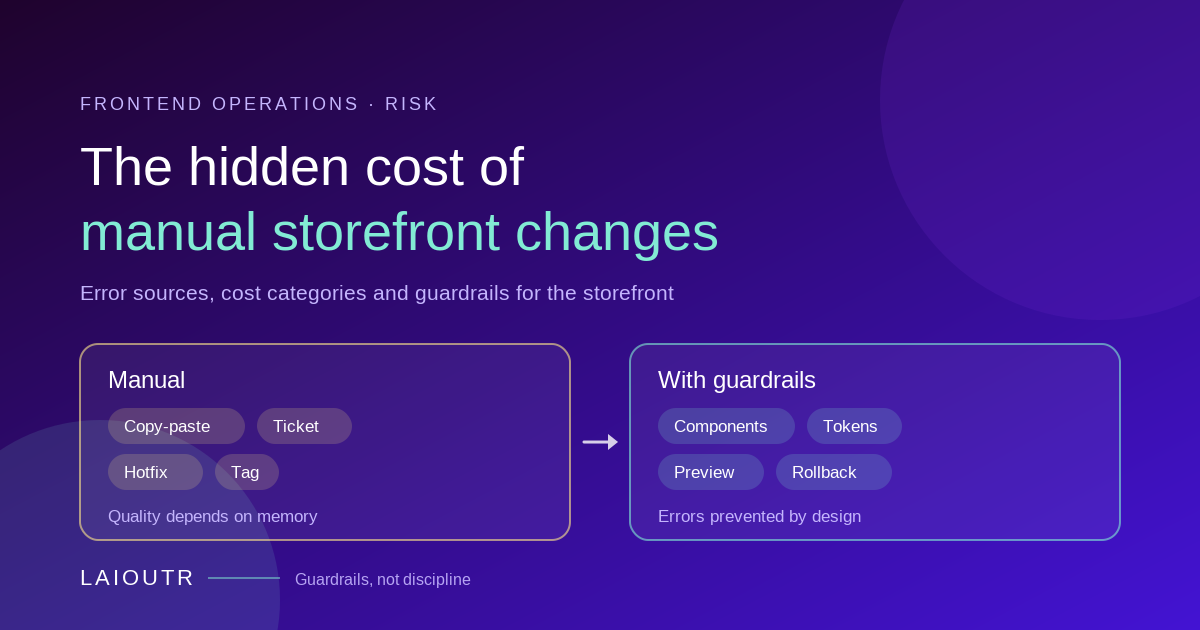The Hidden Cost of Manual Storefront Changes and How to Cut It
Manual frontend changes are the many small edits that keep a storefront running day to day: a new ba…](https://www.laioutr.com/en/blog/frontend-operations-hidden-cost-manual-storefront-changes-2026)
[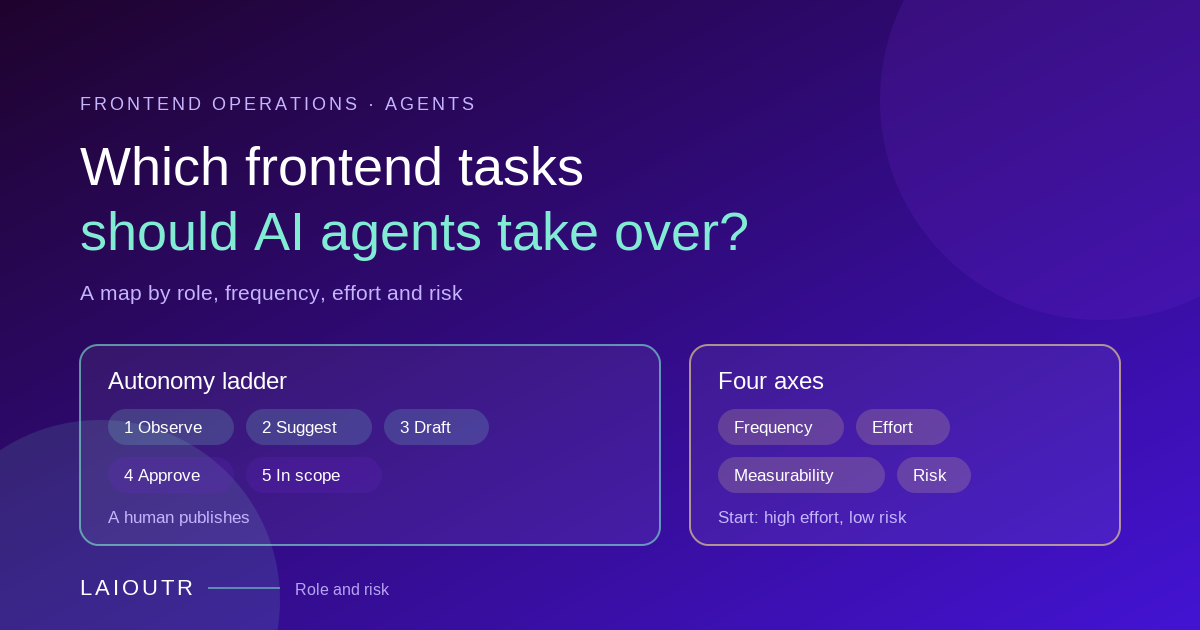Which Frontend Tasks Should AI Agents Take Over? Role and Risk Map
AI agents should first take over the frontend tasks that come up often, involve a lot of manual work…](https://www.laioutr.com/en/blog/frontend-operations-agent-task-map-role-risk-2026)
[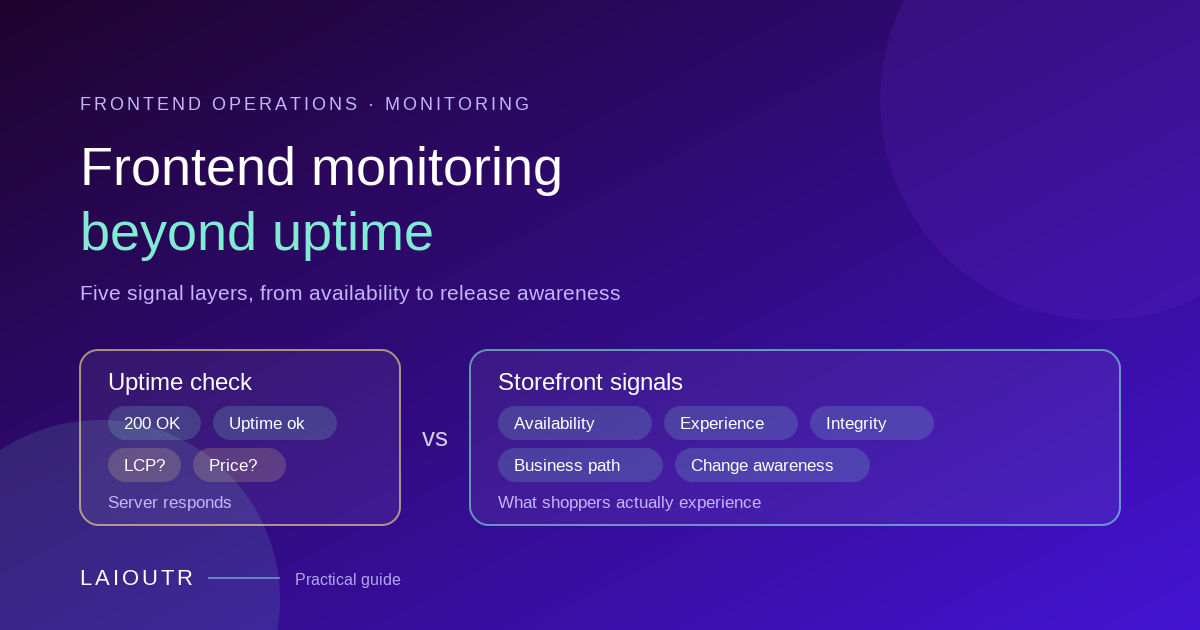Frontend Monitoring Beyond Uptime: Signals a Storefront Needs
Frontend monitoring beyond uptime means checking a storefront not only for availability but for what…](https://www.laioutr.com/en/blog/frontend-operations-monitoring-beyond-uptime-2026)
[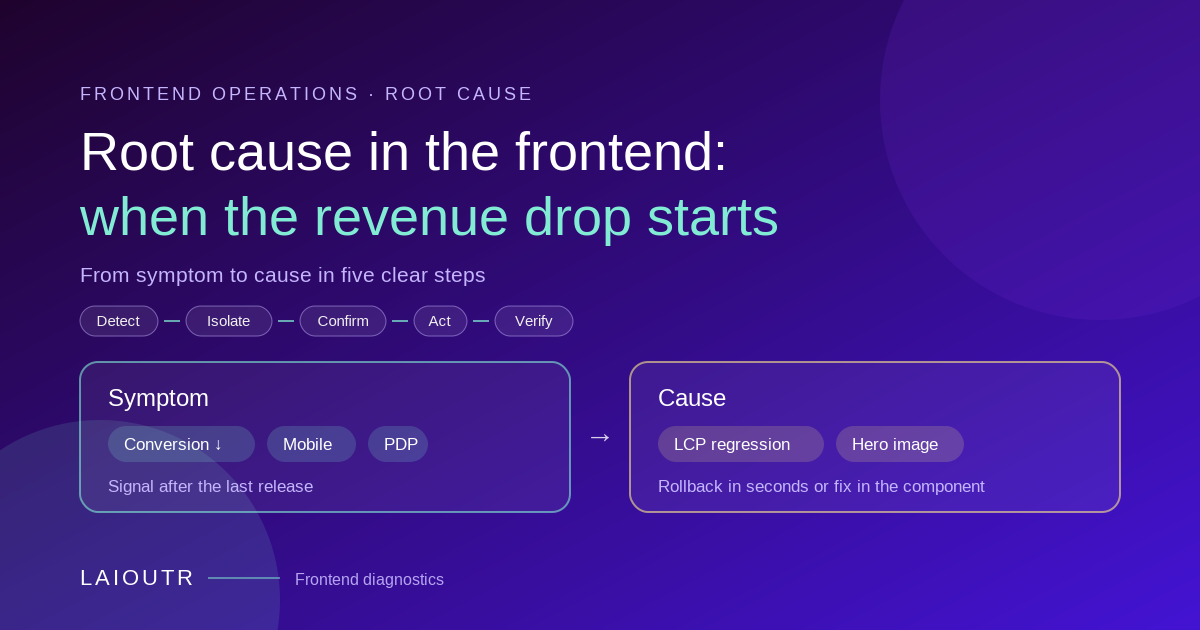Root Cause in the Frontend: When Revenue Drops Start in the Storefront
When revenue or conversion rate drops suddenly, the cause often is not traffic, pricing or the comme…](https://www.laioutr.com/en/blog/frontend-operations-root-cause-revenue-drop-storefront-2026)
[Laioutr Academy Is Live: The Video Manual for Laioutr
Since October 15, 2026, the Laioutr Academy has been live at academy.laioutr.com. It is the user man…](https://www.laioutr.com/en/blog/laioutr-academy-launch-video-manual-certification)
[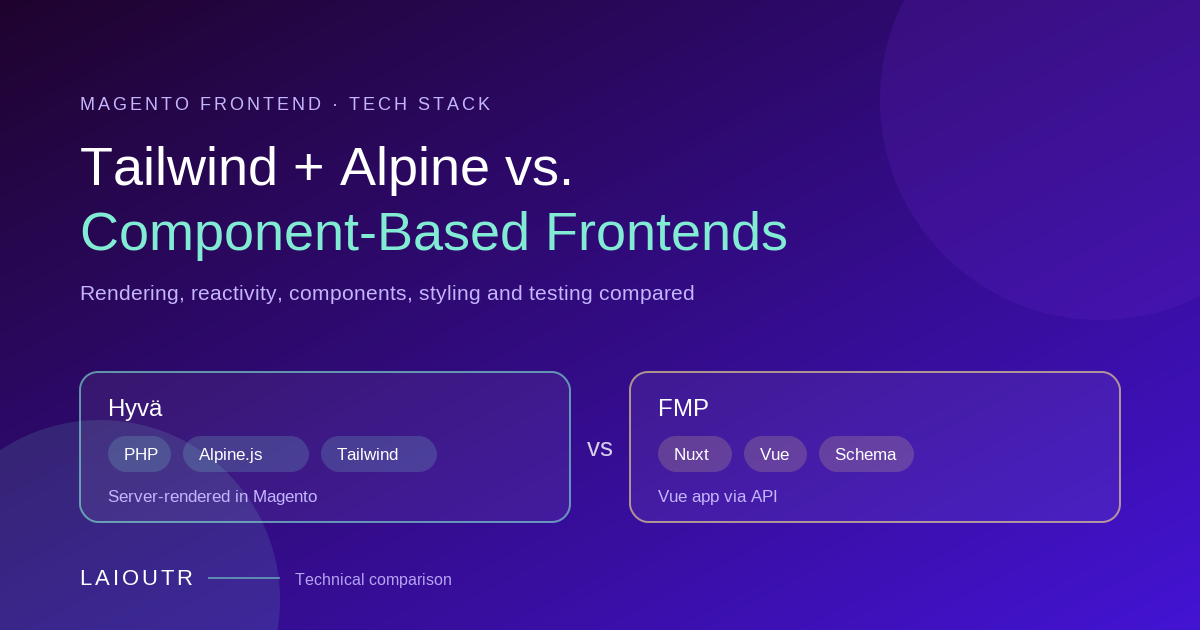Tailwind + Alpine vs. Component-Based Frontends for Magento
Hyvä renders Magento pages on the server with PHP templates and layout XML, adds interactivity throu…](https://www.laioutr.com/en/blog/tailwind-alpine-magento-vs-component-based-frontend-2026)
[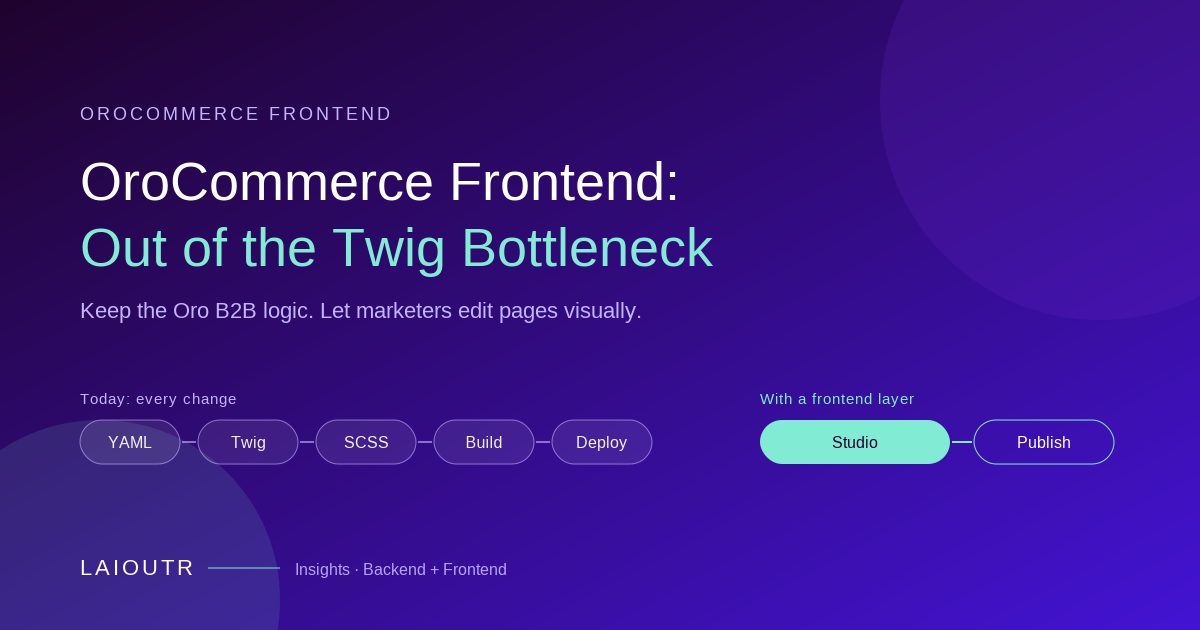OroCommerce Frontend: Out of the Twig and Layouts Bottleneck
The OroCommerce frontend is a server-rendered storefront built from Symfony bundles, OroLayouts and …](https://www.laioutr.com/en/blog/orocommerce-frontend-twig-layouts-bottleneck)
[One Magento Backend, Many Channels: Personalization in Practice
Personalization across web, mobile and voice on a single Magento backend does not start with a featu…](https://www.laioutr.com/en/blog/magento-multichannel-personalization-web-mobile-voice-2026)
[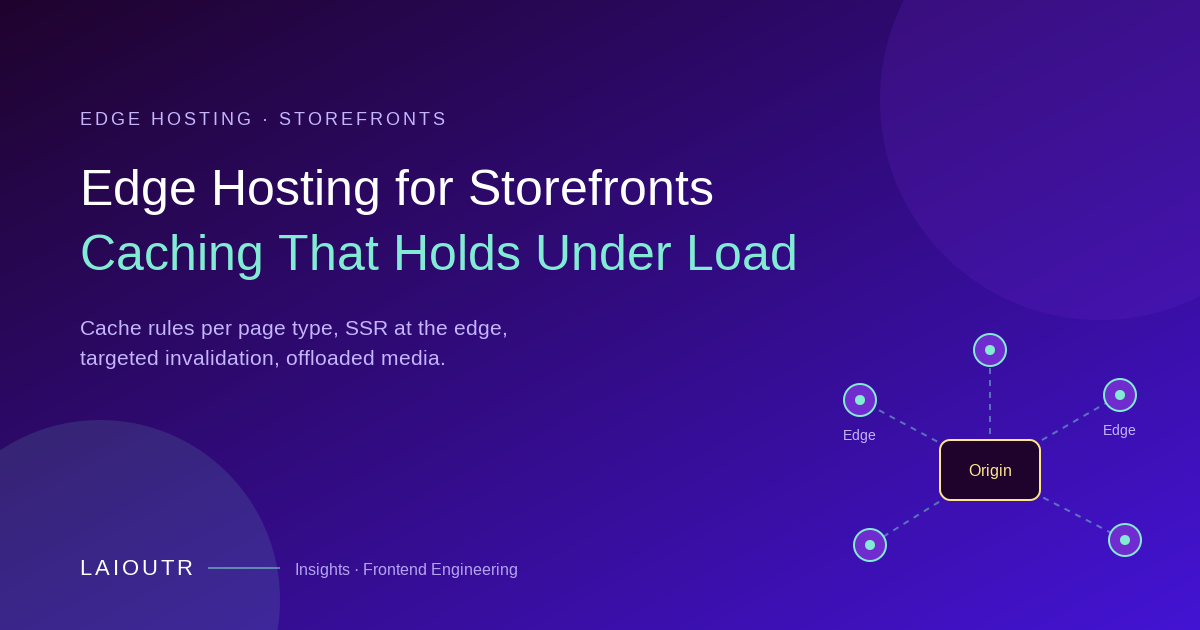Edge Hosting for Storefronts: Caching That Holds Under Peak Load
Edge hosting keeps a storefront fast under load when most requests never reach the origin: pages and…](https://www.laioutr.com/en/blog/edge-hosting-storefronts-peak-traffic-caching-2026)
[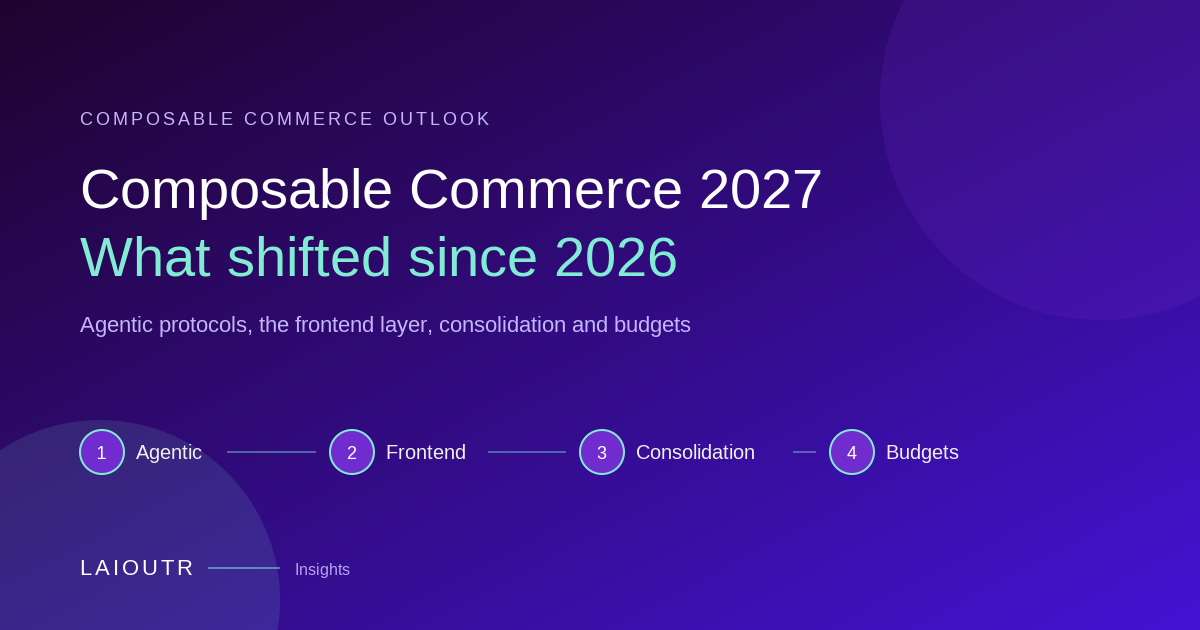Composable Commerce 2027: What Shifted and What Comes Next
Composable commerce enters 2027 with a different agenda than a year ago. The architecture question i…](https://www.laioutr.com/en/blog/composable-commerce-2027-outlook)
[AI Engagement and Conversion: Personalization on the Frontend
AI-driven engagement and conversion on the frontend rests on five mechanics: segments decide who see…](https://www.laioutr.com/en/blog/ai-engagement-conversion-frontend-personalization)
## Apps for the Laioutr platform
[View all apps](https://www.laioutr.com/en/apps)
[](https://www.laioutr.com/en/apps/shopify)
Laioutr
[Shopify](https://www.laioutr.com/en/apps/shopify)
Shopify is a commerce platform for selling online and in physical retail.
[](https://www.laioutr.com/en/apps/shopware)
Laioutr
[Shopware](https://www.laioutr.com/en/apps/shopware)
Shopware is a flexible ecommerce platform from Europe for product catalogs and omnichannel commerce.
[](https://www.laioutr.com/en/apps/adobe-commerce)
Laioutr
[Adobe Commerce](https://www.laioutr.com/en/apps/adobe-commerce)
Adobe Commerce is an enterprise commerce platform for complex, global B2C and B2B scenarios.
Planned
[](https://www.laioutr.com/en/apps/b2b-sellers)
Laioutr
[B2Bsellers](https://www.laioutr.com/en/apps/b2b-sellers)
B2B suite for Shopware that turns an online store into a professional B2B commerce platform.
Planned
[](https://www.laioutr.com/en/apps/commerce-layer)
Laioutr
[Commerce Layer](https://www.laioutr.com/en/apps/commerce-layer)
Commerce Layer is a headless commerce platform for making inventory and catalogs available online.
[](https://www.laioutr.com/en/apps/commercetools)
Laioutr
[Commercetools](https://www.laioutr.com/en/apps/commercetools)
Commercetools is a SaaS-based headless ecommerce platform used worldwide.
[](https://www.laioutr.com/en/apps/emporix)
Laioutr
[Emporix](https://www.laioutr.com/en/apps/emporix)
Emporix is a composable, API-first commerce platform for scalable B2B and B2C scenarios.
Planned
[](https://www.laioutr.com/en/apps/hcl-software)
Laioutr
[HCL Software](https://www.laioutr.com/en/apps/hcl-software)
Enterprise suite for digital commerce and experience with extensive configurability.
Planned
[](https://www.laioutr.com/en/apps/intershop)
Laioutr
[Intershop](https://www.laioutr.com/en/apps/intershop)
Enterprise commerce platform for complex B2B and B2C business models.
Planned
[](https://www.laioutr.com/en/apps/magento-2)
Laioutr
[Magento 2](https://www.laioutr.com/en/apps/magento-2)
Widely used, extensible commerce platform for B2C and B2B scenarios.
[](https://www.laioutr.com/en/apps/oxid-eshop)
Laioutr
[OXID eShop](https://www.laioutr.com/en/apps/oxid-eshop)
OXID eShop is an extensible commerce platform for complex B2B and B2C requirements.
Planned
[](https://www.laioutr.com/en/apps/patchworks)
Laioutr
[Patchworks](https://www.laioutr.com/en/apps/patchworks)
Patchworks is a low-code iPaaS that connects ecommerce, ERP, WMS, 3PL, and marketplaces.
Planned
[](https://www.laioutr.com/en/apps/PrestaShop)
Laioutr
[Prestashop](https://www.laioutr.com/en/apps/PrestaShop)
Open-source commerce platform for small and midsize merchants in Europe and beyond.
Planned
[](https://www.laioutr.com/en/apps/saleor)
Laioutr
[Saleor](https://www.laioutr.com/en/apps/saleor)
Open-source, API-first commerce platform built on GraphQL for custom storefronts.
Planned
[](https://www.laioutr.com/en/apps/salesforce-commerce-cloud)
Laioutr
[Salesforce Commerce Cloud](https://www.laioutr.com/en/apps/salesforce-commerce-cloud)
Salesforce Commerce Cloud is a cloud-based enterprise commerce platform for businesses of any size.
Planned
[](https://www.laioutr.com/en/apps/sap-commerce-cloud)
Laioutr
[SAP Commerce Cloud](https://www.laioutr.com/en/apps/sap-commerce-cloud)
Enterprise commerce platform for complex catalogs, pricing models, and omnichannel journeys.
Planned
[](https://www.laioutr.com/en/apps/scayle)
Laioutr
[Scayle](https://www.laioutr.com/en/apps/scayle)
SCAYLE is a commerce engine that helps brands and retailers scale their business.
Planned
[](https://www.laioutr.com/en/apps/spryker)
Laioutr
[Spryker](https://www.laioutr.com/en/apps/spryker)
Composable commerce platform for sophisticated B2B and B2C business models.
[](https://www.laioutr.com/en/apps/sylius)
Laioutr
[Sylius](https://www.laioutr.com/en/apps/sylius)
Sylius is a developer-friendly ecommerce framework for B2C and B2B shopping experiences.
Planned
[](https://www.laioutr.com/en/apps/vendure)
Laioutr
[Vendure](https://www.laioutr.com/en/apps/vendure)
Vendure is a headless commerce platform for businesses with complex requirements.
Coming Soon
[](https://www.laioutr.com/en/apps/vtex)
Laioutr
[VTEX](https://www.laioutr.com/en/apps/vtex)
Cloud-native, composable commerce platform for B2B and B2C at scale.
Planned
[](https://www.laioutr.com/en/apps/websale)
Laioutr
[Websale](https://www.laioutr.com/en/apps/websale)
Stable, enterprise-ready commerce backend for complex retail environments.

Strategy call
## The frontend as a control layer
A conversation about stack, roadmap and replatforming scenario. The outcome: a clear picture of how Laioutr fits, what it costs and how fast the go-live can happen.
*"After 30 minutes, we knew Laioutr makes our replatforming feasible."*
*Daniel B., CEO,* [*hygibox.de*](https://hygibox.de)
[Book a demo](https://www.laioutr.com/en/contact)
## Structured Data
```json
{
"@context": "https://schema.org",
"@graph": [
{
"@type": "Organization",
"@id": "https://www.laioutr.com/#identity",
"name": "Laioutr",
"legalName": "Laioutr GmbH",
"url": "https://www.laioutr.com/",
"logo": {
"@type": "ImageObject",
"url": "https://www.laioutr.com/laioutr-logo.png",
"width": 400,
"height": 400
},
"email": "info@laioutr.com",
"telephone": "+49 30 75435715",
"address": {
"@type": "PostalAddress",
"streetAddress": "Münchweilersteig 5",
"postalCode": "12559",
"addressLocality": "Berlin",
"addressCountry": "DE"
},
"vatID": "DE450905846",
"sameAs": [
"https://www.linkedin.com/company/laioutr",
"https://www.youtube.com/@Laioutr",
"https://x.com/laioutr"
]
},
{
"@type": "WebSite",
"@id": "https://www.laioutr.com/en/#website",
"url": "https://www.laioutr.com/en/",
"name": "Laioutr",
"inLanguage": "en",
"publisher": {
"@id": "https://www.laioutr.com/#identity"
}
},
{
"@type": "BlogPosting",
"@id": "https://www.laioutr.com/en/blog/shopify-limitations-enterprise#article",
"headline": "The Hidden Ceiling: Why Shopify's Strengths Become Constraints at Enterprise Scale",
"description": "Why Shopify's simplicity becomes a constraint as brands add storefronts and markets, and where enterprise growth hits limits.",
"image": [
"https://eu-west-2.graphassets.com/cmii2mlqi0dux06l5543v7nkc/cmnucypviw8mi07mgmwsd5asa"
],
"datePublished": "2026-10-26T11:03:30.757509+00:00",
"dateModified": "2026-10-26T11:03:29.947809+00:00",
"inLanguage": "en",
"articleSection": "Insights",
"keywords": "Industry & Trends, commercetools, Shopify",
"author": {
"@type": "Person",
"name": "Marcel Thiesies",
"jobTitle": "Co-Founder & CEO, Laioutr",
"image": "https://eu-west-2.graphassets.com/cmii2mlqi0dux06l5543v7nkc/cmj01b962364n07lb0iguvts5"
},
"publisher": {
"@id": "https://www.laioutr.com/#identity"
},
"mainEntityOfPage": {
"@id": "https://www.laioutr.com/en/blog/shopify-limitations-enterprise#webpage"
},
"isPartOf": {
"@id": "https://www.laioutr.com/en/#website"
}
},
{
"@type": "WebPage",
"@id": "https://www.laioutr.com/en/blog/shopify-limitations-enterprise#webpage",
"url": "https://www.laioutr.com/en/blog/shopify-limitations-enterprise",
"name": "The Hidden Ceiling: Why Shopify's Strengths Become Constraints at Enterprise Scale",
"description": "Why Shopify's simplicity becomes a constraint as brands add storefronts and markets, and where enterprise growth hits limits.",
"inLanguage": "en",
"isPartOf": {
"@id": "https://www.laioutr.com/en/#website"
},
"breadcrumb": {
"@id": "https://www.laioutr.com/en/blog/shopify-limitations-enterprise#breadcrumb"
},
"primaryImageOfPage": {
"@type": "ImageObject",
"url": "https://eu-west-2.graphassets.com/cmii2mlqi0dux06l5543v7nkc/cmnucypviw8mi07mgmwsd5asa"
},
"datePublished": "2026-10-26T11:03:30.757509+00:00",
"dateModified": "2026-10-26T11:03:29.947809+00:00",
"mainEntity": {
"@id": "https://www.laioutr.com/en/blog/shopify-limitations-enterprise#article"
}
},
{
"@type": "BreadcrumbList",
"@id": "https://www.laioutr.com/en/blog/shopify-limitations-enterprise#breadcrumb",
"itemListElement": [
{
"@type": "ListItem",
"position": 1,
"name": "Laioutr",
"item": "https://www.laioutr.com/en/"
},
{
"@type": "ListItem",
"position": 2,
"name": "Insights",
"item": "https://www.laioutr.com/en/blogs/insights"
},
{
"@type": "ListItem",
"position": 3,
"name": "The Hidden Ceiling: Why Shopify's Strengths Become Constraints at Enterprise Scale"
}
]
}
]
}
```