---
title: "Visual Editors in Modern DXPs"
canonical_url: "https://www.laioutr.com/en/blog/visual-editors-across-dxps"
locale: en
meta:
description: "Why a DXP's visual editor architecture, not scale or support, determines how your organization actually operates day to day."
"og:description": "Why a DXP's visual editor architecture, not scale or support, determines how your organization actually operates day to day."
"og:title": "Visual Editors in Modern DXPs"
---

# Visual Editors in Modern DXPs: The Silent Divide Between Platform Philosophy and Execution
Table of contents
1. [1.The Architectural Truth: Why Visual Editors Vary So Much](#the-architectural-truth-why-visual-editors-vary-so-much)
2. [2.The Component Problem: Where Flexibility Meets Reality](#the-component-problem-where-flexibility-meets-reality)
3. [3.Data Integration: Composable vs. Monolithic Thinking](#data-integration-composable-vs-monolithic-thinking)
4. [4.The Personalization and Optimization Frontier](#the-personalization-and-optimization-frontier)
5. [5.Performance and Edge Deployment: What Visual Editors Reveal](#performance-and-edge-deployment-what-visual-editors-reveal)
6. [6.The Integration Question: Does Your Editor Assume a Platform Silo?](#the-integration-question-does-your-editor-assume-a-platform-silo)
7. [7.Governance and Scalability: Where Philosophy Meets Operations](#governance-and-scalability-where-philosophy-meets-operations)
8. [8.Making Your Evaluation](#making-your-evaluation)
When you evaluate a digital experience platform, the conversation typically gravitates toward scale, security, and support. But there's a conversation that matters more, one that happens beneath the surface and determines how your organization will actually operate: the architectural foundation of the platform's visual editor.
The visual editor is not a cosmetic feature. It is the primary interface through which your marketing teams, product managers, and content creators interact with your digital infrastructure. The design decisions embedded in this interface reveal everything about how a platform was conceived, who it was built for, and how it will constrain or liberate your organization over time.
At Laioutr, we've observed a widening gap between platforms that have retrofitted visual editing onto legacy architectures and platforms that built visual editing into their DNA from the ground up. This divide has real consequences for your time-to-market, your team's efficiency, and your ability to iterate on digital experiences at the pace your business demands.
## The Architectural Truth: Why Visual Editors Vary So Much
Most platforms claim to offer "visual editing." What they actually offer varies wildly because visual editors emerge from fundamentally different architectural assumptions.
Legacy platforms (those that originated as traditional content management systems or e-commerce backends) tend to treat visual editing as a feature bolted onto their existing infrastructure. The editor becomes a translation layer between what the platform's core database understands and what a human can visualize and manipulate. This creates friction at every level: designers can't simply add components because components must first be registered in a developer-controlled system. Personalization workflows become complex because the platform's data model was never designed for component-level customization. Integration with external tools requires additional layers because the platform was conceived as a self-contained system.
Newer platforms, conversely, were designed with the assumption that humans would interact with digital experiences through visual interfaces. The database schemas, API structures, and content models are built to accommodate what a visual editor needs: granular component management, real-time state tracking, multisource data binding, and rapid composition.
This isn't a matter of superior engineering teams. It's a matter of temporal constraint. Legacy platforms were optimized for a different world.
## The Component Problem: Where Flexibility Meets Reality
Ask yourself a simple question: how long does it take for your team to introduce a new component variation into your digital experience?
If you're working with a traditional platform, the answer likely involves a developer. Someone from engineering must be engaged to register a new component, test it within the system's framework, ensure it integrates with the database, and deploy it. This process might take days. It certainly introduces latency into your creative iteration cycle.
Platforms that privileged the visual editor from their inception handle this differently. Components are discrete, reusable units that can be assembled without requiring developer involvement. A marketer can create variations, preview them in context, and publish them. The platform's architecture assumes that components should be manipulated visually, not coded.
This seemingly minor difference compounds dramatically over time. When your time-to-market for a new experience variant is measured in days rather than hours, your competitive posture changes.
## Data Integration: Composable vs. Monolithic Thinking
Visual editors in monolithic platforms tend to hide complexity rather than expose it. They present a simplified view of what your content can do, which provides a gentler user experience but obscures the platform's limitations.
Consider personalization. In a monolithic system, personalization typically works at the page level. You create a variant for a segment, and the entire page changes. The visual editor reflects this constraint by offering page-level editing. The editor isn't poorly designed; it's accurately representing the platform's capability.
Composable platforms approach this differently. Because they assume that components are independently addressable units, the visual editor can surface component-level personalization. A single banner can show different imagery, messaging, or call-to-action based on visitor context. The visual editor exposes this capability because the underlying architecture supports it.
The implication extends beyond personalization. Composable architectures typically allow visual editors to bind content from multiple sources simultaneously. You might compose an experience that pulls product data from one system, inventory from another, customer context from a CDP, and promotional rules from a fourth system. The visual editor becomes an orchestration layer, not just a content display mechanism.
Monolithic systems can theoretically do this too, but it usually requires data syndication, ETL processes, and integration work that sits outside the visual editor. The editor doesn't surface the capability because the platform wasn't built to prioritize it.
## The Personalization and Optimization Frontier
Modern digital experiences demand personalization at a scale that traditional platforms struggle to accommodate. The visual editor in your platform determines whether personalization is accessible or arcane.
In traditional platforms, creating a personalized experience often means:
1. Defining a segment
2. Creating a variant of your entire experience for that segment
3. Managing multiple versions of similar content
4. Ensuring consistency across variants becomes a manual process
5. Testing and optimization cycles become exponentially more complex
Platforms built around visual editors from inception approach this differently. Personalization is component-scoped. You identify the elements that should change for a segment, adjust those specific elements, and leave everything else intact. Your visual editor shows you personalization rules right alongside the components they affect. You can see the logic directly in context rather than navigating between configuration screens.
This structural difference manifests in real workflows. A traditional platform might require 20 steps to set up a personalized experience and validate that all variants are coherent. A modern visual editor might require 5 steps plus visual verification.
## Performance and Edge Deployment: What Visual Editors Reveal
When you examine how a visual editor renders experiences, you learn something crucial about the platform's performance architecture.
Some platforms render experiences server-side, after fetching content from a centralized database. The visual editor in these platforms tends to operate the same way, fetching data and rendering server-side so you see what your visitors will see. This is accurate but introduces latency every time you make a change. You wait for the server to respond.
Platforms that prioritize edge deployment typically have visual editors that understand this architecture. Your changes propagate to geographically distributed nodes automatically. You preview your experience as it will appear to a user in Tokyo, London, or Rio without explicit deployment steps. The visual editor is aware of the edge infrastructure and leverages it.
This becomes relevant for truly global operations. If your platform doesn't think about edge-first architecture, your visual editor probably doesn't either, and your content delivery performance will reflect that.
## The Integration Question: Does Your Editor Assume a Platform Silo?
A revealing question: how naturally does your platform's visual editor work with tools your organization already uses?
Traditional platforms were built with the assumption that they are the center of your technology universe. Content lives there. Customer data lives there. Everything else integrates with them. This assumption flows through to the visual editor, which tends to work best when you're operating entirely within the platform's boundaries.
Modern platforms often start from a different assumption: we are one tool in your ecosystem. Our visual editor should work seamlessly with your CDP, your e-commerce system, your email platform, your analytics infrastructure, and whatever else you've assembled.
Platforms designed around this philosophy typically offer visual editors that can:
- Query data directly from external APIs without intermediate data syncs
- Display real-time information from external systems
- Allow visual configuration of how external data maps to components
- Support no-code integrations that marketers can set up without engineering involvement
If your current platform's visual editor feels disconnected from the rest of your stack, that's an architectural signal, not a temporary limitation.
## Governance and Scalability: Where Philosophy Meets Operations
As your organization grows, the visual editor becomes a governance tool, not just a creation tool. This is where architectural choices reveal themselves most starkly.
Platforms that treat visual editing as a bolted-on feature tend to handle governance through external controls: role-based access, approval workflows, and change logs that exist outside the editor. The editor focuses on the creative act, and governance happens around it.
Platforms built around visual editors often embed governance into the editor itself. You see approval states, change history, rollback options, and version management as native features. This is not a convenience; it's an architectural necessity because the visual editor is the primary interface through which changes propagate to production.
For large organizations with compliance requirements, this difference matters enormously. You can either manage governance around your editor (requiring additional systems and manual oversight) or through it (making governance part of the creation process itself).
## Making Your Evaluation
When you're evaluating digital experience platforms, spend time with the visual editor. Not in a demo context, but in a working scenario. Try to:
1. Create a new component variation without developer involvement
2. Set up personalization at the component level
3. Integrate data from an external system into your experience
4. Adjust how an experience appears geographically
5. Review what governance and approval workflows look like
The ease or friction you encounter will reveal the platform's foundational assumptions more accurately than any marketing material or analyst report.
The platforms that make these tasks natural were designed around visual editing as a core concept. The platforms that require workarounds or engineering involvement were designed around other priorities and retrofitted visual editing onto them.
This distinction is not about which platform is objectively superior. It's about alignment. If your team operates primarily through visual tools and needs rapid iteration cycles, you need a platform whose architecture privileges visual editing. If your digital experience strategy is developer-centric and changes are infrequent, traditional platforms work fine.
But most organizations are somewhere in between: they want marketing teams to move quickly without constant engineering involvement, they need personalization capabilities that grow with their sophistication, and they operate a complex technology ecosystem that must all work together.
For those organizations, the visual editor is not a feature to evaluate. It's an architectural signal that reveals whether a platform was built for the world you operate in today, or yesterday.
The real question is not whether a platform has a visual editor. The question is whether the platform's entire architecture thinks in visual terms, or whether visual editing is something appended to a system designed around different assumptions.
That distinction determines everything that follows: your team's efficiency, your time-to-market, your ability to experiment, and your flexibility as your requirements evolve. It is worth taking the time to understand.
### **More from the Laioutr Platform**
- [Composable Digital Experience Platform](https://www.laioutr.com/en/composable-digital-experience-platform)
- [Agentic Frontend Management Platform](https://www.laioutr.com/en/agentic-frontend-management-platform)
- [Personalization](https://www.laioutr.com/en/product/personalization)
- [Composable Visual Page Builder](https://www.laioutr.com/en/composable-visual-page-builder)
Related reading: [Visual Editing Across Channels: Why Your Content Strategy Needs Interface Agnosticism](https://www.laioutr.com/en/blog/visual-editing-across-channels-sources) and [An AI Copilot for Editors Looks Nothing Like One for Devs](https://www.laioutr.com/en/blog/editor-persona-copilot-for-editors-merchandising-frontend-2026).
---
Share this article
[Share on Facebook](https://www.facebook.com/sharer/sharer.php?u=https%3A%2F%2Fwww.laioutr.com%2Fen%2Fblog%2Fvisual-editors-across-dxps) [Share on X](https://x.com/intent/post?url=https%3A%2F%2Fwww.laioutr.com%2Fen%2Fblog%2Fvisual-editors-across-dxps&text=) [Share on LinkedIn](https://www.linkedin.com/sharing/share-offsite/?url=https%3A%2F%2Fwww.laioutr.com%2Fen%2Fblog%2Fvisual-editors-across-dxps) [Share on Pinterest](https://pinterest.com/pin/create/button/?url=https%3A%2F%2Fwww.laioutr.com%2Fen%2Fblog%2Fvisual-editors-across-dxps&description=) [Share via email](mailto:?subject=&body=%0A%0Ahttps%3A%2F%2Fwww.laioutr.com%2Fen%2Fblog%2Fvisual-editors-across-dxps)
## More articles on frontend and headless
Practical know-how for frontend development, smart agents, and headless
[To the blog](https://www.laioutr.com/en/blogs/insights)
[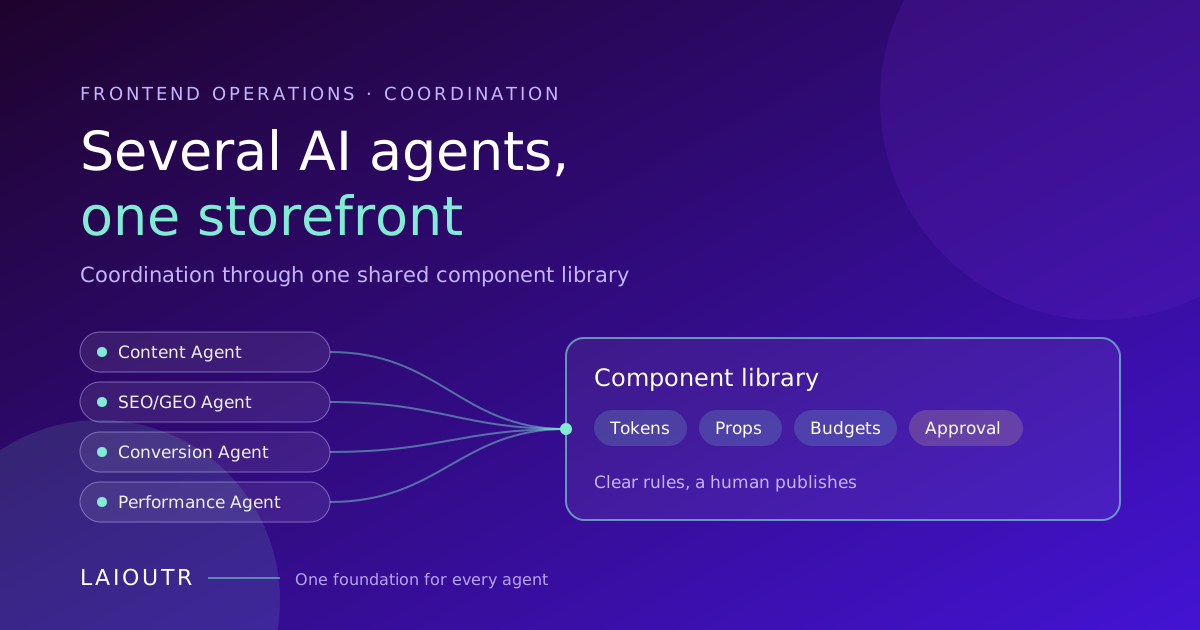Several AI Agents, One Storefront: Coordination Without Collisions
When several AI agents work on the same storefront, conflicts rarely happen between the agents thems…](https://www.laioutr.com/en/blog/frontend-operations-multi-agent-coordination-storefront-2026)
[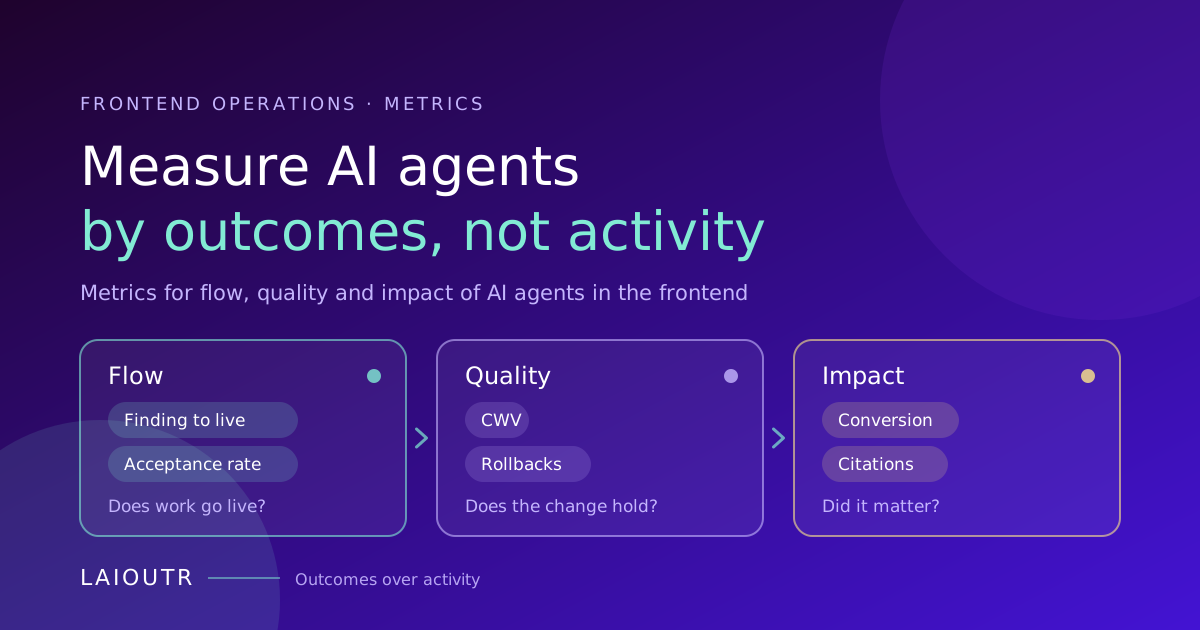Measuring AI Agents by Outcomes: Agentic Frontend Management Metrics
AI agents in the frontend should be measured by outcomes, not by activity. The number of prompts, ge…](https://www.laioutr.com/en/blog/frontend-operations-measuring-ai-agents-outcomes-2026)
[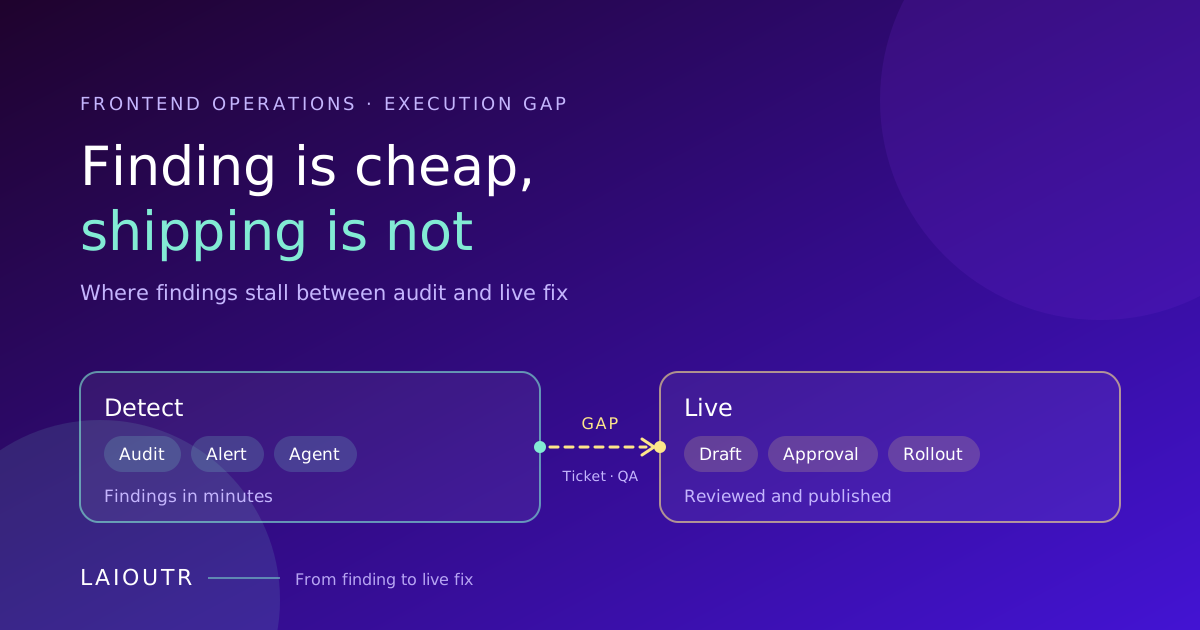The Execution Gap in the Frontend: Finding Is Cheap, Shipping Is Not
The execution gap in the frontend is the time, and the number of handoffs, between "we know wha…](https://www.laioutr.com/en/blog/frontend-operations-execution-gap-detect-vs-deploy-2026)
[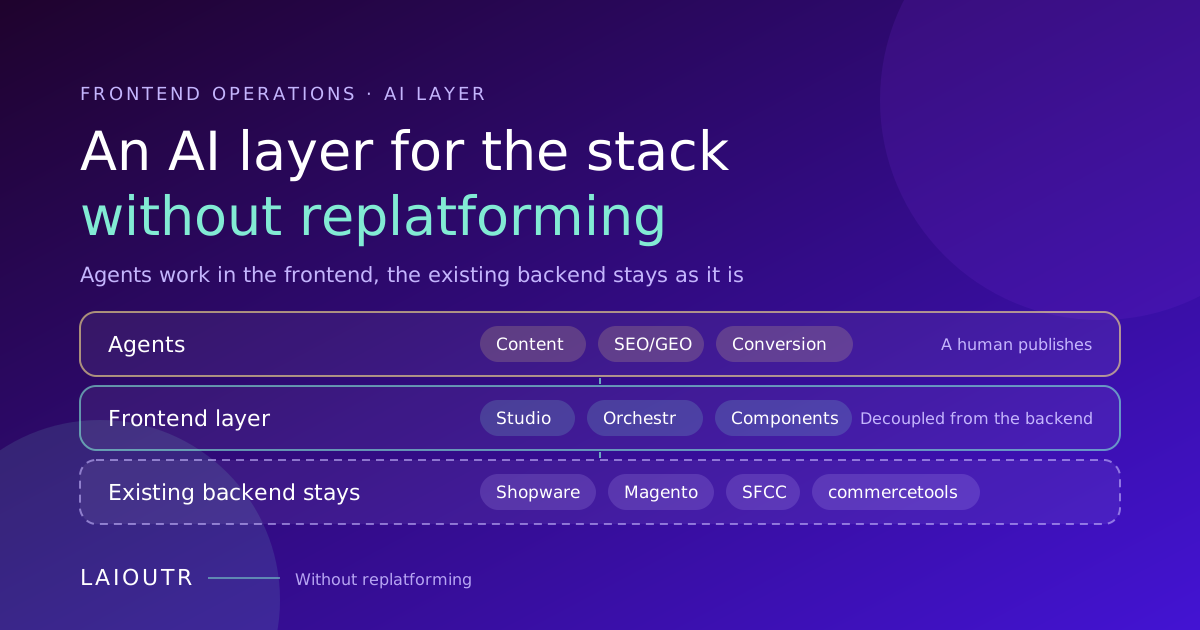Adding an AI Layer to an Existing Commerce Stack Without Replatforming
An AI layer can be added to an existing commerce stack without replacing the shop system. The most p…](https://www.laioutr.com/en/blog/frontend-operations-ai-layer-existing-stack-without-replatforming-2026)
[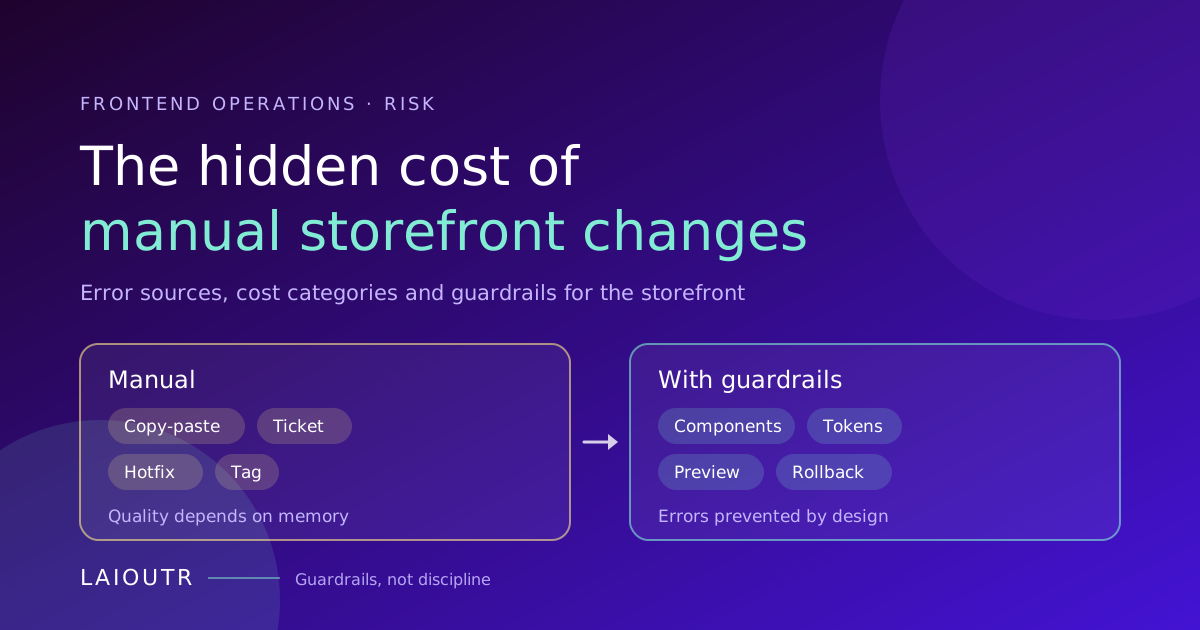The Hidden Cost of Manual Storefront Changes and How to Cut It
Manual frontend changes are the many small edits that keep a storefront running day to day: a new ba…](https://www.laioutr.com/en/blog/frontend-operations-hidden-cost-manual-storefront-changes-2026)
[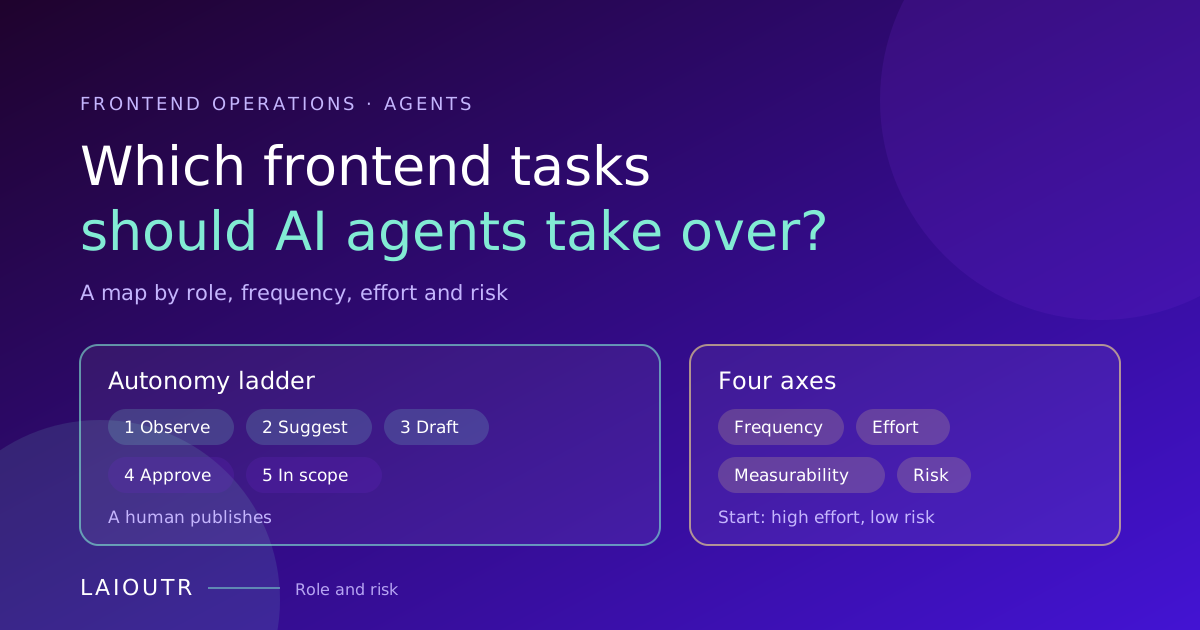Which Frontend Tasks Should AI Agents Take Over? Role and Risk Map
AI agents should first take over the frontend tasks that come up often, involve a lot of manual work…](https://www.laioutr.com/en/blog/frontend-operations-agent-task-map-role-risk-2026)
[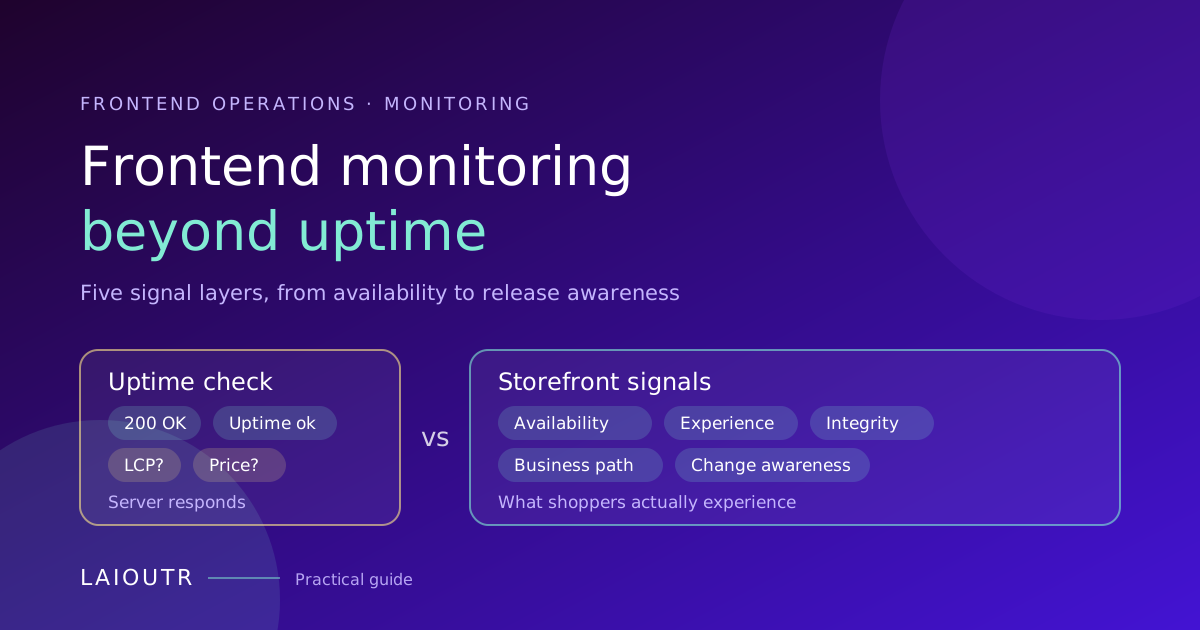Frontend Monitoring Beyond Uptime: Signals a Storefront Needs
Frontend monitoring beyond uptime means checking a storefront not only for availability but for what…](https://www.laioutr.com/en/blog/frontend-operations-monitoring-beyond-uptime-2026)
[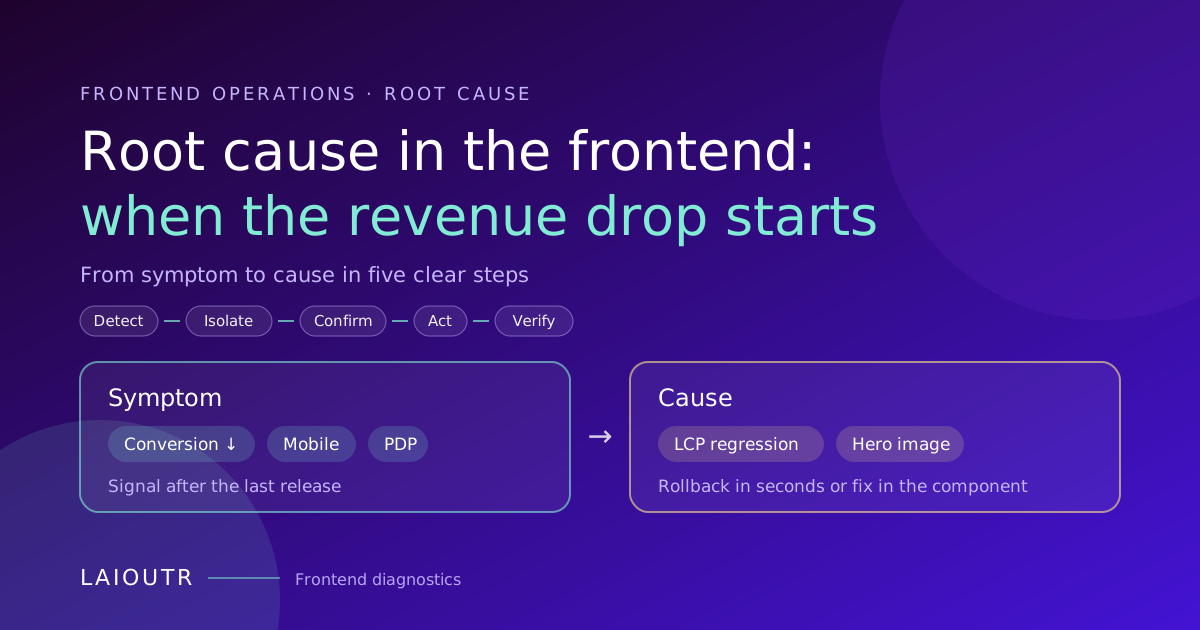Root Cause in the Frontend: When Revenue Drops Start in the Storefront
When revenue or conversion rate drops suddenly, the cause often is not traffic, pricing or the comme…](https://www.laioutr.com/en/blog/frontend-operations-root-cause-revenue-drop-storefront-2026)
[Laioutr Academy Is Live: The Video Manual for Laioutr
Since October 15, 2026, the Laioutr Academy has been live at academy.laioutr.com. It is the user man…](https://www.laioutr.com/en/blog/laioutr-academy-launch-video-manual-certification)
[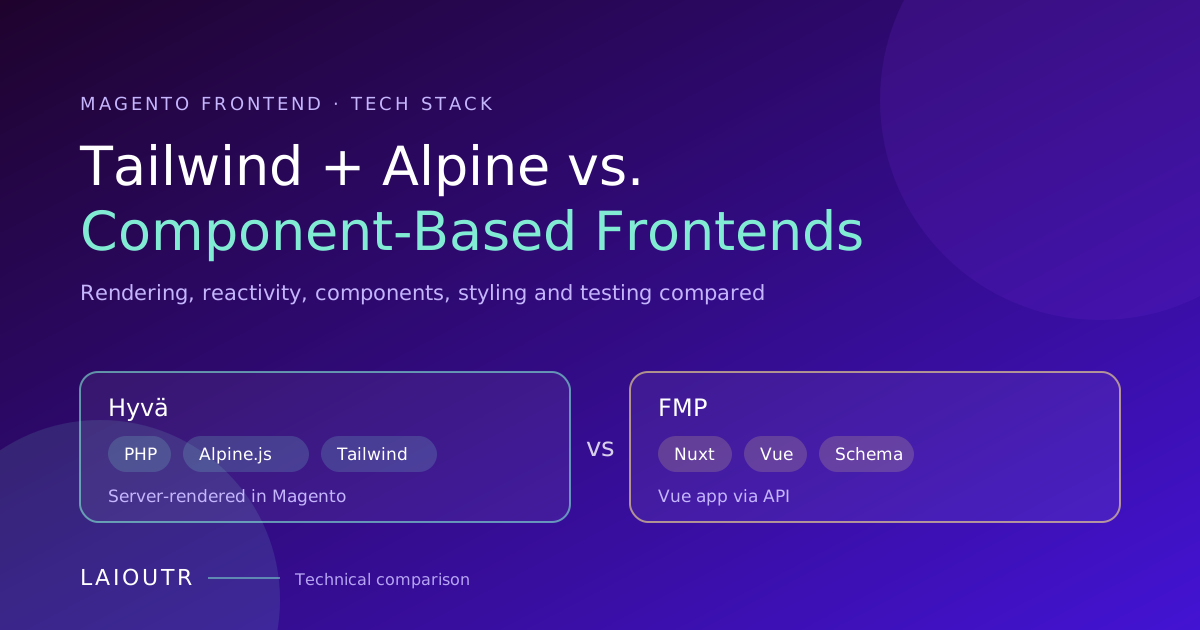Tailwind + Alpine vs. Component-Based Frontends for Magento
Hyvä renders Magento pages on the server with PHP templates and layout XML, adds interactivity throu…](https://www.laioutr.com/en/blog/tailwind-alpine-magento-vs-component-based-frontend-2026)
[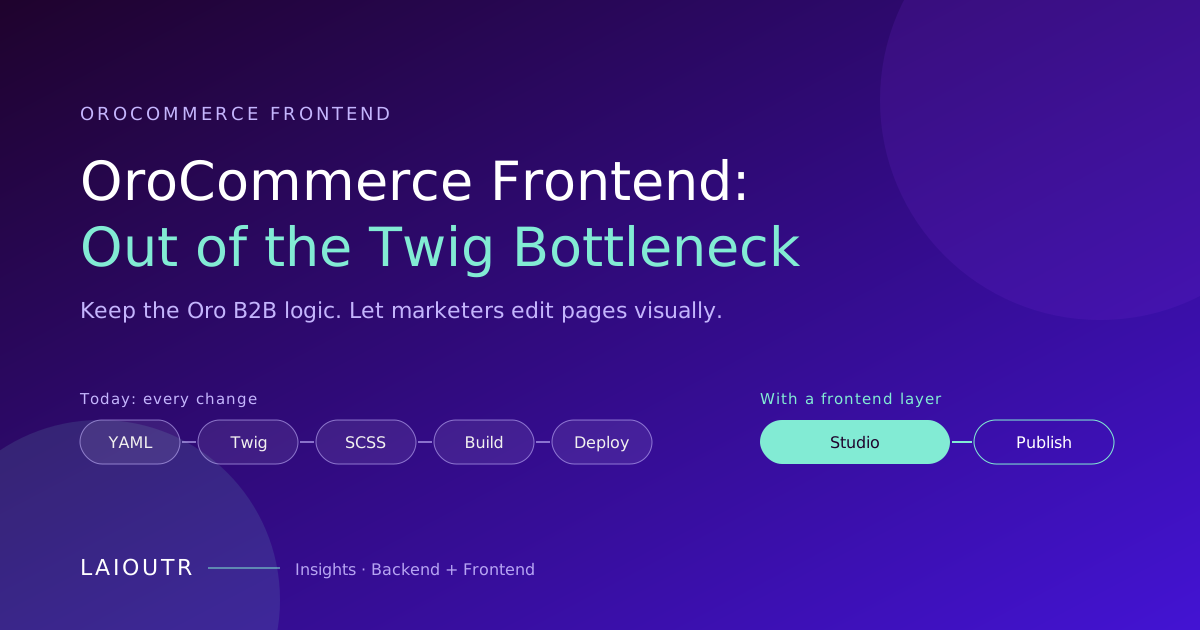OroCommerce Frontend: Out of the Twig and Layouts Bottleneck
The OroCommerce frontend is a server-rendered storefront built from Symfony bundles, OroLayouts and …](https://www.laioutr.com/en/blog/orocommerce-frontend-twig-layouts-bottleneck)
[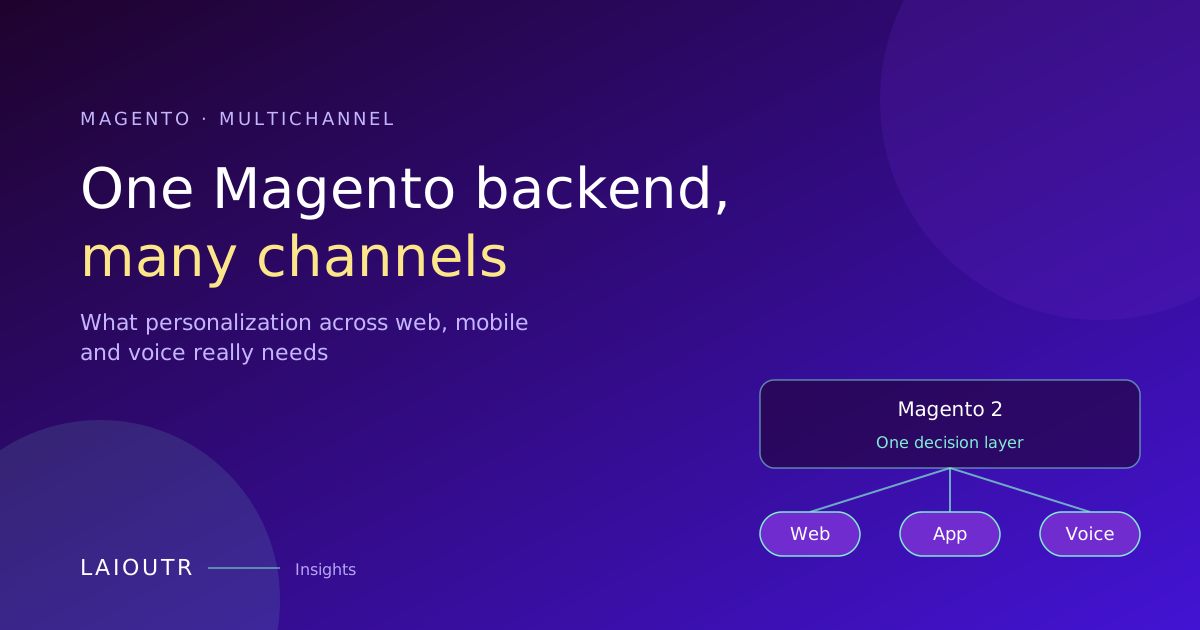One Magento Backend, Many Channels: Personalization in Practice
Personalization across web, mobile and voice on a single Magento backend does not start with a featu…](https://www.laioutr.com/en/blog/magento-multichannel-personalization-web-mobile-voice-2026)
[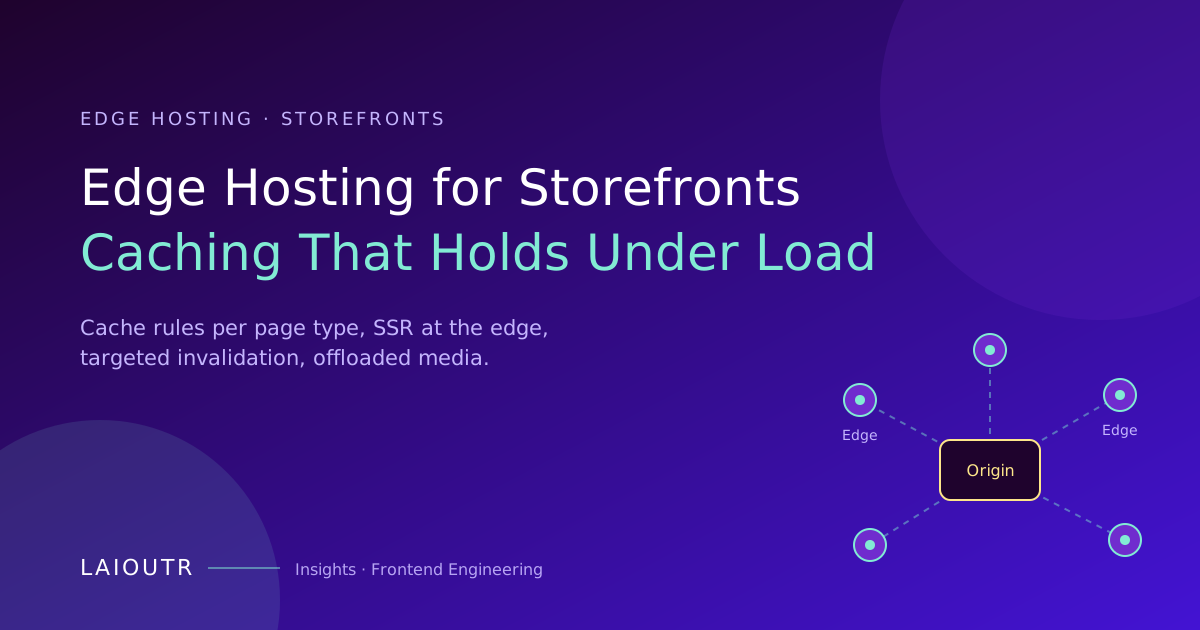Edge Hosting for Storefronts: Caching That Holds Under Peak Load
Edge hosting keeps a storefront fast under load when most requests never reach the origin: pages and…](https://www.laioutr.com/en/blog/edge-hosting-storefronts-peak-traffic-caching-2026)
[Composable Commerce 2027: What Shifted and What Comes Next
Composable commerce enters 2027 with a different agenda than a year ago. The architecture question i…](https://www.laioutr.com/en/blog/composable-commerce-2027-outlook)
[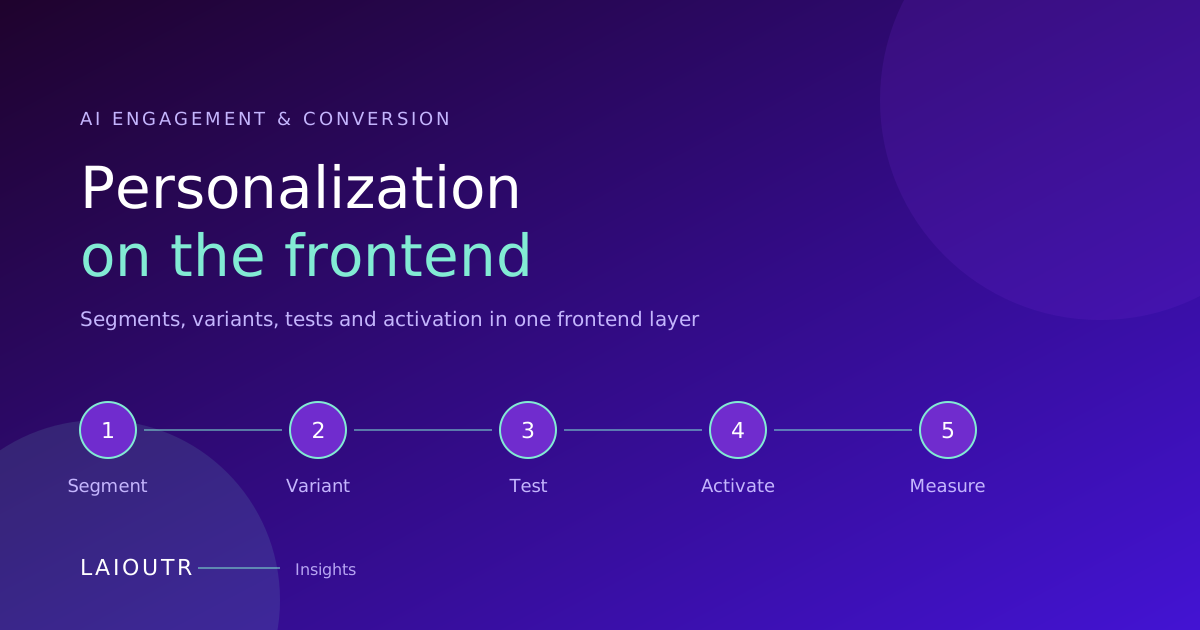AI Engagement and Conversion: Personalization on the Frontend
AI-driven engagement and conversion on the frontend rests on five mechanics: segments decide who see…](https://www.laioutr.com/en/blog/ai-engagement-conversion-frontend-personalization)
## Apps for the Laioutr platform
[View all apps](https://www.laioutr.com/en/apps)
[](https://www.laioutr.com/en/apps/shopify)
Laioutr
[Shopify](https://www.laioutr.com/en/apps/shopify)
Shopify is a commerce platform for selling online and in physical retail.
[](https://www.laioutr.com/en/apps/shopware)
Laioutr
[Shopware](https://www.laioutr.com/en/apps/shopware)
Shopware is a flexible ecommerce platform from Europe for product catalogs and omnichannel commerce.
[](https://www.laioutr.com/en/apps/adobe-commerce)
Laioutr
[Adobe Commerce](https://www.laioutr.com/en/apps/adobe-commerce)
Adobe Commerce is an enterprise commerce platform for complex, global B2C and B2B scenarios.
Planned
[](https://www.laioutr.com/en/apps/b2b-sellers)
Laioutr
[B2Bsellers](https://www.laioutr.com/en/apps/b2b-sellers)
B2B suite for Shopware that turns an online store into a professional B2B commerce platform.
Planned
[](https://www.laioutr.com/en/apps/commerce-layer)
Laioutr
[Commerce Layer](https://www.laioutr.com/en/apps/commerce-layer)
Commerce Layer is a headless commerce platform for making inventory and catalogs available online.
[](https://www.laioutr.com/en/apps/commercetools)
Laioutr
[Commercetools](https://www.laioutr.com/en/apps/commercetools)
Commercetools is a SaaS-based headless ecommerce platform used worldwide.
[](https://www.laioutr.com/en/apps/emporix)
Laioutr
[Emporix](https://www.laioutr.com/en/apps/emporix)
Emporix is a composable, API-first commerce platform for scalable B2B and B2C scenarios.
Planned
[](https://www.laioutr.com/en/apps/hcl-software)
Laioutr
[HCL Software](https://www.laioutr.com/en/apps/hcl-software)
Enterprise suite for digital commerce and experience with extensive configurability.
Planned
[](https://www.laioutr.com/en/apps/intershop)
Laioutr
[Intershop](https://www.laioutr.com/en/apps/intershop)
Enterprise commerce platform for complex B2B and B2C business models.
Planned
[](https://www.laioutr.com/en/apps/magento-2)
Laioutr
[Magento 2](https://www.laioutr.com/en/apps/magento-2)
Widely used, extensible commerce platform for B2C and B2B scenarios.
[](https://www.laioutr.com/en/apps/oxid-eshop)
Laioutr
[OXID eShop](https://www.laioutr.com/en/apps/oxid-eshop)
OXID eShop is an extensible commerce platform for complex B2B and B2C requirements.
Planned
[](https://www.laioutr.com/en/apps/patchworks)
Laioutr
[Patchworks](https://www.laioutr.com/en/apps/patchworks)
Patchworks is a low-code iPaaS that connects ecommerce, ERP, WMS, 3PL, and marketplaces.
Planned
[](https://www.laioutr.com/en/apps/PrestaShop)
Laioutr
[Prestashop](https://www.laioutr.com/en/apps/PrestaShop)
Open-source commerce platform for small and midsize merchants in Europe and beyond.
Planned
[](https://www.laioutr.com/en/apps/saleor)
Laioutr
[Saleor](https://www.laioutr.com/en/apps/saleor)
Open-source, API-first commerce platform built on GraphQL for custom storefronts.
Planned
[](https://www.laioutr.com/en/apps/salesforce-commerce-cloud)
Laioutr
[Salesforce Commerce Cloud](https://www.laioutr.com/en/apps/salesforce-commerce-cloud)
Salesforce Commerce Cloud is a cloud-based enterprise commerce platform for businesses of any size.
Planned
[](https://www.laioutr.com/en/apps/sap-commerce-cloud)
Laioutr
[SAP Commerce Cloud](https://www.laioutr.com/en/apps/sap-commerce-cloud)
Enterprise commerce platform for complex catalogs, pricing models, and omnichannel journeys.
Planned
[](https://www.laioutr.com/en/apps/scayle)
Laioutr
[Scayle](https://www.laioutr.com/en/apps/scayle)
SCAYLE is a commerce engine that helps brands and retailers scale their business.
Planned
[](https://www.laioutr.com/en/apps/spryker)
Laioutr
[Spryker](https://www.laioutr.com/en/apps/spryker)
Composable commerce platform for sophisticated B2B and B2C business models.
[](https://www.laioutr.com/en/apps/sylius)
Laioutr
[Sylius](https://www.laioutr.com/en/apps/sylius)
Sylius is a developer-friendly ecommerce framework for B2C and B2B shopping experiences.
Planned
[](https://www.laioutr.com/en/apps/vendure)
Laioutr
[Vendure](https://www.laioutr.com/en/apps/vendure)
Vendure is a headless commerce platform for businesses with complex requirements.
Coming Soon
[](https://www.laioutr.com/en/apps/vtex)
Laioutr
[VTEX](https://www.laioutr.com/en/apps/vtex)
Cloud-native, composable commerce platform for B2B and B2C at scale.
Planned
[](https://www.laioutr.com/en/apps/websale)
Laioutr
[Websale](https://www.laioutr.com/en/apps/websale)
Stable, enterprise-ready commerce backend for complex retail environments.
Strategy call
## The frontend as a control layer
A conversation about stack, roadmap and replatforming scenario. The outcome: a clear picture of how Laioutr fits, what it costs and how fast the go-live can happen.
*"After 30 minutes, we knew Laioutr makes our replatforming feasible."*
*Daniel B., CEO,* [*hygibox.de*](https://hygibox.de)
[Book a demo](https://www.laioutr.com/en/contact)
## Structured Data
```json
{
"@context": "https://schema.org",
"@graph": [
{
"@type": "Organization",
"@id": "https://www.laioutr.com/#identity",
"name": "Laioutr",
"legalName": "Laioutr GmbH",
"url": "https://www.laioutr.com/",
"logo": {
"@type": "ImageObject",
"url": "https://www.laioutr.com/laioutr-logo.png",
"width": 400,
"height": 400
},
"email": "info@laioutr.com",
"telephone": "+49 30 75435715",
"address": {
"@type": "PostalAddress",
"streetAddress": "Münchweilersteig 5",
"postalCode": "12559",
"addressLocality": "Berlin",
"addressCountry": "DE"
},
"vatID": "DE450905846",
"sameAs": [
"https://www.linkedin.com/company/laioutr",
"https://www.youtube.com/@Laioutr",
"https://x.com/laioutr"
]
},
{
"@type": "WebSite",
"@id": "https://www.laioutr.com/en/#website",
"url": "https://www.laioutr.com/en/",
"name": "Laioutr",
"inLanguage": "en",
"publisher": {
"@id": "https://www.laioutr.com/#identity"
}
},
{
"@type": "BlogPosting",
"@id": "https://www.laioutr.com/en/blog/visual-editors-across-dxps#article",
"headline": "Visual Editors in Modern DXPs: The Silent Divide Between Platform Philosophy and Execution",
"description": "Why a DXP's visual editor architecture, not scale or support, determines how your organization actually operates day to day.",
"image": [
"https://eu-west-2.graphassets.com/cmii2mlqi0dux06l5543v7nkc/cmnucypviw8mi07mgmwsd5asa"
],
"datePublished": "2026-10-26T11:04:44.744564+00:00",
"dateModified": "2026-10-26T11:04:44.195054+00:00",
"inLanguage": "en",
"articleSection": "Insights",
"keywords": "Headless Commerce, Composable, Experience Operations",
"author": {
"@type": "Person",
"name": "Marcel Thiesies",
"jobTitle": "Co-Founder & CEO, Laioutr",
"image": "https://eu-west-2.graphassets.com/cmii2mlqi0dux06l5543v7nkc/cmj01b962364n07lb0iguvts5"
},
"publisher": {
"@id": "https://www.laioutr.com/#identity"
},
"mainEntityOfPage": {
"@id": "https://www.laioutr.com/en/blog/visual-editors-across-dxps#webpage"
},
"isPartOf": {
"@id": "https://www.laioutr.com/en/#website"
}
},
{
"@type": "WebPage",
"@id": "https://www.laioutr.com/en/blog/visual-editors-across-dxps#webpage",
"url": "https://www.laioutr.com/en/blog/visual-editors-across-dxps",
"name": "Visual Editors in Modern DXPs: The Silent Divide Between Platform Philosophy and Execution",
"description": "Why a DXP's visual editor architecture, not scale or support, determines how your organization actually operates day to day.",
"inLanguage": "en",
"isPartOf": {
"@id": "https://www.laioutr.com/en/#website"
},
"breadcrumb": {
"@id": "https://www.laioutr.com/en/blog/visual-editors-across-dxps#breadcrumb"
},
"primaryImageOfPage": {
"@type": "ImageObject",
"url": "https://eu-west-2.graphassets.com/cmii2mlqi0dux06l5543v7nkc/cmnucypviw8mi07mgmwsd5asa"
},
"datePublished": "2026-10-26T11:04:44.744564+00:00",
"dateModified": "2026-10-26T11:04:44.195054+00:00",
"mainEntity": {
"@id": "https://www.laioutr.com/en/blog/visual-editors-across-dxps#article"
}
},
{
"@type": "BreadcrumbList",
"@id": "https://www.laioutr.com/en/blog/visual-editors-across-dxps#breadcrumb",
"itemListElement": [
{
"@type": "ListItem",
"position": 1,
"name": "Laioutr",
"item": "https://www.laioutr.com/en/"
},
{
"@type": "ListItem",
"position": 2,
"name": "Insights",
"item": "https://www.laioutr.com/en/blogs/insights"
},
{
"@type": "ListItem",
"position": 3,
"name": "Visual Editors in Modern DXPs: The Silent Divide Between Platform Philosophy and Execution"
}
]
}
]
}
```