---
title: "Content Management with Content Agent: AI-powered | Laioutr"
canonical_url: "https://www.laioutr.com/en/product/content-management"
locale: en
meta:
description: "Schema-based content management in Laioutr's integrated headless CMS: Collections, multi-language, Studio and a Content Agent that proposes, people approve."
"og:description": "Schema-based content management in Laioutr's integrated headless CMS: Collections, multi-language, Studio and a Content Agent that proposes, people approve."
"og:title": "Content Management with Content Agent: AI-powered | Laioutr"
---
CONTENT MANAGEMENT INSIDE THE FRONTEND PLATFORM
# Schema-based content management,
multilingual, with visual composition right inside Studio and a Content Agent that automates the operational grunt work. Part of the Agentic Frontend Management Platform, not a separate tool.
[Book a demo](https://www.laioutr.com/en/contact)
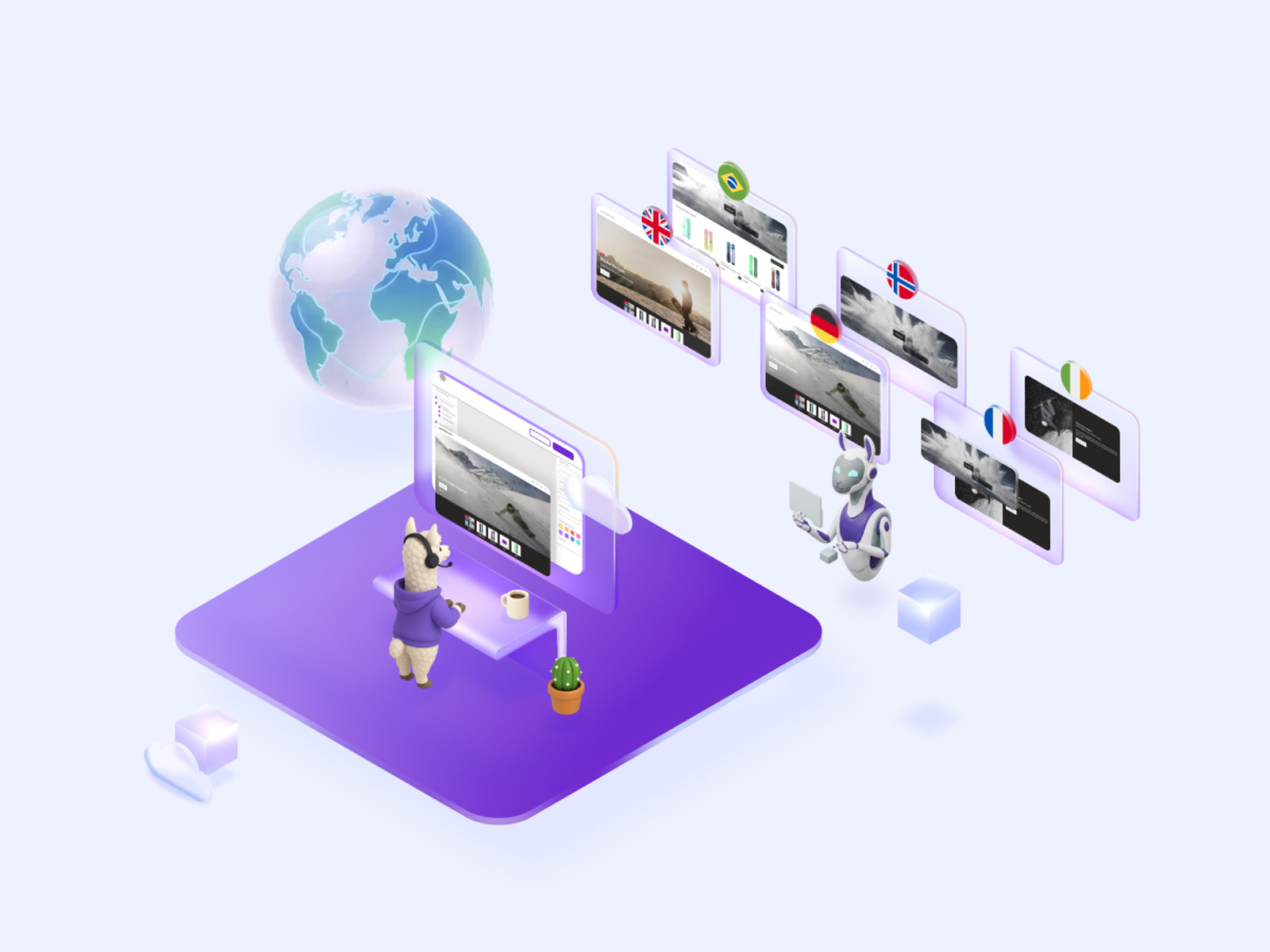
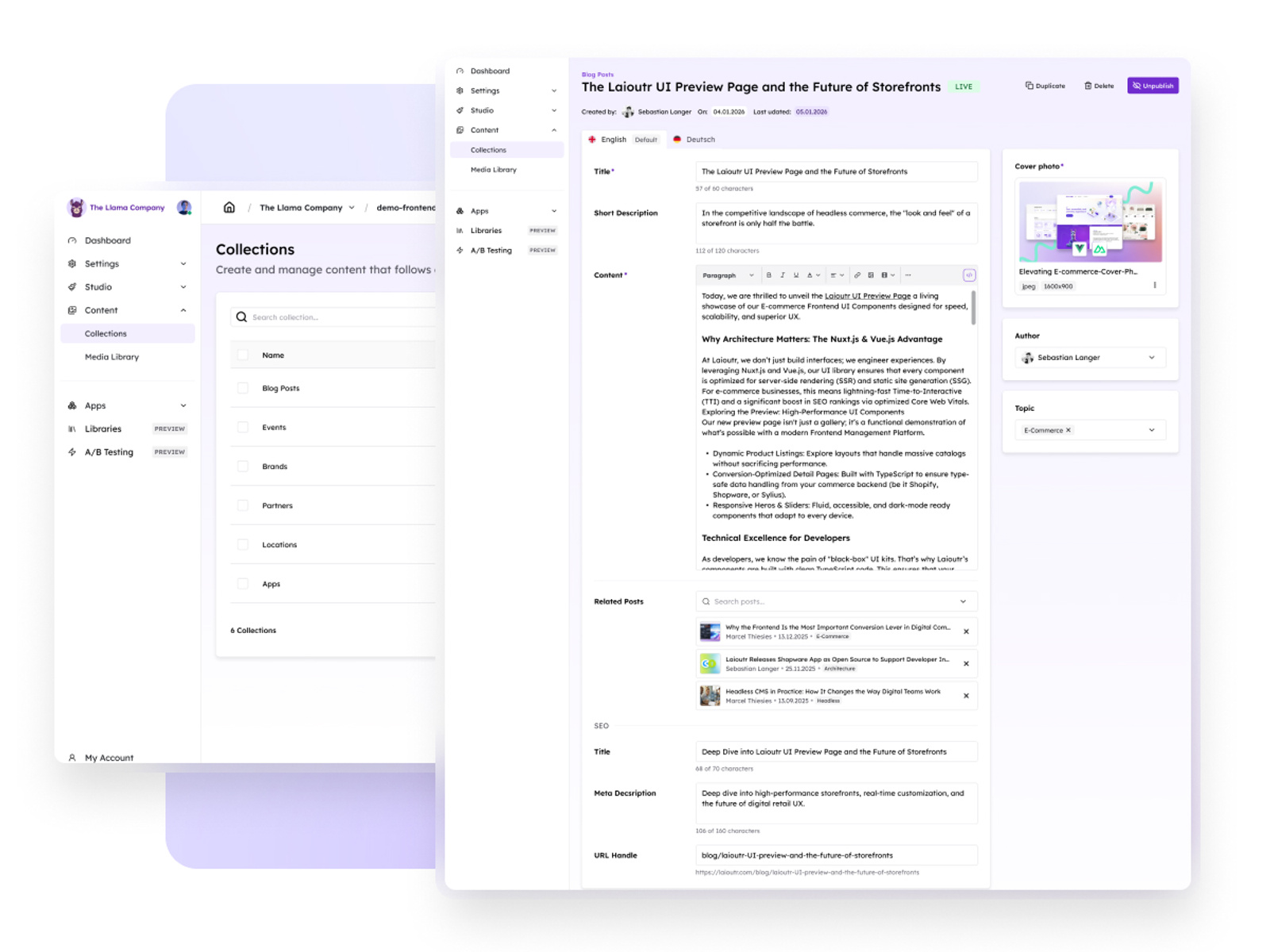
Content belongs where it is delivered. In Laioutr, structured content Collections, multilingual entries, validation and publishing are managed right inside the Cockpit, in the same platform where the frontend is built, delivered and optimized.
The Content Agent works alongside in the background: it continuously proposes translations, product copy, A/B variants and SEO tags instead of waiting for quarterly sprints. Publishing stays with the team.
CMS
## Content management at Laioutr is the schema-based management of structured content right inside the Cockpit of the frontend platform.
Content types (Collections) are defined, filled with entries, maintained across languages and published through a clear status workflow.
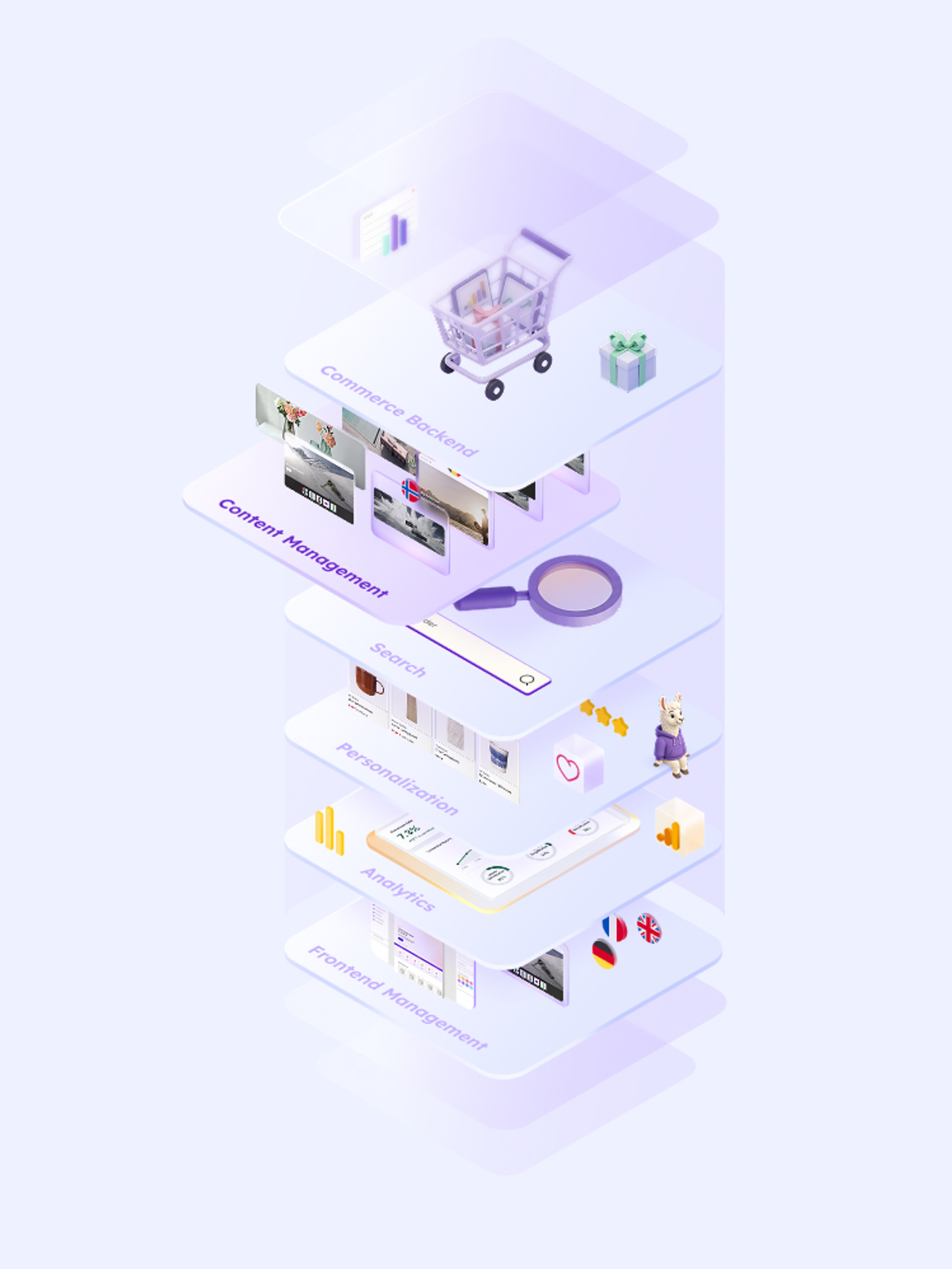
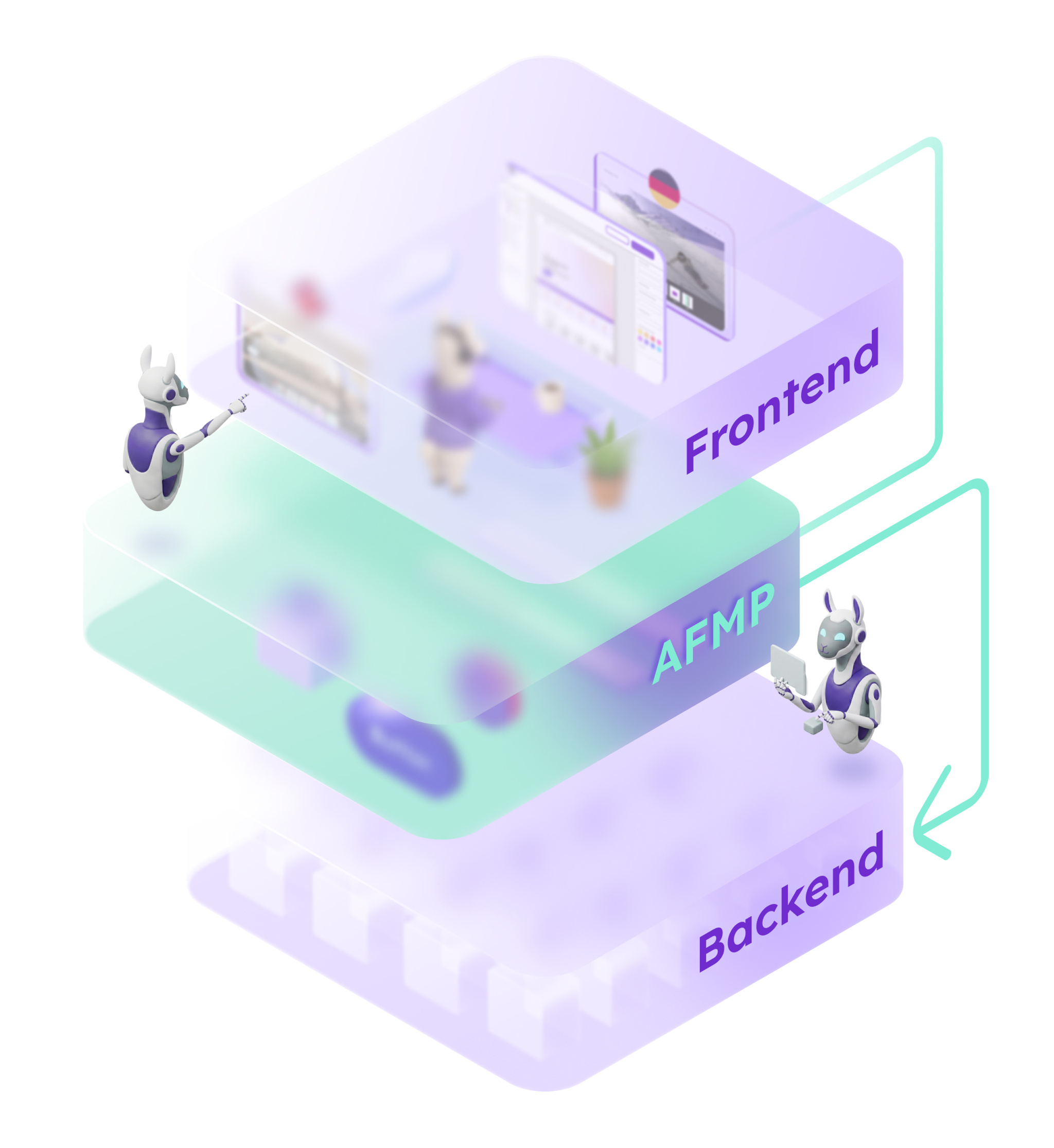
Laioutr is an integrated headless CMS: content management does not live in a separate tool but is a layer within the Agentic Frontend Management Platform. Studio (visual composition), Storefront (delivery), Orchestr (backend connectivity), Cloud (infrastructure) and the Content Agent (AI layer) mesh together without glue code.
[Explore the Agentic Frontend Management Platform](https://www.laioutr.com/en/agentic-frontend-management-platform)
Schema-based
Every Collection has a defined shape: fields, validations, languages. Content is structured and therefore reusable everywhere.
Multilingual out of the box
Multi-language isn't a plugin, it's built in. Tabs per language, default marking, bulk operations.
Agent-assisted
The Content Agent continuously proposes copy, translations and optimizations and audits existing content. Operational content work becomes review work.
## Three steps from schema to live page
Content management in Laioutr follows a clear path: define the schema, maintain entries, publish.
### 1. Define the content Collection
A new Collection is created or taken over from the platform configuration of the frontend project. A broad range of field types is available: text, numbers, select lists, links, media references, rich text and multi-reference fields. Validations and multilingual support can be enabled per field.
### 2. Maintain entries in the manager
Each Collection holds entries, the individual pieces of content that later appear on the storefronts. A sortable table shows title, status, creation date and editor. Search, filters and pagination with a configurable page size are built in. In the editor, content is maintained per language via clear tabs.
### 3. Publish with validation by default
On publish, Laioutr validates all required fields. As long as required fields are empty or inconsistent, the publish button stays locked. Only once validation passes does the entry go live. Unpublish, duplicate and delete are available directly on the entry, with clearly defined behavior.
Multi Market
## At Laioutr, multilingualism isn't an add-on.
It's the standard.
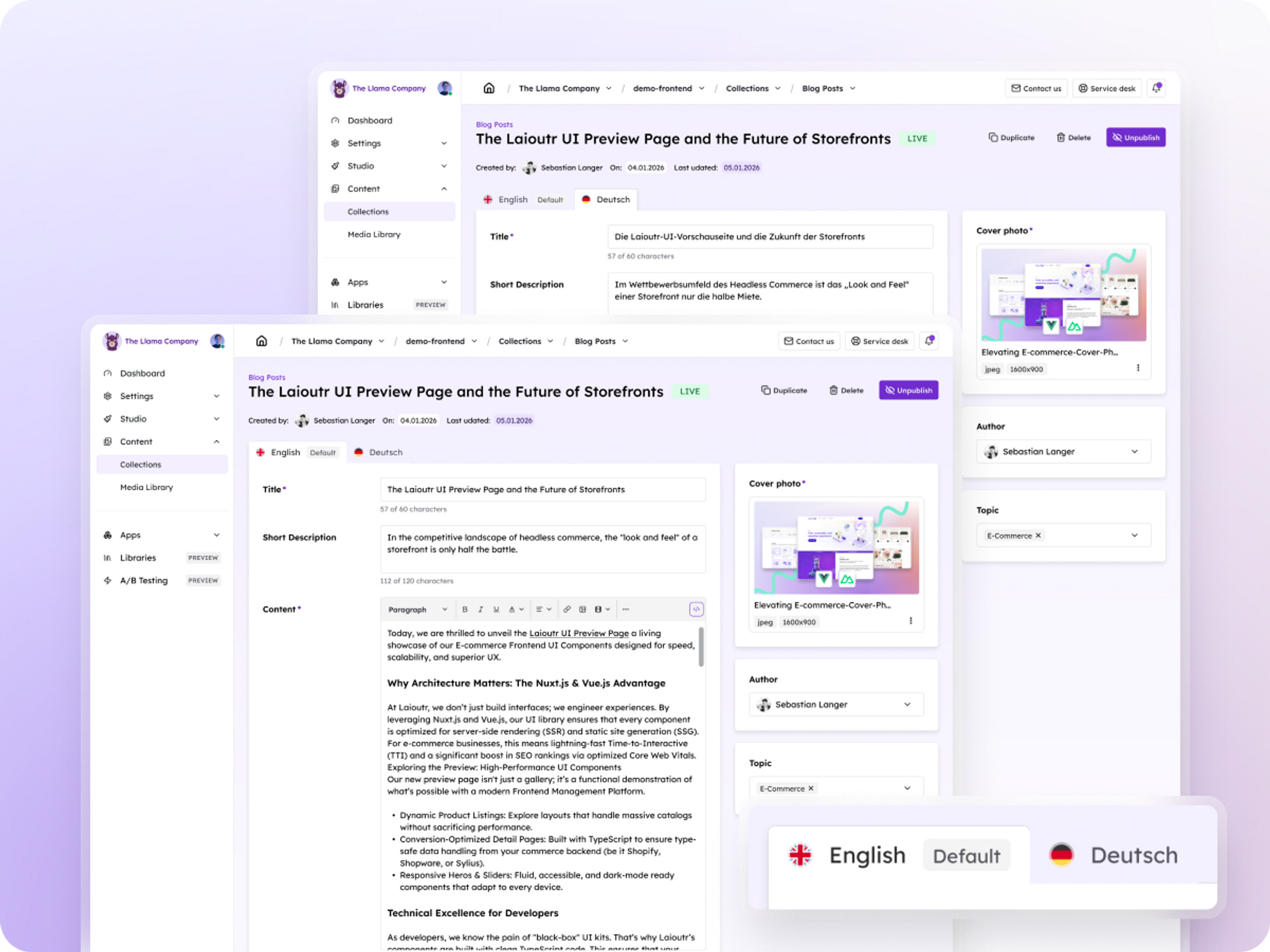
In the entry editor, languages are switched via tabs. The default language carries a marker so it is not changed by accident. Edits on a language tab apply only to that language. Fields that do not need translation (e.g. SKUs, date formats, technical IDs) are configured in the schema as language-independent.
In practice: one Collection definition, n language versions per entry, all in one Cockpit. No forks, no copies, no translation-sync sprints.
[More on multi-brand & multi-market](https://www.laioutr.com/en/product/multi-brand-multi-market)
### This is where the real difference with classic headless CMS lies:
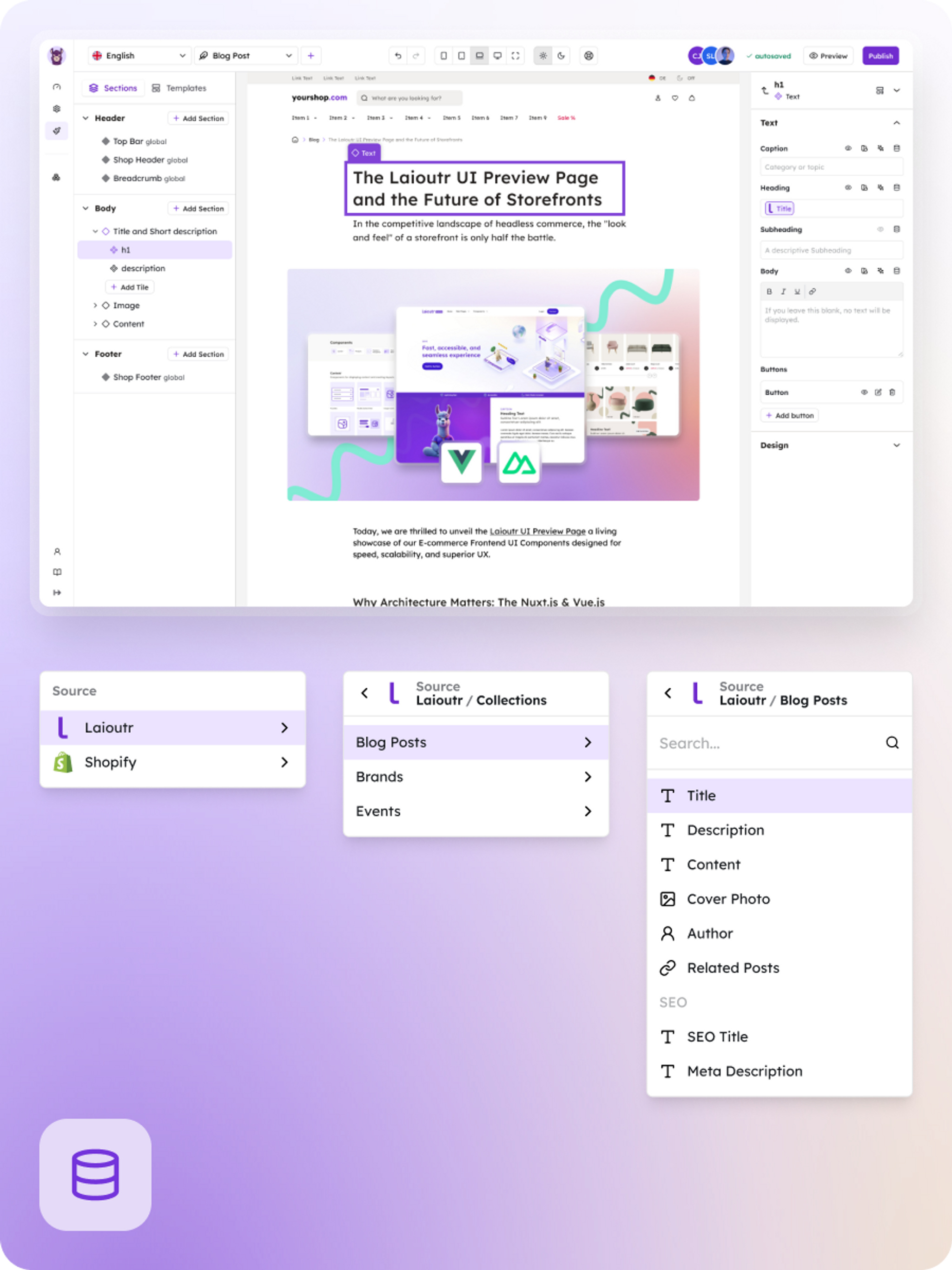
content entries are linked directly to frontend components in Studio: visually, without code mapping.
In a classic headless setup, linking content to a component is an engineering task: fetch the data, map it, pipe it through, render it in the frontend. In Laioutr this happens visually. In the Studio editor, a component is selected and a content field from the Collection is bound in the property panel. The live preview instantly shows how it looks in the frontend.
Each component defines which content can be bound and which fields are required or optional. Anyone in marketing building a new landing page drags the component into Studio and immediately sees a selection of matching content entries, with no searching, exporting or copying in the CMS.
[More on the Studio visual page builder](https://www.laioutr.com/en/composable-visual-page-builder)
Full transparency
## Focused on the outcome
Always on the same page, no need to ask.
Every entry has a clear status that shows instantly where it stands. Three statuses, three meanings. They ensure the marketing team and the tech team always see the same state: no sync meeting, no spreadsheet, no "is this live yet?".

### Draft
Work in progress. The entry exists but is not public. Safe to experiment, with zero impact on live storefronts.

### Changed
The entry was live once, but there are unpublished changes. The old version keeps running, the new one waits for approval. Ideal for preparing updates without breaking live content.

### Live
Published. The entry is visible on the storefronts that render it. Unpublish returns it to draft at any time without deleting it.
Simplicity
## Three content types. One Cockpit.
Not every piece of content should be maintained the same way. Three content types, three use cases, all in the same platform. Whatever the type, everything sits in one Cockpit, in the same rendering layer, with the same performance.
### Structured content
Content that's created once and reused many times. Structured in Collections, cleanly typed, referenceable from anywhere.
**Examples**: product descriptions, service packages, employee profiles, blog articles, FAQ entries, brand statements
### Volatile content
Content that only lives in a specific context: a campaign, a landing page, a banner. Often composed directly in Studio rather than in Collections.
**Examples**: hero banners for seasonal campaigns, Black Friday special copy, regional promo messages, announcement banners
### Generative content
AI-generated or AI-optimized content: headlines, product description variants, localized copy, SEO tags. Proposed by the Content Agent, approved by the team.
**Examples**: personalized CTAs, auto-translated product copy, A/B test variants, SEO meta tags
AGENTIC CMS
## Agentic content management
Content operations are the most invisible cost center in modern commerce teams. Hundreds of product texts, five languages, three brand tones, monthly refreshes, SEO tweaks, personalization variants.
**Until now:** manual sprint work. **With Laioutr:** a continuous background process.
### Generate
Headlines, product descriptions, meta tags, category copy: at the click of a button or as a proposal when new entries are created.
### Translate
Multi-language versions straight from the default content, in the brand tone, with local adaptations: not just word-for-word translation.
### Vary
A/B variants per headline, CTA or description. The agent proposes 3 to 5 variants; once approved, the AI A/B Testing add-on tests them in the frontend.
### Optimize
Existing content is checked for SEO, conversion and readability, and the agent proposes improvements. Refresh instead of rewrite, and only when the data calls for it.
### Personalize
Segment-specific variants: different for first-time customers, for VIPs, for region DE vs. FR. Delivered via Display Conditions in Studio or the AI Personalisation add-on.
### Audit
Find gaps, flag outdated content, identify missing translations. The agent reports where content debt is piling up before it becomes visible.
The comparison
### What changes economically.
Three typical tasks that today take weeks or months and become background routine with the Content Agent. The numbers are orders of magnitude from real customer setups, not marketing figures. Sprint tasks turn into background routines. Costs turn into control workflows.
Pricing Plans Comparison
| Compare differences | Ohne Content Agent | Mit Content Agent |
| --- | --- | --- |
| Ohne Content Agent Mit Content Agent |
| Was sich wirtschaftlich verändert Drei typische Aufgaben, die heute Wochen oder Monate brauchen und mit dem Content Agent zur Hintergrund-Routine werden. Die Größenordnungen stammen aus echten Kunden-Setups, keine Marketing-Werte. |
| 10.000 Produkttexte in 5 Sprachen Mehrsprachiger Produktkatalog für Multi-Markt-Setups: die typische Skalierungs-Herausforderung im Commerce. | Copywriter-Team über 4 bis 6 Monate, fünfstellige Lizenz- und Honorarkosten, sprachliche Inkonsistenzen zwischen Märkten, Update-Sprints bei jeder Sortimentsänderung. | Erst-Generierung in Stunden, kontinuierliche Pflege im Hintergrund. Brand-Tonalität konsistent über alle Sprachen. Updates werden für alle Locales vorgeschlagen und nach Freigabe übernommen. |
| SEO-Meta-Tags für 500 Landingpages SEO-Optimierung als Daueraufgabe statt einmaliger Sprint, ohne manuelle Pflege. | SEO-Agentur oder interne Marketer, 2 bis 3 Wochen Sprint für das Erst-Setup, manuelle Pflege bei jeder Seitenänderung. Meta-Tags veralten, sobald Inhalte sich ändern. | Vorschläge beim Anlegen, Freigabe durch das Team. Re-Audit alle 30 Tage durch den SEO/GEO Agent, damit Meta-Tags konsistent zum Inhalt bleiben. |
| A/B-Varianten pro Hero-Banner Continuous Optimization als Hintergrund-Prozess statt sporadischer Sprint-Aufgabe. | Copywriter-Briefing, Engineering-Setup, Test-Auswertung: pro Variante 1 bis 2 Wochen Vorlauf. A/B-Tests werden zum Quartals-Sport, nicht zum Standard. | Drei Varianten pro Hero auf Knopfdruck, in Brand-Tonalität. Getestet mit dem Add-on AI A/B Testing, die Übernahme des Gewinners gibt das Team frei. |
AGENTIC CONTENT MANAGEMENT
### The team steers the strategy. The agent iterates.
Static content management is a model from the 2010s: write once, publish, forget, until someone notices that half of it is out of date.
That no longer works in a world where market language, customer expectations and SEO standards change faster than editorial sprints. The answer is not "hire even more copywriters" but content that keeps growing.
The Content Agent is the layer that delivers on this. Content is not written once and then merely managed. The agent continuously checks it against performance data, brand guidelines and market conditions and proposes optimizations. Nothing is published until a person approves it.
**The team sets the direction. The agent delivers the iteration.**
Brand guardrails
### What the team steers and what the agent delivers.
AI without control is a risk. AI with clear guardrails is leverage. The Content Agent works within the boundaries the team sets, not outside them. Brand compliance is not the Content Agent's risk. It is its precondition.
The team steers
- Brand tone (formal or casual, short or detailed)
- Banned words and linguistic taboos
- Style guidelines per brand and per market
- Context sources the agent may use (internal documents, external APIs, product databases)
- Which capabilities are active and which are not
- Approvals: agent proposals only go live after a person has reviewed them
The agent delivers
- Content in the desired tone, without taboo words
- A consistent brand voice across all languages and brands
- A/B variants in the brand's style, not in generic AI-speak
- Translations with local adaptations instead of dictionary translation
- Refresh suggestions with a rationale (why now, what specifically)
- Audit reports that show where content debt sits
CMS FEATURES
## Content workflow with full control
Whether multi-language, media library or quick actions: full control over every single entry.
### Search & filter
Full-text search and filters across all entry fields, sorting by title, status, or date. Even large Collections stay searchable.
### Validation before publish
Required fields, format checks, and custom validations block publish until the schema is satisfied. No broken live entries.
### Multi-language editing
Configurable per field: language-dependent or universal. Tabs per language, default marking, bulk operations across all languages.
### Media Library
Central management of images, videos and files, referenceable in every Collection, every entry, every component. (The feature set is currently growing.)
### Command Bar (power user)
Quick access to frequent actions via keyboard. For experienced editors who work faster without a mouse.
COMPOSABLE
## No silo. Just stack.
Three ways Laioutr fits into existing tooling.
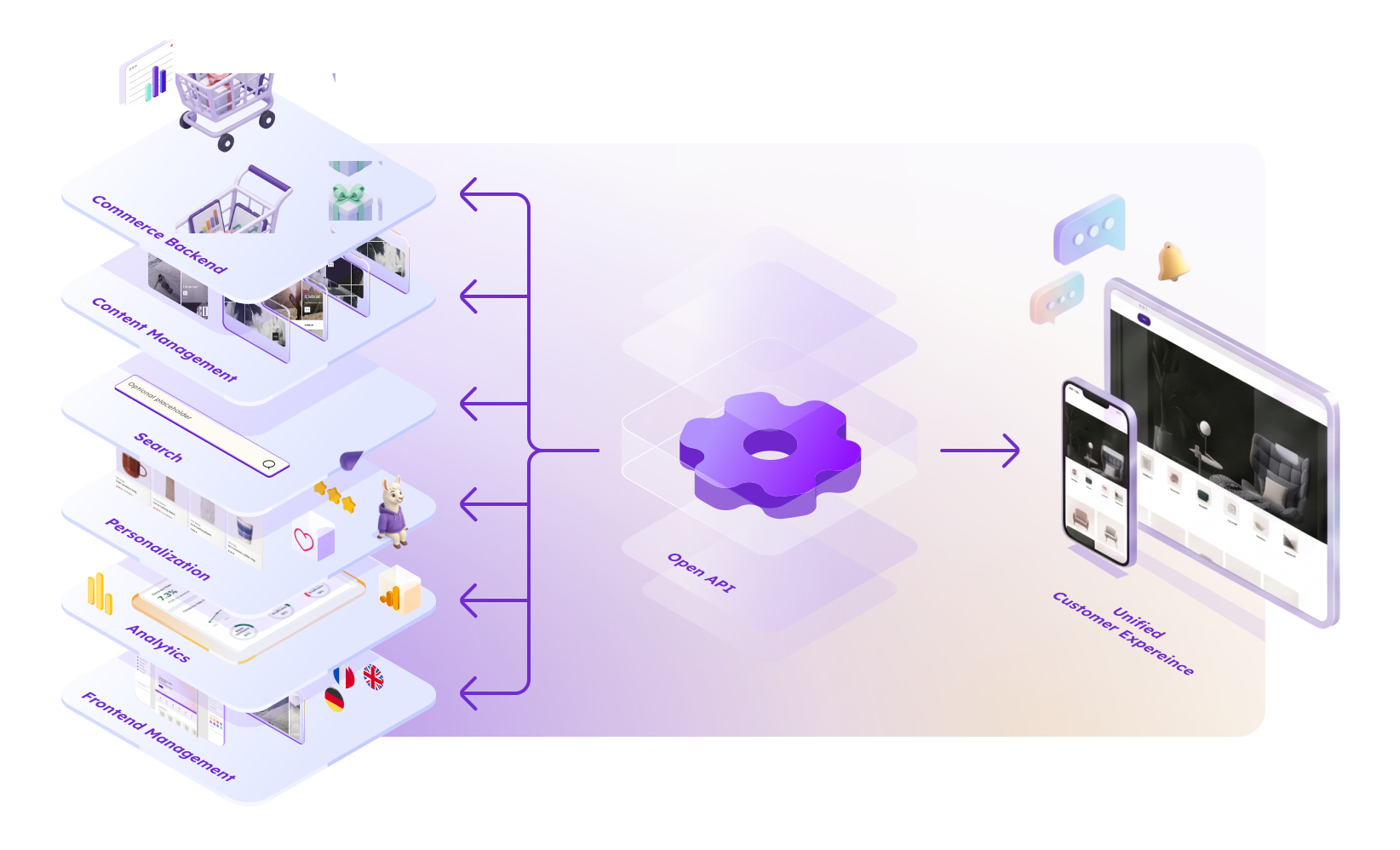
Content management at Laioutr is not isolated: it is part of a composable stack. Three ways content works with existing tooling.
[More on the composable DXP](https://www.laioutr.com/en/composable-digital-experience-platform)
### Connect an external CMS
Teams already using Storyblok, Contentful or Hygraph connect these sources through the Connect layer. Content flows into Studio as if it were native. Step-by-step migration or federation, as needed.
### Consume backend data
Product data, orders and customer states come from the commerce backend (Shopify, OXID, Shopware, etc.). In the content editor they are referenced like native content, without custom API mapping.
### Multi-source visual management
Studio combines content from Laioutr Collections, an external CMS and the commerce backend in one interface. Marketing builds pages from multiple data sources without needing to know which piece comes from which tool.
HEADLESS CMS
## The right tools for the right job.
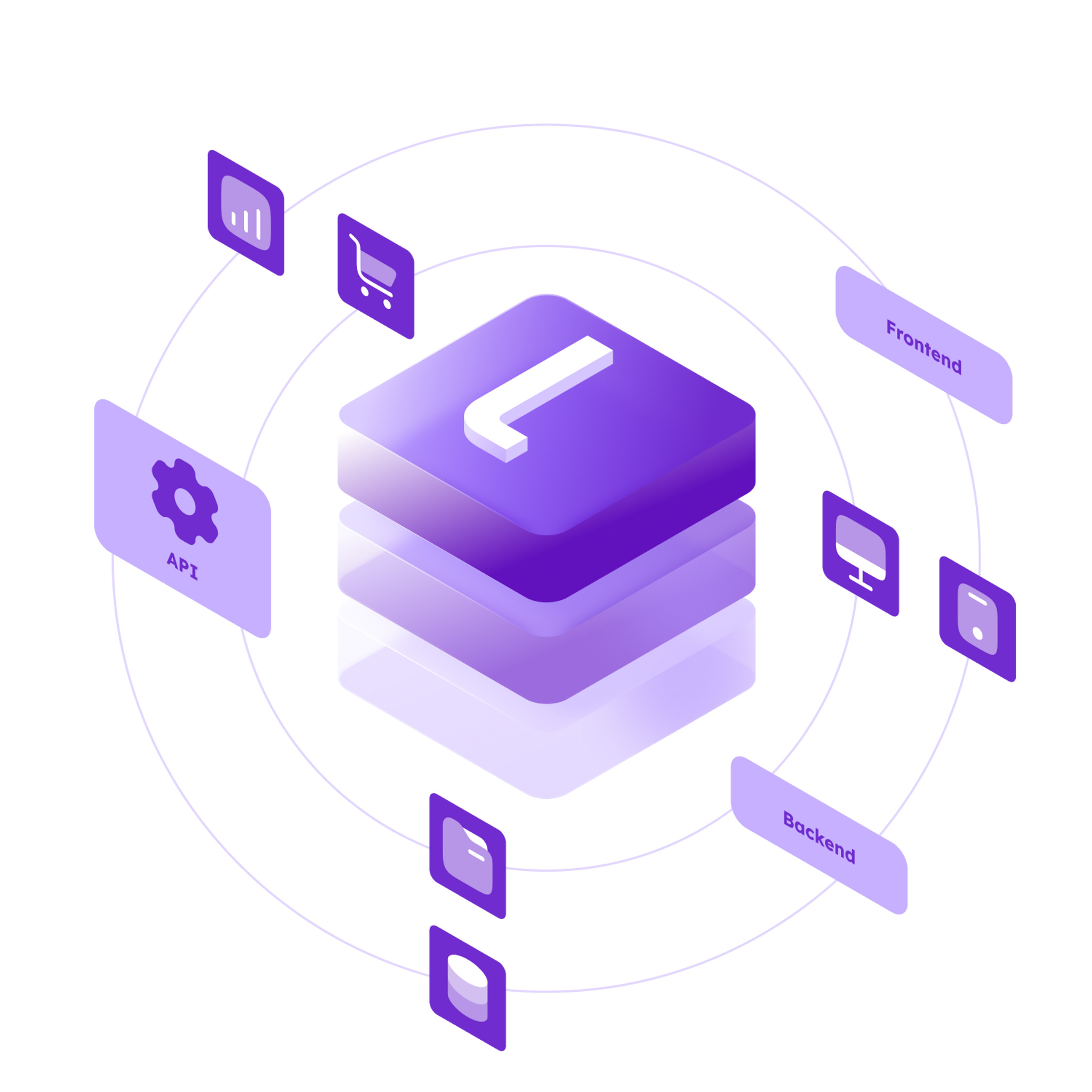
Laioutr Content Management covers most commerce frontend needs right inside the platform. But there are use cases where a dedicated headless CMS is the right complement, and for exactly those cases there are deep partnerships with leading vendors. To us, composability does not mean "build everything in-house" but "the right tools for the right job".
[Headless CMS with Laioutr](https://www.laioutr.com/en/headless-cms)
### Content for more than the web frontend
When content is delivered in parallel to mobile apps, voice assistants, in-store displays, print catalogs or partner APIs, a dedicated headless CMS is worth it, because it is built for exactly that. Laioutr Content Management remains the frontend layer, the headless CMS becomes the single source of truth for all channels.
### A large content base in an established headless CMS
When a team has worked in an established headless CMS for years and thousands of entries live there, migration is expensive and risky. Laioutr docks in through the Connect layer: the CMS stays, Laioutr delivers the frontend layer around it.
### Large editorial team with complex approvals
Large editorial teams with multi-stage approvals, roles per department and established editorial processes often already work in a dedicated headless CMS. Those processes stay there, while Laioutr handles composition and delivery in the frontend.
### Content strategy beyond commerce
Magazines, brand communication or extensive knowledge sections with their own editorial logic are classic use cases for a dedicated headless CMS. Laioutr connects it and delivers its content together with commerce data in the same frontend.
### How a headless CMS connects to Laioutr
The existing CMS stays, Laioutr delivers the frontend layer around it. No lock-in, because apps remain interchangeable on both sides.
#### 01 Activate the app
For each CMS there is a pre-integrated app in the Laioutr App Store.
#### 02 Map the content schema
Define which CMS fields are assigned to which Laioutr components.
#### 03 Use the content
Content flows into Studio like native data. Federation or migration, depending on the setup.
[View the App Store](https://www.laioutr.com/en/apps)
FAQ
## FAQ on content management
Is Laioutr a headless CMS?
Yes. Laioutr is an integrated headless CMS: content Collections, Studio and frontend in one platform. Classic headless CMS (Storyblok, Contentful, Hygraph) deliver content via API, and the frontend is built separately. In Laioutr, schema, editor, multi-language, Studio composition and delivery come together in one platform. Teams that also want a dedicated headless CMS connect it through the Connect layer. There are official partnerships with Contentful, Storyblok and Hygraph.
How do I create new content Collections?
Collections are defined through the schema of the frontend project: by a Laioutr app, by developers or via the platform configuration. The fields are then selected by configuration in the Cockpit. This prevents "free-floating" Collections that never reach the frontend.
Which field types does Laioutr Content Management support?
Text fields, numbers, select lists (single/multi), links (references), media references, rich text, multi-references, measurements and more, depending on the project's schema configuration. Complex custom field types can be added.
Can I maintain several languages at the same time?
Yes. Multi-language is built in: tabs per language, default marking, per-field configuration (some fields are language-independent). Bulk operations enable mass updates across multiple languages. For automated translation of any kind of data there is [Translatr](https://www.laioutr.com/en/product/translation-management), and the Content Agent proposes translations in the desired brand tone.
What happens if I leave required fields empty and click publish?
Publish stays blocked. Laioutr validates the schema before every publish, so broken entries never go live. Faulty fields are highlighted visually and can be corrected right away.
What's the difference between "Draft", "Changed", and "Live"?
Draft: the entry exists but is not public (work in progress). Changed: the entry is live but has unpublished changes; the old version keeps running while the new one waits for approval. Live: the entry is published and visible on storefronts. Statuses show where every entry stands, without a sync meeting.
Does Laioutr Content Management work with my existing CMS (Storyblok, Contentful, Hygraph)?
Yes, and for certain use cases it is actively recommended. The Connect layer integrates the three partner systems deeply. Both can run in parallel (federation), content can be migrated step by step, or the CMS stays the single source of truth with Laioutr as the frontend layer.
What does connecting to commerce backends (Shopify, OXID, etc.) look like?
Backend data (products, prices, stock) is connected through the [Orchestr layer](https://www.laioutr.com/en/product/composability-orchestration). In the content editor and in Studio it is referenced like native content, with no custom API mappings and no engineering sprints per data source.
What exactly can the Content Agent automate?
Six capabilities: generate (headlines, product copy, meta tags), translate (multi-language in the brand tone), vary (A/B test versions), optimize (refresh existing content), personalize (segment variants) and audit (surface content debt). Each capability can be enabled individually and switched off at any time. The agent always works within the defined brand guardrails, proposes changes and leaves publishing to a person.
Who controls what the Content Agent generates?
The team. The agent works within the brand guardrails set in the Cockpit: tone of voice, banned words, style guidelines. Its output consists of proposals, and publishing is always done by a person. Which proposals appear and in what form is configurable per capability and per Collection. AI without control is a risk, so the agent is built to keep control with the team.
Which AI models does the Content Agent use? Can I connect my own model?
The Content Agent runs with the customer's own LLM key. That keeps the choice of model and provider with the company, in line with its own compliance requirements. Setup details are covered in the discovery call.
Can I switch the Content Agent off or disable individual capabilities?
Yes. Per capability, per Collection, per brand, per market. Some teams only enable translation and vary, some also turn on generate, some use the agent exclusively for audits. There's no "all or nothing" mode.
When is Laioutr Content Management enough, and when does a dedicated headless CMS make sense?
Rule of thumb: if content needs are primarily driven by the commerce frontend, Laioutr Content Management is enough: faster, leaner, in one platform. If multi-channel content beyond the frontend is maintained (apps, voice, print), complex editorial workflows with large teams exist, or content strategies go beyond commerce (magazines, brand communication), we actively recommend a dedicated headless CMS and integrate deeply with Contentful, Storyblok or Hygraph.
How does content management fit into a composable DXP?
Content management is one of the core building blocks of a [composable DXP](https://www.laioutr.com/en/composable-digital-experience-platform): the content layer alongside commerce, search, personalization, analytics and the frontend layer. In a composable DXP, the best tool is chosen for each layer and connected via APIs. Laioutr provides the content and frontend layers so content flows into the storefront without a break.
## More on content management and Laioutr
The overarching topic, related pages and matching solutions.
### Agentic Frontend Management Platform
The platform behind content management, Studio, Storefront and agents: frontend operations in one system.
[AFMP overview](https://www.laioutr.com/en/agentic-frontend-management-platform)
### Asset Management
Manage images, videos and documents centrally, place them directly in the frontend and deliver them via CDN.
[Explore asset management](https://www.laioutr.com/en/product/asset-management)
### Content Agent
The agent that proposes copy, translations and optimizations. Publishing stays with the team.
[Explore the Content Agent](https://www.laioutr.com/en/agent/content)
Strategy call
## The frontend as a control layer
A conversation about stack, roadmap and replatforming scenario. The outcome: a clear picture of how Laioutr fits, what it costs and how fast the go-live can happen.
*"After 30 minutes, we knew Laioutr makes our replatforming feasible."*
*Daniel B., CEO,* [*hygibox.de*](https://hygibox.de)
[Book a demo](https://www.laioutr.com/en/contact)
## Structured Data
```json
{
"@context": "https://schema.org",
"@graph": [
{
"@type": "Organization",
"@id": "https://www.laioutr.com/#identity",
"name": "Laioutr",
"legalName": "Laioutr GmbH",
"url": "https://www.laioutr.com/",
"logo": {
"@type": "ImageObject",
"url": "https://www.laioutr.com/laioutr-logo.png",
"width": 400,
"height": 400
},
"email": "info@laioutr.com",
"telephone": "+49 30 75435715",
"address": {
"@type": "PostalAddress",
"streetAddress": "Münchweilersteig 5",
"postalCode": "12559",
"addressLocality": "Berlin",
"addressCountry": "DE"
},
"vatID": "DE450905846",
"sameAs": [
"https://www.linkedin.com/company/laioutr",
"https://www.youtube.com/@Laioutr",
"https://x.com/laioutr"
]
},
{
"@type": "WebSite",
"@id": "https://www.laioutr.com/en/#website",
"url": "https://www.laioutr.com/en/",
"name": "Laioutr",
"inLanguage": "en",
"publisher": {
"@id": "https://www.laioutr.com/#identity"
}
},
{
"@type": "SoftwareApplication",
"@id": "https://www.laioutr.com/#platform",
"name": "Laioutr",
"applicationCategory": "BusinessApplication",
"applicationSubCategory": "Agentic Frontend Management Platform",
"operatingSystem": "Web",
"url": "https://www.laioutr.com/",
"publisher": {
"@id": "https://www.laioutr.com/#identity"
}
},
{
"@type": [
"WebPage",
"FAQPage"
],
"@id": "https://www.laioutr.com/en/product/content-management#webpage",
"url": "https://www.laioutr.com/en/product/content-management",
"name": "Content Management with Content Agent: AI-powered | Laioutr",
"description": "Schema-based content management in Laioutr's integrated headless CMS: Collections, multi-language, Studio and a Content Agent that proposes, people approve.",
"inLanguage": "en",
"isPartOf": {
"@id": "https://www.laioutr.com/en/#website"
},
"breadcrumb": {
"@id": "https://www.laioutr.com/en/product/content-management#breadcrumb"
},
"primaryImageOfPage": {
"@type": "ImageObject",
"url": "https://eu-west-2.graphassets.com/cmii2mlqi0dux06l5543v7nkc/cmq6f25wpl8m208la5uow8xib"
},
"about": {
"@id": "https://www.laioutr.com/#platform"
},
"mainEntity": [
{
"@type": "Question",
"name": "Is Laioutr a headless CMS?",
"acceptedAnswer": {
"@type": "Answer",
"text": "Yes. Laioutr is an integrated headless CMS: content Collections, Studio and frontend in one platform. Classic headless CMS (Storyblok, Contentful, Hygraph) deliver content via API, and the frontend is built separately. In Laioutr, schema, editor, multi-language, Studio composition and delivery come together in one platform. Teams that also want a dedicated headless CMS connect it through the Connect layer. There are official partnerships with Contentful, Storyblok and Hygraph."
}
},
{
"@type": "Question",
"name": "How do I create new content Collections?",
"acceptedAnswer": {
"@type": "Answer",
"text": "Collections are defined through the schema of the frontend project: by a Laioutr app, by developers or via the platform configuration. The fields are then selected by configuration in the Cockpit. This prevents \"free-floating\" Collections that never reach the frontend."
}
},
{
"@type": "Question",
"name": "Which field types does Laioutr Content Management support?",
"acceptedAnswer": {
"@type": "Answer",
"text": "Text fields, numbers, select lists (single/multi), links (references), media references, rich text, multi-references, measurements and more, depending on the project's schema configuration. Complex custom field types can be added."
}
},
{
"@type": "Question",
"name": "Can I maintain several languages at the same time?",
"acceptedAnswer": {
"@type": "Answer",
"text": "Yes. Multi-language is built in: tabs per language, default marking, per-field configuration (some fields are language-independent). Bulk operations enable mass updates across multiple languages. For automated translation of any kind of data there is Translatr, and the Content Agent proposes translations in the desired brand tone."
}
},
{
"@type": "Question",
"name": "What happens if I leave required fields empty and click publish?",
"acceptedAnswer": {
"@type": "Answer",
"text": "Publish stays blocked. Laioutr validates the schema before every publish, so broken entries never go live. Faulty fields are highlighted visually and can be corrected right away."
}
},
{
"@type": "Question",
"name": "What's the difference between \"Draft\", \"Changed\", and \"Live\"?",
"acceptedAnswer": {
"@type": "Answer",
"text": "Draft: the entry exists but is not public (work in progress). Changed: the entry is live but has unpublished changes; the old version keeps running while the new one waits for approval. Live: the entry is published and visible on storefronts. Statuses show where every entry stands, without a sync meeting."
}
},
{
"@type": "Question",
"name": "Does Laioutr Content Management work with my existing CMS (Storyblok, Contentful, Hygraph)?",
"acceptedAnswer": {
"@type": "Answer",
"text": "Yes, and for certain use cases it is actively recommended. The Connect layer integrates the three partner systems deeply. Both can run in parallel (federation), content can be migrated step by step, or the CMS stays the single source of truth with Laioutr as the frontend layer."
}
},
{
"@type": "Question",
"name": "What does connecting to commerce backends (Shopify, OXID, etc.) look like?",
"acceptedAnswer": {
"@type": "Answer",
"text": "Backend data (products, prices, stock) is connected through the Orchestr layer. In the content editor and in Studio it is referenced like native content, with no custom API mappings and no engineering sprints per data source."
}
},
{
"@type": "Question",
"name": "What exactly can the Content Agent automate?",
"acceptedAnswer": {
"@type": "Answer",
"text": "Six capabilities: generate (headlines, product copy, meta tags), translate (multi-language in the brand tone), vary (A/B test versions), optimize (refresh existing content), personalize (segment variants) and audit (surface content debt). Each capability can be enabled individually and switched off at any time. The agent always works within the defined brand guardrails, proposes changes and leaves publishing to a person."
}
},
{
"@type": "Question",
"name": "Who controls what the Content Agent generates?",
"acceptedAnswer": {
"@type": "Answer",
"text": "The team. The agent works within the brand guardrails set in the Cockpit: tone of voice, banned words, style guidelines. Its output consists of proposals, and publishing is always done by a person. Which proposals appear and in what form is configurable per capability and per Collection. AI without control is a risk, so the agent is built to keep control with the team."
}
},
{
"@type": "Question",
"name": "Which AI models does the Content Agent use? Can I connect my own model?",
"acceptedAnswer": {
"@type": "Answer",
"text": "The Content Agent runs with the customer's own LLM key. That keeps the choice of model and provider with the company, in line with its own compliance requirements. Setup details are covered in the discovery call."
}
},
{
"@type": "Question",
"name": "Can I switch the Content Agent off or disable individual capabilities?",
"acceptedAnswer": {
"@type": "Answer",
"text": "Yes. Per capability, per Collection, per brand, per market. Some teams only enable translation and vary, some also turn on generate, some use the agent exclusively for audits. There's no \"all or nothing\" mode."
}
},
{
"@type": "Question",
"name": "When is Laioutr Content Management enough, and when does a dedicated headless CMS make sense?",
"acceptedAnswer": {
"@type": "Answer",
"text": "Rule of thumb: if content needs are primarily driven by the commerce frontend, Laioutr Content Management is enough: faster, leaner, in one platform. If multi-channel content beyond the frontend is maintained (apps, voice, print), complex editorial workflows with large teams exist, or content strategies go beyond commerce (magazines, brand communication), we actively recommend a dedicated headless CMS and integrate deeply with Contentful, Storyblok or Hygraph."
}
},
{
"@type": "Question",
"name": "How does content management fit into a composable DXP?",
"acceptedAnswer": {
"@type": "Answer",
"text": "Content management is one of the core building blocks of a composable DXP: the content layer alongside commerce, search, personalization, analytics and the frontend layer. In a composable DXP, the best tool is chosen for each layer and connected via APIs. Laioutr provides the content and frontend layers so content flows into the storefront without a break."
}
}
]
},
{
"@type": "BreadcrumbList",
"@id": "https://www.laioutr.com/en/product/content-management#breadcrumb",
"itemListElement": [
{
"@type": "ListItem",
"position": 1,
"name": "Laioutr",
"item": "https://www.laioutr.com/en/"
},
{
"@type": "ListItem",
"position": 2,
"name": "Content Management with Content Agent: AI-powered"
}
]
}
]
}
```
```json
{
"@context": "https://schema.org",
"@graph": [
{
"@id": "https://www.laioutr.com/en/product/content-management#webpage",
"description": "Schema-based content management in Laioutr's integrated headless CMS: Collections, multi-language, Studio and a Content Agent that proposes, people approve.",
"name": "Content Management with Content Agent: AI-powered | Laioutr",
"url": "https://www.laioutr.com/en/product/content-management",
"@type": [
"WebPage",
"FAQPage"
],
"mainEntity": [
{
"@id": "https://www.laioutr.com/en/product/content-management#/schema/question/1"
},
{
"@id": "https://www.laioutr.com/en/product/content-management#/schema/question/2"
},
{
"@id": "https://www.laioutr.com/en/product/content-management#/schema/question/3"
},
{
"@id": "https://www.laioutr.com/en/product/content-management#/schema/question/4"
},
{
"@id": "https://www.laioutr.com/en/product/content-management#/schema/question/5"
},
{
"@id": "https://www.laioutr.com/en/product/content-management#/schema/question/6"
},
{
"@id": "https://www.laioutr.com/en/product/content-management#/schema/question/7"
},
{
"@id": "https://www.laioutr.com/en/product/content-management#/schema/question/8"
},
{
"@id": "https://www.laioutr.com/en/product/content-management#/schema/question/9"
},
{
"@id": "https://www.laioutr.com/en/product/content-management#/schema/question/10"
},
{
"@id": "https://www.laioutr.com/en/product/content-management#/schema/question/11"
},
{
"@id": "https://www.laioutr.com/en/product/content-management#/schema/question/12"
},
{
"@id": "https://www.laioutr.com/en/product/content-management#/schema/question/13"
},
{
"@id": "https://www.laioutr.com/en/product/content-management#/schema/question/14"
}
]
},
{
"@id": "https://www.laioutr.com/en/product/content-management#/schema/question/1",
"@type": "Question",
"inLanguage": "en",
"name": "Is Laioutr a headless CMS?",
"acceptedAnswer": {
"@type": "Answer",
"text": "Yes. Laioutr is an integrated headless CMS: content Collections, Studio and frontend in one platform. Classic headless CMS (Storyblok, Contentful, Hygraph) deliver content via API, and the frontend is built separately. In Laioutr, schema, editor, multi-language, Studio composition and delivery come together in one platform. Teams that also want a dedicated headless CMS connect it through the Connect layer. There are official partnerships with Contentful, Storyblok and Hygraph.
"
}
},
{
"@id": "https://www.laioutr.com/en/product/content-management#/schema/question/2",
"@type": "Question",
"inLanguage": "en",
"name": "How do I create new content Collections?",
"acceptedAnswer": {
"@type": "Answer",
"text": "Collections are defined through the schema of the frontend project: by a Laioutr app, by developers or via the platform configuration. The fields are then selected by configuration in the Cockpit. This prevents \"free-floating\" Collections that never reach the frontend.
"
}
},
{
"@id": "https://www.laioutr.com/en/product/content-management#/schema/question/3",
"@type": "Question",
"inLanguage": "en",
"name": "Which field types does Laioutr Content Management support?",
"acceptedAnswer": {
"@type": "Answer",
"text": "Text fields, numbers, select lists (single/multi), links (references), media references, rich text, multi-references, measurements and more, depending on the project's schema configuration. Complex custom field types can be added.
"
}
},
{
"@id": "https://www.laioutr.com/en/product/content-management#/schema/question/4",
"@type": "Question",
"inLanguage": "en",
"name": "Can I maintain several languages at the same time?",
"acceptedAnswer": {
"@type": "Answer",
"text": "Yes. Multi-language is built in: tabs per language, default marking, per-field configuration (some fields are language-independent). Bulk operations enable mass updates across multiple languages. For automated translation of any kind of data there is Translatr, and the Content Agent proposes translations in the desired brand tone.
"
}
},
{
"@id": "https://www.laioutr.com/en/product/content-management#/schema/question/5",
"@type": "Question",
"inLanguage": "en",
"name": "What happens if I leave required fields empty and click publish?",
"acceptedAnswer": {
"@type": "Answer",
"text": "Publish stays blocked. Laioutr validates the schema before every publish, so broken entries never go live. Faulty fields are highlighted visually and can be corrected right away.
"
}
},
{
"@id": "https://www.laioutr.com/en/product/content-management#/schema/question/6",
"@type": "Question",
"inLanguage": "en",
"name": "What's the difference between \"Draft\", \"Changed\", and \"Live\"?",
"acceptedAnswer": {
"@type": "Answer",
"text": "Draft: the entry exists but is not public (work in progress). Changed: the entry is live but has unpublished changes; the old version keeps running while the new one waits for approval. Live: the entry is published and visible on storefronts. Statuses show where every entry stands, without a sync meeting.
"
}
},
{
"@id": "https://www.laioutr.com/en/product/content-management#/schema/question/7",
"@type": "Question",
"inLanguage": "en",
"name": "Does Laioutr Content Management work with my existing CMS (Storyblok, Contentful, Hygraph)?",
"acceptedAnswer": {
"@type": "Answer",
"text": "Yes, and for certain use cases it is actively recommended. The Connect layer integrates the three partner systems deeply. Both can run in parallel (federation), content can be migrated step by step, or the CMS stays the single source of truth with Laioutr as the frontend layer.
"
}
},
{
"@id": "https://www.laioutr.com/en/product/content-management#/schema/question/8",
"@type": "Question",
"inLanguage": "en",
"name": "What does connecting to commerce backends (Shopify, OXID, etc.) look like?",
"acceptedAnswer": {
"@type": "Answer",
"text": "Backend data (products, prices, stock) is connected through the Orchestr layer. In the content editor and in Studio it is referenced like native content, with no custom API mappings and no engineering sprints per data source.
"
}
},
{
"@id": "https://www.laioutr.com/en/product/content-management#/schema/question/9",
"@type": "Question",
"inLanguage": "en",
"name": "What exactly can the Content Agent automate?",
"acceptedAnswer": {
"@type": "Answer",
"text": "Six capabilities: generate (headlines, product copy, meta tags), translate (multi-language in the brand tone), vary (A/B test versions), optimize (refresh existing content), personalize (segment variants) and audit (surface content debt). Each capability can be enabled individually and switched off at any time. The agent always works within the defined brand guardrails, proposes changes and leaves publishing to a person.
"
}
},
{
"@id": "https://www.laioutr.com/en/product/content-management#/schema/question/10",
"@type": "Question",
"inLanguage": "en",
"name": "Who controls what the Content Agent generates?",
"acceptedAnswer": {
"@type": "Answer",
"text": "The team. The agent works within the brand guardrails set in the Cockpit: tone of voice, banned words, style guidelines. Its output consists of proposals, and publishing is always done by a person. Which proposals appear and in what form is configurable per capability and per Collection. AI without control is a risk, so the agent is built to keep control with the team.
"
}
},
{
"@id": "https://www.laioutr.com/en/product/content-management#/schema/question/11",
"@type": "Question",
"inLanguage": "en",
"name": "Which AI models does the Content Agent use? Can I connect my own model?",
"acceptedAnswer": {
"@type": "Answer",
"text": "The Content Agent runs with the customer's own LLM key. That keeps the choice of model and provider with the company, in line with its own compliance requirements. Setup details are covered in the discovery call.
"
}
},
{
"@id": "https://www.laioutr.com/en/product/content-management#/schema/question/12",
"@type": "Question",
"inLanguage": "en",
"name": "Can I switch the Content Agent off or disable individual capabilities?",
"acceptedAnswer": {
"@type": "Answer",
"text": "Yes. Per capability, per Collection, per brand, per market. Some teams only enable translation and vary, some also turn on generate, some use the agent exclusively for audits. There's no \"all or nothing\" mode.
"
}
},
{
"@id": "https://www.laioutr.com/en/product/content-management#/schema/question/13",
"@type": "Question",
"inLanguage": "en",
"name": "When is Laioutr Content Management enough, and when does a dedicated headless CMS make sense?",
"acceptedAnswer": {
"@type": "Answer",
"text": "Rule of thumb: if content needs are primarily driven by the commerce frontend, Laioutr Content Management is enough: faster, leaner, in one platform. If multi-channel content beyond the frontend is maintained (apps, voice, print), complex editorial workflows with large teams exist, or content strategies go beyond commerce (magazines, brand communication), we actively recommend a dedicated headless CMS and integrate deeply with Contentful, Storyblok or Hygraph.
"
}
},
{
"@id": "https://www.laioutr.com/en/product/content-management#/schema/question/14",
"@type": "Question",
"inLanguage": "en",
"name": "How does content management fit into a composable DXP?",
"acceptedAnswer": {
"@type": "Answer",
"text": "Content management is one of the core building blocks of a composable DXP: the content layer alongside commerce, search, personalization, analytics and the frontend layer. In a composable DXP, the best tool is chosen for each layer and connected via APIs. Laioutr provides the content and frontend layers so content flows into the storefront without a break.
"
}
}
]
}
```