---
title: "Multi Brand & Multi Market Frontend Management | Laioutr"
canonical_url: "https://www.laioutr.com/en/product/multi-brand-multi-market"
locale: en
meta:
description: "Several brands, several markets, one platform: Laioutr turns multi-brand and multi-market scaling into a linear task, backend-agnostic and high-performance."
"og:description": "Several brands, several markets, one platform: Laioutr turns multi-brand and multi-market scaling into a linear task, backend-agnostic and high-performance."
"og:title": "Multi Brand & Multi Market Frontend Management | Laioutr"
---
THE NEW SOFTWARE CATEGORY FOR COMMERCE FRONTENDS
# Several brands. Several markets. One platform.
Scaling a brand universe and an international presence on a single frontend layer.
Whether it's five brands in one country, one brand in fifteen markets, or a combination of both: Laioutr is the frontend management platform that turns brand and market scaling into a linear task instead of an exponential one. One platform for the entire customer experience: backend-agnostic, high-performance, brand- and market-flexible.
[Book a demo](https://www.laioutr.com/en/contact)
THE PROBLEM
## Why traditional setups break down with several brands and markets.
Multi-brand and multi-market setups are the supreme discipline of frontend complexity, and exactly the kind of task where traditional stacks fail one after another. This is the point where a frontend management platform is no longer nice-to-have, but a prerequisite.
### A separate stack per brand
Five brands often means: five repos, five deployment pipelines, five component libraries, and every change has to be replicated five times.
### A separate frontend per market
Five markets means, in many setups: five forked frontends, five translation pipelines, five separate performance optimizations.
### Brands × markets = exponential complexity
When both axes come together, the complexity multiplies. 5 brands × 5 markets = 25 frontends. At this point at the latest, an in-house build is no longer manageable.
The solution at a glance
## Three pillars that turn multi-brand and multi-market into a manageable task.
Steering several brands in parallel across different international markets often brings enormous complexity. To pool resources, preserve brand consistency, and still stay agile, a strong strategic foundation is needed.
### A central foundation
One technical foundation for all brands and all markets. Core features and backend integrations are maintained in a single place.
- One component library for everything
- One CI/CD pipeline instead of one per frontend
- One performance baseline for all storefronts
### Individual layers
Each brand and each market gets its own identity: colors, fonts, layouts, content, without code duplicates.
- Brand-specific UI kits without repo forks
- Market-specific content without frontend duplicates
- Display conditions in every component for personalization
### Efficient rollouts
A feature developed once, rolled out to all brands and markets at the push of a button. A new brand or a new market is a configuration, not a sprint.
- New brand: set up in days, not months
- New market: locale configuration instead of a frontend fork
- Updates land everywhere at the same time
On a single platform
## For managing several brands.
Brand families work differently from single brands. Each brand has its own identity, its own language, its own audience, and at the same time nobody wants to maintain five parallel tech setups.
Laioutr separates clean brand identity from shared platform logic. Features are built once and rolled out to all brands, while each brand team gets the freedom to fully control the look and feel of its own brand.
[Book a demo](https://www.laioutr.com/en/contact)

### Consistency and flexibility at the same time
Data quality and technical stability are identical across all brands. Brand-specific responses to trends still happen in hours, not weeks.
### Drastically reduced operating costs
Instead of one team and one maintenance contract per brand, the entire portfolio is orchestrated with a lean infrastructure. IT resources are freed up, and marketing becomes more independent.
### Performance with no compromise
No matter how many brands are added, the storefronts stay fast. Composable architecture ensures that every brand benefits from performance standards that are often a struggle even in a single-brand setup.

MULTI-MARKET
## For operating in several markets.
Internationalization isn't "tacking on a translation table." It's an architecture decision. Anyone who really sells globally needs locally adapted frontends: not just language, but content, layouts, compliance requirements, payment methods, seasonality.
With Laioutr, global standards are managed once and local details are adjusted individually per market. Fast localization instead of expensive frontend forks. A brand acts like a local player in every market, because the frontend makes exactly that possible.
[Book a demo](https://www.laioutr.com/en/contact)
### Central market management
Global standards are defined once, and local details are adjusted individually per market. Translation, pricing, mandatory disclaimers, local payment methods.
### Smart Localization
Translations, market-specific campaigns, and local content go live instantly. No more waiting weeks for per-market frontend adjustments.
### A harmonized tech stack
All markets run on the same high-performance core. Maintenance costs drop, quality stays the same everywhere, whether in five countries or fifty.

MULTI-MARKET
## What happens when the two come together.
One brand. Five markets. Three brands. Fifteen markets. In traditional setups, the complexity multiplies: five brands × five markets = 25 frontends, 25 repos, 25 pipelines, 25 sprint backlogs. Here, an in-house build is no longer frontend work: it's frontend bureaucracy.
With Laioutr, the math changes: 25 brand-market combinations are one platform with 25 configurations. Complexity becomes linear instead of exponential. A new brand is a configuration. A new market is a configuration. A new brand in a new market is a configuration.
Multiplication turns into addition. That's exactly the point of a frontend management platform.
[Book a demo](https://www.laioutr.com/en/contact)
Real help
## How it works day to day.
Three workflows that are central to multi-brand, multi-market operations, and become trivial with Laioutr.
### Manage
Managing markets and brands simply and centrally. All brand-market combinations in one interface: configuration, status, performance, rollout plans.
### Edit
Editing market- and brand-specific content directly in the visual page builder. Switching between Brand A in DE and Brand B in FR with a single click, no editor reload.
### Translate
Translatr translates content right inside the Laioutr platform, from any connected source. Protected terms, replacement rules and a preview keep the brand voice intact, questionable texts are held back automatically, and every translation can be corrected by hand in the Cockpit.
[More on Translatr](https://www.laioutr.com/en/product/translation-management)

ARCHITECTURE
## How Laioutr becomes the frontend layer for everything.
Laioutr is the only frontend layer that connects all existing systems and thereby makes it centrally controllable which brand appears in which market with which data and which visual identity.
One or several existing backends (Shopify, Shopware, OXID, Magento, commercetools, custom) stay in place, as do the CMS (Storyblok, Contentful, Hygraph), PIM, ERP and search tool. Laioutr sits on top and delivers the customer experience for every brand-market combination required.
[More on the architecture](https://www.laioutr.com/en/agentic-frontend-management-platform)
Tools that actually help
## The two tools that make it possible.
To turn the theoretical pillars of multi-brand and multi-market into practice, a solution is needed at the operational level that combines global design consistency with maximum local agility. This is exactly where the seamless interplay of two essential tools comes in:

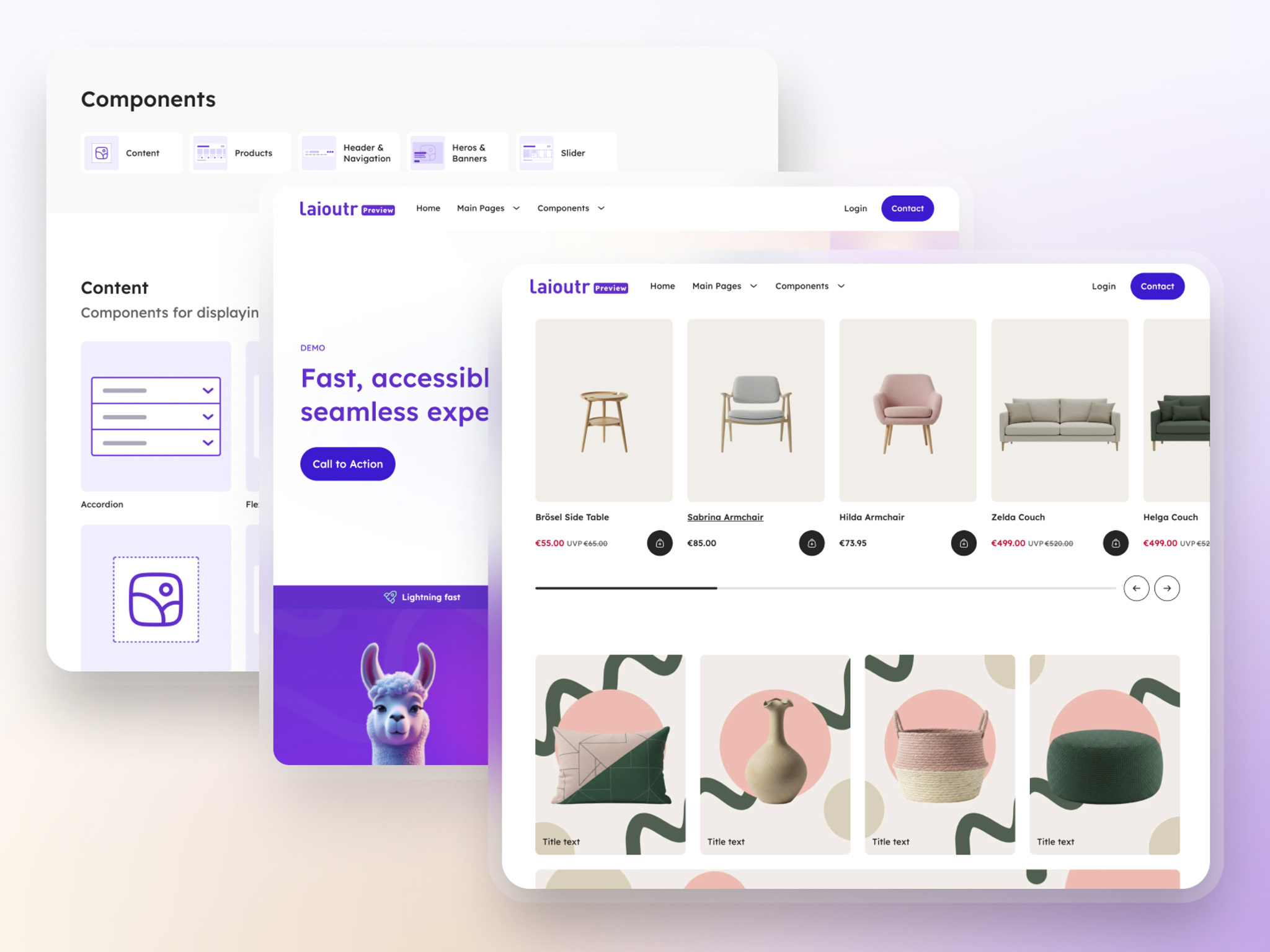
### A visual page builder for every brand environment
With the Studio editor, brand teams design their storefronts visually, no code required. Local marketing teams react to regional trends such as Black Friday in the US or Singles' Day in China, without IT ever being involved. The global stack stays stable. Local freedom and global consistency at the same time.
### A design system that grows with every brand
The UI Kit is the single source of truth across all brands and markets. Reusable components that update globally yet stay visually adapted per brand and per market. No more "pixel recheck per market," no more "rebuild the component per brand."
Frontend does it all
## Not just shops, but the entire digital presence.
One platform for everything: not just storefronts, but all the other digital touchpoints brands need today, per brand, per market.
### Storefronts
High-performance online shops for every brand-market combination. Performance scores and a11y out of the box, connected to the backend of choice.
### Corporate websites
Brand websites with their own visual identity: centrally managed, individually designed, as fast as a storefront.
### Landing pages
Campaign pages for every brand and every market, drag-and-drop, without an IT ticket. Black Friday US, Cyber Monday DE, Singles' Day CN.
### Blogs & magazines
Content formats that position every brand as an expert in its field: per market, with local content and language.
Benefits at a glance
## Three effects that multi-brand, multi-market teams feel immediately.
Performance, time-to-market and local agility: these three effects show up as soon as several brands and markets run on one shared frontend layer.
Performance
### Everywhere
Whether customers shop in New York, Berlin, or Tokyo, they get the same performance. LCP under 1.2s as a global standard, not an exception. Core Web Vitals green in every market.
Time-to-market
### from weeks to days
A new market? A new brand? Existing components are reused and adapted in just a few clicks. Market launches that used to take months are now sprint-sized tasks.
Local flexibility
### without global breakage
Local marketing teams act on their own, for example with a Black Friday campaign in the US, the winter season in DACH or Singles' Day in CN, without the global architecture suffering. IT focuses on platform depth instead of regional banners.
FAQ
## Frequently asked.
What's the difference between multi-brand and multi-market in Laioutr?
Multi-brand means: several brands on one platform, each with its own visual identity, its own branding, its own content strategy. Multi-market means: one or several brands in different countries/languages/currencies. In Laioutr, both run on the same platform, so there is no need to choose one axis.
Can different backends be used per brand?
Yes. Laioutr's Connect layer supports several backends in parallel. Brand A can run on Shopify, Brand B on Shopware, Brand C on a custom GraphQL stack, all within the same platform instance.
How many brands or markets does Laioutr support?
Architecturally unlimited. In practice, setups with up to a double-digit number of brand-market combinations are currently live. The limiting factor is usually not the platform, but the operational bandwidth of the customer team.
What does the migration path from multi-repo to Laioutr look like?
We typically start with one brand or one market as a pilot, usually live within 14 days. After that, further brands and markets are migrated iteratively, without disrupting the existing frontends. Founder-supported migration is standard, not an add-on.
Can each brand look different, or is there a "master look"?
Completely different. Each brand has its own tokens (colors, fonts, spacings), its own component variants, its own layouts. What stays central are the underlying components and their logic. The visual layer is 100% brand-individual.
How does translation maintenance work?
Translations are produced by Translatr directly in the Laioutr platform: Translatr translates content from any connected source, such as Studio pages, Collections or shop data, and delivers it wherever it is needed. Protected terms and replacement rules keep brand and product names consistent, and a preview shows before every run what will be translated. Translatr automatically holds back questionable texts for review, and every translation can be corrected by hand in the Cockpit.
Are there regional hosting options for compliance requirements?
Yes. EU hosting is available, with further regions on request (US, APAC). GDPR-compliant out of the box, with regional data residency possible.
What sets Laioutr apart from a DXP like Adobe Experience Manager for multi-brand?
Adobe Experience Manager is a monolithic DXP that tries to solve all layers (content, commerce, personalization, frontend) in one product. Laioutr is the specialized frontend layer of a composable DXP: backend-agnostic, with a modern Studio editor and performance out of the box.
## Latest news on translation, multi-brand and multi-market
[All Insights](https://www.laioutr.com/en/blogs/insights)
[hreflang, Locale Routing, Fallbacks: SEO for Multi-Market Stores
Whether search engines and AI systems find the right language and market version of a multi-market s…](https://www.laioutr.com/en/blog/hreflang-locale-routing-market-fallbacks-seo-geo)
[Laioutr Release News - October 2026
October centred on four topics. Frontend Core and Orchestr gained source-entity connectors: apps can…](https://www.laioutr.com/en/blog/laioutr-release-news-october-2026)
[Many Country Domains on TYPO3: From n Frontends to One Project
Merchants with many country domains and language variants on TYPO3 often maintain more frontends tha…](https://www.laioutr.com/en/blog/typo3-multi-domain-country-sites-one-frontend-project)
[Local Means Language: Use Locales, Not Country Domains
Online store localization starts with language, content and experience, not with a country domain. T…](https://www.laioutr.com/en/blog/storefront-localization-locale-not-country-domain-2026)
[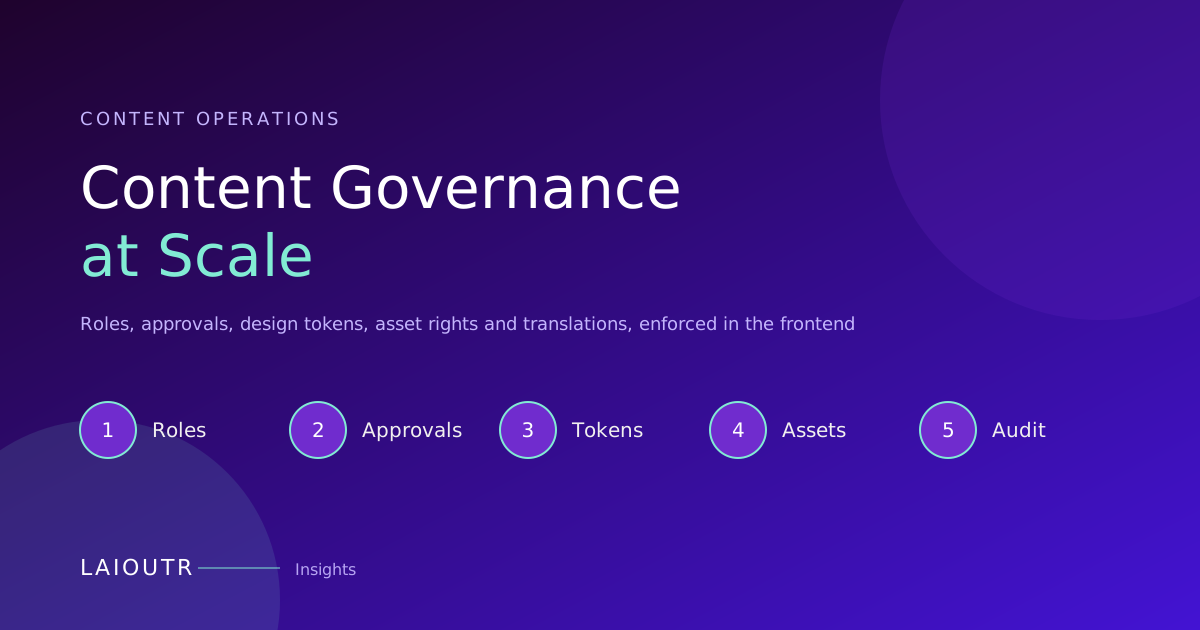Content Governance at Scale: Product Content and Brand Assets
Content governance at scale means that roles, approvals, brand rules, asset rights and translations …](https://www.laioutr.com/en/blog/content-governance-product-content-brand-assets-frontend-2026)
[A New Market in Days, Not Quarters: Time to Market as a Frontend Discipline
When a market entry slips by a quarter, it's rarely the commerce backend causing it. Catalog, pr…](https://www.laioutr.com/en/blog/time-to-market-new-market-frontend-discipline-2026)
[Internationalization in E-Commerce: The 9 Frontend Gaps No Backend Fixes For You
Adding a multi-language field to the backend takes an afternoon. The part that takes months sits in …](https://www.laioutr.com/en/blog/internationalization-ecommerce-nine-frontend-gaps-2026)
[AI Translation or a Translation Agency? A Decision Framework for Every Content Type
Ask a localization lead which translation approach they use and the honest answer is usually "i…](https://www.laioutr.com/en/blog/ai-translation-vs-agency-decision-framework-2026)
[Translation Workflow in the Frontend: How TMS, PIM and Component Schema Connect
Most translation failures are not translation failures. They are handoff failures between three syst…](https://www.laioutr.com/en/blog/translation-workflow-tms-pim-component-schema-2026)
[Trust Is Local: What the ECC Club Study 2026 Means for International Storefronts
The ECC Club Study 2026, "Platforms Between Trust and Reservations," published by IFH Köln…](https://www.laioutr.com/en/blog/trust-is-local-ecc-study-international-storefronts-2026)
[Headless Frontend for IT Resellers: The Icecat Integration
A headless frontend for IT and consumer-el…](https://www.laioutr.com/en/blog/headless-frontend-it-reseller-icecat-integration-2026)
[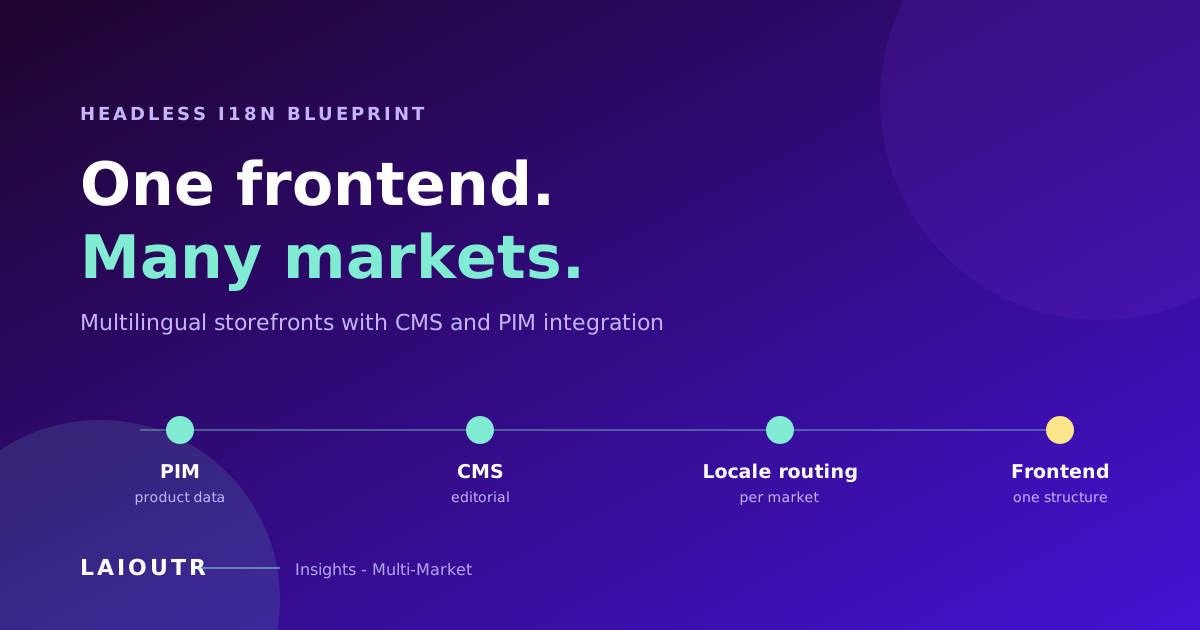Headless Frontend for Multilingual, International Shops
A headless frontend for multilingual, interna…](https://www.laioutr.com/en/blog/headless-frontend-multilingual-cms-pim-2026)
[Run Multiple Brands From One Frontend: The Use-Case
Most teams that run more than one brand or sell into more than one market did not plan their fronten…](https://www.laioutr.com/en/blog/multi-brand-multi-market-frontend-use-case-2026)
[DORA and the Storefront: Why Composable Commerce Is Becoming a Compliance Decision in Financial E-Commerce
Most regulatory programmes hit your business in waves. There is the legal team's first reading. …](https://www.laioutr.com/en/blog/dora-and-the-storefront-why-composable-commerce-is-becoming-a-compliance-decision-in-financial-e-commerce)
[Local and Global Content Strategy for E-Commerce: How to Scale Your Storefront Across Markets
International expansion is one of the most exciting growth levers in e-commerce. It is also one of t…](https://www.laioutr.com/en/blog/local-and-global-content-strategy-for-e-commerce-how-to-scale-your-storefront-across-markets)
READ MORE
## More on translation, visibility and brand management
### Translation Management
Translatr translates content and product data from any source into 71 languages, with protected terms and preview.
[More on Translation Management](https://www.laioutr.com/en/product/translation-management)
### SEO & GEO
Clean markup, structured data and llms.txt ensure visibility in Google and in AI search, in every market.
[More on SEO & GEO](https://www.laioutr.com/en/product/seo-and-geo)
### Brand Consistency
Design tokens and shared components keep every brand consistent, even across many markets.
[More on Brand Consistency](https://www.laioutr.com/en/product/brand-consistency)
Strategy call
## The frontend as a control layer
A conversation about stack, roadmap and replatforming scenario. The outcome: a clear picture of how Laioutr fits, what it costs and how fast the go-live can happen.
*"After 30 minutes, we knew Laioutr makes our replatforming feasible."*
*Daniel B., CEO,* [*hygibox.de*](https://hygibox.de)
[Book a demo](https://www.laioutr.com/en/contact)
## Structured Data
```json
{
"@context": "https://schema.org",
"@graph": [
{
"@type": "Organization",
"@id": "https://www.laioutr.com/#identity",
"name": "Laioutr",
"legalName": "Laioutr GmbH",
"url": "https://www.laioutr.com/",
"logo": {
"@type": "ImageObject",
"url": "https://www.laioutr.com/laioutr-logo.png",
"width": 400,
"height": 400
},
"email": "info@laioutr.com",
"telephone": "+49 30 75435715",
"address": {
"@type": "PostalAddress",
"streetAddress": "Münchweilersteig 5",
"postalCode": "12559",
"addressLocality": "Berlin",
"addressCountry": "DE"
},
"vatID": "DE450905846",
"sameAs": [
"https://www.linkedin.com/company/laioutr",
"https://www.youtube.com/@Laioutr",
"https://x.com/laioutr"
]
},
{
"@type": "WebSite",
"@id": "https://www.laioutr.com/en/#website",
"url": "https://www.laioutr.com/en/",
"name": "Laioutr",
"inLanguage": "en",
"publisher": {
"@id": "https://www.laioutr.com/#identity"
}
},
{
"@type": "SoftwareApplication",
"@id": "https://www.laioutr.com/#platform",
"name": "Laioutr",
"applicationCategory": "BusinessApplication",
"applicationSubCategory": "Agentic Frontend Management Platform",
"operatingSystem": "Web",
"url": "https://www.laioutr.com/",
"publisher": {
"@id": "https://www.laioutr.com/#identity"
}
},
{
"@type": [
"WebPage",
"FAQPage"
],
"@id": "https://www.laioutr.com/en/product/multi-brand-multi-market#webpage",
"url": "https://www.laioutr.com/en/product/multi-brand-multi-market",
"name": "Multi Brand & Multi Market Frontend Management | Laioutr",
"description": "Several brands, several markets, one platform: Laioutr turns multi-brand and multi-market scaling into a linear task, backend-agnostic and high-performance.",
"inLanguage": "en",
"isPartOf": {
"@id": "https://www.laioutr.com/en/#website"
},
"breadcrumb": {
"@id": "https://www.laioutr.com/en/product/multi-brand-multi-market#breadcrumb"
},
"primaryImageOfPage": {
"@type": "ImageObject",
"url": "https://eu-west-2.graphassets.com/cmii2mlqi0dux06l5543v7nkc/cmlj7u8unf2dn06l4gf74lh49"
},
"about": {
"@id": "https://www.laioutr.com/#platform"
},
"mainEntity": [
{
"@type": "Question",
"name": "What's the difference between multi-brand and multi-market in Laioutr?",
"acceptedAnswer": {
"@type": "Answer",
"text": "Multi-brand means: several brands on one platform, each with its own visual identity, its own branding, its own content strategy. Multi-market means: one or several brands in different countries/languages/currencies. In Laioutr, both run on the same platform, so there is no need to choose one axis."
}
},
{
"@type": "Question",
"name": "Can different backends be used per brand?",
"acceptedAnswer": {
"@type": "Answer",
"text": "Yes. Laioutr's Connect layer supports several backends in parallel. Brand A can run on Shopify, Brand B on Shopware, Brand C on a custom GraphQL stack, all within the same platform instance."
}
},
{
"@type": "Question",
"name": "How many brands or markets does Laioutr support?",
"acceptedAnswer": {
"@type": "Answer",
"text": "Architecturally unlimited. In practice, setups with up to a double-digit number of brand-market combinations are currently live. The limiting factor is usually not the platform, but the operational bandwidth of the customer team."
}
},
{
"@type": "Question",
"name": "What does the migration path from multi-repo to Laioutr look like?",
"acceptedAnswer": {
"@type": "Answer",
"text": "We typically start with one brand or one market as a pilot, usually live within 14 days. After that, further brands and markets are migrated iteratively, without disrupting the existing frontends. Founder-supported migration is standard, not an add-on."
}
},
{
"@type": "Question",
"name": "Can each brand look different, or is there a \"master look\"?",
"acceptedAnswer": {
"@type": "Answer",
"text": "Completely different. Each brand has its own tokens (colors, fonts, spacings), its own component variants, its own layouts. What stays central are the underlying components and their logic. The visual layer is 100% brand-individual."
}
},
{
"@type": "Question",
"name": "How does translation maintenance work?",
"acceptedAnswer": {
"@type": "Answer",
"text": "Translations are produced by Translatr directly in the Laioutr platform: Translatr translates content from any connected source, such as Studio pages, Collections or shop data, and delivers it wherever it is needed. Protected terms and replacement rules keep brand and product names consistent, and a preview shows before every run what will be translated. Translatr automatically holds back questionable texts for review, and every translation can be corrected by hand in the Cockpit."
}
},
{
"@type": "Question",
"name": "Are there regional hosting options for compliance requirements?",
"acceptedAnswer": {
"@type": "Answer",
"text": "Yes. EU hosting is available, with further regions on request (US, APAC). GDPR-compliant out of the box, with regional data residency possible."
}
},
{
"@type": "Question",
"name": "What sets Laioutr apart from a DXP like Adobe Experience Manager for multi-brand?",
"acceptedAnswer": {
"@type": "Answer",
"text": "Adobe Experience Manager is a monolithic DXP that tries to solve all layers (content, commerce, personalization, frontend) in one product. Laioutr is the specialized frontend layer of a composable DXP: backend-agnostic, with a modern Studio editor and performance out of the box."
}
}
]
},
{
"@type": "BreadcrumbList",
"@id": "https://www.laioutr.com/en/product/multi-brand-multi-market#breadcrumb",
"itemListElement": [
{
"@type": "ListItem",
"position": 1,
"name": "Laioutr",
"item": "https://www.laioutr.com/en/"
},
{
"@type": "ListItem",
"position": 2,
"name": "Multi Brand & Multi Market Frontend Management"
}
]
}
]
}
```
```json
{
"@context": "https://schema.org",
"@graph": [
{
"@id": "https://www.laioutr.com/en/product/multi-brand-multi-market#webpage",
"description": "Several brands, several markets, one platform: Laioutr turns multi-brand and multi-market scaling into a linear task, backend-agnostic and high-performance.",
"name": "Multi Brand & Multi Market Frontend Management | Laioutr",
"url": "https://www.laioutr.com/en/product/multi-brand-multi-market",
"@type": [
"WebPage",
"FAQPage"
],
"mainEntity": [
{
"@id": "https://www.laioutr.com/en/product/multi-brand-multi-market#/schema/question/1"
},
{
"@id": "https://www.laioutr.com/en/product/multi-brand-multi-market#/schema/question/2"
},
{
"@id": "https://www.laioutr.com/en/product/multi-brand-multi-market#/schema/question/3"
},
{
"@id": "https://www.laioutr.com/en/product/multi-brand-multi-market#/schema/question/4"
},
{
"@id": "https://www.laioutr.com/en/product/multi-brand-multi-market#/schema/question/5"
},
{
"@id": "https://www.laioutr.com/en/product/multi-brand-multi-market#/schema/question/6"
},
{
"@id": "https://www.laioutr.com/en/product/multi-brand-multi-market#/schema/question/7"
},
{
"@id": "https://www.laioutr.com/en/product/multi-brand-multi-market#/schema/question/8"
}
]
},
{
"@id": "https://www.laioutr.com/en/product/multi-brand-multi-market#/schema/question/1",
"@type": "Question",
"inLanguage": "en",
"name": "What's the difference between multi-brand and multi-market in Laioutr?",
"acceptedAnswer": {
"@type": "Answer",
"text": "Multi-brand means: several brands on one platform, each with its own visual identity, its own branding, its own content strategy. Multi-market means: one or several brands in different countries/languages/currencies. In Laioutr, both run on the same platform, so there is no need to choose one axis.
"
}
},
{
"@id": "https://www.laioutr.com/en/product/multi-brand-multi-market#/schema/question/2",
"@type": "Question",
"inLanguage": "en",
"name": "Can different backends be used per brand?",
"acceptedAnswer": {
"@type": "Answer",
"text": "Yes. Laioutr's Connect layer supports several backends in parallel. Brand A can run on Shopify, Brand B on Shopware, Brand C on a custom GraphQL stack, all within the same platform instance.
"
}
},
{
"@id": "https://www.laioutr.com/en/product/multi-brand-multi-market#/schema/question/3",
"@type": "Question",
"inLanguage": "en",
"name": "How many brands or markets does Laioutr support?",
"acceptedAnswer": {
"@type": "Answer",
"text": "Architecturally unlimited. In practice, setups with up to a double-digit number of brand-market combinations are currently live. The limiting factor is usually not the platform, but the operational bandwidth of the customer team.
"
}
},
{
"@id": "https://www.laioutr.com/en/product/multi-brand-multi-market#/schema/question/4",
"@type": "Question",
"inLanguage": "en",
"name": "What does the migration path from multi-repo to Laioutr look like?",
"acceptedAnswer": {
"@type": "Answer",
"text": "We typically start with one brand or one market as a pilot, usually live within 14 days. After that, further brands and markets are migrated iteratively, without disrupting the existing frontends. Founder-supported migration is standard, not an add-on.
"
}
},
{
"@id": "https://www.laioutr.com/en/product/multi-brand-multi-market#/schema/question/5",
"@type": "Question",
"inLanguage": "en",
"name": "Can each brand look different, or is there a \"master look\"?",
"acceptedAnswer": {
"@type": "Answer",
"text": "Completely different. Each brand has its own tokens (colors, fonts, spacings), its own component variants, its own layouts. What stays central are the underlying components and their logic. The visual layer is 100% brand-individual.
"
}
},
{
"@id": "https://www.laioutr.com/en/product/multi-brand-multi-market#/schema/question/6",
"@type": "Question",
"inLanguage": "en",
"name": "How does translation maintenance work?",
"acceptedAnswer": {
"@type": "Answer",
"text": "Translations are produced by Translatr directly in the Laioutr platform: Translatr translates content from any connected source, such as Studio pages, Collections or shop data, and delivers it wherever it is needed. Protected terms and replacement rules keep brand and product names consistent, and a preview shows before every run what will be translated. Translatr automatically holds back questionable texts for review, and every translation can be corrected by hand in the Cockpit.
"
}
},
{
"@id": "https://www.laioutr.com/en/product/multi-brand-multi-market#/schema/question/7",
"@type": "Question",
"inLanguage": "en",
"name": "Are there regional hosting options for compliance requirements?",
"acceptedAnswer": {
"@type": "Answer",
"text": "Yes. EU hosting is available, with further regions on request (US, APAC). GDPR-compliant out of the box, with regional data residency possible.
"
}
},
{
"@id": "https://www.laioutr.com/en/product/multi-brand-multi-market#/schema/question/8",
"@type": "Question",
"inLanguage": "en",
"name": "What sets Laioutr apart from a DXP like Adobe Experience Manager for multi-brand?",
"acceptedAnswer": {
"@type": "Answer",
"text": "Adobe Experience Manager is a monolithic DXP that tries to solve all layers (content, commerce, personalization, frontend) in one product. Laioutr is the specialized frontend layer of a composable DXP: backend-agnostic, with a modern Studio editor and performance out of the box.
"
}
}
]
}
```