---
title: "AI Editorial Workflows in 2026"
canonical_url: "https://www.laioutr.com/en/blog/ai-editorial-workflows-in-2026-why-your-best-production-asset-is-not-the-model"
locale: en
meta:
description: "The teams that gain from AI editorial workflows separate AI drafting from human review and treat brand voice as versioned config."
"og:description": "The teams that gain from AI editorial workflows separate AI drafting from human review and treat brand voice as versioned config."
"og:title": "AI Editorial Workflows in 2026"
---
# AI Editorial Workflows in 2026: Why Your Best Production Asset Is Not the Model
Table of contents
1. [1.From novelty to production reality](#from-novelty-to-production-reality)
2. [2.The three failure modes we keep seeing in 2026](#the-three-failure-modes-we-keep-seeing-in-2026)
3. [3.What production-grade AI editorial workflows look like](#what-production-grade-ai-editorial-workflows-look-like)
4. [4.When bulk operations earn their keep](#when-bulk-operations-earn-their-keep)
5. [5.The brand voice problem hiding in plain sight](#the-brand-voice-problem-hiding-in-plain-sight)
6. [6.Where AI editorial workflows actually pay off in 2026](#where-ai-editorial-workflows-actually-pay-off-in-2026)
7. [7.Why AI editorial workflows belong in your frontend strategy](#why-ai-editorial-workflows-belong-in-your-frontend-strategy)
8. [8.Bottom line: workflow before model, governance before scale](#bottom-line-workflow-before-model-governance-before-scale)
1. [1.From novelty to production reality](#from-novelty-to-production-reality)
2. [2.The three failure modes we keep seeing in 2026](#the-three-failure-modes-we-keep-seeing-in-2026)
3. [3.What production-grade AI editorial workflows look like](#what-production-grade-ai-editorial-workflows-look-like)
4. [4.When bulk operations earn their keep](#when-bulk-operations-earn-their-keep)
5. [5.The brand voice problem hiding in plain sight](#the-brand-voice-problem-hiding-in-plain-sight)
6. [6.Where AI editorial workflows actually pay off in 2026](#where-ai-editorial-workflows-actually-pay-off-in-2026)
7. [7.Why AI editorial workflows belong in your frontend strategy](#why-ai-editorial-workflows-belong-in-your-frontend-strategy)
8. [8.Bottom line: workflow before model, governance before scale](#bottom-line-workflow-before-model-governance-before-scale)
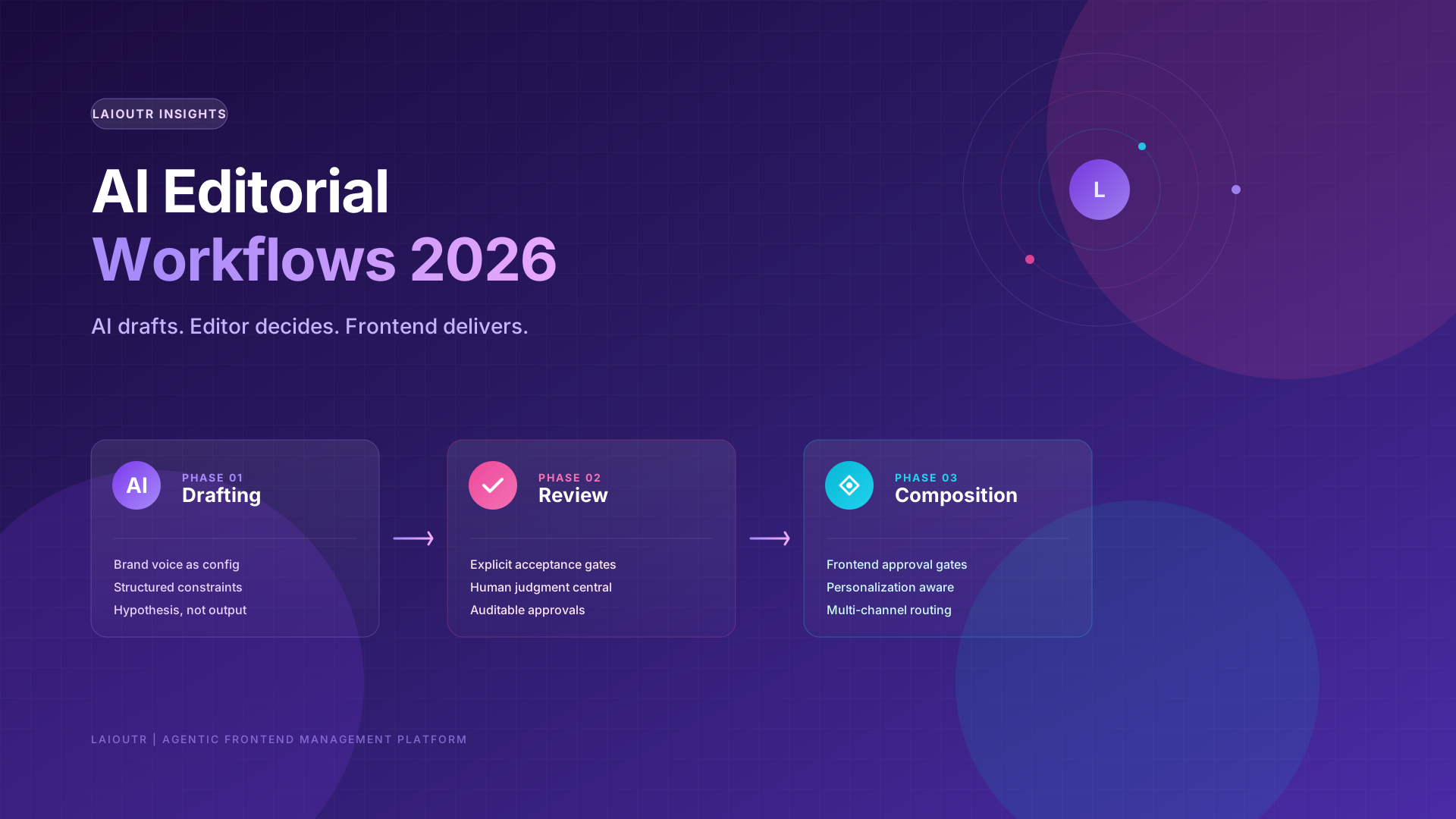
By 2026, AI editorial workflows are no longer a novelty. They are an expectation. The teams that get measurable lift from them are not the ones with the most sophisticated LLM. They are the ones whose architecture separates AI drafting from human review and from frontend composition, and treats brand voice as a versioned configuration rather than a tone-of-voice PDF. Bulk operations earn their keep only where the cost of an editorial miss is low. The pattern that scales is unglamorous: AI drafts, editor decides, frontend delivers under explicit approval gates.
## From novelty to production reality
Two years ago, a content team running an LLM inside their editorial workflow was a talking point. Today, in mid-2026, it is the baseline. Every credible content platform ships some form of AI-assisted drafting. Most marketing departments have already retrofitted older content with AI-generated meta descriptions, summaries, or alt text. The technology is not the differentiator anymore.
What separates the teams getting real lift from those quietly diluting their brand is the architecture around the model. The model itself is now a commodity. The handoff between drafting and human judgment is not. The connection between the editorial pipeline and the frontend that actually delivers the content to a reader is even less so. And brand voice, treated as a serious operational asset rather than a marketing artifact, has emerged as the deciding factor in whether AI editorial workflows feel like an upgrade or a slow leak.
This article looks at how production-grade AI editorial workflows are being built in 2026, where they fail, and why the most consequential decisions sit in the architecture, not in the model.
## The three failure modes we keep seeing in 2026
Every project review we run with content leaders in 2026 surfaces the same three failure modes. They are not new, but they have become more consequential as bulk operations expand the blast radius of any mistake.
The first failure mode is the missing review gate. Teams configure an AI action that fills a content field automatically. The field goes into production through a workflow that does not require explicit human approval. Within weeks, the team is publishing assertions, statistics, or product descriptions that no editor has actually read. The first time this surfaces externally is usually a complaint or a quiet drop in engagement metrics that takes a quarter to diagnose.
The second failure mode is brand voice erosion. The model is competent. The output is grammatically clean. But it drifts towards a generic, slightly American, slightly corporate tone that is technically correct and quietly wrong. Across hundreds of bulk-processed entries, this drift becomes invisible to editors who are reviewing items one at a time. The first signal often comes from outside: a long-time reader noting that the brand "sounds different now."
The third failure mode is the disconnected pipeline. The editorial side does AI-assisted drafting, the frontend side runs personalization and A/B tests, and neither system tells the other what is approved, what is experimental, and what should never have left draft state. The result is occasional embarrassments: a placeholder reaching live traffic, a draft variant getting promoted to a winner, a deprecated message persisting in personalization rules nobody owns anymore.
These three failures share a root cause. They come from treating AI as a tool that drops into an existing workflow rather than as a pipeline that needs its own architecture.
## What production-grade AI editorial workflows look like
The pattern that holds up under load has three clearly separated phases. We see variants of this pattern at every Laioutr customer that has scaled AI in their editorial stack without brand cost.
### Drafting under constraints, not from blanks
Modern AI drafting is not about asking a model to write a post. It is about giving the model a tight set of constraints, the right context, and a clear definition of what good looks like. The constraints include brand voice configuration, glossary, banned terms, structural requirements, and a target length. The context is the source material, not a vague brief. The definition of good is the same standard the editor will apply later, expressed in a form the model can actually use.
The output of this phase is explicitly a draft. It is a hypothesis that this is what the asset should say. It is not a candidate for the live field, no matter how good the model is. The discipline of treating outputs as drafts, even when they look polished, is what protects everything downstream.
### Review with explicit acceptance criteria
In a well-built workflow, the editor does not "look over" the AI draft. The editor applies a checklist that is part of the workflow itself. Are the factual claims in the source material? Does the voice match the brand configuration? Is anything missing that the format requires? Has the framing changed because the post was edited after the draft was generated?
Acceptance criteria do two things. They make the review faster, because the editor knows exactly what to check. And they make the review auditable, because what was approved against what standard is recoverable later. Auditability matters more in 2026 than it did two years ago. Compliance teams, particularly in regulated industries, now ask for traces of who reviewed AI-assisted content and under what criteria.
### Composition that respects the approval gate
This phase is where most editorial discussions end too early. Approved content is not the same as delivered content. Between approval and the moment a reader actually sees something, a composition layer decides which variant to serve, to whom, on which channel, in which market, under which personalization rule.
The non-negotiable feature in this phase is the approval gate. A composition layer must know the publication status of every asset and refuse to serve anything that is not explicitly cleared for the channel and audience in question. Sounds basic. Is routinely broken. The teams that get this right treat the approval state as a hard constraint, not a soft hint.
## When bulk operations earn their keep
Bulk processing is the part of AI editorial workflows that gets the most attention, often for the wrong reasons. The promise is intoxicating: hundreds of meta descriptions in an afternoon, thousands of alt texts in a weekend, an entire content archive brought up to current editorial standards in a single sprint. The reality is that the value of bulk depends entirely on the brand risk of the task.
For tasks where errors are easy to spot and cheap to fix, bulk is genuinely transformative. Alt text for stock imagery. SEO meta descriptions for evergreen content. Taxonomy suggestions across a legacy archive. In these cases, an editor can review a batch of 50 generated outputs in 10 minutes and approve, edit, or reject with confidence.
For tasks where errors are subtle or expensive, bulk is a trap. Any text that touches product claims, pricing, service guarantees, statistics, or direct quotes belongs in a one-at-a-time workflow, no matter how tempting the time savings sound. The rule of thumb we share with clients is simple. If an editor cannot validate an output in 15 seconds, the task does not belong in a bulk batch.
The same rule applies to AI-suggested taxonomy and tagging. Suggestions are great. Auto-application is dangerous, because tag drift is silent and recovers slowly.
## The brand voice problem hiding in plain sight
Brand voice has quietly become the single hardest constraint in AI editorial workflows. Two years ago, it was a marketing artifact: a one-page document with adjectives, a glossary, a few "we do this, not that" examples. In 2026, it has to be an operational configuration. It has to be machine-readable, versioned, applied at draft generation, enforced at review, and used in composition decisions.
Where this lands well, the workflow improves with every cycle. Editors flag voice drift in their reviews, the configuration gets updated, the next batch of drafts is measurably better, and the system gets sharper over time. Where it lands poorly, voice drift accumulates silently. By the time the marketing team notices that everything sounds slightly off, hundreds of assets are already in the wild.
The investment is small relative to the return. A brand voice configuration with a glossary of 100 to 200 terms, ten or fifteen style rules, and clear "voice guards" for tone covers most of what an LLM needs. Maintaining it is a habit, not a project. The teams that build this habit early end up with the strongest AI editorial workflows by 2027.
## Where AI editorial workflows actually pay off in 2026
TL;DR summaries are a popular entry point because they are short, contained, and easy to review. They are a good place to learn the workflow. They are not where most of the value lives.
The most productive applications we see in 2026 are these. SEO meta descriptions and alt text retrofits across legacy content archives. Channel-specific teaser variations from a master article, drafted by AI and approved per channel by an editor. Multilingual draft generation as a baseline for native-speaker editors, not as a final translation. Taxonomy suggestion at scale, with human approval. Personalization variant drafting for A/B testing, gated by approval before variants enter the test pool.
Each of these tasks has the same structure. A clearly defined input, a measurable output, a fast review, and a controlled handoff to the system that actually delivers the content. None of them require a frontier model. All of them require disciplined integration.
## Why AI editorial workflows belong in your frontend strategy
In most organizations, the conversation about AI in content ends with whoever owns the CMS. That is a comfortable boundary, and it is wrong. The value of AI editorial workflows compounds when they are connected to the layer that actually delivers content to users, which is the frontend.
Here is a concrete example. A retailer generates short, emotional headlines for 12,000 product detail pages using an AI editorial workflow. The CMS workflow looks great. On the frontend, however, the team discovers that some headlines perform brilliantly in one market and weakly in another, that a personalization segment responds to a different style than another, and that engagement varies dramatically by entry channel. Without a connection between the editorial pipeline and the frontend control layer, these learnings stay in the analytics tool and never flow back into the brand voice configuration or the drafting prompts.
With a frontend control layer such as Laioutr, the loop closes. Approved AI drafts can be treated as variants, exposed to controlled personalization tests, scored against business outcomes, and fed back as signals into the voice configuration. The workflow becomes a learning system rather than a one-time batch.
## Bottom line: workflow before model, governance before scale
AI editorial workflows in 2026 are not a frontier topic. They are an operational reality. What separates a successful program from a risky one is not the model in use. It is the architecture around it, the discipline of the handoffs, and the seriousness with which brand voice is treated as a configuration rather than a sentiment.
Teams that get this right keep their editors central, treat AI as a drafting accelerator rather than a publisher, run bulk operations only where risk is low, and connect the editorial pipeline to the frontend layer that delivers to readers. Teams that skip these steps gain two weeks of perceived velocity and risk six months of brand erosion.
The pattern that scales is the boring one. AI drafts, editor decides, frontend delivers under explicit approval gates. Everything else is optimization in the wrong direction.
### Related Laioutr articles
- [Agentic Analytics in 2026: Why Marketers Will Stop Reading Dashboards](https://www.laioutr.com/en/blog/agentic-analytics-in-2026-why-marketers-will-stop-reading-dashboards "https://www.laioutr.com/en/blog/agentic-analytics-in-2026-why-marketers-will-stop-reading-dashboards")
- [Hybrid AI Architecture in Commerce: Why the LLM-Only Strategy Quietly Loses Money](https://www.laioutr.com/en/blog/hybrid-ai-architecture-in-commerce-why-the-llm-only-strategy-quietly-loses-money "https://www.laioutr.com/en/blog/hybrid-ai-architecture-in-commerce-why-the-llm-only-strategy-quietly-loses-money")
- [Speed-to-Market for Modern Commerce: Why Velocity Is the New Competitive Moat](https://www.laioutr.com/en/blog/speed-to-market-for-modern-commerce-why-velocity-is-the-new-competitive-moat "https://www.laioutr.com/en/blog/speed-to-market-for-modern-commerce-why-velocity-is-the-new-competitive-moat")
### Want to see this in action?
Book a 30-minute strategy session and we will show you what production-grade AI editorial workflows look like in your stack, where bulk operations are worth the risk, and how brand voice can live as a versioned configuration inside your frontend control layer. [Request a demo](https://www.laioutr.com/en/contact "https://www.laioutr.com/en/contact").
### **More from the Laioutr Platform**
- [Agentic Frontend Management Platform](https://www.laioutr.com/en/agentic-frontend-management-platform)
- [SEO and GEO](https://www.laioutr.com/en/product/seo-and-geo)
- [Composable Digital Experience Platform](https://www.laioutr.com/en/composable-digital-experience-platform)
---
Share this article
[Share on Facebook](https://www.facebook.com/sharer/sharer.php?u=https%3A%2F%2Fwww.laioutr.com%2Fen%2Fblog%2Fai-editorial-workflows-in-2026-why-your-best-production-asset-is-not-the-model) [Share on X](https://x.com/intent/post?url=https%3A%2F%2Fwww.laioutr.com%2Fen%2Fblog%2Fai-editorial-workflows-in-2026-why-your-best-production-asset-is-not-the-model&text=) [Share on LinkedIn](https://www.linkedin.com/sharing/share-offsite/?url=https%3A%2F%2Fwww.laioutr.com%2Fen%2Fblog%2Fai-editorial-workflows-in-2026-why-your-best-production-asset-is-not-the-model) [Share on Pinterest](https://pinterest.com/pin/create/button/?url=https%3A%2F%2Fwww.laioutr.com%2Fen%2Fblog%2Fai-editorial-workflows-in-2026-why-your-best-production-asset-is-not-the-model&description=) [Share via email](mailto:?subject=&body=%0A%0Ahttps%3A%2F%2Fwww.laioutr.com%2Fen%2Fblog%2Fai-editorial-workflows-in-2026-why-your-best-production-asset-is-not-the-model)
## More interesting articles
Practical know-how for frontend development, smart agents, and headless
[To the blog](https://www.laioutr.com/en/blogs)
[iPhone Duo and Ecommerce: What Merchants Need to Know Now
iPhone Duo goes on sale on October 23, 2026. Online stores don't need a dedicated app or a custo…](https://www.laioutr.com/en/blog/iphone-duo-ecommerce-foldable-storefront)
[Structured Product Data: How It Shows Up in Your Storefront
Structured product data means every product fact lives in a typed attribute with a unit, a stable id…](https://www.laioutr.com/en/blog/structured-product-data-pim-frontend-2026)
[44% Decide via Trial or PoC: How to Run a Storefront PoC in DACH
In DACH, software decisions are increasingly made hands-on: in the study "Software Buying in DA…](https://www.laioutr.com/en/blog/storefront-proof-of-concept-dach-buyers-2026)
[Frontend Management Platform Comparison: How to Choose the Right FMP
Choosing a frontend management platform (FMP) is less about feature lists and more about where your …](https://www.laioutr.com/en/blog/frontend-management-platform-comparison-how-to-choose-2026)
[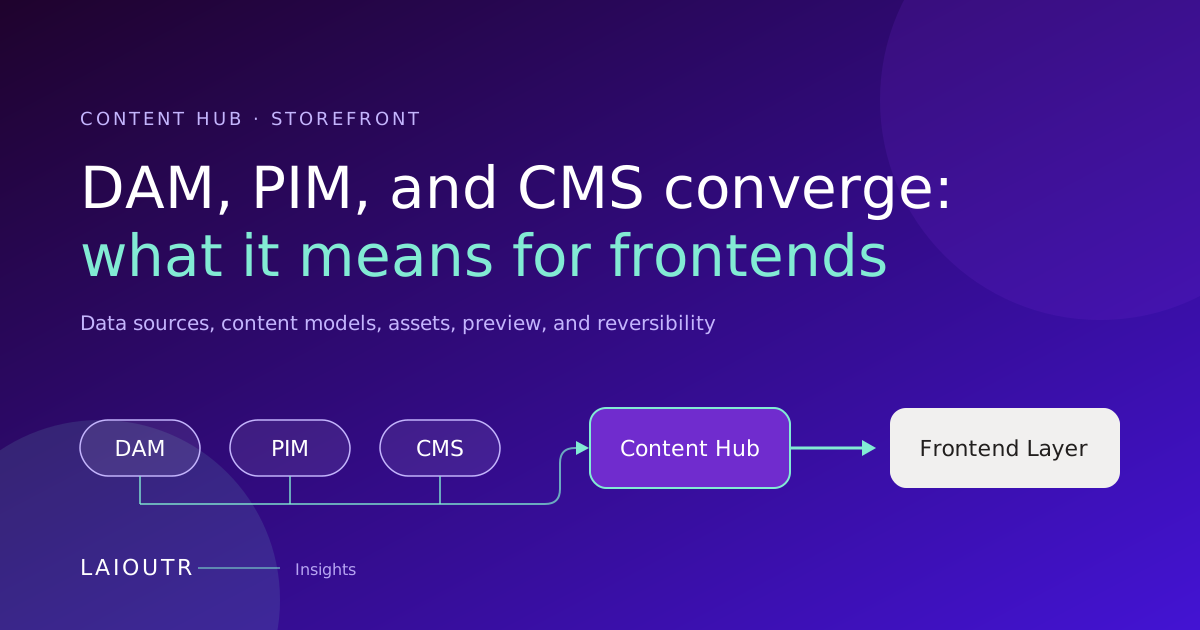DAM, PIM, and CMS Are Converging: What It Means for Your Storefront
DAM, PIM, and CMS vendors are moving into each other's territory, and more teams now evaluate on…](https://www.laioutr.com/en/blog/dam-pim-cms-convergence-content-hub-storefront-2026)
[Contentful Live Preview: What Your Frontend Has to Deliver
Contentful Live Preview lets editors see a draft right next to the entry editor and watch changes ap…](https://www.laioutr.com/en/blog/contentful-live-preview-frontend-perspective-2026)
[Content Governance at Scale: Product Content and Brand Assets
Content governance at scale means that roles, approvals, brand rules, asset rights and translations …](https://www.laioutr.com/en/blog/content-governance-product-content-brand-assets-frontend-2026)
[AI Agents as Frontend Operators: Architecture and Control Model
An AI agent becomes a frontend operator when it watches the running storefront, spots concrete issue…](https://www.laioutr.com/en/blog/ai-agents-as-frontend-operators-2026)
[Shopping Agents Read Your Feed: What Agentic Commerce Changes
Agentic commerce adds a new reader to your product data: shopping agents in ChatGPT, Google AI Mode,…](https://www.laioutr.com/en/blog/shopping-agents-product-feeds-agentic-data-distribution-2026)
[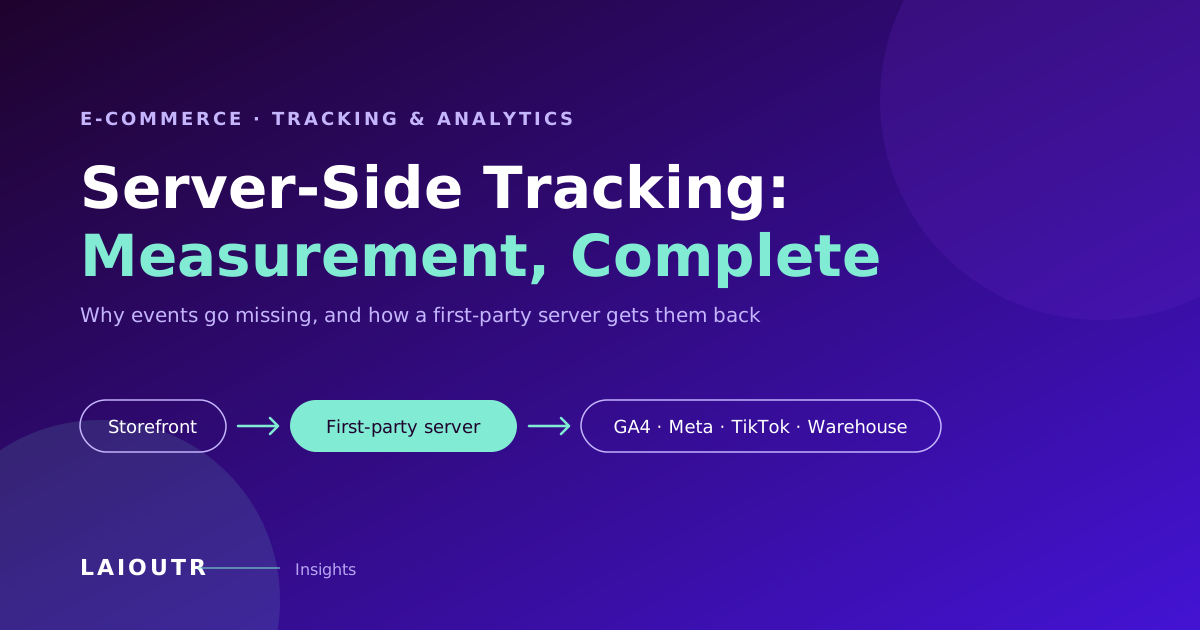Server-Side Tracking in E-Commerce: Making Measurement Complete Again
Server-side tracking moves the forwarding of analytics and conversion events from the visitor's …](https://www.laioutr.com/en/blog/server-side-tracking-ecommerce-complete-measurement-2026)
[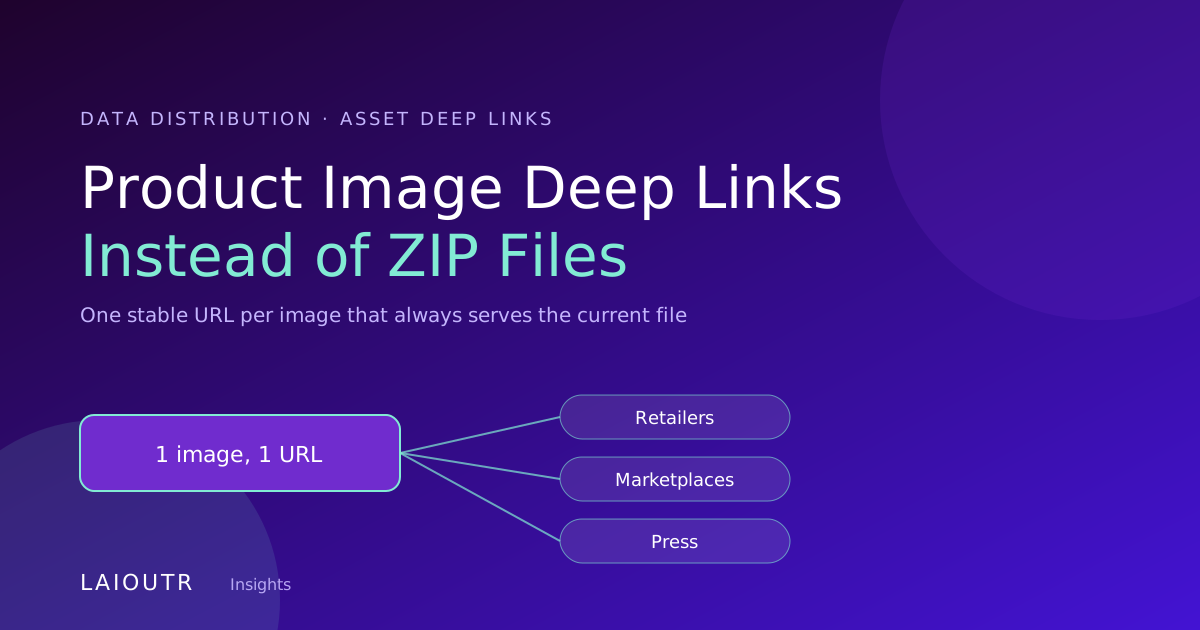Product Image Deep Links, Not ZIP Files: Assets That Stay Current
If you still send product images to retailers, marketplaces and press as ZIP files, every package st…](https://www.laioutr.com/en/blog/product-image-deeplinks-asset-distribution-2026)
[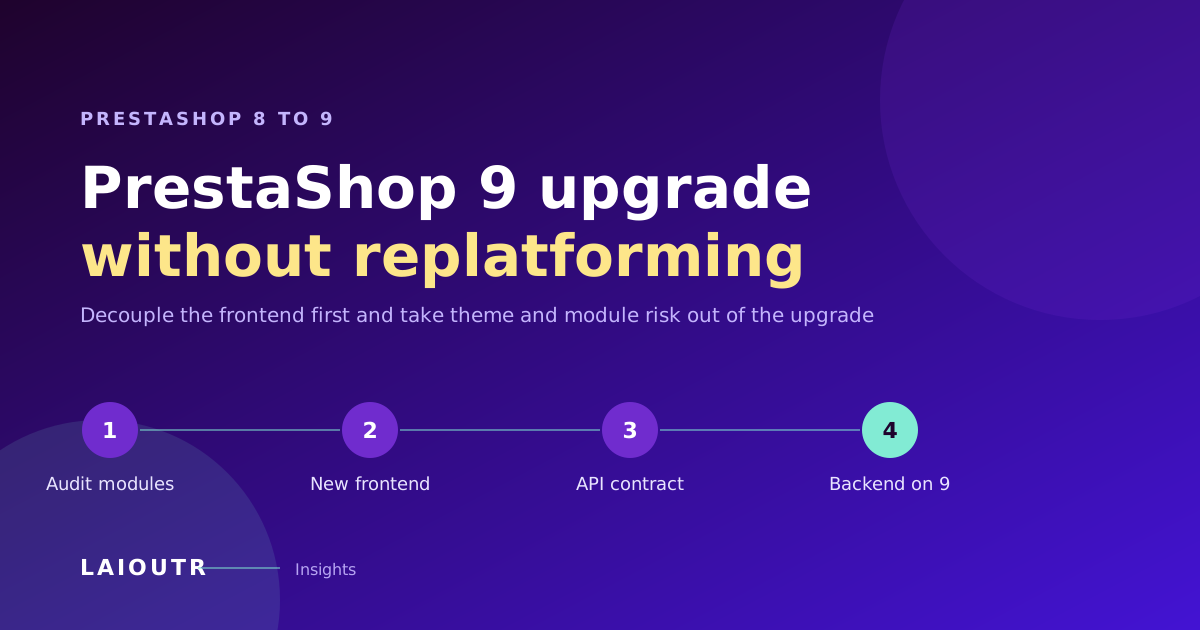PrestaShop 8 to 9 Upgrade Without Replatforming: Decouple the Frontend
You can take most of the risk out of the PrestaShop 8 to 9 upgrade by moving the storefront off the …](https://www.laioutr.com/en/blog/prestashop-8-to-9-upgrade-without-replatforming-2026)
[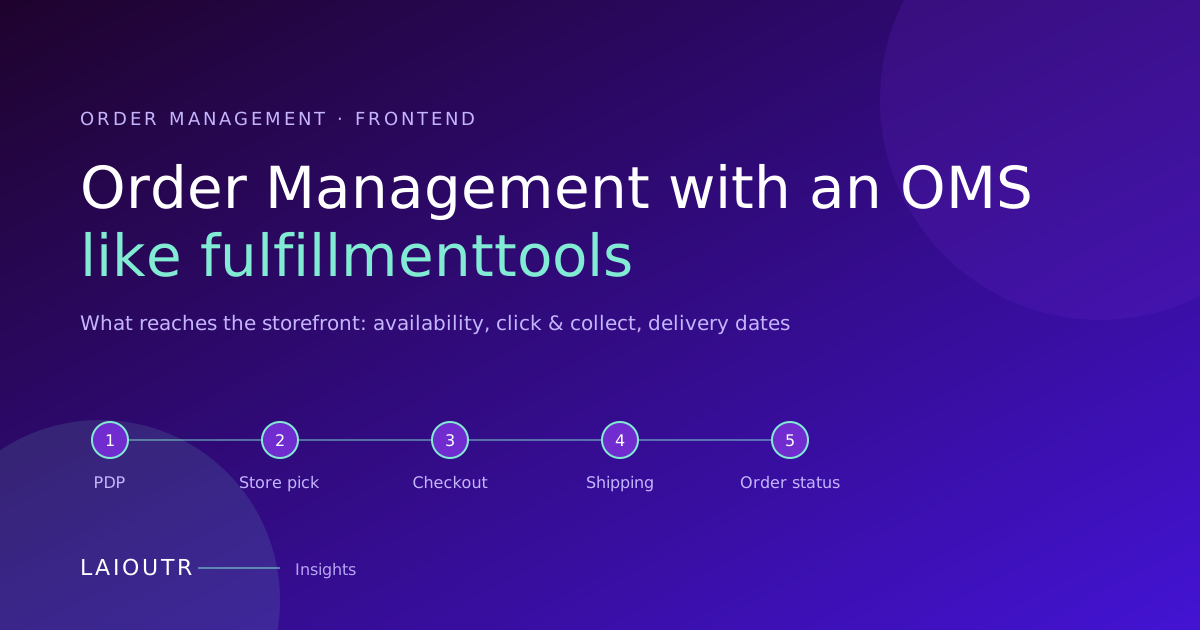Order Management With an OMS Like fulfillmenttools: The Frontend View
An efficient order management system decides which location fulfills an order, how much stock is rea…](https://www.laioutr.com/en/blog/order-management-fulfillmenttools-oms-frontend-2026)
[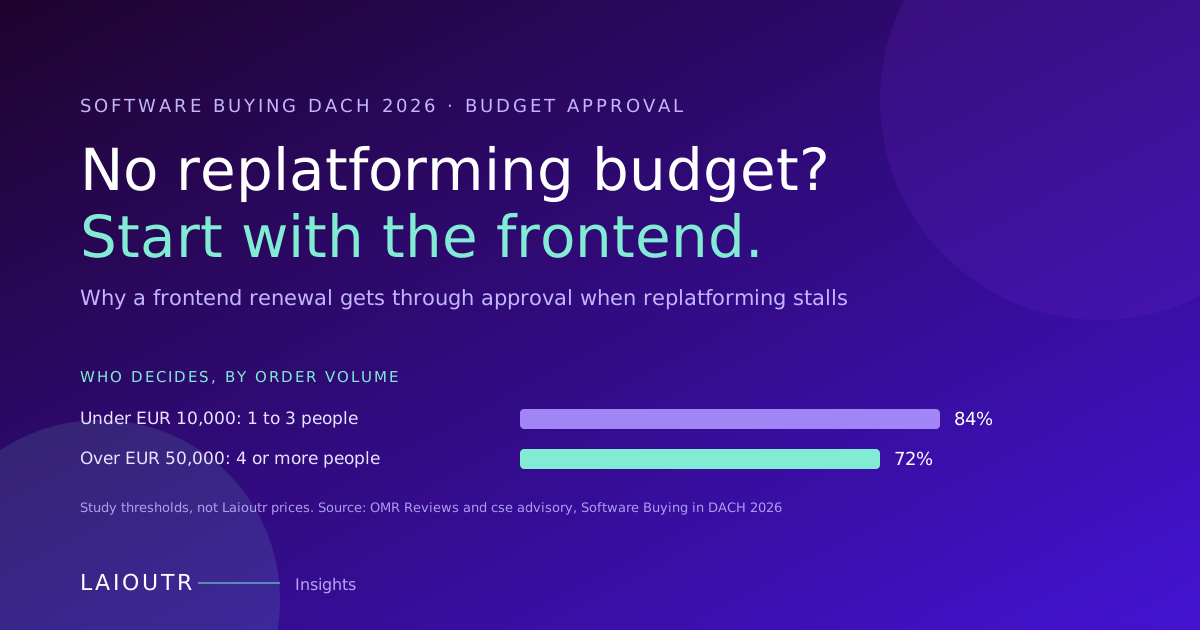No Replatforming Budget in 2026? Why the Frontend Gets Approved
If your 2026 budget has no room for a replatforming project, you are not alone, and you do not have …](https://www.laioutr.com/en/blog/no-replatforming-budget-frontend-project-approval-2026)
[Garden Retail Order Management: What Your Storefront Must Show
In garden and DIY retail, one cart can hold a parcel item, a patio set that ships by freight, live p…](https://www.laioutr.com/en/blog/garden-retail-order-management-seasonal-frontend-2026)
[](https://www.laioutr.com/en/apps/shopify)
Laioutr
[Shopify](https://www.laioutr.com/en/apps/shopify)
Shopify is a commerce platform for selling online and in physical retail.
[](https://www.laioutr.com/en/apps/shopware)
Laioutr
[Shopware](https://www.laioutr.com/en/apps/shopware)
Shopware is a flexible ecommerce platform from Europe for product catalogs and omnichannel commerce.
[](https://www.laioutr.com/en/apps/adobe-commerce)
Laioutr
[Adobe Commerce](https://www.laioutr.com/en/apps/adobe-commerce)
Adobe Commerce is an enterprise commerce platform for complex, global B2C and B2B scenarios.
Planned
[](https://www.laioutr.com/en/apps/b2b-sellers)
Laioutr
[B2Bsellers](https://www.laioutr.com/en/apps/b2b-sellers)
B2B suite for Shopware that turns an online store into a professional B2B commerce platform.
Planned
[](https://www.laioutr.com/en/apps/commerce-layer)
Laioutr
[Commerce Layer](https://www.laioutr.com/en/apps/commerce-layer)
Commerce Layer is a headless commerce platform for making inventory and catalogs available online.
[](https://www.laioutr.com/en/apps/commercetools)
Laioutr
[Commercetools](https://www.laioutr.com/en/apps/commercetools)
Commercetools is a SaaS-based headless ecommerce platform used worldwide.
[](https://www.laioutr.com/en/apps/emporix)
Laioutr
[Emporix](https://www.laioutr.com/en/apps/emporix)
Emporix is a composable, API-first commerce platform for scalable B2B and B2C scenarios.
Planned
[](https://www.laioutr.com/en/apps/hcl-software)
Laioutr
[HCL Software](https://www.laioutr.com/en/apps/hcl-software)
Enterprise suite for digital commerce and experience with extensive configurability.
Planned
[](https://www.laioutr.com/en/apps/intershop)
Laioutr
[Intershop](https://www.laioutr.com/en/apps/intershop)
Enterprise commerce platform for complex B2B and B2C business models.
Planned
[](https://www.laioutr.com/en/apps/magento-2)
Laioutr
[Magento 2](https://www.laioutr.com/en/apps/magento-2)
Widely used, extensible commerce platform for B2C and B2B scenarios.
[](https://www.laioutr.com/en/apps/oxid-eshop)
Laioutr
[OXID eShop](https://www.laioutr.com/en/apps/oxid-eshop)
OXID eShop is an extensible commerce platform for complex B2B and B2C requirements.
Planned
[](https://www.laioutr.com/en/apps/patchworks)
Laioutr
[Patchworks](https://www.laioutr.com/en/apps/patchworks)
Patchworks is a low-code iPaaS that connects ecommerce, ERP, WMS, 3PL, and marketplaces.
Planned
[](https://www.laioutr.com/en/apps/PrestaShop)
Laioutr
[Prestashop](https://www.laioutr.com/en/apps/PrestaShop)
Open-source commerce platform for small and midsize merchants in Europe and beyond.
Planned
[](https://www.laioutr.com/en/apps/saleor)
Laioutr
[Saleor](https://www.laioutr.com/en/apps/saleor)
Open-source, API-first commerce platform built on GraphQL for custom storefronts.
Planned
[](https://www.laioutr.com/en/apps/salesforce-commerce-cloud)
Laioutr
[Salesforce Commerce Cloud](https://www.laioutr.com/en/apps/salesforce-commerce-cloud)
Salesforce Commerce Cloud is a cloud-based enterprise commerce platform for businesses of any size.
Planned
[](https://www.laioutr.com/en/apps/sap-commerce-cloud)
Laioutr
[SAP Commerce Cloud](https://www.laioutr.com/en/apps/sap-commerce-cloud)
Enterprise commerce platform for complex catalogs, pricing models, and omnichannel journeys.
Planned
[](https://www.laioutr.com/en/apps/scayle)
Laioutr
[Scayle](https://www.laioutr.com/en/apps/scayle)
SCAYLE is a commerce engine that helps brands and retailers scale their business.
Planned
[](https://www.laioutr.com/en/apps/spryker)
Laioutr
[Spryker](https://www.laioutr.com/en/apps/spryker)
Composable commerce platform for sophisticated B2B and B2C business models.
[](https://www.laioutr.com/en/apps/sylius)
Laioutr
[Sylius](https://www.laioutr.com/en/apps/sylius)
Sylius is a developer-friendly ecommerce framework for B2C and B2B shopping experiences.
Planned
[](https://www.laioutr.com/en/apps/vendure)
Laioutr
[Vendure](https://www.laioutr.com/en/apps/vendure)
Vendure is a headless commerce platform for businesses with complex requirements.
Coming Soon
[](https://www.laioutr.com/en/apps/vtex)
Laioutr
[VTEX](https://www.laioutr.com/en/apps/vtex)
Cloud-native, composable commerce platform for B2B and B2C at scale.
Planned
[](https://www.laioutr.com/en/apps/websale)
Laioutr
[Websale](https://www.laioutr.com/en/apps/websale)
Stable, enterprise-ready commerce backend for complex retail environments.

Strategy call
## Ready to turn your frontend into a control layer?
Show us your stack, your roadmap, your replatforming scenario, and we'll show you how Laioutr fits, what it costs, and how fast you go live.
*"After 30 minutes, we knew Laioutr makes our replatforming feasible." - Daniel B., CEO,* [*hygibox.de*](https://hygibox.de)
[Book a demo](https://www.laioutr.com/en/contact)
## Structured Data
```json
{
"@context": "https://schema.org",
"@graph": [
{
"@type": "Organization",
"@id": "https://www.laioutr.com/#identity",
"name": "Laioutr",
"legalName": "Laioutr GmbH",
"url": "https://www.laioutr.com/",
"logo": {
"@type": "ImageObject",
"url": "https://www.laioutr.com/laioutr-logo.png",
"width": 400,
"height": 400
},
"email": "info@laioutr.com",
"telephone": "+49 30 75435715",
"address": {
"@type": "PostalAddress",
"streetAddress": "Münchweilersteig 5",
"postalCode": "12559",
"addressLocality": "Berlin",
"addressCountry": "DE"
},
"vatID": "DE450905846",
"sameAs": [
"https://www.linkedin.com/company/laioutr",
"https://www.youtube.com/@Laioutr",
"https://x.com/laioutr"
]
},
{
"@type": "WebSite",
"@id": "https://www.laioutr.com/en/#website",
"url": "https://www.laioutr.com/en/",
"name": "Laioutr",
"inLanguage": "en",
"publisher": {
"@id": "https://www.laioutr.com/#identity"
}
},
{
"@type": "BlogPosting",
"@id": "https://www.laioutr.com/en/blog/ai-editorial-workflows-in-2026-why-your-best-production-asset-is-not-the-model#article",
"headline": "AI Editorial Workflows in 2026: Why Your Best Production Asset Is Not the Model",
"description": "The teams that gain from AI editorial workflows separate AI drafting from human review and treat brand voice as versioned config.",
"image": [
"https://eu-west-2.graphassets.com/cmii2mlqi0dux06l5543v7nkc/cmp59ltlf1dbt07lbx90mwp9d"
],
"datePublished": "2026-06-30T17:34:48.831042+00:00",
"dateModified": "2026-06-30T17:34:48.212974+00:00",
"inLanguage": "en",
"articleSection": "Insights",
"keywords": "Industry & Trends",
"author": {
"@type": "Person",
"name": "Marcel Thiesies",
"jobTitle": "Co-Founder & CEO, Laioutr",
"image": "https://eu-west-2.graphassets.com/cmii2mlqi0dux06l5543v7nkc/cmj01b962364n07lb0iguvts5"
},
"publisher": {
"@id": "https://www.laioutr.com/#identity"
},
"mainEntityOfPage": {
"@id": "https://www.laioutr.com/en/blog/ai-editorial-workflows-in-2026-why-your-best-production-asset-is-not-the-model#webpage"
},
"isPartOf": {
"@id": "https://www.laioutr.com/en/#website"
}
},
{
"@type": "WebPage",
"@id": "https://www.laioutr.com/en/blog/ai-editorial-workflows-in-2026-why-your-best-production-asset-is-not-the-model#webpage",
"url": "https://www.laioutr.com/en/blog/ai-editorial-workflows-in-2026-why-your-best-production-asset-is-not-the-model",
"name": "AI Editorial Workflows in 2026: Why Your Best Production Asset Is Not the Model",
"description": "The teams that gain from AI editorial workflows separate AI drafting from human review and treat brand voice as versioned config.",
"inLanguage": "en",
"isPartOf": {
"@id": "https://www.laioutr.com/en/#website"
},
"breadcrumb": {
"@id": "https://www.laioutr.com/en/blog/ai-editorial-workflows-in-2026-why-your-best-production-asset-is-not-the-model#breadcrumb"
},
"primaryImageOfPage": {
"@type": "ImageObject",
"url": "https://eu-west-2.graphassets.com/cmii2mlqi0dux06l5543v7nkc/cmp59ltlf1dbt07lbx90mwp9d"
},
"datePublished": "2026-06-30T17:34:48.831042+00:00",
"dateModified": "2026-06-30T17:34:48.212974+00:00",
"mainEntity": {
"@id": "https://www.laioutr.com/en/blog/ai-editorial-workflows-in-2026-why-your-best-production-asset-is-not-the-model#article"
}
},
{
"@type": "BreadcrumbList",
"@id": "https://www.laioutr.com/en/blog/ai-editorial-workflows-in-2026-why-your-best-production-asset-is-not-the-model#breadcrumb",
"itemListElement": [
{
"@type": "ListItem",
"position": 1,
"name": "Laioutr",
"item": "https://www.laioutr.com/en/"
},
{
"@type": "ListItem",
"position": 2,
"name": "Insights",
"item": "https://www.laioutr.com/en/blogs/insights"
},
{
"@type": "ListItem",
"position": 3,
"name": "AI Editorial Workflows in 2026: Why Your Best Production Asset Is Not the Model"
}
]
}
]
}
```