---
title: "RFC 10008: HTTP Query for Headless Frontends Explained"
canonical_url: "https://www.laioutr.com/en/blog/rfc-10008-http-query-headless-frontend"
locale: en
meta:
description: "See how RFC 10008 defines HTTP query handling for headless frontends: syntax, caching impact, and implementation notes for your storefront stack."
"og:description": "See how RFC 10008 defines HTTP query handling for headless frontends: syntax, caching impact, and implementation notes for your storefront stack."
"og:title": "RFC 10008: HTTP Query for Headless Frontends Explained"
---
# RFC 10008: The New HTTP Method That Makes You Rethink Headless Storefronts
Table of contents
1. [1.The problem QUERY solves](#the-problem-query-solves)
2. [2.What QUERY does differently](#what-query-does-differently)
3. [3.Being honest about the adoption path](#being-honest-about-the-adoption-path)
4. [4.Why this is a strategic question - not just a technical one](#why-this-is-a-strategic-question-not-just-a-technical-one)
5. [5.What this means for you - today](#what-this-means-for-you-today)
6. [6.Build on a frontend-independent foundation](#build-on-a-frontend-independent-foundation)
7. [7.Frequently asked questions about RFC 10008](#frequently-asked-questions-about-rfc-10008)
1. [1.The problem QUERY solves](#the-problem-query-solves)
2. [2.What QUERY does differently](#what-query-does-differently)
3. [3.Being honest about the adoption path](#being-honest-about-the-adoption-path)
4. [4.Why this is a strategic question - not just a technical one](#why-this-is-a-strategic-question-not-just-a-technical-one)
5. [5.What this means for you - today](#what-this-means-for-you-today)
6. [6.Build on a frontend-independent foundation](#build-on-a-frontend-independent-foundation)
7. [7.Frequently asked questions about RFC 10008](#frequently-asked-questions-about-rfc-10008)
In June 2026, the IETF published a new HTTP standard that almost nobody in commerce frontend circles is talking about. RFC 10008 defines a new HTTP method: **QUERY**. That sounds unspectacular. I think it is not.
## The problem QUERY solves
Every headless frontend lives on queries. Search, faceted filtering, product listings, GraphQL queries, personalisation - all of these are, at their core, structured requests to a data endpoint. Until now, we had exactly two options for that, and both are unsatisfying.
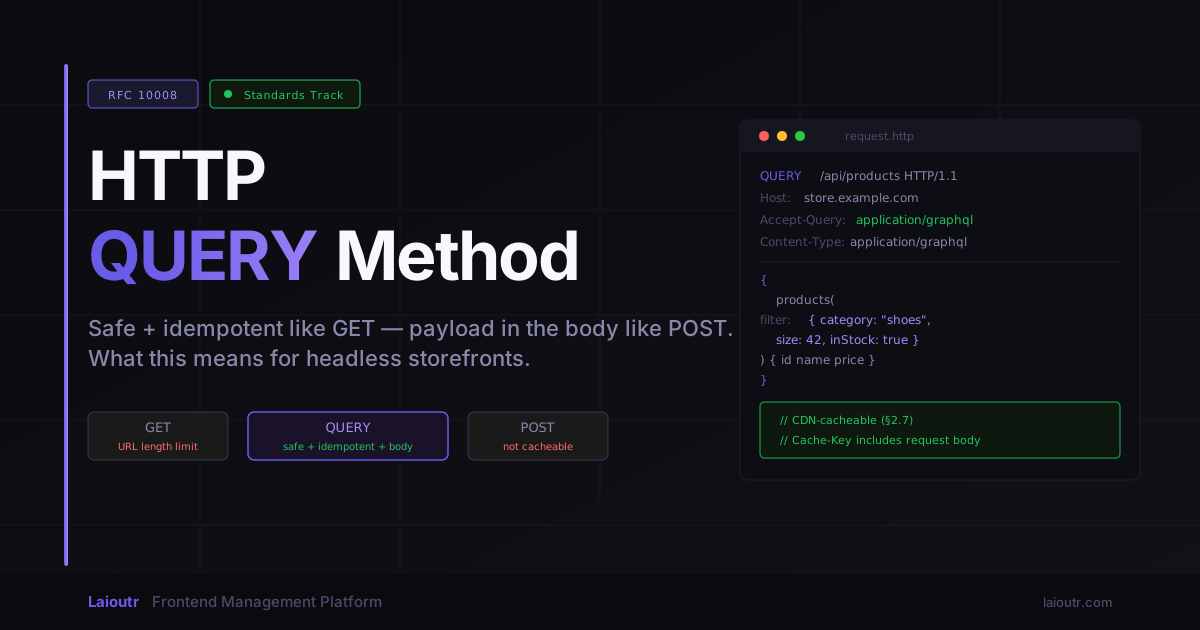
**GET** is semantically the right choice: cacheable, safe (does not trigger a state change), idempotent (safe to repeat automatically). But the query must live in the URL. RFC 9110 recommends staying under 8,000 octets in URL length - with complex filter structures, nested GraphQL queries, or personalised search requests, that ceiling arrives quickly. Beyond that, query parameters end up in logs, proxy records, and browser history. Not ideal for parameters that carry any degree of sensitivity.
**POST** solves the URL problem: the payload goes in the body, arbitrarily large, no URL limit. But POST is semantically neither safe nor idempotent - the HTTP layer cannot know whether a repeated POST is harmless or triggers a state change. The consequence: CDNs and edge proxies do not cache POST. This is exactly why almost every GraphQL query today bypasses the CDN and hits the origin directly. Persisted queries, query hashing, CDN workarounds - these are all patches for this fundamental mismatch. I've written about why workarounds like these compound into real cost over time in our [composable reality check](https://www.laioutr.com/en/blog/composable-rush-not-paying-off).
## What QUERY does differently
RFC 10008 closes this gap with a new HTTP method that combines both properties. The formal definition (Abstract, §2, Table 1 of the RFC):
- **Payload in the body** - like POST, no URL limit, no URL leakage
- **Explicitly safe** - QUERY has no side effect; the server may treat that as a guarantee
- **Explicitly idempotent** - an HTTP client, proxy, or CDN may repeat QUERY requests without risk
This is not a semantic subtlety. It is the foundation on which CDNs and edge caches make caching decisions. With QUERY, complex search requests and filter queries can once again be cached at the edge - the cache key includes the request body and request metadata (§2.7). Origin load decreases, latency decreases, storefronts become faster without any change to the business logic layer.
RFC 10008 also introduces the `Accept-Query` header field (§3). It makes it machine-discoverable which query formats an endpoint supports - a clean basis for format discovery instead of hardcoded client assumptions.
One important note on the CORS side: because QUERY is not on the CORS safelist of methods in the WHATWG Fetch standard, it triggers a preflight request (§4 Security Considerations). That is not a bug; it is the expected consequence of a new method. This needs to be accounted for on the browser side.
## Being honest about the adoption path
GraphQL-over-QUERY is not part of RFC 10008 and has not been standardised. RFC 10008 defines the method, not the payload formats. Whether and how GraphQL clients adopt QUERY will be a separate discussion. I mention it here because it could, in the medium term, make persisted query workarounds unnecessary - as a possibility, not a promise.
And even when clients are ready: servers, CDNs, reverse proxies, and browsers all need to support QUERY before the standard is usable in production in a meaningful way. This is a multi-year road. Writing about it now is not because QUERY is production-ready tomorrow. It is because the right time to think about a standard is not when it has already shipped everywhere.
## Why this is a strategic question - not just a technical one
Here it gets interesting, and here is the point where the architecture decision we made at Laioutr becomes relevant to me.
If you have built a headless frontend as **custom software** - your own Next.js project, a Nuxt application, your own API layer - you will need to implement QUERY support in every storefront individually. Touch the transport layer. Rethink caching logic. Handle CORS and preflight. Define retry strategies. Configure cache keys. Test everything. Per project. Again and again, for each client, for each storefront.
This is not a technical problem solved once. It is a multiplication problem: as many projects as storefronts.
If you build on a **platform**, your starting position is different. At Laioutr, we abstract the data and transport layer. Our customers compose sections and blocks - they do not wire HTTP calls by hand. The platform owns the layer where QUERY becomes relevant.
What that means in practice: once the ecosystem is ready - servers, CDNs, browsers, GraphQL clients - we can adopt the standard **centrally**. Every storefront on Laioutr benefits without a single customer touching their code. No 50 parallel migration tickets. No divergence between older and newer projects. It is the same logic that lets us make [switching commerce vendors without a full replatforming](https://www.laioutr.com/en/blog/switching-vendors-without-replatforming) possible - the platform absorbs the change, not the customer.
We are preparing the platform for this today. Not because QUERY is going live tomorrow, but because architecture decisions that need to be elastic later have to be made early.
## What this means for you - today
If you are building headless on custom software, RFC 10008 is not an operational priority today. But it is a good moment to ask two questions.
**First question:** Who in your architecture owns the transport layer? If the answer is "we do - per project", that is a signal about the kind of effort protocol shifts like this one will create. Frontend independence is becoming a buying criterion for exactly these reasons - [more on that in our weekly wrap](https://www.laioutr.com/en/blog/frontend-independence-buying-criterion-2026-wrap).
**Second question:** Which of your current workarounds - persisted queries, query hashing, CDN bypasses - are actually solving a problem that a cleaner HTTP foundation would remove on its own?
A frontend management platform is not there to take those questions away from you. It is there so that you do not have to encode your answers to them in transport layer code.
RFC 10008 is published: https://www.rfc-editor.org/rfc/rfc10008.html. Authors: J. Reschke (greenbytes), J. M. Snell (Cloudflare), M. Bishop (Akamai). Standards Track, June 2026.
If you are building headless and want to understand what QUERY means concretely for your architecture - write to me or [book a demo](https://www.laioutr.com/en/).
## Build on a frontend-independent foundation
[Composable Headless Frontend](https://www.laioutr.com/en/composable-headless-frontend) · [Performance & Core Web Vitals](https://www.laioutr.com/en/product/performance-core-web-vitals) · [Agentic Frontend Management Platform](https://www.laioutr.com/en/agentic-frontend-management-platform)
## Frequently asked questions about RFC 10008
### What is RFC 10008?
RFC 10008 standardises the HTTP QUERY method: a request method that is safe and idempotent like GET, but can carry a request body like POST. It closes the long-standing gap between GET (no body, limited URL length) and POST (a body, but not safe, idempotent, or cacheable).
### What does the HTTP QUERY method change for headless frontends?
It lets a storefront send complex search, filter, and GraphQL-style requests in a request body while the response stays cacheable and idempotent. For product listing pages, faceted search, and search-as-a-service calls, that means CDN-level caching that POST could never deliver, without cramming state into ever-longer URLs.
### Is HTTP QUERY the same as sending GraphQL over GET?
No. GraphQL over GET works only for small queries because the whole query has to fit in the URL, and it is easy to exceed URL length limits. HTTP QUERY carries the query in the body with no practical size limit, and it is defined as safe and idempotent, so intermediaries and CDNs may cache the response.
### When can we use RFC 10008 in production?
Adoption depends on client, server, and CDN support rolling out across the stack. The pragmatic path today is feature detection with a POST fallback: use HTTP QUERY where the whole chain supports it, and fall back to POST elsewhere, so nothing breaks while support matures.
---
Share this article
[Share on Facebook](https://www.facebook.com/sharer/sharer.php?u=https%3A%2F%2Fwww.laioutr.com%2Fen%2Fblog%2Frfc-10008-http-query-headless-frontend) [Share on X](https://x.com/intent/post?url=https%3A%2F%2Fwww.laioutr.com%2Fen%2Fblog%2Frfc-10008-http-query-headless-frontend&text=) [Share on LinkedIn](https://www.linkedin.com/sharing/share-offsite/?url=https%3A%2F%2Fwww.laioutr.com%2Fen%2Fblog%2Frfc-10008-http-query-headless-frontend) [Share on Pinterest](https://pinterest.com/pin/create/button/?url=https%3A%2F%2Fwww.laioutr.com%2Fen%2Fblog%2Frfc-10008-http-query-headless-frontend&description=) [Share via email](mailto:?subject=&body=%0A%0Ahttps%3A%2F%2Fwww.laioutr.com%2Fen%2Fblog%2Frfc-10008-http-query-headless-frontend)
## More interesting articles
Practical know-how for frontend development, smart agents, and headless
[To the blog](https://www.laioutr.com/en/blogs)
[iPhone Duo and Ecommerce: What Merchants Need to Know Now
iPhone Duo goes on sale on October 23, 2026. Online stores don't need a dedicated app or a custo…](https://www.laioutr.com/en/blog/iphone-duo-ecommerce-foldable-storefront)
[Structured Product Data: How It Shows Up in Your Storefront
Structured product data means every product fact lives in a typed attribute with a unit, a stable id…](https://www.laioutr.com/en/blog/structured-product-data-pim-frontend-2026)
[44% Decide via Trial or PoC: How to Run a Storefront PoC in DACH
In DACH, software decisions are increasingly made hands-on: in the study "Software Buying in DA…](https://www.laioutr.com/en/blog/storefront-proof-of-concept-dach-buyers-2026)
[Frontend Management Platform Comparison: How to Choose the Right FMP
Choosing a frontend management platform (FMP) is less about feature lists and more about where your …](https://www.laioutr.com/en/blog/frontend-management-platform-comparison-how-to-choose-2026)
[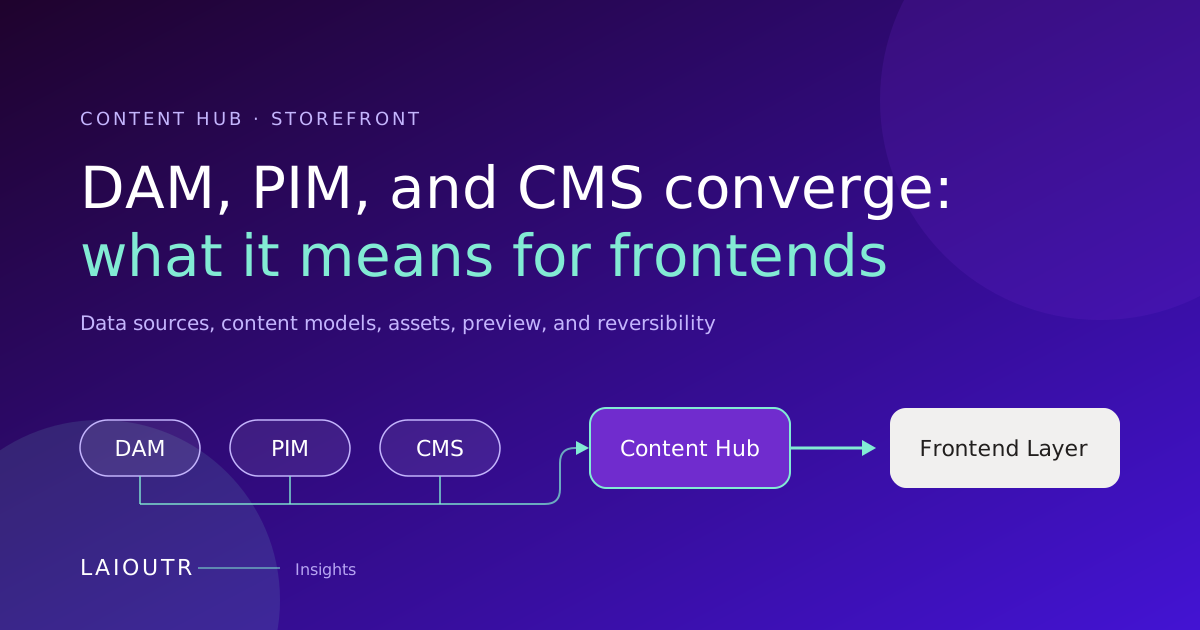DAM, PIM, and CMS Are Converging: What It Means for Your Storefront
DAM, PIM, and CMS vendors are moving into each other's territory, and more teams now evaluate on…](https://www.laioutr.com/en/blog/dam-pim-cms-convergence-content-hub-storefront-2026)
[Contentful Live Preview: What Your Frontend Has to Deliver
Contentful Live Preview lets editors see a draft right next to the entry editor and watch changes ap…](https://www.laioutr.com/en/blog/contentful-live-preview-frontend-perspective-2026)
[Content Governance at Scale: Product Content and Brand Assets
Content governance at scale means that roles, approvals, brand rules, asset rights and translations …](https://www.laioutr.com/en/blog/content-governance-product-content-brand-assets-frontend-2026)
[AI Agents as Frontend Operators: Architecture and Control Model
An AI agent becomes a frontend operator when it watches the running storefront, spots concrete issue…](https://www.laioutr.com/en/blog/ai-agents-as-frontend-operators-2026)
[Shopping Agents Read Your Feed: What Agentic Commerce Changes
Agentic commerce adds a new reader to your product data: shopping agents in ChatGPT, Google AI Mode,…](https://www.laioutr.com/en/blog/shopping-agents-product-feeds-agentic-data-distribution-2026)
[Server-Side Tracking in E-Commerce: Making Measurement Complete Again
Server-side tracking moves the forwarding of analytics and conversion events from the visitor's …](https://www.laioutr.com/en/blog/server-side-tracking-ecommerce-complete-measurement-2026)
[Product Image Deep Links, Not ZIP Files: Assets That Stay Current
If you still send product images to retailers, marketplaces and press as ZIP files, every package st…](https://www.laioutr.com/en/blog/product-image-deeplinks-asset-distribution-2026)
[PrestaShop 8 to 9 Upgrade Without Replatforming: Decouple the Frontend
You can take most of the risk out of the PrestaShop 8 to 9 upgrade by moving the storefront off the …](https://www.laioutr.com/en/blog/prestashop-8-to-9-upgrade-without-replatforming-2026)
[Order Management With an OMS Like fulfillmenttools: The Frontend View
An efficient order management system decides which location fulfills an order, how much stock is rea…](https://www.laioutr.com/en/blog/order-management-fulfillmenttools-oms-frontend-2026)
[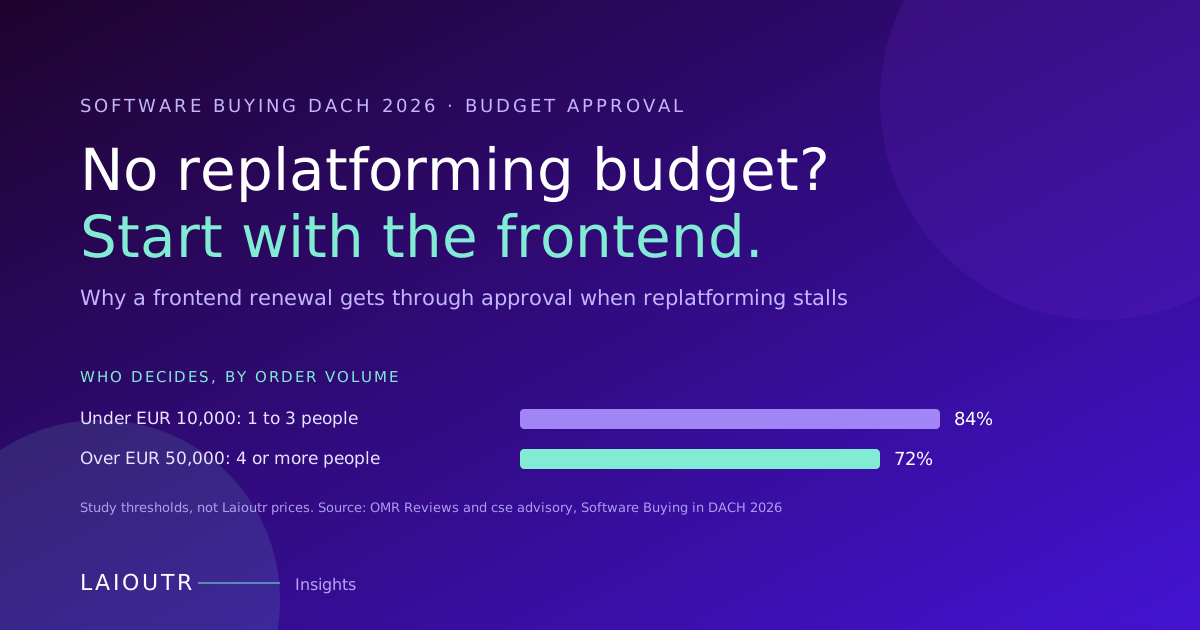No Replatforming Budget in 2026? Why the Frontend Gets Approved
If your 2026 budget has no room for a replatforming project, you are not alone, and you do not have …](https://www.laioutr.com/en/blog/no-replatforming-budget-frontend-project-approval-2026)
[Garden Retail Order Management: What Your Storefront Must Show
In garden and DIY retail, one cart can hold a parcel item, a patio set that ships by freight, live p…](https://www.laioutr.com/en/blog/garden-retail-order-management-seasonal-frontend-2026)
[](https://www.laioutr.com/en/apps/shopify)
Laioutr
[Shopify](https://www.laioutr.com/en/apps/shopify)
Shopify is a commerce platform for selling online and in physical retail.
[](https://www.laioutr.com/en/apps/shopware)
Laioutr
[Shopware](https://www.laioutr.com/en/apps/shopware)
Shopware is a flexible ecommerce platform from Europe for product catalogs and omnichannel commerce.
[](https://www.laioutr.com/en/apps/adobe-commerce)
Laioutr
[Adobe Commerce](https://www.laioutr.com/en/apps/adobe-commerce)
Adobe Commerce is an enterprise commerce platform for complex, global B2C and B2B scenarios.
Planned
[](https://www.laioutr.com/en/apps/b2b-sellers)
Laioutr
[B2Bsellers](https://www.laioutr.com/en/apps/b2b-sellers)
B2B suite for Shopware that turns an online store into a professional B2B commerce platform.
Planned
[](https://www.laioutr.com/en/apps/commerce-layer)
Laioutr
[Commerce Layer](https://www.laioutr.com/en/apps/commerce-layer)
Commerce Layer is a headless commerce platform for making inventory and catalogs available online.
[](https://www.laioutr.com/en/apps/commercetools)
Laioutr
[Commercetools](https://www.laioutr.com/en/apps/commercetools)
Commercetools is a SaaS-based headless ecommerce platform used worldwide.
[](https://www.laioutr.com/en/apps/emporix)
Laioutr
[Emporix](https://www.laioutr.com/en/apps/emporix)
Emporix is a composable, API-first commerce platform for scalable B2B and B2C scenarios.
Planned
[](https://www.laioutr.com/en/apps/hcl-software)
Laioutr
[HCL Software](https://www.laioutr.com/en/apps/hcl-software)
Enterprise suite for digital commerce and experience with extensive configurability.
Planned
[](https://www.laioutr.com/en/apps/intershop)
Laioutr
[Intershop](https://www.laioutr.com/en/apps/intershop)
Enterprise commerce platform for complex B2B and B2C business models.
Planned
[](https://www.laioutr.com/en/apps/magento-2)
Laioutr
[Magento 2](https://www.laioutr.com/en/apps/magento-2)
Widely used, extensible commerce platform for B2C and B2B scenarios.
[](https://www.laioutr.com/en/apps/oxid-eshop)
Laioutr
[OXID eShop](https://www.laioutr.com/en/apps/oxid-eshop)
OXID eShop is an extensible commerce platform for complex B2B and B2C requirements.
Planned
[](https://www.laioutr.com/en/apps/patchworks)
Laioutr
[Patchworks](https://www.laioutr.com/en/apps/patchworks)
Patchworks is a low-code iPaaS that connects ecommerce, ERP, WMS, 3PL, and marketplaces.
Planned
[](https://www.laioutr.com/en/apps/PrestaShop)
Laioutr
[Prestashop](https://www.laioutr.com/en/apps/PrestaShop)
Open-source commerce platform for small and midsize merchants in Europe and beyond.
Planned
[](https://www.laioutr.com/en/apps/saleor)
Laioutr
[Saleor](https://www.laioutr.com/en/apps/saleor)
Open-source, API-first commerce platform built on GraphQL for custom storefronts.
Planned
[](https://www.laioutr.com/en/apps/salesforce-commerce-cloud)
Laioutr
[Salesforce Commerce Cloud](https://www.laioutr.com/en/apps/salesforce-commerce-cloud)
Salesforce Commerce Cloud is a cloud-based enterprise commerce platform for businesses of any size.
Planned
[](https://www.laioutr.com/en/apps/sap-commerce-cloud)
Laioutr
[SAP Commerce Cloud](https://www.laioutr.com/en/apps/sap-commerce-cloud)
Enterprise commerce platform for complex catalogs, pricing models, and omnichannel journeys.
Planned
[](https://www.laioutr.com/en/apps/scayle)
Laioutr
[Scayle](https://www.laioutr.com/en/apps/scayle)
SCAYLE is a commerce engine that helps brands and retailers scale their business.
Planned
[](https://www.laioutr.com/en/apps/spryker)
Laioutr
[Spryker](https://www.laioutr.com/en/apps/spryker)
Composable commerce platform for sophisticated B2B and B2C business models.
[](https://www.laioutr.com/en/apps/sylius)
Laioutr
[Sylius](https://www.laioutr.com/en/apps/sylius)
Sylius is a developer-friendly ecommerce framework for B2C and B2B shopping experiences.
Planned
[](https://www.laioutr.com/en/apps/vendure)
Laioutr
[Vendure](https://www.laioutr.com/en/apps/vendure)
Vendure is a headless commerce platform for businesses with complex requirements.
Coming Soon
[](https://www.laioutr.com/en/apps/vtex)
Laioutr
[VTEX](https://www.laioutr.com/en/apps/vtex)
Cloud-native, composable commerce platform for B2B and B2C at scale.
Planned
[](https://www.laioutr.com/en/apps/websale)
Laioutr
[Websale](https://www.laioutr.com/en/apps/websale)
Stable, enterprise-ready commerce backend for complex retail environments.
Strategy call
## Ready to turn your frontend into a control layer?
Show us your stack, your roadmap, your replatforming scenario, and we'll show you how Laioutr fits, what it costs, and how fast you go live.
*"After 30 minutes, we knew Laioutr makes our replatforming feasible." - Daniel B., CEO,* [*hygibox.de*](https://hygibox.de)
[Book a demo](https://www.laioutr.com/en/contact)
## Structured Data
```json
{
"@context": "https://schema.org",
"@graph": [
{
"@type": "Organization",
"@id": "https://www.laioutr.com/#identity",
"name": "Laioutr",
"legalName": "Laioutr GmbH",
"url": "https://www.laioutr.com/",
"logo": {
"@type": "ImageObject",
"url": "https://www.laioutr.com/laioutr-logo.png",
"width": 400,
"height": 400
},
"email": "info@laioutr.com",
"telephone": "+49 30 75435715",
"address": {
"@type": "PostalAddress",
"streetAddress": "Münchweilersteig 5",
"postalCode": "12559",
"addressLocality": "Berlin",
"addressCountry": "DE"
},
"vatID": "DE450905846",
"sameAs": [
"https://www.linkedin.com/company/laioutr",
"https://www.youtube.com/@Laioutr",
"https://x.com/laioutr"
]
},
{
"@type": "WebSite",
"@id": "https://www.laioutr.com/en/#website",
"url": "https://www.laioutr.com/en/",
"name": "Laioutr",
"inLanguage": "en",
"publisher": {
"@id": "https://www.laioutr.com/#identity"
}
},
{
"@type": "BlogPosting",
"@id": "https://www.laioutr.com/en/blog/rfc-10008-http-query-headless-frontend#article",
"headline": "RFC 10008: The New HTTP Method That Makes You Rethink Headless Storefronts",
"description": "See how RFC 10008 defines HTTP query handling for headless frontends: syntax, caching impact, and implementation notes for your storefront stack.",
"image": [
"https://eu-west-2.graphassets.com/cmii2mlqi0dux06l5543v7nkc/cmqusawpa3pgo06l96mfqybll"
],
"datePublished": "2026-07-27T09:59:06.2355+00:00",
"dateModified": "2026-07-27T09:59:05.165656+00:00",
"inLanguage": "en",
"articleSection": "Insights",
"keywords": "Headless Commerce, Composable, Frontend Management, Edge, Industry & Trends",
"author": {
"@type": "Person",
"name": "Marcel Thiesies",
"jobTitle": "Co-Founder & CEO, Laioutr",
"image": "https://eu-west-2.graphassets.com/cmii2mlqi0dux06l5543v7nkc/cmj01b962364n07lb0iguvts5"
},
"publisher": {
"@id": "https://www.laioutr.com/#identity"
},
"mainEntityOfPage": {
"@id": "https://www.laioutr.com/en/blog/rfc-10008-http-query-headless-frontend#webpage"
},
"isPartOf": {
"@id": "https://www.laioutr.com/en/#website"
}
},
{
"@type": "WebPage",
"@id": "https://www.laioutr.com/en/blog/rfc-10008-http-query-headless-frontend#webpage",
"url": "https://www.laioutr.com/en/blog/rfc-10008-http-query-headless-frontend",
"name": "RFC 10008: The New HTTP Method That Makes You Rethink Headless Storefronts",
"description": "See how RFC 10008 defines HTTP query handling for headless frontends: syntax, caching impact, and implementation notes for your storefront stack.",
"inLanguage": "en",
"isPartOf": {
"@id": "https://www.laioutr.com/en/#website"
},
"breadcrumb": {
"@id": "https://www.laioutr.com/en/blog/rfc-10008-http-query-headless-frontend#breadcrumb"
},
"primaryImageOfPage": {
"@type": "ImageObject",
"url": "https://eu-west-2.graphassets.com/cmii2mlqi0dux06l5543v7nkc/cmqusawpa3pgo06l96mfqybll"
},
"datePublished": "2026-07-27T09:59:06.2355+00:00",
"dateModified": "2026-07-27T09:59:05.165656+00:00",
"mainEntity": {
"@id": "https://www.laioutr.com/en/blog/rfc-10008-http-query-headless-frontend#article"
}
},
{
"@type": "BreadcrumbList",
"@id": "https://www.laioutr.com/en/blog/rfc-10008-http-query-headless-frontend#breadcrumb",
"itemListElement": [
{
"@type": "ListItem",
"position": 1,
"name": "Laioutr",
"item": "https://www.laioutr.com/en/"
},
{
"@type": "ListItem",
"position": 2,
"name": "Insights",
"item": "https://www.laioutr.com/en/blogs/insights"
},
{
"@type": "ListItem",
"position": 3,
"name": "RFC 10008: The New HTTP Method That Makes You Rethink Headless Storefronts"
}
]
}
]
}
```