---
title: "Headless for OXID | Frontend without a custom build"
canonical_url: "https://www.laioutr.com/en/headless-frontend-for-oxid"
locale: en
meta:
description: "Headless for OXID eShop with Laioutr: visual builder, 70+ B2B components, EU hosting. Faster to launch than a custom build, BFSG-compliant, DACH mid-market ready."
"og:description": "Headless for OXID eShop with Laioutr: visual builder, 70+ B2B components, EU hosting. Faster to launch than a custom build, BFSG-compliant, DACH mid-market ready."
"og:title": "Headless for OXID | Frontend without a custom build"
---
OXID × Laioutr
# Headless for OXID, without custom-build engineering
The Frontend Management Platform for OXID eShop. Visual page builder, 70+ e-commerce components including B2B building blocks, EU hosting. Faster to launch than a custom build with Next.js, multi-edition-ready, compatible with account selection, permission sets, and customer-specific assortments.
5.0 stars on OMR Reviews. EU server location. BFSG-ready. In use with DACH OXID partners.
[Request a demo](https://www.laioutr.com/en/contact)
Feel free to reach out to one of our partners for your e-commerce frontend built on Laioutr.
[](https://www.bestit.de/ "Best it")

5/5
OMR Reviews
70+
E-commerce components
Lighthouse 100
Performance from day 1
Made in EU
GDPR-compliant, servers in Germany
## What does headless mean for OXID?
Headless for OXID separates the frontend, everything your customers see, from the OXID backend with its products, account selection, permission sets, and ordering processes. Instead of the Flow Theme or Wave, the frontend is connected through the OXID GraphQL StoreFront module and can be designed freely, without Smarty theme limits and with full performance control.
For deeper reading, see our guides on [when a headless switch is worth it for OXID](https://www.laioutr.com/en/blog/oxid-headless-when-is-the-switch-worth-it), the [OXID 6 to 7 upgrade](https://www.laioutr.com/en/blog/oxid-6-to-7-upgrade-decouple-frontend-without-replatforming), and [what OXID 6 end of life means for your frontend](https://www.laioutr.com/en/blog/oxid-6-end-of-life-frontend-implications-2026).
Book a strategy call
# 1. The backend stays OXID
OXID continues to manage products, account selection, permission sets, customer-specific assortments, VAT workflows, orders, and checkout. You use the OXID admin unchanged, with all the B2B modules of the Enterprise Edition.
# 2. The frontend is chosen
You have four established options: Flow Theme (default Smarty), Wave Theme (a more modern variant, also not headless), Custom Build (Next.js or Nuxt with OXID GraphQL StoreFront), or a Frontend Management Platform like Laioutr.
# 3. Data flows via GraphQL in real time
No data duplication, no sync conflicts. Laioutr talks directly to the OXID GraphQL StoreFront API, including all B2B endpoints for account selection, permission sets, and customer-specific assortments.
Benefits
## What frontend options do you have for OXID?
OXID has no official headless framework like FastStore or PWA Studio. Instead, you choose between classic themes and a custom build with GraphQL StoreFront. Four options are established in the market. Here's where each one pays off for OXID buyers.
Book a strategy call
# 1. Flow Theme (default storefront)
Smarty-based, shipped with OXID by default, not headless. Useful for existing setups that don't want to migrate, or for greenfield projects with minimal customization needs. The performance and modernization limits are real.
# 2. Wave Theme
A more modern theme variant, also Smarty-based. Useful if you want to replace Flow but aren't ready to go headless yet. Better UI than Flow, but the same architectural limits.
# 3. Custom Build with OXID GraphQL StoreFront (Next.js, Nuxt, Vue Storefront)
Maximum control, highest effort. A six- to nine-month build phase plus ongoing maintenance with two to three engineers. Useful for enterprise teams with dedicated frontend engineering and highly specific B2B requirements.
# 4. Laioutr FMP
A Frontend Management Platform with a visual builder, 70+ components including B2B building blocks, EU hosting, and multi-backend support. Useful if you want to go live fast, need standard B2B features out of the box, and need marketing velocity without an engineering sprint per page.
USE CASES
## What you build with Laioutr for OXID
Laioutr is built for OXID setups that want to leave their Smarty theme limits behind, without starting a six- to nine-month custom build with their own Next.js team. From an account-specific B2B portal to a multi-brand storefront.
Book a strategy call
# B2B portals with account selection, permission sets, and customer-specific assortments
OXID B2B delivers the complete workflows. Laioutr calls the GraphQL StoreFront API directly and renders account-specific frontends with permission logic, customer-specific price lists, and individual assortments.
# Modernizing Flow Theme or Wave Theme
An existing Smarty theme stack is to be replaced, without touching the OXID backend. Migration in phases, without the existing performance suffering.
# Multi-brand storefronts on a single OXID instance
Multiple brands on a single OXID EE instance, with their own frontends, their own domains, a shared backend, and a shared B2B configuration.
# Internationalization setups with localized B2B workflows
OXID multi-country with localized price lists, VAT workflows, and language variants. The frontend is configured in Studio, without setting up a custom build per market.
# Replacing a custom build with OXID GraphQL StoreFront
You have a custom build with Next.js and OXID GraphQL StoreFront running, and the engineering team has been thinned out. Migration to an FMP, without touching the OXID backend.
# Greenfield storefronts on new OXID projects
New OXID project, clean slate. With Laioutr themes and the UI library, you go live in weeks instead of investing six months in a custom build with OXID GraphQL StoreFront.
Laioutr vs. Custom Build (Next.js with OXID GraphQL StoreFront)
## The honest composable comparison
A custom build is the most common path to headless OXID: the official GraphQL StoreFront module plus your own frontend in Next.js, Nuxt, or Vue Storefront. Laioutr is a complete Frontend Management Platform with a visual builder, component library, and multi-backend support. Both work with OXID. If you want maximum code control and a dedicated frontend team, a custom build is the most flexible option. If you want marketing velocity, B2B components, and predictable TCO, you'll be more productive with Laioutr.
Pricing Plans Comparison
| Compare differences | Laioutr FMP | Custom Build (Next.js + OXID GraphQL StoreFront) |
| --- | --- | --- |
| Laioutr FMP Custom Build (Next.js + OXID GraphQL StoreFront) |
| Builder und Komponenten Was Sie aus der Box bekommen, mit Fokus auf B2B und DACH-Mittelstand. |
| Visueller Page Builder Drag-and-Drop-Editor für Marketing- und Content-Teams. | Inklusive (Studio) Live-Preview, komponentenbasiert | Nicht enthalten Reine Code-Entwicklung in Next.js |
| B2B-Komponenten Vorgefertigte UI-Bausteine für Account-Selection, Permission-Sets, kundenspezifische Sortimente. | 70+ Komponenten B2B-Bausteine inkl. Permission-UI | Selbst bauen B2B-UI als Custom-Build pro Workflow |
| Themes und Vorlagen Startpunkt für neue Storefronts ohne Greenfield-Aufwand. | Vorgefertigte Themes Sofort einsatzbereit, voll erweiterbar | Greenfield Storefront komplett selbst designen |
| Hosting Wo das Frontend ausgeliefert wird und wer es betreibt. | Inklusive (EU-CDN) Laioutr Cloud, kein separater Deploy | Selbst hosten Vercel, AWS, Hetzner, eigene Infrastruktur |
| Architektur und OXID-Integration Wie das Frontend das OXID-Backend nutzt und wie viel Eigenleistung nötig ist. |
| Backend-Flexibilität Welche E-Commerce-Backends sich anbinden lassen. | Multi-Backend OXID, Shopware, commercetools, weitere | OXID-spezifisch Code ist auf OXID-Schema zugeschnitten |
| OXID-API-Anbindung Wie das Frontend mit dem OXID-Backend kommuniziert. | GraphQL StoreFront Standard-Anbindung über offizielles Modul | GraphQL StoreFront Standard-Anbindung über offizielles Modul |
| Performance und Core Web Vitals Wie viel Aufwand für Lighthouse-100-Niveau nötig ist. | Out of the box Lighthouse 100 als Default-Ziel | Manuelles Tuning Performance-Engineering durch Team |
| BFSG und WCAG 3.0 Konformität mit Barrierefreiheitsstärkungsgesetz und WCAG 3.0. | Im Standard WCAG 3.0, BFSG, EN 301 549 | Eigenverantwortung Audit separat erforderlich |
| Team und Wirtschaftlichkeit Wer mit der Plattform produktiv ist und was es Sie über die Zeit kostet. |
| Lernkurve Wie schnell ein neues Teammitglied produktiv wird. | Niedrig Marketing onboardet in Tagen | Hoch Next.js, GraphQL, OXID-Schema |
| Time-to-Launch Realistische Zeitspanne bis zum Live-Gang einer neuen Storefront. | Wochen Mit Themes und Komponenten | Monate 6 bis 9 Monate Build-Phase |
| Ideales Team-Setup Wer mit der Plattform arbeiten kann und wer arbeiten muss. | Cross-funktional Marketing, Design und Dev gemeinsam | Engineering-only Next.js-Team mit OXID-Erfahrung |
| Total Cost of Ownership Software plus Engineering plus Wartung über 3 bis 5 Jahre. | [SaaS (planbar) Hosting und Komponenten inklusive](https://www.laioutr.com/pricing) [Preise ansehen](https://www.laioutr.com/pricing) | Engineering-lastig Hohe Build- und Wartungs-Kosten |
*All data is based on publicly available information, insights from sales conversations with DACH e-commerce brands, and our own platform testing. As of: April 2026. OXID features may have evolved since.*
OXID
# When a custom build is the right choice
You have a dedicated Next.js or Nuxt team with OXID API experience (at least three engineers), you accept six- to nine-month build phases, maximum pixel-level differentiation is strategically important, highly specific B2B workflows can't be mapped with standard components, and years of engineering maintenance are budgeted for. Classic use case: an industrial goods manufacturer with a complex configurator and a dedicated frontend team.
LAIOUTR
# When Laioutr is the right choice
You want weeks instead of months to go-live, marketing should build pages on its own, standard B2B features should be available out of the box, you don't have a dedicated frontend engineering team, total cost of ownership over 5 years is relevant, and BFSG compliance must be solved without a separate audit. Classic use case: a DACH mid-market B2B brand on OXID that wants to modernize without building a frontend engineering team.
BLUEPRINTS
## Start with a Blueprint instead of from scratch
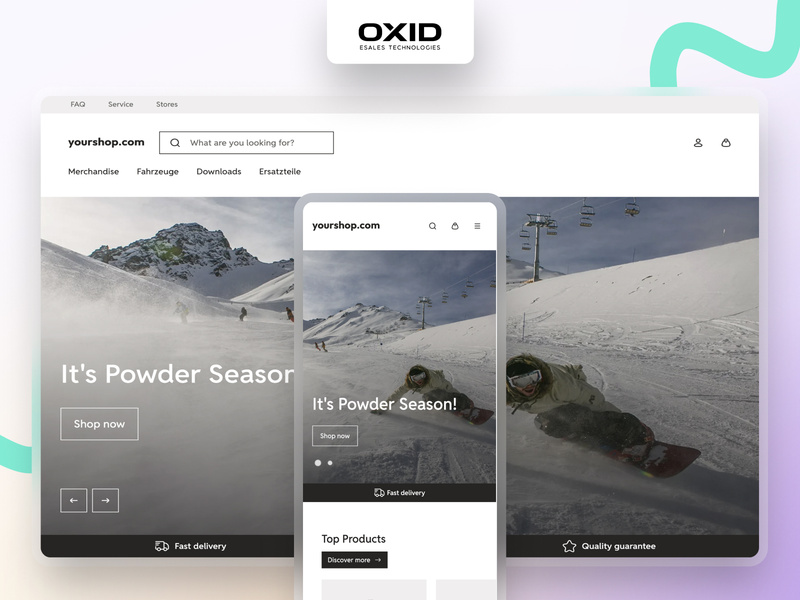
Discover our Blueprints: pre-composed frontends for your industry, instantly customizable and, when in doubt, a fit for your OXID setup too. Pick a starting point and go live faster.
[View Blueprints](https://www.laioutr.com/en/blueprints)
UI PREVIEW
## What you can build with Laioutr for OXID
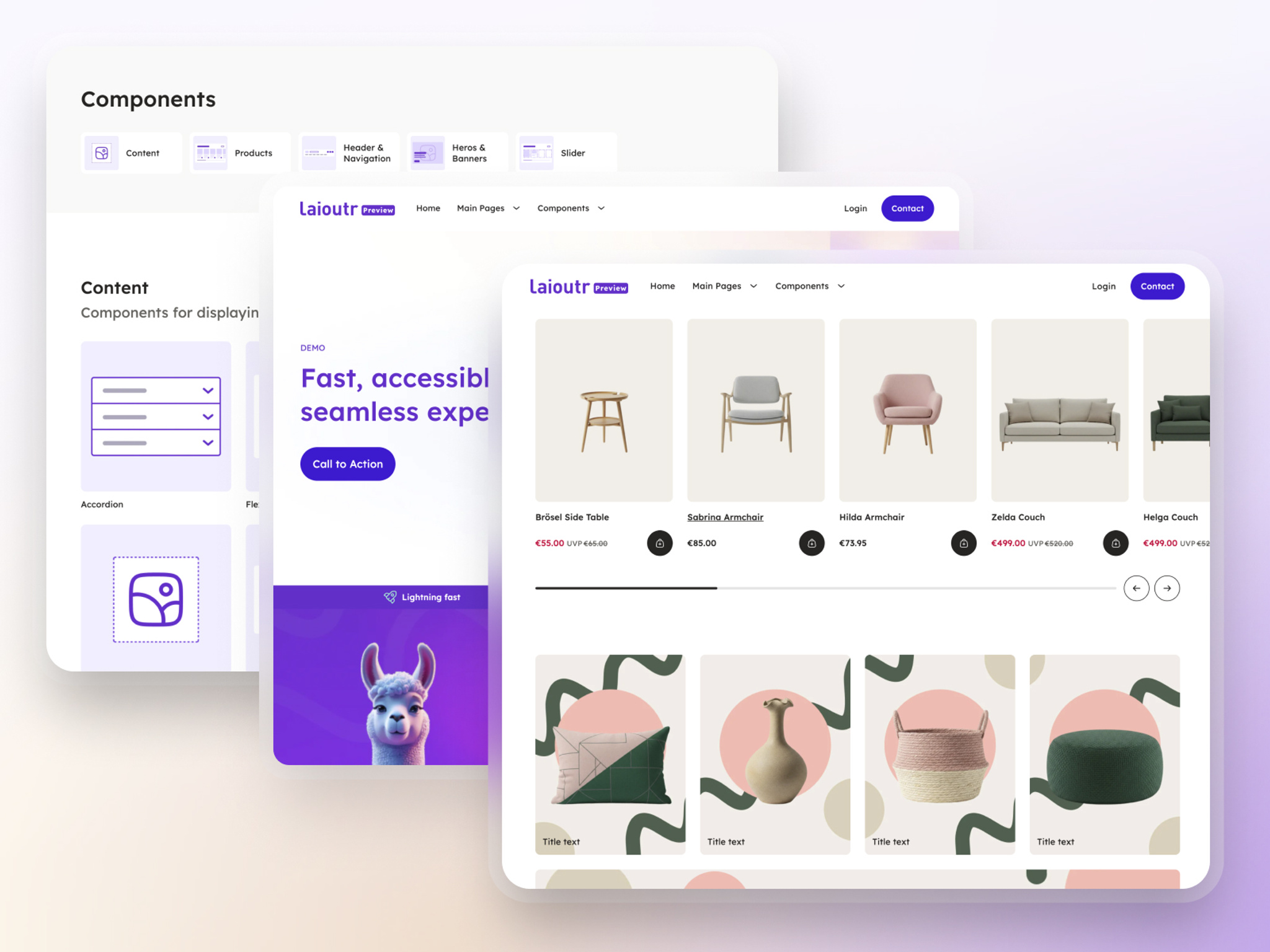
Product launch pages, home pages, product detail pages, product list pages, sales pages, blogs, content pages, and more.
[Explore the UI preview](https://preview.laioutr.com/)
You don't have to do this alone. Our OXID implementation partners have delivered OXID frontend projects with Laioutr, from Flow Theme migrations to custom-build replacements.
[](https://www.bestit.de/ "Best it")

FAQ
## Frequently asked questions about headless for OXID
Does Laioutr work with OXID Community, Professional, and Enterprise Edition?
Yes. Laioutr uses the OXID GraphQL StoreFront module, which is compatible with all three editions. B2B features like account selection and permission sets, however, are part of the Enterprise Edition.
How does Laioutr differ from a custom build with OXID GraphQL StoreFront?
A custom build with Next.js or Nuxt is code-first and requires a dedicated frontend team plus a six- to nine-month build. Laioutr is a ready-to-use frontend platform with a visual builder, 70+ components, and built-in hosting. Faster to launch, a lower learning curve, and marketing can work on its own.
Can we use OXID B2B features like account selection and permission sets?
Yes. OXID EE B2B features (account selection, permission sets, customer-specific assortments, price lists, VAT workflows) are served through the GraphQL StoreFront module and rendered in Laioutr B2B components.
How does Laioutr relate to OXID modules from the OXID Marketplace?
OXID modules that provide backend functionality remain usable. Modules with frontend components (Smarty templates) are not carried over one-to-one with Laioutr; they need to be rebuilt as components in Studio or integrated via custom components.
Does Laioutr work with German ERPs like SAP, abas, Microsoft Dynamics?
Yes. ERP integration runs through OXID backend connectors, leaving the frontend untouched. Integration with third-party tools via the Laioutr App Store for marketing workflows (email, CRM, analytics) is standard.
Can we keep using our existing OXID analytics and tracking setups?
Yes. Analytics tags (Google Analytics, etracker, Matomo) are integrated via JavaScript, exactly as with any other frontend solution. GDPR-compliant setups via cookie management tools (Usercentrics, OneTrust) work as usual.
How long does a migration from Flow Theme or Wave Theme take?
For a mid-sized setup with clear branding and no exotic custom logic: 6 to 12 weeks from kickoff to go-live. With complex B2B workflows or multi-edition setups, allow more (10 to 18 weeks).
What does Laioutr cost compared to a custom build plus engineering?
A custom build with OXID GraphQL StoreFront is technically free (the module is part of OXID), but the engineering investment is substantial (a six- to nine-month build phase plus ongoing maintenance with two to three engineers). Laioutr is SaaS with transparent plans; hosting and components are included. Total cost of ownership is typically 30 to 50 percent below a custom build.
Can we later move away from the OXID backend without rebuilding the frontend?
Yes. This is precisely one of the key advantages over a custom build. Laioutr is backend-agnostic: switching from OXID to Shopware, Adobe Commerce, or another backend means reconfiguring an API connection, not rebuilding the frontend.
Is the solution BFSG- and GDPR-compliant?
Yes. EU/Germany server location, EU standard contract, German-language support, WCAG 3.0 and BFSG (the German Accessibility Reinforcement Act, binding since 2025) are covered by default. Exactly what OXID mid-market buyers in DACH need.
Is Laioutr an OXID Solution Partner?
Yes, we are an official OXID Partner.
Can I run OXID eShop headless?
Yes. OXID eShop exposes the needed data via its GraphQL Storefront API, and Laioutr delivers the decoupled frontend on top. The backend stays OXID, the frontend becomes headless, fast and without a custom build.
What does the OXID 6 to OXID 7 move mean for my frontend?
The version jump raises the pressure to modernize the frontend. With a decoupled Laioutr frontend you separate that decision from the backend, modernize the storefront independently and stay ready for OXID 7 without a full theme rebuild.
Does Laioutr use the OXID GraphQL Storefront API?
Yes. Laioutr talks to the OXID GraphQL Storefront API through the Orchestr layer and normalizes products, categories, prices and cart into one frontend data model, so the storefront components stay backend-agnostic.
Does a headless OXID frontend also work for B2B with tiered pricing and quotes?
Yes. The B2B logic, tiered pricing, customer-specific prices, quote requests, stays in the OXID backend, and Laioutr renders the matching B2B components in the frontend, including account, approval and quick-order flows.
[OXID eSales for B2B Wholesalers: A Modern Frontend, No Backend Swap
B2B wholesalers running on OXID eSales can modernize their frontend layer, add tiered pricing, RFQ f…](https://www.laioutr.com/en/blog/oxid-b2b-wholesale-frontend-modernization-2026)
[The 2026 Headless Market: Four Enterprise Strategies, and Where the Frontend Layer Actually Decides
CX Today published a rundown this week of "the four enterprise strategies reshaping CX software…](https://www.laioutr.com/en/blog/2026-headless-market-four-enterprise-strategies-frontend-layer)
[The 30-Minute Storefront Is the Easy Part. The 3-Year Storefront Is the Work
This week was, once again, about speed. On July 2, Salesforce made Storefront Next generally availab…](https://www.laioutr.com/en/blog/frontend-management-vs-generation-lifecycle-fmp-2026)
[Composable Readiness Check: When Does Composable Actually Pay Off?
The composable commerce conversation has shifted. Anyone who followed K5 2026 knows the tone: less e…](https://www.laioutr.com/en/blog/composable-readiness-check-dach-mid-market-2026)
[Frontend Independence Becomes a Buying Criterion (Week 26 Wrap)
This week, three moves in the commerce stack overlapped, and they all touch the same question: who a…](https://www.laioutr.com/en/blog/frontend-independence-buying-criterion-2026-wrap)
[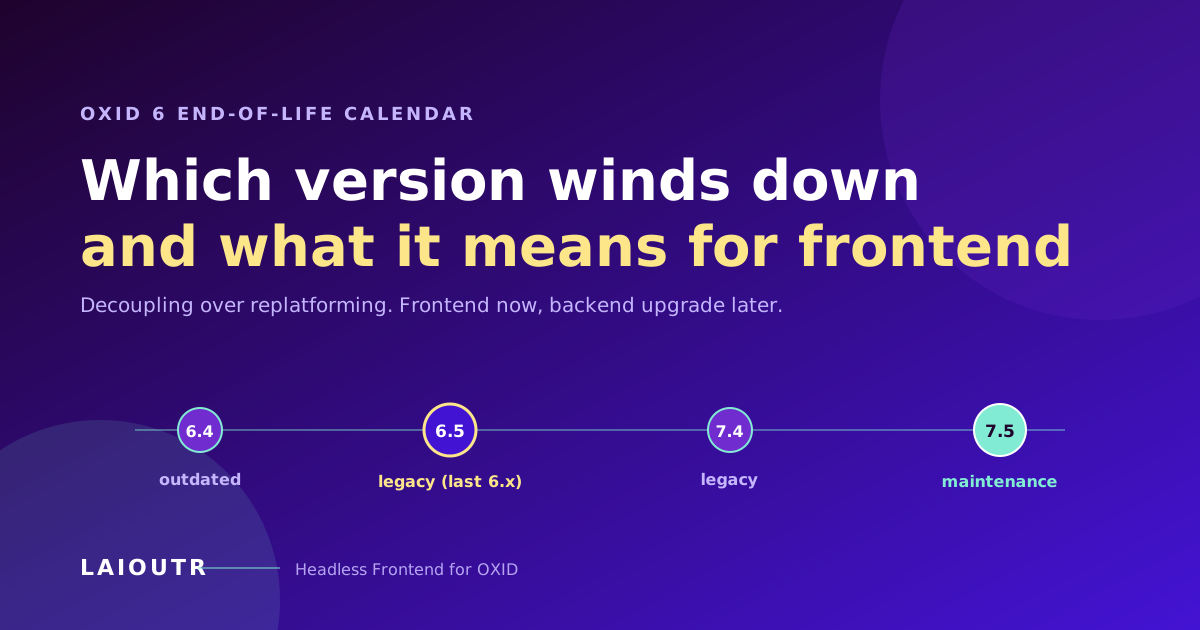OXID 6 End-of-Life: What the Calendar Means for Your Frontend
OXID 6 is no longer a current product, it's a winding-down version. In the official OXID eSales …](https://www.laioutr.com/en/blog/oxid-6-end-of-life-frontend-implications-2026)
[The Composable Stack in the DACH Mid-Market: What Actually Ships After K5
K5 in Berlin is over, and the field agrees on one thing: composable commerce has arrived in the mid-…](https://www.laioutr.com/en/blog/composable-commerce-dach-mid-market-experience-layer-2026)
[Spree BBQ 2026: What DACH Mid-Market Is Actually Discussing
Tonight at 18:00, Dock 10 Berlin. The Spree BBQ 2026 kicks off, and Laioutr is there as co-sponsor. …](https://www.laioutr.com/en/blog/spree-bbq-2026-frontend-stack-dach-live)
[How to Evaluate a Frontend Management Platform: 2026 Checklist
The frontend management platform (FMP) market is consolidating fast. What was an open field with a h…](https://www.laioutr.com/en/blog/frontend-management-platform-evaluation-checklist-2026)
[MCP Commerce: How an Autonomous Agent Actually Acts on Your Storefront
Next week in Berlin, the K5 Future Retail Conference brings together thousands of retail decision-ma…](https://www.laioutr.com/en/blog/mcp-endpoints-storefront-agent-actions-2026)
[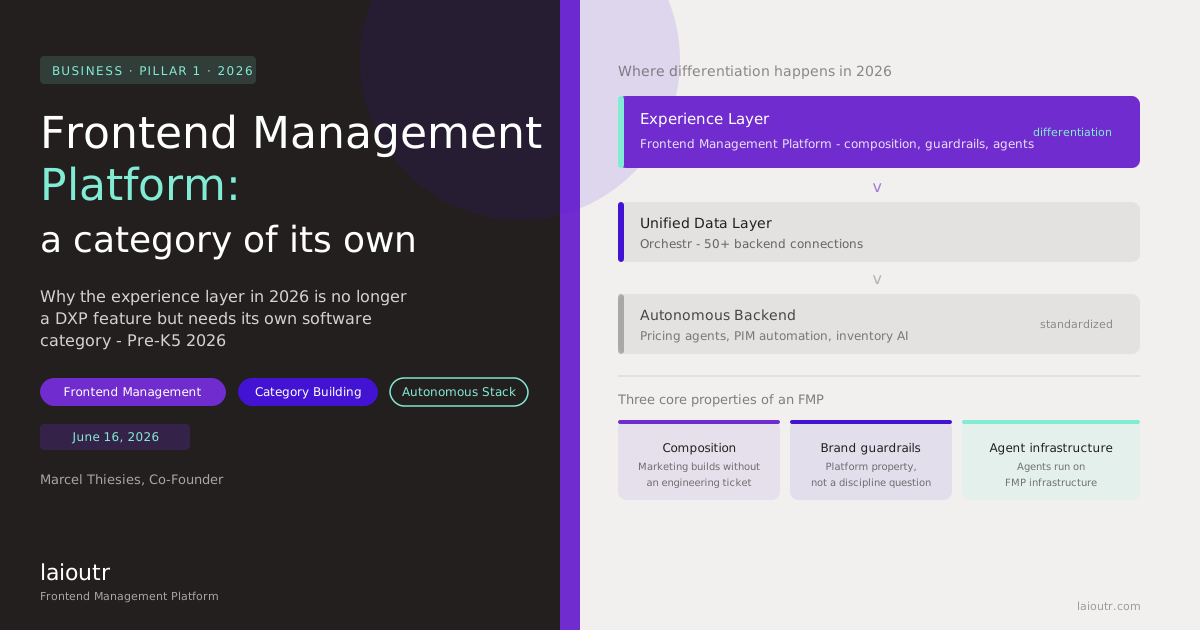Frontend Management Platform: a category of its own
Why the autonomous stack makes the experience layer a category of its ownHere is my take: as backend…](https://www.laioutr.com/en/blog/frontend-management-platform-experience-layer-category-2026)
[The Future of E-Commerce: Why Adaptation Falls Short and Evolution Starts in the Frontend
At the eCommerce BBQ 2026, one line captured the mood of the whole evening: yesterday we did what wa…](https://www.laioutr.com/en/blog/future-of-ecommerce-evolution-frontend)
[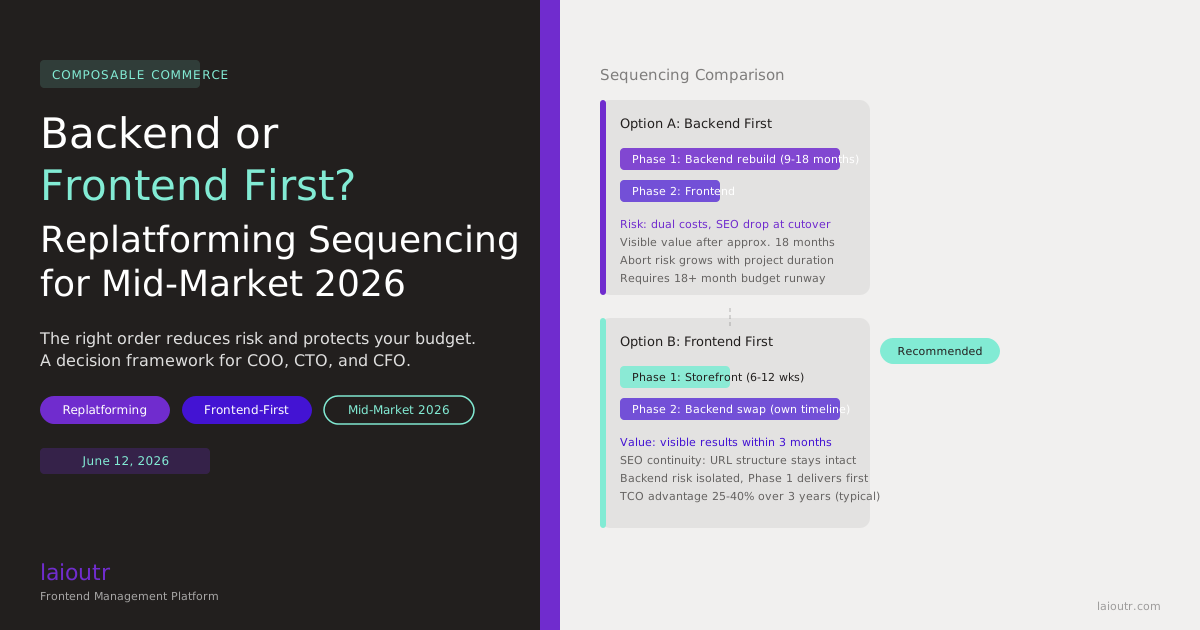Replatform the Backend or the Frontend First? A Sequencing Guide for Mid-Market 2026
The one decision that shapes your entire replatforming projectYou know your commerce stack needs mod…](https://www.laioutr.com/en/blog/replatforming-sequencing-backend-or-frontend-first-2026)
[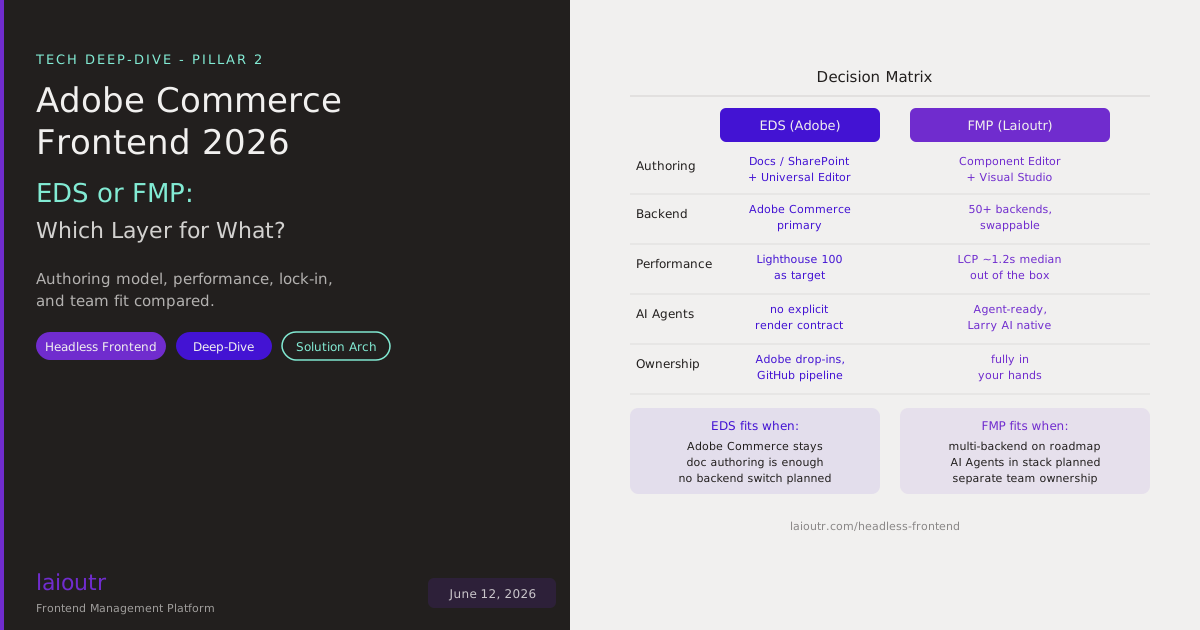Adobe Commerce Frontend 2026: Edge Delivery Services or Frontend Management Platform - Which Layer for What?
Over the course of 2024 and 2025, Adobe has positioned two clearly distinct paths for Adobe Commerce…](https://www.laioutr.com/en/blog/adobe-commerce-edge-delivery-services-vs-fmp-2026)
[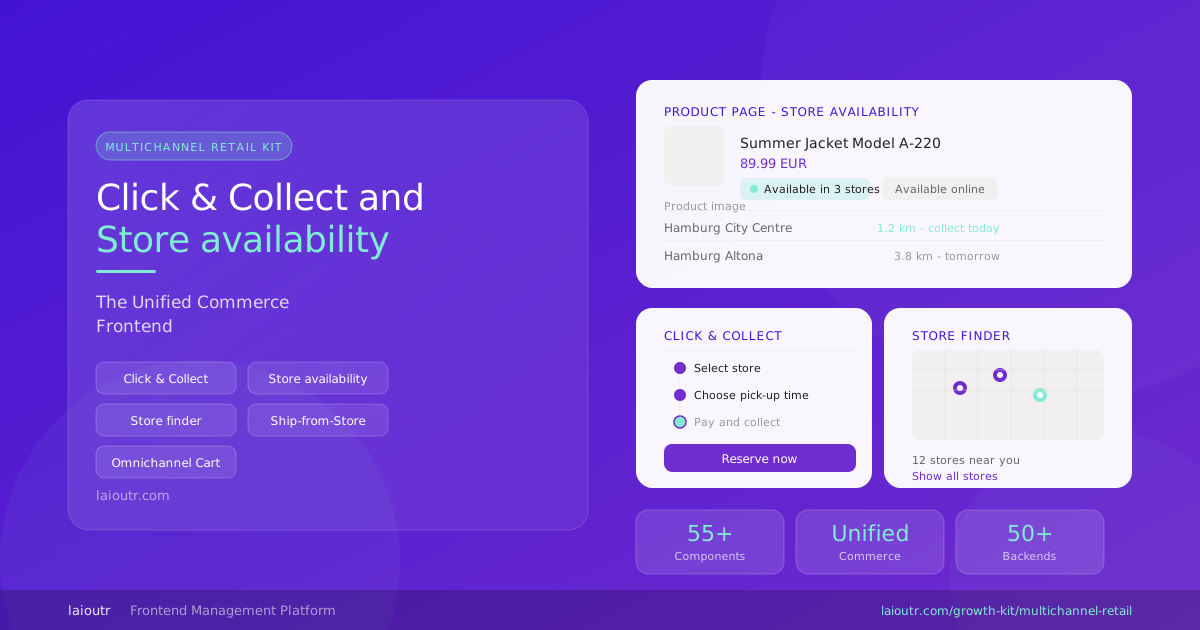Click & Collect and Store Availability: the Unified Commerce Frontend
Click & Collect is no longer a differentiator. It is a baseline expectation. When a shopper open…](https://www.laioutr.com/en/blog/unified-commerce-click-collect-filialverfuegbarkeit)


STILL UNSURE?
# Ready to bring your OXID frontend live in weeks instead of months?
30 minutes with our team. We'll show you Laioutr live on your OXID setup and answer all your questions about migration, B2B features, GraphQL StoreFront connection, and pricing.
[Request a demo](https://www.laioutr.com/en/contact)
## Structured Data
```json
{
"@context": "https://schema.org",
"@graph": [
{
"@type": "Organization",
"@id": "https://www.laioutr.com/#identity",
"name": "Laioutr",
"legalName": "Laioutr GmbH",
"url": "https://www.laioutr.com/",
"logo": {
"@type": "ImageObject",
"url": "https://www.laioutr.com/laioutr-logo.png",
"width": 400,
"height": 400
},
"email": "info@laioutr.com",
"telephone": "+49 30 75435715",
"address": {
"@type": "PostalAddress",
"streetAddress": "Münchweilersteig 5",
"postalCode": "12559",
"addressLocality": "Berlin",
"addressCountry": "DE"
},
"vatID": "DE450905846",
"sameAs": [
"https://www.linkedin.com/company/laioutr",
"https://www.youtube.com/@Laioutr",
"https://x.com/laioutr"
]
},
{
"@type": "WebSite",
"@id": "https://www.laioutr.com/en/#website",
"url": "https://www.laioutr.com/en/",
"name": "Laioutr",
"inLanguage": "en",
"publisher": {
"@id": "https://www.laioutr.com/#identity"
}
},
{
"@type": [
"WebPage",
"FAQPage"
],
"@id": "https://www.laioutr.com/en/headless-frontend-for-oxid#webpage",
"url": "https://www.laioutr.com/en/headless-frontend-for-oxid",
"name": "Headless for OXID | Frontend without a custom build",
"description": "Headless for OXID eShop with Laioutr: visual builder, 70+ B2B components, EU hosting. Faster to launch than a custom build, BFSG-compliant, DACH mid-market ready.",
"inLanguage": "en",
"isPartOf": {
"@id": "https://www.laioutr.com/en/#website"
},
"breadcrumb": {
"@id": "https://www.laioutr.com/en/headless-frontend-for-oxid#breadcrumb"
},
"primaryImageOfPage": {
"@type": "ImageObject",
"url": "https://eu-west-2.graphassets.com/cmii2mlqi0dux06l5543v7nkc/cmk19p2eask1h07mlr6q5kx0k"
},
"mainEntity": [
{
"@type": "Question",
"name": "Does Laioutr work with OXID Community, Professional, and Enterprise Edition?",
"acceptedAnswer": {
"@type": "Answer",
"text": "Yes. Laioutr uses the OXID GraphQL StoreFront module, which is compatible with all three editions. B2B features like account selection and permission sets, however, are part of the Enterprise Edition."
}
},
{
"@type": "Question",
"name": "How does Laioutr differ from a custom build with OXID GraphQL StoreFront?",
"acceptedAnswer": {
"@type": "Answer",
"text": "A custom build with Next.js or Nuxt is code-first and requires a dedicated frontend team plus a six- to nine-month build. Laioutr is a ready-to-use frontend platform with a visual builder, 70+ components, and built-in hosting. Faster to launch, a lower learning curve, and marketing can work on its own."
}
},
{
"@type": "Question",
"name": "Can we use OXID B2B features like account selection and permission sets?",
"acceptedAnswer": {
"@type": "Answer",
"text": "Yes. OXID EE B2B features (account selection, permission sets, customer-specific assortments, price lists, VAT workflows) are served through the GraphQL StoreFront module and rendered in Laioutr B2B components."
}
},
{
"@type": "Question",
"name": "How does Laioutr relate to OXID modules from the OXID Marketplace?",
"acceptedAnswer": {
"@type": "Answer",
"text": "OXID modules that provide backend functionality remain usable. Modules with frontend components (Smarty templates) are not carried over one-to-one with Laioutr; they need to be rebuilt as components in Studio or integrated via custom components."
}
},
{
"@type": "Question",
"name": "Does Laioutr work with German ERPs like SAP, abas, Microsoft Dynamics?",
"acceptedAnswer": {
"@type": "Answer",
"text": "Yes. ERP integration runs through OXID backend connectors, leaving the frontend untouched. Integration with third-party tools via the Laioutr App Store for marketing workflows (email, CRM, analytics) is standard."
}
},
{
"@type": "Question",
"name": "Can we keep using our existing OXID analytics and tracking setups?",
"acceptedAnswer": {
"@type": "Answer",
"text": "Yes. Analytics tags (Google Analytics, etracker, Matomo) are integrated via JavaScript, exactly as with any other frontend solution. GDPR-compliant setups via cookie management tools (Usercentrics, OneTrust) work as usual."
}
},
{
"@type": "Question",
"name": "How long does a migration from Flow Theme or Wave Theme take?",
"acceptedAnswer": {
"@type": "Answer",
"text": "For a mid-sized setup with clear branding and no exotic custom logic: 6 to 12 weeks from kickoff to go-live. With complex B2B workflows or multi-edition setups, allow more (10 to 18 weeks)."
}
},
{
"@type": "Question",
"name": "What does Laioutr cost compared to a custom build plus engineering?",
"acceptedAnswer": {
"@type": "Answer",
"text": "A custom build with OXID GraphQL StoreFront is technically free (the module is part of OXID), but the engineering investment is substantial (a six- to nine-month build phase plus ongoing maintenance with two to three engineers). Laioutr is SaaS with transparent plans; hosting and components are included. Total cost of ownership is typically 30 to 50 percent below a custom build."
}
},
{
"@type": "Question",
"name": "Can we later move away from the OXID backend without rebuilding the frontend?",
"acceptedAnswer": {
"@type": "Answer",
"text": "Yes. This is precisely one of the key advantages over a custom build. Laioutr is backend-agnostic: switching from OXID to Shopware, Adobe Commerce, or another backend means reconfiguring an API connection, not rebuilding the frontend."
}
},
{
"@type": "Question",
"name": "Is the solution BFSG- and GDPR-compliant?",
"acceptedAnswer": {
"@type": "Answer",
"text": "Yes. EU/Germany server location, EU standard contract, German-language support, WCAG 3.0 and BFSG (the German Accessibility Reinforcement Act, binding since 2025) are covered by default. Exactly what OXID mid-market buyers in DACH need."
}
},
{
"@type": "Question",
"name": "Is Laioutr an OXID Solution Partner?",
"acceptedAnswer": {
"@type": "Answer",
"text": "Yes, we are an official OXID Partner."
}
},
{
"@type": "Question",
"name": "Can I run OXID eShop headless?",
"acceptedAnswer": {
"@type": "Answer",
"text": "Yes. OXID eShop exposes the needed data via its GraphQL Storefront API, and Laioutr delivers the decoupled frontend on top. The backend stays OXID, the frontend becomes headless, fast and without a custom build."
}
},
{
"@type": "Question",
"name": "What does the OXID 6 to OXID 7 move mean for my frontend?",
"acceptedAnswer": {
"@type": "Answer",
"text": "The version jump raises the pressure to modernize the frontend. With a decoupled Laioutr frontend you separate that decision from the backend, modernize the storefront independently and stay ready for OXID 7 without a full theme rebuild."
}
},
{
"@type": "Question",
"name": "Does Laioutr use the OXID GraphQL Storefront API?",
"acceptedAnswer": {
"@type": "Answer",
"text": "Yes. Laioutr talks to the OXID GraphQL Storefront API through the Orchestr layer and normalizes products, categories, prices and cart into one frontend data model, so the storefront components stay backend-agnostic."
}
},
{
"@type": "Question",
"name": "Does a headless OXID frontend also work for B2B with tiered pricing and quotes?",
"acceptedAnswer": {
"@type": "Answer",
"text": "Yes. The B2B logic, tiered pricing, customer-specific prices, quote requests, stays in the OXID backend, and Laioutr renders the matching B2B components in the frontend, including account, approval and quick-order flows."
}
}
]
},
{
"@type": "BreadcrumbList",
"@id": "https://www.laioutr.com/en/headless-frontend-for-oxid#breadcrumb",
"itemListElement": [
{
"@type": "ListItem",
"position": 1,
"name": "Laioutr",
"item": "https://www.laioutr.com/en/"
},
{
"@type": "ListItem",
"position": 2,
"name": "Headless for OXID: Frontend without a custom build"
}
]
}
]
}
```