---
title: "Headless CMS Visual Editing: How It Actually Works"
canonical_url: "https://www.laioutr.com/en/blog/headless-cms-visual-editing"
locale: en
meta:
description: "See headless CMS visual editing in practice: edit live, skip the dev handoff, launch faster. Compare platforms and see Laioutr's approach."
"og:description": "See headless CMS visual editing in practice: edit live, skip the dev handoff, launch faster. Compare platforms and see Laioutr's approach."
"og:title": "Headless CMS Visual Editing: How It Actually Works"
---
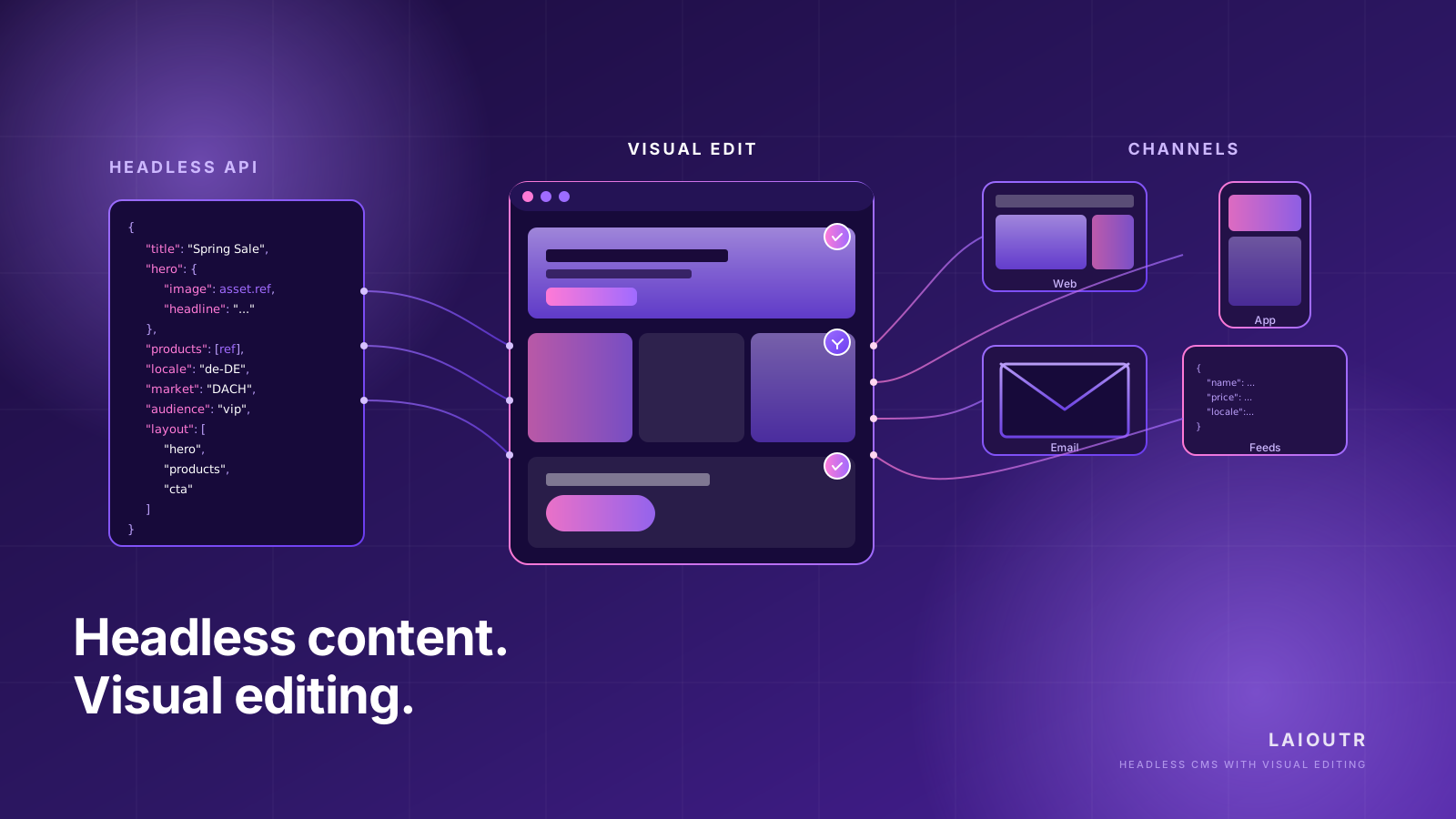
# Headless CMS with Visual Editing 2026: Platforms Compared
Table of contents
1. [1.What does visual editing mean in a headless CMS?](#what-does-visual-editing-mean-in-a-headless-cms)
2. [2.When do you need visual editing?](#when-do-you-need-visual-editing)
3. [3.The platforms at a glance](#the-platforms-at-a-glance)
4. [4.Selection criteria: how to decide](#selection-criteria-how-to-decide)
5. [5.Conclusion](#conclusion)
1. [1.What does visual editing mean in a headless CMS?](#what-does-visual-editing-mean-in-a-headless-cms)
2. [2.When do you need visual editing?](#when-do-you-need-visual-editing)
3. [3.The platforms at a glance](#the-platforms-at-a-glance)
4. [4.Selection criteria: how to decide](#selection-criteria-how-to-decide)
5. [5.Conclusion](#conclusion)
The headless CMS world has come of age. Pure API-first platforms like Contentful, Sanity, and Strapi have proven that structured content can be delivered cleanly. What they underestimated: editors want to see what they're building. That's where the second generation comes in: headless CMS with visual editing.
This guide lists the leading platforms in 2026 that combine headless architecture with visual editing. No ranking, just a clear view of which editing model sits underneath: inline editing on the live page, parallel preview pane, or block-based editing away from the page.
## What does visual editing mean in a headless CMS?
Classic headless CMS means: editors maintain fields in a form, the frontend renders somewhere else. Visual editing means: editors see the final page (or a close approximation) and edit there directly. Three common models:
1. **Inline editing on the live page** (Storyblok, Sanity Visual Editing, Builder.io): the editor opens the live page, components show edit hotspots, changes appear instantly.
2. **Parallel preview** (Contentful Studio, Sanity, Prismic): left half is form editor, right half is live preview, both sync in real time.
3. **Block- or slice-based editing** (Prismic Slices, Hygraph): the editor picks from a component library and arranges blocks; the preview renders the result.
Each model has different strengths. Inline editing is marketing-friendly but technically demanding. Parallel preview is robust and works well for structured content models. Block editing is a sensible compromise between structure and visual control.
## When do you need visual editing?
Common triggers:
- **Marketing frustration** with pure form editors; editors build pages "blind"
- **Brand consistency** hard to enforce because editors don't see the final output
- **Multi-brand or multi-locale operations** where page structure is identical but content differs per variant
- **Composable stack** with headless CMS plus a requirement that marketing teams work autonomously
- **A/B testing and personalization** where content variants need to ship without waiting for an engineering sprint
## The platforms at a glance
### Laioutr: frontend management platform with composable visual editing
[Laioutr](https://www.laioutr.com/en "https://www.laioutr.com/en") isn't strictly a headless CMS. It's a frontend management platform that brings *visual editing* into composable stacks. Content can come from any headless CMS, products from any commerce engine, personalization from any CDP. Laioutr is the visual layer that ties editing comfort to composable architecture.
**The problem.** Pure headless CMS deliver structured content but lack end-to-end visual editing for composable storefronts. Visual builders deliver visual editing but don't know commerce or CDP data. Marketing falls between two stools.
**The solution.** Laioutr connects a visual drag-and-drop builder with a centralized component library. Components pull data natively from headless CMS, commerce engine, and CDP. Editors see the page as it will go live, and change content, products, and personalization directly in the layout.
**Use case.** A typical Laioutr customer uses Storyblok, Sanity, or Contentful for content, commercetools or Shopify Plus for commerce, BlueShift or Bloomreach Engagement for personalization. With Laioutr, marketing builds pages that combine structured content, product data, and personalization in a single visual editor.
**Differentiation.**
- Headless-agnostic; works with any structured content source
- Ecommerce- and composable-commerce-first, not a generic web builder
- Larry AI for content generation, translation, and personalization directly in the visual editor
- DACH and broader European footprint, with EU hosting and German-language support
**Next step.** Book a 30-minute [strategy call](https://www.laioutr.com/en/contact "https://www.laioutr.com/en/contact"). We'll check whether Laioutr makes sense as a visual layer above your headless CMS.
### Storyblok
Storyblok, based in Linz, Austria, has been the market leader for years in headless CMS with inline visual editing. Editors open the live page, click on components, and edit in context. Strength: one of the most mature visual editors on the market, large plugin ecosystem, strong European presence. Trade-off: component structure must be modeled cleanly early on; retrofitting changes carries significant migration cost.
### Contentful Studio
Contentful (Berlin) added Studio in 2025, a visual workspace that lets marketers build pages without an engineering bottleneck. Strength: deep integration with the Contentful ecosystem, enterprise readiness, multi-space governance. Trade-off: Studio is younger than the headless CMS foundation, feature scope still expanding.
### Sanity (with Visual Editing)
Sanity has added Visual Editing as a modular feature, giving editors a live preview alongside the Studio. Strength: extremely flexible content model, very strong GraphQL/GROQ query system, large developer community. Trade-off: visual editing isn't the primary approach, it's an extension; setup effort for clean integration is non-trivial.
### Prismic (Slice Machine)
Prismic uses the Slice model: engineering defines reusable slices (components), editors compose pages from those slices. Strength: clean designer-engineer workflow, Slice Machine generates code components directly. Trade-off: no inline editing on the live page, just slice-based block editing.
### DatoCMS
DatoCMS, headquartered in Italy, is an API-first headless CMS with solid live preview and block-based editing. Strength: very good developer experience, performant image pipeline, clean UI. Trade-off: visual editing leans more toward live preview than inline editing, less marketer-centric than Storyblok or Builder.io.
### Hygraph
Hygraph (Berlin, formerly GraphCMS) is a GraphQL-first headless CMS with a strong content federation model for complex multi-source setups. Strength: strong structured content modelling, good performance, EU hosting. Trade-off: visual editing isn't the focus, more an add-on to the API-first approach.
### Kontent.ai
Kontent.ai (formerly Kentico Kontent) is an enterprise headless CMS with Web Spotlight as its visual editing layer. Strength: solid workflow and approval features, enterprise readiness, EU and global hosting options. Trade-off: smaller market share than Storyblok or Contentful, Web Spotlight not as mature as Storyblok's visual editor.
### Builder.io
Builder.io is a visual builder with headless CMS features, less a classic headless CMS, more a visual composition platform. Strength: extremely flexible visual editor, A/B testing built in, broad framework support. Trade-off: content modelling is less structured than in pure headless CMS, editor UX can feel complex.
### Webiny
Webiny is a serverless open-source headless CMS with a built-in page builder. Strength: open source, self-hosting possible, page builder included. Trade-off: smaller ecosystem, less enterprise maturity than commercial alternatives.
## Selection criteria: how to decide
- **Editing model**: inline on the live page, parallel preview, or block/slice-based? Which fits your marketing workflow?
- **Content structure**: is your content highly structured (product specs, taxonomy) or narrative (storytelling, microsites)?
- **Engineering effort**: how much setup work is needed before editors can work comfortably?
- **Frontend strategy**: is there a frontend layer that complements visual editing (e.g. a frontend management platform like Laioutr)?
- **Performance & SEO**: SSR/ISR/edge, image pipeline, Core Web Vitals
- **Region & compliance**: EU hosting, GDPR, data residency
- **Total cost**: license, implementation, engineering hours per page
## Conclusion
Headless CMS with visual editing is the standard in 2026, no longer the exception. The question isn't "headless or not" anymore. It's which editing model fits your workflow. Storyblok is the established market standard for inline editing. Contentful Studio is catching up quickly. Sanity, Prismic, and DatoCMS serve different persona mixes. For composable commerce setups where editing covers not only content but also products, personalization, and promotions, a specialized [frontend management platform](https://www.laioutr.com/en/agentic-frontend-management-platform "https://www.laioutr.com/en/agentic-frontend-management-platform") such as Laioutr is a sensible complement on top of the headless CMS.
If you're currently choosing a visual editing model: [book a strategy call with Laioutr](https://www.laioutr.com/en/contact "https://www.laioutr.com/en/contact"). We'll show you which model scales in composable commerce setups and where friction tends to appear.
Related: [AI content management](https://www.laioutr.com/en/product/content-management).
Related: [Composable Visual Page Builder](https://www.laioutr.com/en/composable-visual-page-builder).
Related reading: [Visual Editing in Multi-Brand Storefronts: A 2026 Workflow](https://www.laioutr.com/en/blog/visual-editing-multi-brand-component-library-control-2026) and [Visual Editing Across Channels: Why Your Content Strategy Needs Interface Agnosticism](https://www.laioutr.com/en/blog/visual-editing-across-channels-sources).
---
Share this article
[Share on Facebook](https://www.facebook.com/sharer/sharer.php?u=https%3A%2F%2Fwww.laioutr.com%2Fen%2Fblog%2Fheadless-cms-visual-editing) [Share on X](https://x.com/intent/post?url=https%3A%2F%2Fwww.laioutr.com%2Fen%2Fblog%2Fheadless-cms-visual-editing&text=) [Share on LinkedIn](https://www.linkedin.com/sharing/share-offsite/?url=https%3A%2F%2Fwww.laioutr.com%2Fen%2Fblog%2Fheadless-cms-visual-editing) [Share on Pinterest](https://pinterest.com/pin/create/button/?url=https%3A%2F%2Fwww.laioutr.com%2Fen%2Fblog%2Fheadless-cms-visual-editing&description=) [Share via email](mailto:?subject=&body=%0A%0Ahttps%3A%2F%2Fwww.laioutr.com%2Fen%2Fblog%2Fheadless-cms-visual-editing)
## More interesting articles
Practical know-how for frontend development, smart agents, and headless
[To the blog](https://www.laioutr.com/en/blogs)
[Which Frontend Tasks Should AI Agents Take Over? Role and Risk Map
AI agents should first take over the frontend tasks that come up often, involve a lot of manual work…](https://www.laioutr.com/en/blog/frontend-operations-agent-task-map-role-risk-2026)
[Frontend Monitoring Beyond Uptime: Signals a Storefront Needs
Frontend monitoring beyond uptime means checking a storefront not only for availability but for what…](https://www.laioutr.com/en/blog/frontend-operations-monitoring-beyond-uptime-2026)
[Root Cause in the Frontend: When Revenue Drops Start in the Storefront
When revenue or conversion rate drops suddenly, the cause often is not traffic, pricing or the comme…](https://www.laioutr.com/en/blog/frontend-operations-root-cause-revenue-drop-storefront-2026)
[Laioutr Academy Is Live: The Video Manual for Laioutr
Since October 15, 2026, the Laioutr Academy has been live at academy.laioutr.com. It is the user man…](https://www.laioutr.com/en/blog/laioutr-academy-launch-video-manual-certification)
[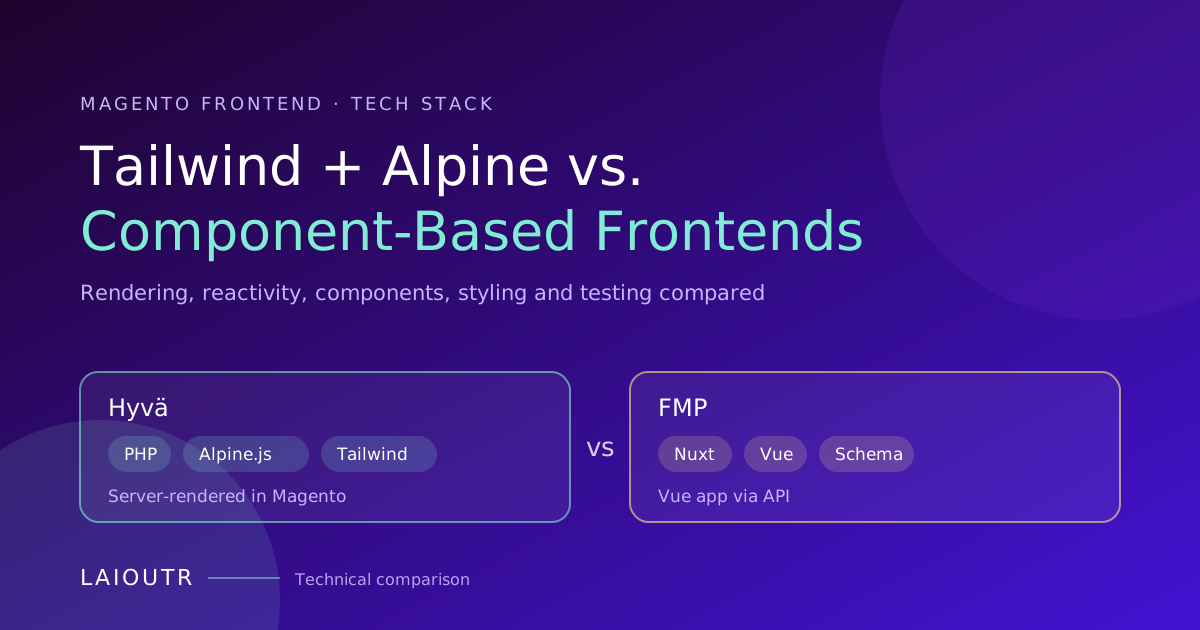Tailwind + Alpine vs. Component-Based Frontends for Magento
Hyvä renders Magento pages on the server with PHP templates and layout XML, adds interactivity throu…](https://www.laioutr.com/en/blog/tailwind-alpine-magento-vs-component-based-frontend-2026)
[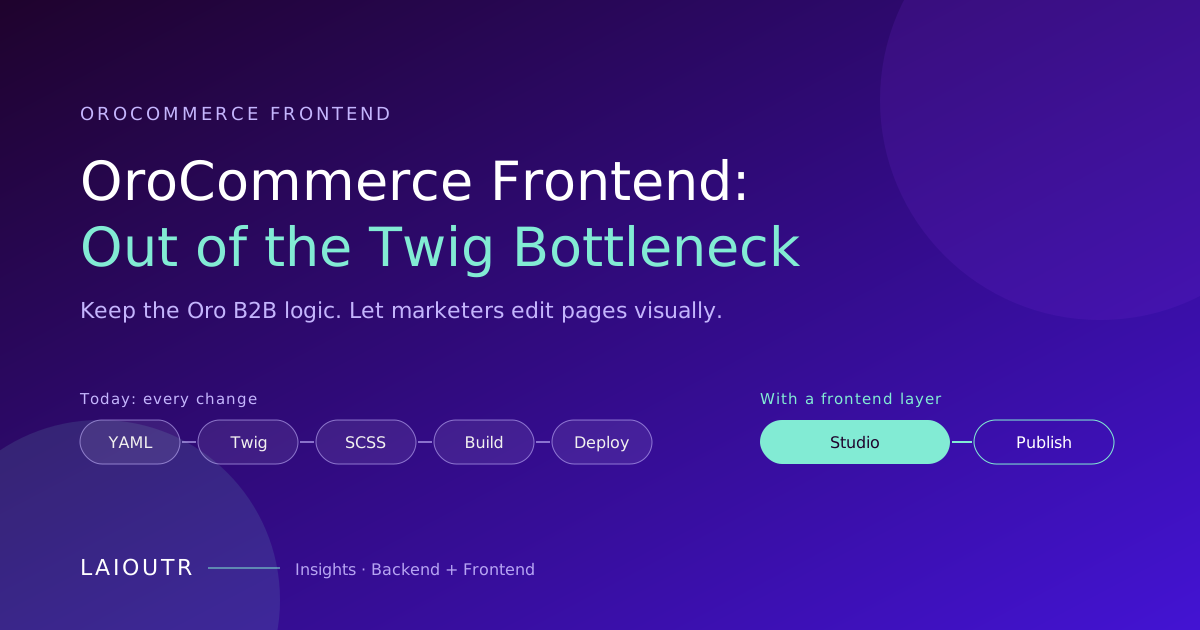OroCommerce Frontend: Out of the Twig and Layouts Bottleneck
The OroCommerce frontend is a server-rendered storefront built from Symfony bundles, OroLayouts and …](https://www.laioutr.com/en/blog/orocommerce-frontend-twig-layouts-bottleneck)
[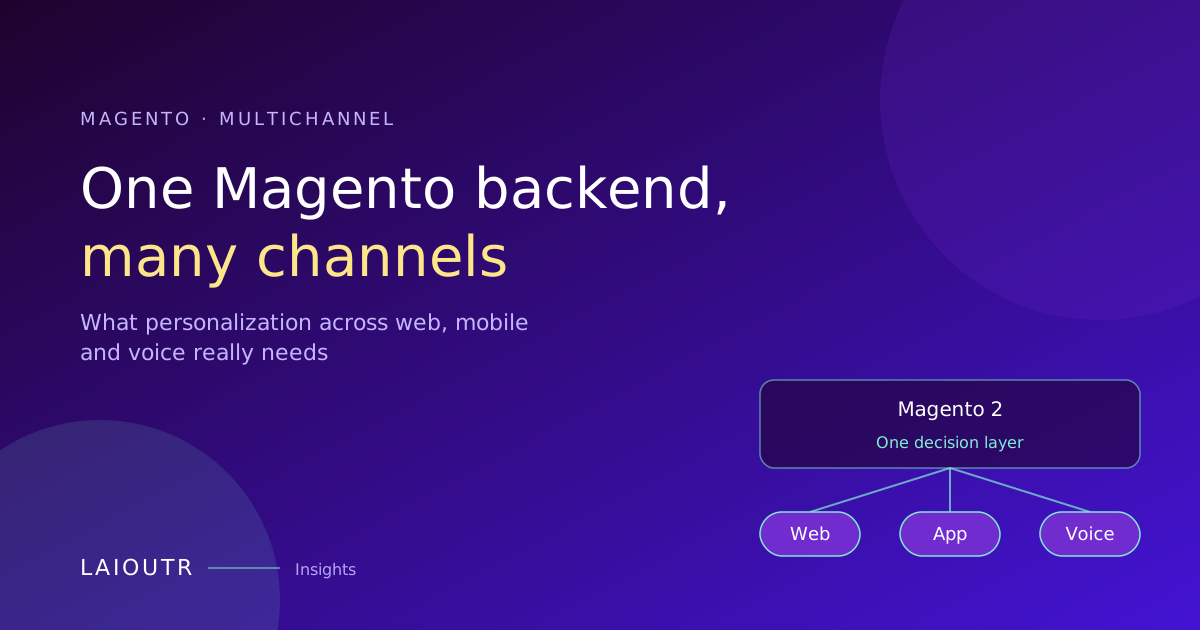One Magento Backend, Many Channels: Personalization in Practice
Personalization across web, mobile and voice on a single Magento backend does not start with a featu…](https://www.laioutr.com/en/blog/magento-multichannel-personalization-web-mobile-voice-2026)
[Edge Hosting for Storefronts: Caching That Holds Under Peak Load
Edge hosting keeps a storefront fast under load when most requests never reach the origin: pages and…](https://www.laioutr.com/en/blog/edge-hosting-storefronts-peak-traffic-caching-2026)
[Composable Commerce 2027: What Shifted and What Comes Next
Composable commerce enters 2027 with a different agenda than a year ago. The architecture question i…](https://www.laioutr.com/en/blog/composable-commerce-2027-outlook)
[AI Engagement and Conversion: Personalization on the Frontend
AI-driven engagement and conversion on the frontend rests on five mechanics: segments decide who see…](https://www.laioutr.com/en/blog/ai-engagement-conversion-frontend-personalization)
[Website Tracking in E-Commerce 2026: An Honest Stack Overview
Website tracking in e-commerce is not one tool but a stack of five layers: consent management, tag m…](https://www.laioutr.com/en/blog/website-tracking-ecommerce-stack-overview-2026)
[One Content Source, Every Channel: Print to Storefront
Re-keying happens when the same product text, specification or image is typed in again for every cha…](https://www.laioutr.com/en/blog/unified-content-source-print-to-storefront-omnichannel-2026)
[Third-Party Cookies Are Not Dead: Why Data Still Has Gaps
Third-party cookies still exist in 2026. Google decided in 2025 not to remove them from Chrome and r…](https://www.laioutr.com/en/blog/third-party-cookies-2026-why-tracking-data-has-gaps)
[Structured Product Content: Why PIM and DAM Decide AI Visibility
AI answer engines and assistants recommend products they can understand and verify. Whether a produc…](https://www.laioutr.com/en/blog/structured-product-content-agents-ai-visibility-2026)
[Guest Checkout vs. Customer Account: A Frontend Decision to Test
Guest checkout should be the default path in a B2C storefront, and the customer account should be an…](https://www.laioutr.com/en/blog/guest-checkout-vs-customer-account-frontend-testing)
[](https://www.laioutr.com/en/apps/shopify)
Laioutr
[Shopify](https://www.laioutr.com/en/apps/shopify)
Shopify is a commerce platform for selling online and in physical retail.
[](https://www.laioutr.com/en/apps/shopware)
Laioutr
[Shopware](https://www.laioutr.com/en/apps/shopware)
Shopware is a flexible ecommerce platform from Europe for product catalogs and omnichannel commerce.
[](https://www.laioutr.com/en/apps/adobe-commerce)
Laioutr
[Adobe Commerce](https://www.laioutr.com/en/apps/adobe-commerce)
Adobe Commerce is an enterprise commerce platform for complex, global B2C and B2B scenarios.
Planned
[](https://www.laioutr.com/en/apps/b2b-sellers)
Laioutr
[B2Bsellers](https://www.laioutr.com/en/apps/b2b-sellers)
B2B suite for Shopware that turns an online store into a professional B2B commerce platform.
Planned
[](https://www.laioutr.com/en/apps/commerce-layer)
Laioutr
[Commerce Layer](https://www.laioutr.com/en/apps/commerce-layer)
Commerce Layer is a headless commerce platform for making inventory and catalogs available online.
[](https://www.laioutr.com/en/apps/commercetools)
Laioutr
[Commercetools](https://www.laioutr.com/en/apps/commercetools)
Commercetools is a SaaS-based headless ecommerce platform used worldwide.
[](https://www.laioutr.com/en/apps/emporix)
Laioutr
[Emporix](https://www.laioutr.com/en/apps/emporix)
Emporix is a composable, API-first commerce platform for scalable B2B and B2C scenarios.
Planned
[](https://www.laioutr.com/en/apps/hcl-software)
Laioutr
[HCL Software](https://www.laioutr.com/en/apps/hcl-software)
Enterprise suite for digital commerce and experience with extensive configurability.
Planned
[](https://www.laioutr.com/en/apps/intershop)
Laioutr
[Intershop](https://www.laioutr.com/en/apps/intershop)
Enterprise commerce platform for complex B2B and B2C business models.
Planned
[](https://www.laioutr.com/en/apps/magento-2)
Laioutr
[Magento 2](https://www.laioutr.com/en/apps/magento-2)
Widely used, extensible commerce platform for B2C and B2B scenarios.
[](https://www.laioutr.com/en/apps/oxid-eshop)
Laioutr
[OXID eShop](https://www.laioutr.com/en/apps/oxid-eshop)
OXID eShop is an extensible commerce platform for complex B2B and B2C requirements.
Planned
[](https://www.laioutr.com/en/apps/patchworks)
Laioutr
[Patchworks](https://www.laioutr.com/en/apps/patchworks)
Patchworks is a low-code iPaaS that connects ecommerce, ERP, WMS, 3PL, and marketplaces.
Planned
[](https://www.laioutr.com/en/apps/PrestaShop)
Laioutr
[Prestashop](https://www.laioutr.com/en/apps/PrestaShop)
Open-source commerce platform for small and midsize merchants in Europe and beyond.
Planned
[](https://www.laioutr.com/en/apps/saleor)
Laioutr
[Saleor](https://www.laioutr.com/en/apps/saleor)
Open-source, API-first commerce platform built on GraphQL for custom storefronts.
Planned
[](https://www.laioutr.com/en/apps/salesforce-commerce-cloud)
Laioutr
[Salesforce Commerce Cloud](https://www.laioutr.com/en/apps/salesforce-commerce-cloud)
Salesforce Commerce Cloud is a cloud-based enterprise commerce platform for businesses of any size.
Planned
[](https://www.laioutr.com/en/apps/sap-commerce-cloud)
Laioutr
[SAP Commerce Cloud](https://www.laioutr.com/en/apps/sap-commerce-cloud)
Enterprise commerce platform for complex catalogs, pricing models, and omnichannel journeys.
Planned
[](https://www.laioutr.com/en/apps/scayle)
Laioutr
[Scayle](https://www.laioutr.com/en/apps/scayle)
SCAYLE is a commerce engine that helps brands and retailers scale their business.
Planned
[](https://www.laioutr.com/en/apps/spryker)
Laioutr
[Spryker](https://www.laioutr.com/en/apps/spryker)
Composable commerce platform for sophisticated B2B and B2C business models.
[](https://www.laioutr.com/en/apps/sylius)
Laioutr
[Sylius](https://www.laioutr.com/en/apps/sylius)
Sylius is a developer-friendly ecommerce framework for B2C and B2B shopping experiences.
Planned
[](https://www.laioutr.com/en/apps/vendure)
Laioutr
[Vendure](https://www.laioutr.com/en/apps/vendure)
Vendure is a headless commerce platform for businesses with complex requirements.
Coming Soon
[](https://www.laioutr.com/en/apps/vtex)
Laioutr
[VTEX](https://www.laioutr.com/en/apps/vtex)
Cloud-native, composable commerce platform for B2B and B2C at scale.
Planned
[](https://www.laioutr.com/en/apps/websale)
Laioutr
[Websale](https://www.laioutr.com/en/apps/websale)
Stable, enterprise-ready commerce backend for complex retail environments.
Strategy call
## Ready to turn your frontend into a control layer?
Show us your stack, your roadmap, your replatforming scenario, and we'll show you how Laioutr fits, what it costs, and how fast you go live.
*"After 30 minutes, we knew Laioutr makes our replatforming feasible." - Daniel B., CEO,* [*hygibox.de*](https://hygibox.de)
[Book a demo](https://www.laioutr.com/en/contact)
## Structured Data
```json
{
"@context": "https://schema.org",
"@graph": [
{
"@type": "Organization",
"@id": "https://www.laioutr.com/#identity",
"name": "Laioutr",
"legalName": "Laioutr GmbH",
"url": "https://www.laioutr.com/",
"logo": {
"@type": "ImageObject",
"url": "https://www.laioutr.com/laioutr-logo.png",
"width": 400,
"height": 400
},
"email": "info@laioutr.com",
"telephone": "+49 30 75435715",
"address": {
"@type": "PostalAddress",
"streetAddress": "Münchweilersteig 5",
"postalCode": "12559",
"addressLocality": "Berlin",
"addressCountry": "DE"
},
"vatID": "DE450905846",
"sameAs": [
"https://www.linkedin.com/company/laioutr",
"https://www.youtube.com/@Laioutr",
"https://x.com/laioutr"
]
},
{
"@type": "WebSite",
"@id": "https://www.laioutr.com/en/#website",
"url": "https://www.laioutr.com/en/",
"name": "Laioutr",
"inLanguage": "en",
"publisher": {
"@id": "https://www.laioutr.com/#identity"
}
},
{
"@type": "BlogPosting",
"@id": "https://www.laioutr.com/en/blog/headless-cms-visual-editing#article",
"headline": "Headless CMS with Visual Editing 2026: Platforms Compared",
"description": "See headless CMS visual editing in practice: edit live, skip the dev handoff, launch faster. Compare platforms and see Laioutr's approach.",
"image": [
"https://eu-west-2.graphassets.com/cmii2mlqi0dux06l5543v7nkc/cmotoqwlghvpf07mmu534t32z"
],
"datePublished": "2026-07-27T10:04:38.368468+00:00",
"dateModified": "2026-07-24T08:28:37.431194+00:00",
"inLanguage": "en",
"articleSection": "Insights",
"keywords": "Industry & Trends, commercetools, Shopify, contentful, hygraph, kontent.ai, sanity, storyblok, strapi",
"author": {
"@type": "Person",
"name": "Marcel Thiesies",
"jobTitle": "Co-Founder & CEO, Laioutr",
"image": "https://eu-west-2.graphassets.com/cmii2mlqi0dux06l5543v7nkc/cmj01b962364n07lb0iguvts5"
},
"publisher": {
"@id": "https://www.laioutr.com/#identity"
},
"mainEntityOfPage": {
"@id": "https://www.laioutr.com/en/blog/headless-cms-visual-editing#webpage"
},
"isPartOf": {
"@id": "https://www.laioutr.com/en/#website"
}
},
{
"@type": "WebPage",
"@id": "https://www.laioutr.com/en/blog/headless-cms-visual-editing#webpage",
"url": "https://www.laioutr.com/en/blog/headless-cms-visual-editing",
"name": "Headless CMS with Visual Editing 2026: Platforms Compared",
"description": "See headless CMS visual editing in practice: edit live, skip the dev handoff, launch faster. Compare platforms and see Laioutr's approach.",
"inLanguage": "en",
"isPartOf": {
"@id": "https://www.laioutr.com/en/#website"
},
"breadcrumb": {
"@id": "https://www.laioutr.com/en/blog/headless-cms-visual-editing#breadcrumb"
},
"primaryImageOfPage": {
"@type": "ImageObject",
"url": "https://eu-west-2.graphassets.com/cmii2mlqi0dux06l5543v7nkc/cmotoqwlghvpf07mmu534t32z"
},
"datePublished": "2026-07-27T10:04:38.368468+00:00",
"dateModified": "2026-07-24T08:28:37.431194+00:00",
"mainEntity": {
"@id": "https://www.laioutr.com/en/blog/headless-cms-visual-editing#article"
}
},
{
"@type": "BreadcrumbList",
"@id": "https://www.laioutr.com/en/blog/headless-cms-visual-editing#breadcrumb",
"itemListElement": [
{
"@type": "ListItem",
"position": 1,
"name": "Laioutr",
"item": "https://www.laioutr.com/en/"
},
{
"@type": "ListItem",
"position": 2,
"name": "Insights",
"item": "https://www.laioutr.com/en/blogs/insights"
},
{
"@type": "ListItem",
"position": 3,
"name": "Headless CMS with Visual Editing 2026: Platforms Compared"
}
]
}
]
}
```